
🏠 Home > 🗺️ Recipes > 👑🥘 Signature Royal Sauces (Sauces) > 🇦🇺 Australia Signature Royal Sauces (Sauces) Recipes
🇦🇺 👑🥘 Australia Signature Royal Sauces (Sauces) Recipes
Published by Supakorn | Updated: September 2026
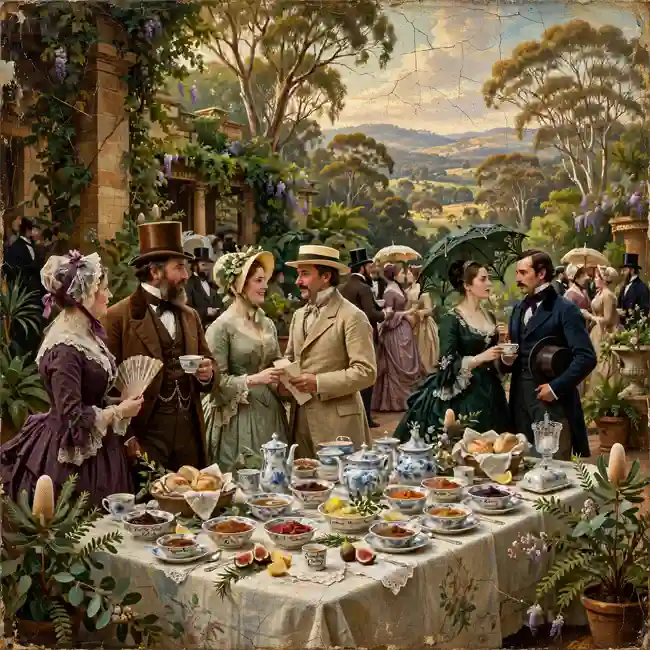
🛎️📜 The Storyteller's Intro: Where Empire Met the Outback Table
G'day, fellow food wanderer. Before we dive in, let's get something straight — Australia never had kings or queens of its own, no palace kitchens tucked behind marble walls, no dukes squabbling over the last spoonful of sauce. What Australia did have was something arguably more interesting: a strange, delicious collision between the rigid formality of British aristocratic dining and the wild, ancient food knowledge of a continent that had been feeding people for over 65,000 years before the first ship ever dropped anchor.
So this isn't a tale of royal sauces in the European sense. It's the story of the "squattocracy" — the wealthy landowning families who, from the early 1800s onward, carved out enormous pastoral estates across New South Wales, Victoria, and beyond, and lived like landed gentry transplanted to the far side of the world. They built homesteads with imported silverware and English cooks, then found themselves stranded thousands of miles from Fortnum & Mason, forced to improvise with what the land actually offered.
That improvisation is where the real secrets live. Three loose "eras" define this story. First, the early colonial period (1790s–1850s), when settler cooks tried — often badly — to recreate English sauces with local substitutes. Second, the squatter boom (1850s–1900s), when wool fortunes funded lavish homestead entertaining and a genuine colonial cuisine started to take shape, blending French classical technique (brought by hired chefs) with native bush ingredients. Third, the Federation-era refinement (1900s onward), when Australian high society began confidently claiming its own culinary identity rather than apologizing for not being England.
Throughout all three eras, one thing stayed constant: the sauce was where status was performed. A well-dressed table needed a proper sauce, and the "properness" of that sauce — its silkiness, its depth, its ability to disguise tough colonial mutton as something fit for a viceroy — was a quiet flex of wealth and taste.
🗺️ The Colonial Culinary Trail: Mapping Flavors to Historic Landscapes
If you ever find yourself tracing this history in person, the map tells its own story:
• The Hawkesbury and Hunter Valley (NSW) — among the earliest fertile farming districts, where colonial cooks first tested European produce against Australian soil and climate.
• The Western District (Victoria) — the true heartland of the squattocracy, dotted with grand bluestone homesteads built on wool money, many still standing and open for heritage tours today.
• The Darling Downs (Queensland) — a pastoral frontier where homestead hospitality became legendary, blending British formality with a looser, sun-drenched informality.
• The Adelaide Hills (South Australia) — settled with a notably genteel, planned-colony character, where German and English culinary traditions mingled early.
Travelers chasing this history will find that many of these regions now lean into their "heritage station" identity, offering homestead-stay tourism, colonial-era cellar door experiences, and restored kitchen gardens that still grow the same herbs a 19th-century cook would have reached for.
🚣 Cradle of Colonial Refinement — The River & Coastal Estates
Australia's earliest wealth flowed along its rivers and coastlines, and so did its earliest attempts at "proper" sauce-making.
• Along the Hawkesbury River, some of the colony's first successful farming estates supplied Sydney's growing elite, and it was here that colonial cooks first tried adapting English white sauce and gravy techniques using local dairy and game.
• Coastal estates near Sydney Harbour hosted some of the colony's grandest dinners, where imported French chefs — a status symbol in themselves — introduced classical mother sauces like velouté and béchamel to the Australian table for the first time.
• Fish and shellfish sauces took on a distinctly local character here too, as cooks experimented with native seafood that had no European equivalent, forcing genuine culinary invention rather than mere imitation.
• These river-and-harbour estates functioned as a kind of proving ground — what worked here often made its way inland to the pastoral properties over the following decades.
Today, heritage food trails along these waterways let curious travelers walk the same grounds where colonial kitchen gardens once supplied the sauce pot, with several historic homesteads preserved as museums.
⛰️ Kingdom of Wild Aromatics — The Pastoral High Country & Bushland Estates
Further inland and up into the high country, the story shifts from imitation to genuine innovation, as isolation forced homestead cooks to lean hard on native bush ingredients.
• Properties in the high country of Victoria and the Snowy Mountains foothills were often so remote that imported spices simply didn't arrive reliably, pushing cooks toward native peppers, wattleseed, and bush herbs as substitutes for European flavorings.
• Lemon myrtle, native to the subtropical forests of northern NSW and Queensland, became a prized aromatic in colonial sauce-making — bright, citrusy, and entirely unavailable anywhere in Europe, making it a genuine point of colonial pride.
• Bush tomato and native pepperberry, sourced through observation of and, at times, direct knowledge-sharing with local Aboriginal communities, gave depth and heat to sauces that European recipes alone could never achieve.
• Homestead cooks in these highland estates developed rich pan sauces for game meats — kangaroo, native duck — that blended French deglazing technique with ingredients no French chef back home would have recognized.
• These bushland innovations were rarely written down formally; they lived in the hands and memory of homestead cooks, which is exactly why so much of this knowledge feels like a "lost" or "secret" cuisine today.
This region rewards travelers who want more than a plaque and a photo — many bushland heritage trails now partner with Aboriginal-led tourism experiences that explain the deeper, much older origins of the native ingredients colonial cooks borrowed.
🤫 Whispered Names from the Homestead Pantry
Every great colonial kitchen had its handful of sauces that never made it into a printed cookbook — the ones a head cook guarded, passed down only by watching and tasting, never by measuring. Here are some of the names that still echo through old homestead journals and oral family histories:
✦ The Overseer's Reserve — a rich, glossy pan sauce said to have been kept back specifically for the property owner's table, never served to the working stockmen, and rumored to hold a native pepperberry kick that visiting English guests found startling.
✦ Bluestone Velvet — named for the bluestone homesteads of Victoria's Western District, a silky, deeply savory sauce built for game meats, prized for a smoothness that supposedly took a cook years to master.
✦ The Squire's Whisper — a quiet, herbaceous sauce built around lemon myrtle, said to have been served only when the homestead owner wanted to impress a visiting dignitary without appearing to try too hard.
✦ Drover's Secret — despite the humble name, this was actually one of the most closely held recipes on many high-country stations, a dark, aromatic reduction reputedly flavored with native bush herbs no outsider could quite identify.
✦ The Governor's Blush — a delicately colored sauce said to have been developed specifically for a vice-regal visit, its exact composition allegedly never written down out of fear a rival estate might copy it.
✦ Highland Hush — tied to the remote high-country properties, this sauce earned its name from cooks who reportedly refused to discuss its ingredients even with other kitchen staff on the same property.
✦ The Wool King's Table Sauce — a nod to the fortunes built on wool, this was reportedly reserved for the grandest homestead dinners, served only when a season's wool clip had sold particularly well.
These names survive mostly as fragments — a mention in a diary, a line in a family history, a story passed at a homestead reunion — which is exactly what makes them feel less like recipes and more like heirlooms. Nobody wrote the "how." They only remembered that something extraordinary was there.
🛎️🤴 Colonial Kitchen FAQ: Unlocking Homestead Secrets
Q1.Did Australia actually have an aristocracy?
Not in the European sense of hereditary titles, but the "squattocracy" — wealthy pastoral landowners of the 1800s — functioned as a de facto colonial gentry, complete with grand homes, imported chefs, and elaborate dining customs modeled on the British upper class.
Q2.Where did colonial cooks get their sauce recipes from?
Mostly from imported English and French cookbooks and hired European chefs, then adapted out of necessity using local ingredients, dairy, and game that behaved differently from their British counterparts.
Q3.Why do native ingredients like wattleseed and lemon myrtle show up in this "colonial" story?
Because colonial cooks, often working in isolation, borrowed heavily from ingredients Aboriginal peoples had used and understood for tens of thousands of years — a debt this story owes far more credit for than history books have traditionally given.
Q4.Is any of this still cooked today?
Yes — heritage homesteads, native-ingredient-focused restaurants, and a growing "modern Australian" fine dining movement all trace a direct line back to these colonial-era sauce experiments.
🧠 Final Thoughts: The Timeless Allure of Colonial Gastronomy
There's something quietly thrilling about a cuisine built on improvisation rather than tradition — where the "secret" isn't a guarded royal formula passed down through generations of nobility, but the ingenuity of homestead cooks working out, sauce by sauce, how to feed colonial ambition with what the Australian land actually gave them. That tension between imported formality and native reality is still the beating heart of Australian fine dining today.
Keep this page bookmarked — the full recipes behind these colonial sauce secrets are coming soon, and they're worth the wait.
👑 Credit to the Keepers of the Culture
None of this story exists without acknowledging its true foundation: the Aboriginal and Torres Strait Islander peoples, whose knowledge of native Australian ingredients — cultivated and understood over tens of thousands of years — was the raw material colonial cooks borrowed from, often without credit or compensation. Any honest telling of Australian colonial cuisine owes its deepest respect to that original knowledge, and to the communities who continue to preserve and share it today.
👑🥘 500-Year-Old Bush Sauce Secrets: The Ancestral Flavors of Australia
👉 Indulge in Irresistible Australian Royal Sauces
| 🌐 👑🥘 < Back | 🇦🇺 👑🍱 < Previous |