
🏠 Home > 🗺️ Recipes > 🍞 Breads > 🇦🇹 Austria Breads > 🍞 Kaiser Semmel (The Emperor's Roll) , Salzstangerl (Savory Salt Sticks) , Vollkornbrot (Austrian Whole Grain Bread)
🍞 The Austrian Baker’s Toolkit: Mastering 3 World-Famous Breads at Home
Published by Supakorn | Updated: February 2026
🌭 A Warm Welcome to Austrian Baking: More Than Just Strudel
When people think of Austrian cuisine, their minds often drift to the sweet symphony of Sachertorte or the light, flaky perfection of Apfelstrudel. But to truly understand the heart of Austrian food culture, you must look to its exceptional breads. In Austria, bread is a daily essential, a cornerstone of every meal from the breakfast table (Frühstück) to the evening platter (Abendessen).
Austrian bakers are artists, meticulously crafting everything from crispy, white rolls to dense, complex rye loaves. The secret often lies in long fermentation, high-quality flour, and a perfect blend of Brotgewürz (bread spices) like caraway, fennel, and coriander. These breads aren’t just locally loved; they are celebrated and recreated by bakers worldwide, a true testament to their simple perfection.
This extensive, friendly guide is designed to transform your kitchen into a Viennese Bäckerei. We'll walk you through three distinct and globally popular Austrian bread recipes:
1.Kaiser Semmel (Emperor's Roll): The quintessential, crispy white breakfast roll.
2.Salzstangerl (Salt Sticks): Savory, twisted sticks often flavored with caraway and salt.
3.Vollkornbrot (Whole Grain Bread): A moist, dense, and deeply satisfying everyday loaf.
Ready to get your hands covered in flour and experience the joy of a truly great, freshly baked Austrian bread? Let's dive in!

👑 Recipe 1: Kaiser Semmel (The Emperor's Roll)
🧐 About this Recipe: The Quintessential Viennese Roll
The Kaiser Semmel, or Emperor’s Roll, is arguably the most recognizable piece of Austrian Kleingebäck (small baked goods). It’s an iconic, round roll with a signature five-petal star pattern on top, created either by hand-folding or using a special stamp. This roll is the ultimate Austrian breakfast staple, famed for its incredibly crispy, thin crust and its light, fluffy, slightly chewy interior (the crumb).
The best Semmel is soft enough to yield easily to butter and jam, yet sturdy enough to hold a slice of ham and cheese. Mastering the shape is the biggest challenge, but the dough itself is surprisingly straightforward, relying on simple, high-quality ingredients and a good, long rest.
🔪 Ingredients & Measurements (Makes 10 Rolls)
- 500 g (4 cups) High-Protein Bread Flour, plus more for dusting
- 300 ml (1 1/4 cups) Lukewarm Water (about 95°F or 35°C)
- 10 g (2 1/4 teaspoons) Fresh Yeast (or 5g / 1 1/2 tsp Dry Instant Yeast)
- 10 g (2 teaspoons) Fine Salt
- 15 g (1 tablespoon) Sugar
- 30 g (2 tablespoons) Unsalted Butter, softened
- Optional Topping: Poppy seeds, Sesame seeds, or a light wash of water/milk.
👨🍳 Step-by-Step Instructions
1.Activate the Yeast: In a small bowl, dissolve the yeast and sugar in the lukewarm water. Let it sit for 5–10 minutes until a slight foam (the Dampferl) appears, indicating the yeast is active.
2.Mix the Dough: In a large mixing bowl or the bowl of a stand mixer, combine the bread flour and salt. Add the yeast mixture and the softened butter.
3.Knead: Knead the dough for 8–10 minutes, either by hand or with a dough hook. The resulting dough should be smooth, elastic, and slightly tacky, but not sticky.
4.First Rise (Bulk Fermentation): Place the dough in a lightly oiled bowl, cover it with a kitchen towel or plastic wrap, and let it rise in a warm place for 60–90 minutes, or until it has doubled in size.
5.Divide and Shape: Gently punch down the dough and divide it into 10 equal pieces (about 80g each). Roll each piece tightly into a smooth, round ball. Cover the balls and let them rest for 15 minutes.
6.The Signature Shape: Flatten each ball slightly with your palm. Now, for the star pattern:
- Method A (Hand Fold): This is complex, but traditional. You perform a series of five specific folds/knots to create the star shape.
- Method B (Semmel Stamp): The easiest way—simply use a Kaiser roll stamp or a similar object to press the five-petal pattern deeply into the center of each roll.
7.Second Rise (Proofing): Place the shaped rolls (pattern-side up) on a parchment-lined baking sheet. Cover lightly and let them rise for another 30–45 minutes. Preheat your oven to 425∘F ( 220∘C) during the last 15 minutes of proofing.
8.Bake: Just before baking, lightly spray the rolls with water to encourage a crispy crust. Bake for 15–20 minutes, or until deeply golden brown. Cool on a wire rack.
💡 Tips & Mistakes to Avoid
- Crust is Everything: The secret to the Semmel's thin, crispy crust is heat and moisture. Use a hot oven and spray the rolls (and/or the oven walls) with water a couple of times during the first 5 minutes of baking to create steam.
- Butter vs. Lard: While butter is commonly used in home baking, traditional Semmel often uses a small amount of lard or vegetable fat for a richer flavor and softer crumb.
- Don't Over-Flour: Keep the dough on the softer side (just tacky, not sticky) for a lighter, airier result. Over-flouring will lead to a dense, tough roll.
🤔 FAQ (Frequently Asked Questions)
Q: My Semmel pattern disappears when I bake it. Why?
A: This is a common issue! The pattern disappears if the rolls are over-proofed before baking. Make sure the rolls still feel a bit "springy" (not completely puffed up and delicate) when you put them into the hot oven. Also, ensure the stamp/impression is pressed deeply enough.
Q: Can I use whole wheat flour?
A: Authentic Semmel is made with white flour (similar to European Type 550 or American bread flour) for the characteristic light crumb. Using whole wheat will change the structure and result in a denser roll.
Q: What is a Semmel Stamp?
A: It's a small plastic or wooden tool with the distinct Kaiser roll star pattern used to quickly and uniformly stamp the rolls before the final rise.
📝 Summary: Kaiser Semmel
The Kaiser Semmel is a perfect example of elegance in simplicity. It’s a rewarding bake that delivers a taste of authentic Viennese breakfast tradition—crispy, light, and endlessly versatile.

🥨 Recipe 2: Salzstangerl (Savory Salt Sticks)
🧐 About this Recipe: The Salty, Twisted Companion
The Salzstangerl is the savory, elongated cousin of the Semmel. Translating to "Salt Sticks," these rolls are made from a rich, light yeast dough that is often twisted or shaped into a crescent, brushed with an egg wash or milk, and heavily topped with coarse salt and, crucially, Caraway Seeds (Kümmel).
These sticks are slightly richer due to the inclusion of milk and butter in the dough, giving them a tender interior. The salty, sharp spice of the caraway and the crunchy crust make them an addictive snack, perfect alongside soups, salads, or a charcuterie board. They are especially popular in Heuriger (traditional wine taverns).
🔪 Ingredients & Measurements (Makes 12 Sticks)
- 450 g (3 1/2 cups) All-Purpose Flour
- 250 ml (1 cup) Lukewarm Milk (about 95∘F or 35∘C
- 10 g (2 1/4 teaspoons) Fresh Yeast (or 5g / 1 1/2 tsp Dry Instant Yeast)
- 10 g (2 teaspoons) Fine Salt (for the dough)
- 15 g (1 tablespoon) Sugar
- 50 g (3 1/2 tablespoons) Unsalted Butter, melted and cooled
For Topping:
- 1 Egg White, lightly beaten (for brushing)
- 2 tablespoons Coarse Sea Salt or Pretzel Salt
- 1 tablespoon Whole Caraway Seeds
👨🍳 Step-by-Step Instructions
1.Start the Dough: Follow the same initial steps as the Semmel: dissolve the yeast and sugar in the lukewarm milk. In a separate bowl, mix flour and salt.
2.Combine and Knead: Add the yeast mixture and the melted butter to the flour/salt mixture. Knead for 8–10 minutes until the dough is smooth and elastic. This dough is slightly softer due to the milk and butter.
3.First Rise: Place the dough in a lightly oiled bowl, cover, and let it rise in a warm spot for 60–75 minutes, or until doubled in size.
4.Divide and Shape: Gently punch down the risen dough. Divide it into 12 equal pieces. Roll each piece into a small ball. Cover and let rest for 10 minutes.
5.Form the Sticks: Take one ball and roll it out into a thin oval or rectangle (about 12 inches/30 cm long). Starting from the short end, roll the dough tightly into a cigar shape. For the classic twisted look, you can give the roll a gentle twist or two halfway through the rolling process.
6.Second Rise: Place the shaped sticks on a parchment-lined baking sheet. Cover and let proof for 20–30 minutes while preheating the oven to 400°F / 200°C.
7.Top and Bake: Just before baking, brush the sticks generously with the beaten egg white. This helps the toppings stick and gives a nice sheen. Sprinkle immediately and liberally with coarse salt and caraway seeds.
8.Bake: Bake for 15–20 minutes, until they are golden brown and sound hollow when tapped. Cool slightly on a wire rack.
💡 Tips & Mistakes to Avoid
- The Caraway Factor: Caraway seeds are essential for authentic Salzstangerl flavor. If you find the flavor too strong, you can crush a few of the seeds lightly before sprinkling to release the aroma without an overpowering taste.
- Avoid Over-Proofing: Salzstangerl should have a slightly denser, chewy crust compared to Semmel. Don't let them become too puffy during the second rise, as this will lead to a softer crust.
- Tight Rolling: When forming the stick, roll the dough tightly to ensure a good structure and a nice, even spiral if you twist it. This prevents large air pockets from forming in the finished product.
🤔 FAQ (Frequently Asked Questions)
Q: Can I replace the milk with water?
A: Yes, you can replace the milk with water for a slightly crisper, less tender stick, but the milk contributes to the richness and keeping quality of the Stangerl.
Q: I don't have coarse salt. Can I use table salt?
A: No, do not use table salt! It will dissolve immediately and make the bread too salty. You need a coarse salt like pretzel salt, rock salt, or coarse sea salt for the crunchy texture and visual appeal.
Q: Can I freeze these?
A: Yes, you can freeze them after baking. Cool completely, wrap tightly, and reheat in a 350∘F / 175∘C oven for 5 minutes for a fresh taste.
📝 Summary: Salzstangerl
The Salzstangerl offers a delightful contrast of textures and flavors: tender dough, crunchy salt, and spicy caraway. It’s the perfect roll for those who love a savory, boldly flavored bread.
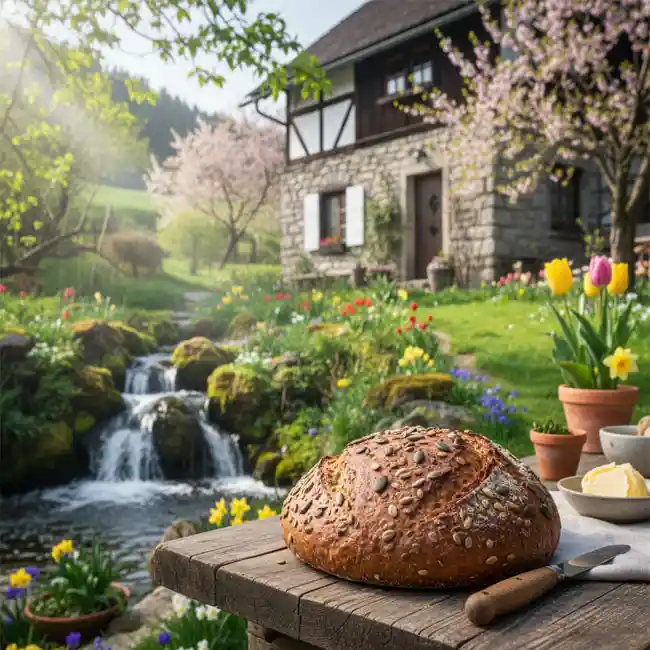
🌾 Recipe 3: Vollkornbrot (Austrian Whole Grain Bread)
🧐 About this Recipe: The Wholesome, Complex Loaf
Vollkornbrot simply means "Whole Grain Bread," but in the Austrian and German traditions, this is a category of bread that is far more complex and robust than its name suggests. This is a dense, deeply flavorful loaf, often made with a blend of whole rye flour, whole wheat flour, and a multitude of seeds and grains. It has an extended shelf life and is packed with nutrients, making it the perfect everyday slicing bread for open-faced sandwiches or a light Abendbrot (evening meal).
The texture is moist and dense, not airy and light like white bread, and its flavor is earthy, slightly sour (often achieved through sourdough or a long, slow fermentation), and nutty from the added seeds. It is a baker's triumph in patience and flavor building.
🔪 Ingredients & Measurements (Makes 1 Loaf)
- 250 g (2 cups) Whole Rye Flour
- 250 g (2 cups) Whole Wheat Flour (or Spelt Flour)
- 125 g (1 cup) Mixed Seeds (e.g., Sunflower, Flax, Pumpkin Seeds)
- 450 ml (1 3/4 cups) Warm Water (about 95°F ( 35°C)
- 10 g (2 1/4 teaspoons) Fresh Yeast (or 5g / 1 1/2 tsp Dry Instant Yeast)
- 15 g (1 tablespoon) Dark Molasses or Honey (for color and softness)
- 10 g (2 teaspoons) Fine Salt
- 1 teaspoon Ground Fennel Seeds (part of Brotgewürz)
- 1 teaspoon Ground Coriander (part of Brotgewürz)
- Optional: 1/2 cup Rolled Oats (for coating)
👨🍳 Step-by-Step Instructions
1.Soak the Seeds (Optional but Recommended): Place the mixed seeds in a bowl and cover them with a small amount of hot water. Let them soak for at least 30 minutes to soften. This prevents them from sucking moisture out of the final dough.
2.Activate Yeast and Combine: Dissolve the yeast in the warm water and stir in the molasses or honey. In a very large bowl, combine the rye flour, whole wheat flour, salt, fennel, and coriander.
3.Mix the Dough: Add the yeast mixture and the drained, soaked seeds to the flour. Note: This dough will be very sticky and wet—it is not meant to be kneaded like a white bread dough. Stir everything vigorously with a strong spoon or a dough hook on a low setting for 5–7 minutes until all ingredients are fully hydrated and combined.
4.First Rise: Cover the bowl and let the dough rise in a warm place for 90 minutes to 2 hours, or until it has increased in volume by about 50-75%. It may not double due to the high rye content.
5.Shape and Place: Liberally flour your work surface and your hands (or dust with oats). Turn the sticky dough out. Gently form it into a tight log shape, adding just enough flour to handle it. Place the log into a well-greased loaf pan (9 times 5 inches is ideal).
6.Second Rise: Sprinkle the top with rolled oats (if using) and let it rise, uncovered, for 30–45 minutes. Preheat your oven to 400°F / 200°C.
7.Bake: Bake the loaf for 15 minutes, then reduce the heat to 350∘F or 175∘C and continue baking for another 45–60 minutes. The bread should sound very hollow when tapped, and the internal temperature should reach at least 200∘F / 93∘C.
8.Cool Completely: Crucial Step: Immediately remove the bread from the pan and let it cool completely on a wire rack for several hours, ideally 8–12 hours. Slicing it while warm will result in a gummy, heavy texture.
💡 Tips & Mistakes to Avoid
- Rye is Sticky: Rye flour has very little gluten and is extremely sticky when wet. Embrace the stickiness; do not add too much extra flour, as this will result in a heavy, dry loaf. Work with wet or oiled hands if handling is difficult.
- Patience is Mandatory: This bread needs a long, slow bake and a long, complete cool-down. Slicing it too soon is the most common mistake and will ruin the crumb. Wait for that full flavor to develop overnight.
- The Brotgewürz Blend: The use of ground fennel and coriander is what gives this bread its uniquely Austrian complexity and digestive benefits. Do not skip these spices!
🤔 FAQ (Frequently Asked Questions)
Q: Why does my loaf sink in the middle?
A: Vollkornbrot often sinks due to being over-proofed before baking (high rye content can't support a big rise) or not being baked long enough. Ensure your final rise is moderate, and check the internal temperature before removing it from the oven.
Q: Can I use a sourdough starter instead of yeast?
A: Yes, absolutely! Traditional Vollkornbrot is often made with a rye sourdough starter, which creates a more complex flavor and helps control the dough structure. Substitute the fresh yeast and some of the water/flour with your active starter.
Q: How should I store this bread?
A: Store Vollkornbrot wrapped tightly in a linen cloth or parchment paper at room temperature. Its high moisture and seed content mean it stays fresh for several days. Do not refrigerate.
📝 Summary: Vollkornbrot
Vollkornbrot is the healthy, wholesome hero of Austrian baking. It’s a labor of love that rewards you with a deeply satisfying, textured, and nourishing loaf that lasts for days.
🧡 Final Thoughts: The Joy of the Austrian Bake
Congratulations! You now have the blueprints for mastering three of Austria's most treasured bread recipes. We've moved from the light, crackling crust of the Kaiser Semmel to the savory spice of the Salzstangerl, and finally, to the dense, earthy complexity of Vollkornbrot.
What we've learned is that great bread is less about fancy techniques and more about patience, temperature control, and honoring the simple yet powerful flavors of caraway, salt, and quality grain.
If you’re new to baking, start with the Semmel or Salzstangerl. If you're ready for a rewarding challenge, dive into the Vollkornbrot. Each loaf you pull from the oven will fill your home with the warm, comforting aroma of a traditional Austrian bakery.
Your Austrian baking adventure is just beginning! We can’t wait to hear how your rolls and loaves turn out.
Would you like me to create a quick, easy-to-mix recipe for the traditional Austrian Brotgewürz (Bread Spice Mix) that you can use in these recipes?
| 🇦🇹 🍞 < Back |