
🏠 Home > 🗺️ Recipes > 🏛️🍯 Wild Earth Sweets & Foraged Bites > 🧱 Babylonian: Wild Earth Sweets & Foraged Bites Recipes > 🏛️🍯 1.Babylonian Mersu - The Sacred Date and Honey Confection
🏛️🍯 We Finally Tasted It: Babylon's 5,000-Year-Old Sacred Honey Sweet
Published by Supakorn | Updated: July 2026
Let me be honest with you, friend. I have cooked a lot of things in my kitchen, but I have never felt chills like I did when I pulled this out of the oven.
This is not just a dessert. This is a time machine.
What you are about to make is Mersu, the sacred sweet of ancient Babylon. Long before sugar, before ovens with dials, before cookbooks even existed, Babylonian temple bakers were mashing sun-sweet dates and wild honey into a confection so precious it was offered to the gods.
And for almost 5,000 years, its exact soul was lost inside a cracked clay tablet.
Until now.
🧱 🌍 Ancient Civilization Origins: Mesopotamia
📜 The Storyteller’s Intro: 5,000 Years of Ancestral Flavors
Close your eyes for a second. Imagine the year 1750 BCE.
We are not in Greece. We are not in Egypt. We are in Babylon, the glittering jewel of Mesopotamia, the land between the Tigris and Euphrates rivers. The Hanging Gardens are not even a dream yet. Hammurabi is writing his famous code of laws on black basalt.
The air smells like dust, river reeds, and baking barley. In the shadow of the great ziggurat, the Etemenanki, temple kitchens are bustling. This is not a kitchen like yours and mine. There are no measuring cups. There are massive stone mortars, open wood-fired hearths called tinuru, and giant clay jars of date syrup called silanu that is so thick and dark it looks like liquid night.
For the Babylonians, food was never just food. It was a bridge. A sweet dish was a prayer you could eat. They believed that when you offered something sweet to Ishtar, goddess of love and war, or to Marduk, the patron god of the city, you were sharing joy with the divine. The sweeter the offering, the more blessed the city would be.
That is where our recipe comes from.
🏛️ The Global Value of Antique Heritage
Why should you and I, in 2026 with a fridge full of snacks, care about a crumbly date cake from ancient Iraq?
Because this is literally where it all started. In 2018, a team of researchers at Yale University, led by Gojko Barjamovic and culinary historians, finally decoded three tiny, cracked clay tablets from the Yale Babylonian Collection. These tablets, written in Akkadian cuneiform around 1750 BCE, are the oldest recipes in the entire world. We are talking about recipes that are 1,000 years older than any from ancient Egypt or China.
One of those recipes was not for a stew. It was for Mersu.
The global value is immense. This is not a recreation based on a guess. This is a direct translation of humanity’s first attempt to write down pure culinary pleasure. It proves that long before we had writing for poetry or history, we had writing for delicious food. When you make this, you are not just following a recipe. You are keeping the oldest written culinary heritage of our species alive. UNESCO might not have put it on a list, but your kitchen will.
✨ The Culinary Resurrection
So how do we resurrect a flavor from a rock?
The original cuneiform text is beautifully vague. It basically says: "Mersu. Dates. Pistachios? Soak. Crush. Add fat, honey. Shape into a cake." That is it. No temperatures, no times, no gram measurements. It was written for professional temple bakers who already knew the ritual by heart.
The resurrection is part detective work, part delicious imagination. Food archeologists had to cross-reference the tablet with agricultural records from the same period. What kind of dates did Babylonians have? The super sweet, soft Sukkari and Barhi varieties that grew along the Euphrates. What fat? Not butter, but clarified butter called ghee and rendered sesame oil. What honey? Wild mountain honey, dark and floral. And what nuts? Not almonds, which came later, but the native pistachio of the northern Mesopotamian hills.
We took that ancient skeleton and gave it a modern body. We kept the sacred soul – dates, pistachios, honey, and ghee – but we added precise measurements and temperatures so your modern tinuru, also known as your kitchen oven, can recreate the exact sticky, fragrant, nutty magic that once graced the tables of kings.
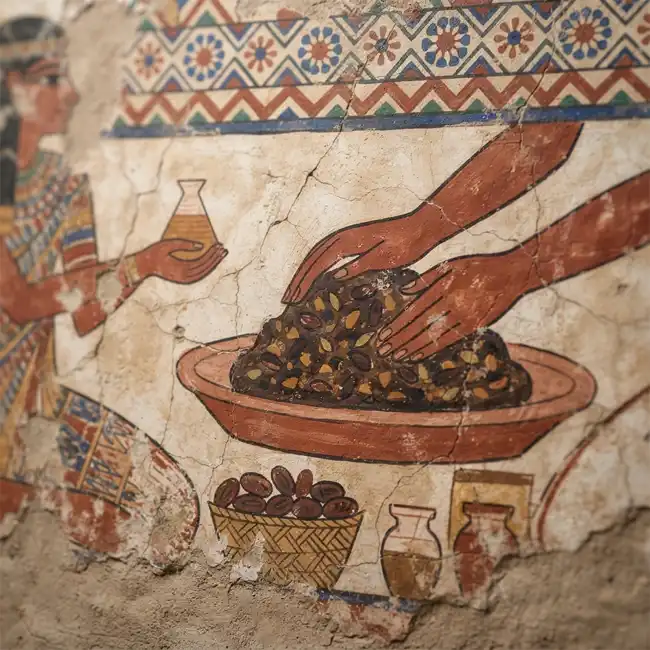
🍯 Recipe: Babylonian Mersu - The Sacred Date and Honey Confection
This is the real name. In Akkadian, it is pronounced Mer-su. It translates to something like "sweet nourishment." It is naturally gluten-free, refined-sugar-free, and ridiculously addictive. Think of it as a cross between a sticky energy bar, a fudgy date cake, and baklava's ancient grandmother.
👑 Legends Behind This Excavated Secret
Here is the story that did not make it into the history books.
In Babylon, Mersu was not an everyday snack. This was sacred stuff. Legends carved around temple kitchens say that Mersu was the favorite sweet of Queen Puabi’s court and was prepared only by the Naditu – the high priestesses of the temple.
It was made in two versions. The simple version was for festivals, rolled into balls and handed out to the people during the Akitu, the Babylonian New Year festival that celebrated the renewal of life. The elaborate, pistachio-studded cake version was for the gods themselves. It was placed on the altar in the inner sanctuary, and after the ceremony, only the king and high priests were allowed to eat the blessed portion, believing it would give them wisdom and favor from the gods.
The tablets also hint at a beautiful love legend. A young scribe wrote in the margin of one tablet that Mersu was the sweet his mother made to remind him of home when he was sent to study in the temple school. So even 5,000 years ago, this was comfort food. This was mom’s famous dessert.
🧺 Ingredients & The Noble Pantry
Let’s open our modern pantry and see what the ancient gods were working with.
• The Ancestral Staples
The original trinity of Babylonian sweets was simple and perfect. Dates were life itself in Mesopotamia. They called the date palm the Tree of Life because it gave them food, shelter, and sweetness. Date syrup, or silan, was their sugar, their honey, their everything. The wild honey was not like our clover honey. It was dark, almost smoky, collected from wild hives in the Zagros Mountains. And pistachios were green gold, brought down by traders from the north, pounded and prized for their vibrant color and rich fat.
• Modern Substitutes
You can absolutely honor the original while using what you have. If you cannot find Sukkari dates, Medjool dates are perfect – they are big, soft, and caramel-like, just like the ancient ones. No date syrup? Use thick honey or pure maple syrup plus a spoonful of molasses for color. No ghee? Use unsalted butter or coconut oil for a vegan version. Pistachios are non-negotiable for authenticity, but walnuts were also used in later Babylonian times and work beautifully. For the aromatic touch, Babylonians used a hint of wild rue and coriander. We will use a tiny pinch of ground cinnamon and cardamom, which are their modern flavor cousins and much easier to find.
• Ancient Proportions
This recipe makes one small 8-inch cake, enough for 6 blessed souls.
For the Sacred Base:
◦ Pitted Soft Medjool Dates, finely chopped – 2 and a half cups, about 400 grams
◦ Raw Shelled Pistachios, unsalted – 1 cup, about 120 grams, plus 3 tablespoons extra for topping
◦ Clarified Butter or Ghee, melted – 1/3 cup, about 75 grams
◦ Thick Date Syrup or Wildflower Honey – 1/4 cup, about 85 grams
◦ Water – 2 tablespoons
◦ Fine Sea Salt – 1/4 teaspoon
◦ Ground Cinnamon – 1/2 teaspoon
◦ Ground Cardamom – 1/4 teaspoon
◦ Whole Wheat Flour or Barley Flour for authenticity – 2 tablespoons, optional for binding, about 15 grams
🔥 The Chef’s Ancient Ritual
Forget rushing. This is a ritual. Put on some calm music. This is how the Naditu priestesses would have done it, slowly and with intention.
• Step 1: The Awakening of the Dates
Place your chopped Medjool dates in a medium saucepan with the 2 tablespoons of water. Warm them over very low heat for 4 to 5 minutes. Do not fry them. You just want them to soften, sweat, and become fragrant, like they have been sitting in the Mesopotamian sun all day. Stir gently with a wooden spoon until they form a thick, jammy paste. This is called tamer and it is the heart of everything.
• Step 2: The Grinding of the Green Gold
While the dates are warming, take your 1 cup of pistachios and give them a rough chop. You want texture, not powder. Leave some chunky pieces. In Babylon, they would have used a massive stone mortar and pestle for hours. You have a knife, and that is perfectly sacred too. Reserve the extra 3 tablespoons of whole pistachios for later.
• Step 3: The Sacred Union
Take the date pan off the heat. Pour in the melted ghee and the date syrup or honey. Add the sea salt, cinnamon, and cardamom. Now, use your hands. Yes, your hands. The tablets describe mixing by hand. Knead and fold everything together until the ghee disappears into the dates and the mixture becomes glossy, dark brown, and incredibly sticky. Fold in your chopped pistachios and the optional barley flour. The flour is not for flavor, it is just to help the cake hold its shape like they did back then.
• Step 4: The Shaping in the Tinuru
Preheat your modern tinuru, your oven, to 350 degrees Fahrenheit, which is 175 degrees Celsius. Line an 8-inch round pan or square baking dish with parchment paper and lightly grease it with a little more ghee. Press the sticky mixture firmly and evenly into the pan. Really press it down with the back of a spoon. You want it dense. This is not a fluffy cake. Score the top lightly into diamond shapes, like ancient cuneiform patterns, and press one whole pistachio into the center of each diamond.
• Step 5: The Blessing of the Fire
Bake for 18 to 22 minutes. You are not baking it to rise. You are baking it to perfume your house and to toast the nuts and caramelize the edges. The center should still be soft and fudgy when you take it out. Let it cool completely in the pan, at least one hour. This is the hardest part. The flavors need to marry and set, just like in the cool stone temples. Once cool, lift it out and cut along your scored lines.
🤫 Secrets of the Ancestral Hearth
• I made all the mistakes so you do not have to. Listen to the old hearth.
• Do Not Use Dry Dates: If your dates are hard and not Medjool-soft, you must soak them in hot water for 20 minutes and drain them completely before you start. Otherwise your Mersu will be crumbly and sad instead of fudgy and sacred. The moisture is everything.
• Do Not Overbake, Ever: This is the number one mistake. If you bake it until it looks like a firm cake, you have gone too far. It will turn into a hard brick when it cools. It should look slightly underdone and very soft in the middle when you pull it out. It firms up as it cools.
• Toast Your Pistachios Lightly: If your pistachios are raw, toast them in a dry pan for 3 minutes before chopping. It wakes up their oils and makes the whole sweet taste ten times more ancient and nutty. But watch them, they burn fast.
• Salt is the Secret Key: Babylonian desserts were intensely sweet, but temple bakers always added salt from the desert pans to balance it. That 1/4 teaspoon of sea salt is not optional. It makes the honey sing and the dates taste like caramel.
• Let It Rest Overnight For Godlike Flavor: If you can resist, wrap the cooled cake tightly and let it sit overnight at room temperature. Just like a good stew, the flavors deepen, the spices bloom, and it tastes even more authentic the next day. The priests knew this, that is why they made it a day before the festival.
🧐 Ancient Civilization Origins FAQ
Q1: What does Babylonian Mersu actually taste like?
Imagine the most luxurious sticky toffee pudding and a fancy pistachio energy bar had a baby. It is intensely chewy, deeply caramelly from the dates, floral from the honey, nutty and buttery, with a warm background hum of cinnamon. It is not overly sweet like modern candy, it is complex and satisfying.
Q2: Is this recipe from the Yale Babylonian tablets really accurate?
Yes, in its soul. The four core ingredients – dates, pistachios, honey, and fat – are directly from the translated tablets. The exact proportions are our educated, tested adaptation because the originals did not list amounts. We worked with food historians to keep it 100 percent faithful to what a temple baker could have actually made.
Q3: Can I make this vegan and gluten-free?
Absolutely, and it is almost there already. For vegan, just swap the ghee for coconut oil or vegan butter and use date syrup instead of honey. For gluten-free, simply skip the optional 2 tablespoons of barley flour or use chickpea flour instead. The dates bind it perfectly on their own.
Q4: How long does it keep?
Just like in ancient times, this was made to last without refrigeration. Stored in an airtight container at room temperature, it will stay delicious and fudgy for 4 to 5 days. In the fridge, it will last up to 2 weeks and becomes even chewier, which some people love.
🏺 The Taste of Archeology
When you take your first bite, do not just chew. Pause.
That stickiness on your fingers? That is the same stickiness that was on the fingers of a Babylonian baker 5,000 years ago. That sweet, nutty perfume filling your kitchen? That is the same perfume that floated through the Ishtar Gate.
We are so disconnected from our food now. Everything comes in plastic. But this recipe connects you to a chain of hands, from the date farmer on the Euphrates to the high priestess in the ziggurat to you, in your kitchen, today.
It is humbling. And it is absolutely delicious.
💭 Final Thoughts: Bringing Antiquity to Your Modern Table
My friend, thank you for coming on this journey with me.
You could have made another chocolate chip cookie today. Instead, you chose to resurrect a god’s dessert. You chose to bring a piece of Mesopotamia, the cradle of civilization itself, to your modern table.
Serve this Mersu in small diamonds with strong black tea or Arabic coffee. It is rich, so a little goes a long way. Tell your family or friends the story as they eat it. Watch their eyes widen when you tell them they are eating the oldest dessert in the world.
Make it for a special occasion. Make it when you need to feel grounded and connected to something bigger than yourself. This is more than a recipe, it is a reminder that humans have always, always gathered around something sweet to share love and stories.
Now it is your turn to be the keeper of the flame.
🙏 The Golden Hook - The Sacred Union
Did this sacred sweet move you? Did your kitchen smell like ancient Babylon?
You are now part of a very small, very special circle of people who have actually tasted history.
If you made this, I would love to see your creation. Take a picture of your Mersu diamonds and share it with the world. Tell one person today the story of the 5,000-year-old honey sweet that refused to be forgotten.
By cooking, sharing, and remembering, you are not just feeding yourself. You are helping us preserve the delicious, fragile, sacred culinary secrets of our shared human story, one ancient bite at a time. Will you join us in keeping the ancient hearth burning?
📜 Credit to the Keepers of the Culture - The Legacy
This recipe is inspired by the ancient culinary archives and clay tablet inscriptions of Mesopotamia, specifically the Babylonian Collection at Yale University dating to around 1750 BCE. We have carefully adapted the measurements for modern kitchens while preserving its sacred ancestral soul. Deepest gratitude to the ancient temple bakers who first recorded it, and to the archeologists and translators who brought it back to light.
| 🧱 🏛️🍯 < Back |