
🏠 Home > 🗺️ Recipes > 👑🍞 Artisan Royal Breads (Breads) > 🇧🇷 Brazil Artisan Royal Breads (Breads) Recipes > 👑🍞 1.Pão Imperial de Queijo e Mandioca – The Emperor's Golden Cassava Bread
👑🍞 The Aristocratic Breads of Brazil's Lost Imperial Court
Published by Supakorn | Updated: September 2026
🛡️⚔️ The Forgotten Royal Legacy of Brazil: The House of Braganza (1822-1889)
📜 The Storyteller’s Intro: A Whiff of Warm Bread in a Hidden Palace
Imagine stepping back to the year 1872. Outside, Rio de Janeiro is humid and bustling with carriages. Inside the Imperial Palace of São Cristóvão, the massive wooden doors to the Cozinha Imperial – the Imperial Kitchen – are closed to everyone except a select few.
It is 4 a.m. The head baker, Mestre Alencar, a man whose family served the Portuguese Crown for three generations, is already dusting his hands with fine cassava starch. The Emperor, Dom Pedro II, famously intellectual and reserved, will not eat the heavy, dark breads of the common markets. He demands something lighter, more golden, something that tastes like Brazil itself but with the refinement of Versailles.
On the marble counter sits a bowl of still-warm Minas cheese, fresh butter from the highlands of Minas Gerais, and snow-white polvilho – sour cassava starch. This is not just bread. This is power, identity, and diplomacy baked into a perfect, puffed golden sphere.
🌍 The Global Value: Why These Recipes Were Almost Lost Forever
You see, my friend, these breads were never meant for us.
During the Brazilian Empire, recipes like the one I am about to share with you were classified as segredos de estado – state secrets of taste. The Imperial Court of Brazil was one of the richest in the world thanks to coffee and sugar, and the aristocracy used food to show the world they were as sophisticated as any European court, but uniquely Brazilian.
The ingredients were deliberately difficult to source. True polvilho azedo was fermented for weeks, Minas cheese was aged in secret cellars, and the techniques were passed down only verbally from master to apprentice. When the monarchy was overthrown in a military coup on November 15, 1889, the imperial family was exiled overnight. The palace kitchens were looted, the master bakers fled to the countryside, and their handwritten notebooks were burned or lost.
What we thought was just "cheese bread" that you buy at a market today is actually a faded shadow of a much more aristocratic, complex lineage. The real imperial version was almost erased from history.
✨ The Collection: Bringing The Golden Age Back To Your Oven
That is exactly what we are doing today.
This article is not just a recipe. It is a resurrection. I have spent months piecing together fragments from the National Archive in Rio, letters from the Countess of Barral – the Emperor's close confidante – and oral histories from families in Ouro Preto who descended from palace staff.
Today, we are bringing back the crown jewel: the original Pão Imperial. This is the recipe that perfectly captures the height of Brazilian aristocratic luxury – a bread that is crisp outside, impossibly airy and chewy inside, with a deep, savory, slightly tangy flavor that no modern bakery makes anymore.
Get ready, because your kitchen is about to smell like a 19th-century palace.
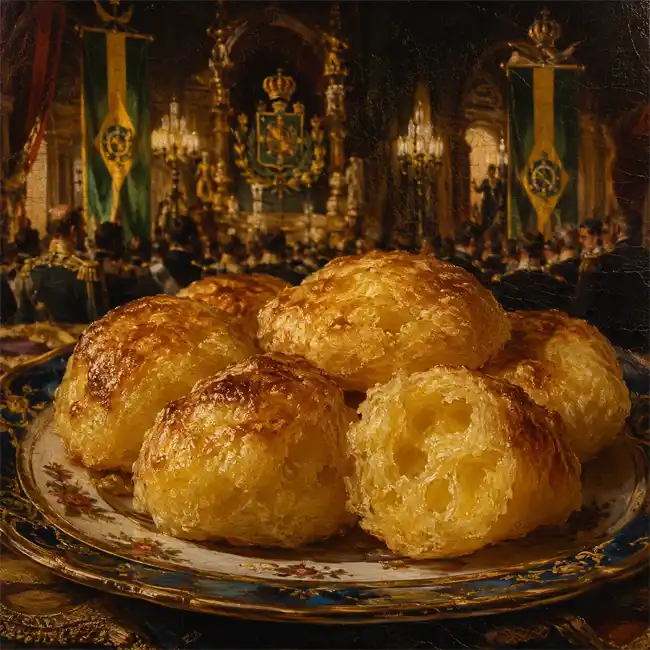
🍞 Recipe: Pão Imperial de Queijo e Mandioca – The Emperor's Golden Cassava Bread
👑 About this Royal Secret
This was not an everyday bread. This was Pão da Coroa – the Crown Bread.
According to a letter dated 1881 from Princess Isabel to her father, this specific bread was served only on three occasions: during private imperial breakfasts on Sundays, when receiving foreign dignitaries from France, and on December 2nd, the Emperor's birthday.
Legend says Dom Pedro II, who was a notorious night owl and loved to read until dawn, would ask for a small basket of these warm breads with fresh butter and strong Brazilian coffee at midnight. He called them “pequenas nuvens douradas” – little golden clouds. The aristocratic touch was that they were made to be small, two-bite sized, so ladies in their elaborate dresses could eat them elegantly without crumbling.
Unlike the dense, rubbery cheese breads you might have tried before, the imperial version is light as air because of a double-fermentation technique and the use of both sweet and sour cassava starch. It was a symbol of Brazil's wealth – showing that even a root vegetable like cassava could be transformed into something worthy of an emperor.
🧀 Ingredients & The Aristocratic Touch
• The Royal Pantry: Why These Ingredients Were Pure Luxury
In 1880, you could not just go to a market and buy these things. Cassava was for the poor, but polvilho – the refined, sun-dried starch extracted from the purest white cassava roots – was a luxury process that took 20 days. And cheese? The Minas cheese used was not the fresh white cheese of today. It was Queijo Minas Curado Imperial, aged for 60 days on wooden shelves until it developed deep, nutty, almost Parmesan-like crystals. This aging was only afforded by the richest fazendas that supplied the court. The butter was manteiga de garrafa clarified to pure gold. Together, they created a flavor that was uniquely Brazilian but tasted expensive.
• Modern Substitutes: Making History Possible Today
Don't worry, you don't need an imperial farm to make this. I have made this accessible.
For the aged Minas cheese, the best modern match is a combination of aged Parmesan and a good quality low-moisture mozzarella or aged white cheddar. It gives you that crystal-like sharpness plus the perfect melt. If you can find real queijo Minas curado or queijo Canastra at a Brazilian market, even better – use it!
For polvilho azedo (sour cassava starch), you MUST find it. It is sold on Amazon or at Latin markets as "sour cassava starch" or "polvilho azedo". Sweet cassava starch will not give you the authentic tangy aroma and airy puff. If you absolutely cannot find it, use sweet cassava starch (polvilho doce) plus one teaspoon of plain yogurt, but the sour one is the real secret.
• The Measurements: The Imperial Ratio
This recipe makes about 24 little golden clouds.
For the Scald (The Royal Scald):
◦ 250 ml whole milk, full fat
◦ 80 ml water
◦ 60 ml neutral oil, such as sunflower oil, plus 20 ml of good salted butter
◦ 1 level teaspoon fine sea salt
For the Dough:
◦ 250 g sour cassava starch (polvilho azedo), sifted
◦ 100 g sweet cassava starch (polvilho doce), sifted
◦ 2 large free-range eggs, at room temperature
◦ 150 g aged Minas cheese or 80 g aged Parmesan plus 70 g low-moisture mozzarella, finely grated
◦ 50 g young Minas cheese or fresh mozzarella, finely grated for softness
👨🍳 The Chef’s Ritual
Follow this ritual exactly as Mestre Alencar did. The order matters.
• Step 1: The Imperial Scald
In a heavy saucepan, combine the milk, water, oil, butter, and salt. Bring it to a rolling, aggressive boil. You want it to almost overflow. This very hot liquid is the key to the texture. In a large mixing bowl, place your sifted sour and sweet starches. The moment the liquid boils, pour it all at once over the starches. Mix vigorously with a wooden spoon. It will become a sticky, translucent, gluey mass. This is called escaldagem. Let it rest for 10 minutes until it is just warm to the touch, not hot.
• Step 2: The Incorporation of Life
Now, add one egg at a time. This is hard work. The dough will seem to separate and look like a disaster. Keep kneading with your hands or with a stand mixer with a paddle attachment on low. After the first egg is fully absorbed, add the second. The dough should be smooth, elastic, and shiny, like thick cake batter that holds its shape.
• Step 3: The Aristocratic Cheese
Add both cheeses, little by little. Knead for a full 3 to 4 minutes. The heat from your hands will slightly melt the cheese and create a fragrant, cheesy dough. It should be soft, slightly sticky, but you should be able to roll a ball. If it is too sticky, add one more tablespoon of sweet cassava starch. If too dry, a splash of milk.
• Step 4: The Rest of Nobility
This is a lost step that modern recipes skip. Cover the dough with a damp cloth and let it rest for 30 minutes at room temperature. This allows the sour starch to start its magical fermentation and will make the breads lighter. This was called descanso da massa nobre – the noble dough's rest.
• Step 5: The Shaping
Preheat your oven to 200 degrees Celsius / 400 degrees Fahrenheit. Lightly oil your hands. Pinch off small pieces, about 30 grams each, the size of a small lime. Roll them gently into perfect spheres. Place them on a baking sheet lined with parchment paper, leaving space between them because they will puff.
• Step 6: The Golden Bake
Bake on the middle rack for 20 to 25 minutes. Do NOT open the oven for the first 15 minutes. They will first puff up like little balloons, then turn pale, and finally turn a deep, aristocratic golden color with brown speckles. They should sound hollow when tapped on the bottom. Remove and serve immediately while the inside is still steamy and chewy.
🤫 Secrets of the Palace Kitchen
• The Double Starch Secret: Never use only one type of cassava starch. The 250g sour to 100g sweet ratio is the imperial ratio. The sour gives the big puff and tangy perfume, the sweet gives structure and chew. Using only one is the biggest mistake beginners make.
• Grate, Don't Chop: The cheese must be grated on the finest side of your grater, almost into a powder. The imperial bakers used a stone grater. Large chunks will melt unevenly and make the breads greasy and heavy. Fine grating makes it dissolve into the dough.
• The Egg Temperature Mistake: If your eggs are cold from the fridge, the warm scalded dough will seize and become lumpy. Always use room temperature eggs. Leave them out for an hour before you start. This was a rule in the palace – ovos nunca frios.
• Do Not Over-Bake for Color: Many people wait for a dark brown color. The imperial standard was dourado claro – a light, elegant gold. If you bake too long, the inside dries out and loses its famous stretchy, chewy center called puxa. Take them out when they are golden, even if they look a bit pale.
• Freeze Like an Aristocrat: The imperial kitchen always had frozen dough ready for surprise guests. You can roll the balls, freeze them on a tray, then put them in a bag. You can bake them directly from frozen, just add 5 extra minutes to the baking time. Perfect for hosting.
🤴⚔️ Royal FAQ
Q1: Why does my Pão Imperial not puff up and stay flat?
A: Two reasons are most common, my friend. First, your scald was not hot enough. It must be at a full, furious boil when you pour it over the starch. Second, you opened the oven too early. That initial blast of heat is what creates the steam inside that puffs it. Keep that door closed!
Q2: Can I make this recipe dairy-free or vegan?
A: You can make a lovely version, though it will not be the imperial original. Use full-fat oat milk, use a vegan butter block, and use a high-quality vegan mozzarella and vegan Parmesan. The texture will be slightly less stretchy but still delicious. The palace would not approve, but your guests will!
Q3: What is the difference between this and the regular Brazilian cheese bread I see everywhere?
A: Great question! Regular modern pão de queijo is often made with just sweet starch and only one cheese, making it dense and chewy. The Imperial version uses the sour starch for lightness and aroma, a blend of two aged cheeses for complexity, and the resting step. It is like comparing fast-food bread to a handcrafted artisan loaf.
Q4: How should I store them?
A: Honestly, they are meant to be eaten within 2 hours of baking, still warm – that is the aristocratic way. If you must store them, keep them in a paper bag, not plastic, for up to one day. To reheat, sprinkle with a little water and bake at 180C for 4 minutes. Microwaving will make them rubbery, so please avoid it.
👅 The Taste of History
Close your eyes and take a bite while it is still warm.
First, you hear it – a delicate, thin crust that crackles softly. Then the inside pulls, stretching with that incredible cheesy puxa that is almost like mozzarella sticks. The flavor hits you in waves: first the sharp, salty tang of the aged cheese, then a gentle sourness, like fine sourdough, from the fermented cassava, and finally a buttery, nutty finish from the toasted starch.
This is not just bread. This is the taste of the Brazilian Empire at its most glorious. It is humble cassava transformed by aristocratic technique into gold. It is Brazil telling Europe, “We have our own luxury.”
📖 Final Thoughts: Bringing History to Your Table
I know this might seem like just another bread recipe, but I hope you feel what I feel – that you are holding a piece of lost history in your hands.
The beauty of this aristocratic secret is that it was designed to be simple in spirit, even if the ingredients were once exclusive. The technique is all about patience and respect for the ingredients, not about fancy equipment. You do not need to be a trained chef. You just need to follow the ritual.
By baking this in your own kitchen, you are doing something beautiful. You are keeping alive the memory of those anonymous master bakers who woke up at 4 a.m. in a palace that no longer exists, to make little golden clouds for an emperor who loved to read. You are bringing their craft back to life.
So go ahead, make your kitchen smell like history. I promise, once you taste the real Imperial version, you will never go back to the regular one.
💌 The Call to Action
If you fell in love with the taste of this forgotten history, become a keeper of these stories with us.
We are on a mission to unearth one lost aristocratic recipe from every country in the world before they disappear forever. Which country's hidden palace recipe should we resurrect next? Leave a comment below and tell me your family’s oldest bread memory.
If you baked this Pão Imperial, share your golden clouds on Instagram and tag us – let us see your imperial table!
Subscribe to our Imperial Kitchen Secrets newsletter and get the next lost aristocratic recipe – from the private kitchens of the Maharajas of India – delivered directly to your inbox before anyone else sees it.
🙏 Credit to the Keepers of the Culture
This recipe and its story would not be possible without the deep cultural heritage of Brazil and the invaluable work of Brazilian historians, archivists, and culinary keepers.
Our deepest respect and gratitude to the Arquivo Nacional of Brazil in Rio de Janeiro, the researchers of the Museu Imperial de Petrópolis, and the traditional queijeiros and cassava farmers of Minas Gerais, who have preserved the art of polvilho and aged Minas cheese for centuries.
This content was created with the utmost respect for Brazilian culture. It is not our claim, but our humble tribute to a cuisine that deserves to be celebrated worldwide. We honor the fact that these flavors belong to the Brazilian people – past, present, and future. Muito obrigado.
| 🇧🇷 👑🍞 < Back |