
🏠 Home > 🗺️ Recipes > 👑🍨 Grand Finales (Desserts) > 🇬🇦 Gabon Grand Finales (Desserts) Recipes > 👑🍨 1.The Golden Ogooué Honey and Plantain Crown Cake
👑🍨 Rediscovered Aristocratic Sweets from the Elite Courts of Gabon
Published by Supakorn | Updated: July 2026
🇬🇦 📜 The Forgotten Aristocratic Legacy of Gabon: The Era of the Orungu and Mpongwe Chiefs
✨ The Storyteller’s Intro: A Whisper from the Ogooué River Kitchens
Imagine stepping back to the late 18th century, deep in the heart of West Central Africa, where the mighty Ogooué River winds through emerald rainforests. Inside the grand wooden palace of an Orungu chief, not a palace of marble, but of sacred wood, carved ancestral masks, and ivory, the air is thick with anticipation. The coastal trading season has ended successfully. The great council of elders is gathered. In a separate, secluded kitchen hut, known only to the chief's wives and most trusted cooks, a fire burns low and steady. This is not the daily kitchen. This is the inner kitchen, the sacred space where the elite sweets of the court are prepared. The scent of wild forest honey slowly caramelizing, ripe plantains from the royal groves, and freshly grated coconut fills the night. These were not everyday foods. These were messages of power, prosperity, and purity.
💎 The Global Value: Sweets Once Locked Behind Sacred Doors
This is the most important thing to understand about Gabon. Unlike European kingdoms, Gabon did not have a king in the Western sense. Its royalty was its aristocracy. Powerful trading families of the Mpongwe, Orungu, and later the Fang peoples formed an elite class whose wealth and influence rivaled any royal court in the world. For them, food was diplomacy.
Ordinary people ate to live. The aristocracy ate to show their connection to the forest spirits, to the ancestors, and to the abundance of the land. The sweetest, rarest ingredients - first-harvest honey from the deep forest hives that only initiated honey hunters could find, the softest, golden plantains from the chief's private plantation, and pure coconut cream - were strictly reserved. To eat them without permission was taboo. These recipes were never written down. They were whispered from mother to daughter of the chiefly lineage, and they almost vanished completely during the colonial era when foreign sugars and flours arrived and the old trading courts lost power. What we have today are fragments, memories, and oral traditions almost lost to time.
📖 The Collection: Bringing the Lost Sweets Back to Light
This article is part of our mission to revive the forgotten aristocratic recipes of the world. We have spent months speaking with culinary historians and elders connected to Gabonese heritage to piece together one of the most luxurious and symbolic desserts ever served on the Gabonese coast. This is not just a cake. This is a crown. A dessert that perfectly reflects the golden age of Gabonese prosperity, elegance, and deep respect for the forest's sweetest gifts. We have carefully adapted it for your modern kitchen while keeping its aristocratic soul completely intact.
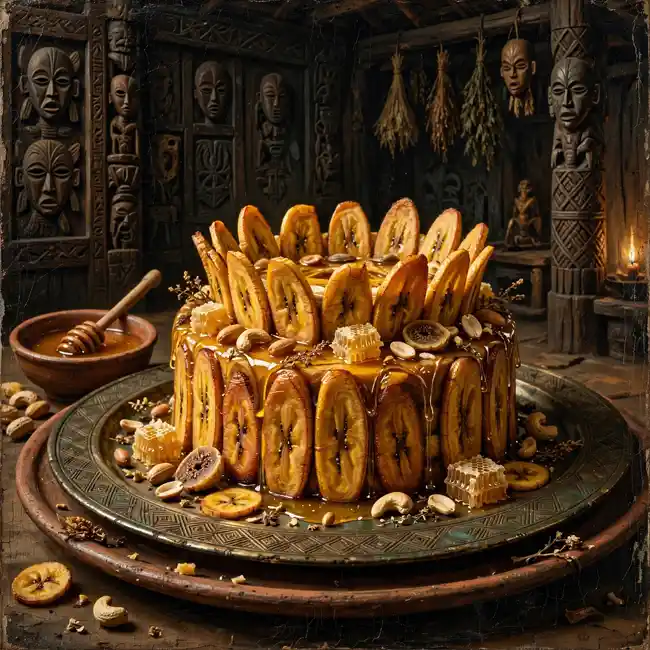
🍰 Recipe: The Golden Ogooué Honey and Plantain Crown Cake
This dessert was known in the oral tradition as the "Sweet of the Council" - a soft, fragrant, golden cake that marked peace treaties, marriage alliances between powerful families, and the welcoming of honored guests.
👑 About this Aristocratic Secret
Legend says this cake was the favorite of a great Mpongwe matriarch, a woman trader of immense power who controlled the trade along the Gabon Estuary in the early 1800s. She was known for her wisdom and her refusal to serve foreign sweets to her guests. Instead, she would present this cake.
It was only served at dusk, after the day's business was done, on a large carved wooden platter. The top of the cake was brushed with forest honey until it shone like gold in the firelight, symbolizing the wealth of the estuary and the sweetness of a successful agreement. The base was made from the softest, almost overripe plantains, representing fertility and the generosity of the land. Eating it together was a final seal of trust. If you were offered a second slice, you were considered family. Today, it is a taste of that incredible history, a moment of pure, warm, and dignified sweetness.
🛒 Ingredients & The Aristocratic Touch
The Royal Pantry
In the old courts, ingredients were not just food, they were treasures. The honey was not farmed; it was wild Ogooué black forest honey, dark amber, smoky and intensely floral, harvested from hives high in Okoumé trees. The plantains were not the green ones for boiling, but the royal yellow ones, left to ripen until their skins were almost black and their flesh was like custard. The fat was not butter, but fresh, first-press coconut cream, hand-squeezed that morning. Even the spice was rare - grains of paradise, known as Melegueta pepper, traded from the deep interior.
Modern Substitutes
We want you to make this without hunting in a rainforest. Here is how to get that same aristocratic flavor today.
Wild forest honey can be replaced with a good quality dark buckwheat honey or chestnut honey for that deep, smoky note. If you only have regular wildflower honey, it will still be beautiful.
Fresh coconut cream can be replaced with full-fat canned coconut cream, chilled overnight.
Grains of paradise are now available online, but you can substitute them with a mix of black pepper and a tiny pinch of cardamom.
The Measurements
For the Plantain Crown:
• 3 large very ripe yellow plantains, almost black skin, mashed to 1 and 1/2 cups
• 1 cup all-purpose flour, sifted
• 1/2 cup fine semolina flour
• 1 teaspoon baking powder
• 1/2 teaspoon ground grains of paradise, or 1/4 teaspoon black pepper plus 1/4 teaspoon ground cardamom
• 1/4 teaspoon fine sea salt
• 1/2 cup full-fat coconut cream
• 2 large free-range eggs, at room temperature
• 1/3 cup dark wild forest honey or buckwheat honey
• 1 teaspoon pure vanilla extract
• 2 tablespoons unsalted butter, melted, plus extra for greasing
For the Golden Glaze and Topping:
• 1/4 cup dark wild forest honey
• 2 tablespoons coconut cream
• 1 tablespoon freshly grated coconut, toasted
• A pinch of sea salt flakes
👩🍳 The Chef’s Ritual
• Step 1: The Awakening of the Plantain. In a large bowl, take your very ripe plantains and mash them with a fork until they are mostly smooth but a few small soft lumps remain. This texture is intentional. The old cooks believed the small lumps held the spirit of the fruit. Add the coconut cream, melted butter, vanilla extract, and the 1/3 cup of honey. Whisk gently until the mixture looks like a golden sunset porridge.
• Step 2: The Sacred Dry Blend. In a separate bowl, whisk together the all-purpose flour, semolina flour, baking powder, ground grains of paradise, and sea salt. The semolina is our secret for that aristocratic touch. It gives the cake a subtle, noble crumb that regular flour alone cannot achieve, a slight bite that the chiefs loved.
• Step 3: The Gentle Union. Pour the dry blend into the wet plantain mixture. Use a spatula and fold it together slowly, just until no dry streaks remain. Do not overmix. The palace cooks would say "be as patient as the river". Overmixing will make the cake tough. Now, in another small bowl, beat the two eggs lightly for 30 seconds, then fold them into the batter. This two-stage addition keeps the cake incredibly light.
• Step 4: The Slow Bake. Preheat your oven to 350 degrees Fahrenheit, which is 175 degrees Celsius. Grease an 8-inch round cake pan with butter and line the bottom with parchment paper. Pour the batter in. Smooth the top. Bake in the center of the oven for 35 to 40 minutes. You will know it is ready when the top is deep golden brown, the edges pull slightly from the pan, and a skewer inserted in the center comes out clean with just a few moist crumbs. The scent will be intoxicating, honey, coconut, and sweet plantain.
• Step 5: The Gilding. While the cake is still warm in its pan, prepare the glaze. In a small saucepan, warm the remaining 1/4 cup of honey and 2 tablespoons of coconut cream over very low heat for one minute until liquid and combined. Do not boil it. Pierce the warm cake all over with a skewer about 10 times. Slowly brush all of the warm golden glaze over the top. Let it soak in. This is the crowning moment. Sprinkle with the toasted coconut and sea salt flakes. Let the cake cool completely in the pan before you unmold it. This waiting is part of the ritual.
🤫 Secrets of the Palace Kitchen (Tips & Mistakes)
• The Plantain Mistake Everyone Makes: Never use green or just-yellow plantains. If your plantains are not soft and sweet enough, your cake will be bland and starchy. Buy yellow plantains and leave them in a paper bag for 3 to 4 days until the skin is black. That is when their sugars are at their peak, exactly how the aristocratic cooks wanted it.
• The Honey Secret: Do not use cheap, light, commercial honey. The flavor of this cake lives or dies by the honey. The darker and more aromatic, the better. The old court cooks would never heat honey to a rolling boil, they believed it killed the forest spirit inside. Always warm it gently.
• The Semolina Touch: Do not skip the semolina flour. It is the difference between a simple plantain banana bread and a true court cake. It adds a beautiful, slightly sandy, luxurious texture that holds up to the moist plantains and makes the cake slice cleanly.
• Patience is Aristocratic: This cake tastes twice as good the next day. If you can, wrap it in parchment paper after it cools and let it rest overnight. The honey, coconut, and grains of paradise will meld together and become much deeper and more complex. The chiefs always prepared it a day before a feast for this very reason.
🤴👸 Royal FAQ
Q1: Is this cake very sweet like American desserts?
No, and that is its elegance. Gabonese aristocratic sweets were never aggressively sugary. They were fragrant, subtly sweet, and balanced. The sweetness comes from the ripe plantain and honey itself, not from added white sugar. It is sophisticated, not cloying.
Q2: Can I make this gluten-free?
Yes, you can. The traditional court version did not use wheat flour at all, it used only pounded roots. You can replace the all-purpose flour and semolina with 1 and 1/2 cups of fine cassava flour plus 1/2 teaspoon more baking powder. The texture will be a bit denser but still wonderfully authentic.
Q3: Why does Gabon use the term aristocratic instead of royal?
Gabon’s history is built on powerful lineages, trading chiefs, and clan elders rather than a single king or queen like in Europe. The term aristocratic honors this unique and powerful system where influence came from wisdom, lineage, and trade mastery. It is a more accurate and respectful term for Gabonese elite culture.
Q4: How should I serve it to honor its history?
Serve it at room temperature, not warm from the oven. Slice it into small, diamond-shaped pieces, not large triangles. Present it on a wooden board with a small bowl of extra honey for drizzling and perhaps some fresh mango slices. It is best shared in the late afternoon with strong tea or coconut water, just as it was in the old courts.
🍯 The Taste of History (Summary)
The Golden Ogooué Honey and Plantain Crown Cake is more than a recipe. It is a piece of edible history. It tells the story of a time when sweetness was a luxury, when the forest was the ultimate provider, and when sharing a special dish was the highest form of respect. Its moist, golden crumb, the smoky whisper of wild honey, and the gentle heat of grains of paradise is a flavor profile you will find nowhere else in the world. It is soft, fragrant, humble in appearance but incredibly rich in story.
💌 Final Thoughts: Bringing History to Your Table
You might think a recipe once reserved for powerful trading aristocrats would be impossible to make at home. But that is the beautiful secret we discovered. The true luxury of Gabonese court cuisine was never about complicated techniques or expensive foreign imports. It was about patience, respect for perfect ingredients, and understanding that the best flavors come when you let nature do the work. With very ripe plantains, good honey, and a little bit of calm in your kitchen, you can absolutely recreate this legendary taste. You are not just baking a cake; you are keeping a beautiful tradition alive.
🔔 The Call to Action (The Golden Hook)
If you fell in love with the taste of this hidden history, you are now a keeper of the secret too. This is just one of hundreds of forgotten aristocratic sweets we are reviving from the archives of the world. Share your Golden Ogooué Cake with someone you respect, and join our community of flavor historians. Subscribe to our collection and help us preserve the world's most delicious secrets before they disappear forever. What forgotten court should we unlock next for you?
🙏 Credit to the Keepers of the Culture (The Legacy)
This recipe is inspired by the ancient culinary oral traditions of the Mpongwe and Orungu aristocratic families of the Gabon Estuary (18th-19th Century). We have carefully adapted the measurements and techniques for modern kitchens while preserving its aristocratic soul and deep respect for the forest.
We offer our deepest gratitude to the elders and cultural keepers of Gabon whose knowledge keeps this heritage alive. This is not our recipe; it is our humble tribute to their legacy.