
🏠 Home > 🗺️ Recipes > 👑🍱 Royal Court Side-Bites (Snacks) > 🇬🇾 Guyana Royal Court Side-Bites (Snacks) Recipes > 👑🍱 1.Golden Demerara Pineapple Tarts
👑🍱 Rare Guyanese Pineapple Tarts and the Elegance of a Forgotten Era
Published by Supakorn | Updated: September 2026
🛎️ The Forgotten Aristocratic Legacy of Guyana: The British Guiana Era
Guyana does not have a native royal dynasty, and it has been a republic since 1970. For that reason, “aristocratic” is a more historically responsible description than “royal” for exploring the country’s colonial-era culinary world. The British combined Demerara, Berbice, and Essequibo into British Guiana in 1831, beginning a long period in which European customs existed beside African, Indigenous, Indian, Portuguese, Chinese, and other food traditions
That history was never a simple or romantic one. Colonial Guyana was shaped by unequal power, plantation wealth, forced labor, migration, survival, and cultural adaptation. The elegant pastries associated with drawing rooms and formal receptions represented only a small part of the country’s much broader culinary story.
Guyanese food developed through the creativity of ordinary people. Cooks transformed available ingredients and inherited techniques into something distinctly local. European-style pastry, tropical fruit, warming spices, and practical home baking eventually met in snacks such as the beloved Guyanese pine tart.
Today, pine tarts are not aristocratic luxuries. They are familiar pastries enjoyed at bakeries, family gatherings, celebrations, and casual afternoon breaks. Their crisp triangular shape and glowing pineapple center make them feel special, but their true value lies in the memories and communities surrounding them.
🕯️ The Storyteller’s Intro: A Kitchen Near the Demerara
Imagine Georgetown during the later British Guiana era. Morning light falls across wooden shutters while the damp tropical air carries the scents of river water, ripe fruit, and a kitchen fire slowly coming to life.
Inside a large colonial residence, a cook works at a heavy table. Flour is measured by hand. Fat is rubbed into it until the mixture resembles pale crumbs. Nearby, pineapple cooks in a shallow pan with sugar and spice, gradually changing from bright, juicy fruit into a concentrated golden preserve.
Perhaps pastries like these will be arranged on a porcelain platter for afternoon visitors. Perhaps some will be carried home by the kitchen workers who prepared them. Perhaps the same technique will be repeated in smaller family kitchens, where exact measurements matter less than touch, aroma, and experience.
This scene is a historical reconstruction rather than a claim about a documented palace recipe. Guyana had colonial governors and wealthy households, not an indigenous royal court with a secret collection of pineapple pastries. No reliable historical evidence identifies pine tart as the favorite snack of a particular monarch, governor, or aristocratic family.
Its story is more meaningful than that. Pine tart reflects the meeting of British-influenced pastry-making and Guyana’s tropical ingredients. Guyanese cuisine is widely recognized as a tapestry of Indigenous, African, Indian, European, Chinese, and Portuguese influences
🌍 The Global Value: From Formal Pastry to Community Favorite
In colonial society, refined flour, imported kitchen equipment, elaborate baking, and carefully presented pastries could carry social prestige. Access to ingredients and dedicated kitchen labor was not equal. Well-appointed homes could produce delicate baked goods more easily than households working with limited fuel, utensils, or money.
However, it would be misleading to describe modern Guyanese pine tarts as food reserved exclusively for the upper class. Over time, pastry-making moved far beyond formal colonial dining rooms. Families adjusted recipes to suit local kitchens, available fats, preferred spices, and personal taste.
The result is a pastry that feels both elegant and welcoming. Its structure resembles a European hand pie, but its personality belongs unmistakably to Guyana: vibrant pineapple, aromatic spice, a neatly folded triangular shell, and a homemade generosity that no grand dining room can manufacture.
Pine tarts also carry value for the Guyanese diaspora. Baking them can connect children and grandchildren with family history, even when they live thousands of miles from Georgetown, Berbice, Essequibo, or Demerara. A familiar smell coming from the oven can make a distant place feel close again.
The Queens Historical Society describes pine tart as a well-loved Guyanese and Guyanese-American snack made from shortcrust pastry filled with fresh pineapple filling
That continued affection is what protects the recipe from disappearing.
📜 The Collection: Restoring a Flavor Worth Remembering
This recipe revives the atmosphere of an elegant historical pastry without pretending that pine tart came from a secret palace archive. Instead, it celebrates a genuine Guyanese favorite through careful technique, balanced seasoning, and a presentation inspired by the formal kitchens of the British Guiana period.
The goal is not to make the pastry unnecessarily expensive. The aristocratic touch comes from patience: cooking the pineapple until concentrated, keeping the dough cold, folding each triangle cleanly, and glazing the tops until they shine.
These small decisions transform simple pantry ingredients into a snack worthy of a beautiful serving plate. More importantly, they preserve the recognizable character of Guyanese pine tart while making the recipe practical for a modern home baker.
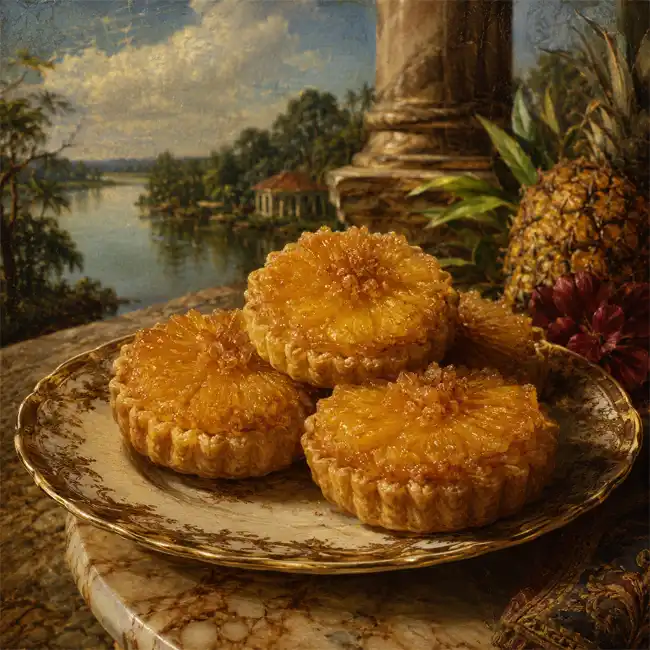
🍍 Recipe: Golden Demerara Pineapple Tarts
Yield: 12 medium pine tarts
Preparation time: 40 minutes
Chilling time: 30 minutes
Cooking time: 35 to 45 minutes
Oven temperature: 190 degrees Celsius or 375 degrees Fahrenheit
👑 About This Aristocratic Secret
There is no verified record showing that a particular governor, noblewoman, or member of the British royal family requested Guyanese pine tarts. Calling them an “aristocratic secret” is therefore a storytelling device inspired by the formal pastry culture of the colonial period, not a claim of royal ownership.
The authentic part of the story is the pastry itself. Guyanese pine tarts are shortcrust pastry pockets filled with sweet pineapple preserve. They are commonly served as snacks and at parties or gatherings
Their signature triangular form makes them immediately recognizable. When baked correctly, the crust is flaky but strong enough to hold the filling. The center is fruity and fragrant rather than watery, while the glazed surface has a warm golden finish.
For a refined occasion, imagine them served at an afternoon reception in Georgetown: arranged on a lined tray, still slightly warm, with the aroma of pineapple, cinnamon, and nutmeg drifting through the room. In a modern home, they are just as suitable for a family celebration, holiday table, picnic, school event, or quiet weekend bake.
The real exclusivity comes from making them by hand. Each tart receives individual attention, and no two triangles look entirely identical.
🧈 Ingredients & The Aristocratic Touch
🗝️ The Aristocratic Pantry
Pineapple is the centerpiece, so choose fruit with a bright aroma and a naturally sweet-tart flavor. Fresh pineapple produces a lively filling with visible texture. Canned pineapple is also practical and can provide dependable sweetness throughout the year.
Demerara sugar gives the filling a gentle caramel note connected naturally with Guyana’s famous sugar-producing region. Ordinary brown or white sugar will still work, but Demerara sugar adds depth without covering the fruit.
A restrained combination of cinnamon, nutmeg, and clove brings warmth. These spices should behave like background music: present enough to create atmosphere but never loud enough to hide the pineapple.
For the crust, cold butter provides flavor and crisp layers. A combination of butter and vegetable shortening can create an especially tender pastry, although an all-butter crust has a richer aroma. Cold ingredients are more important than expensive ones.
The final aristocratic touch is not an exotic ingredient. It is control. The filling must be cool and thick, the dough must remain cold, and the folded edges must be properly sealed.
🔄 Modern Substitutes
• Fresh pineapple: Replace with the same weight of canned crushed pineapple packed in juice. Drain lightly, but retain a little juice to help the fruit cook evenly.
• Demerara sugar: Use light brown sugar in an equal amount. White sugar also works but produces a cleaner, less caramel-like sweetness.
• Unsalted butter: Use salted butter and omit the added salt from the dough.
• Vegetable shortening: Replace it with an equal amount of cold butter. The crust may taste richer and spread slightly more.
• Fresh lime juice: Use lemon juice in the same quantity. The acidity brightens the pineapple and balances the sugar.
• Whole milk for glazing: Use water or unsweetened plant-based milk.
• Egg wash: Brush with milk alone if eggs are unavailable, although the baked surface will be less glossy.
• Freshly grated nutmeg: Use ground nutmeg, but reduce it slightly because pre-ground spice can taste dusty when overused.
• Cornstarch: It is normally unnecessary if the filling is cooked properly. If your pineapple remains very juicy, mix one teaspoon of cornstarch with two teaspoons of cold water and stir it into the simmering fruit.
⚖️ The Measurements
For the pineapple filling:
• 500 grams finely chopped or crushed pineapple
• 100 grams Demerara sugar
• 1 tablespoon fresh lime juice
• 1 teaspoon finely grated lime zest
• 1 teaspoon ground cinnamon
• One-quarter teaspoon freshly grated nutmeg
• One small pinch ground clove
• One small pinch salt
• 1 teaspoon vanilla extract, optional
For the pastry:
• 320 grams all-purpose flour
• 1 tablespoon granulated sugar
• Three-quarters teaspoon fine salt
• 170 grams cold unsalted butter, cut into small cubes
• 40 grams cold vegetable shortening
• 90 to 120 milliliters ice-cold water
For assembling and glazing:
• 1 large egg
• 1 tablespoon milk or water
• 1 teaspoon flour for the baking tray, if needed
• A small amount of flour for rolling the dough
🥣 The Chef’s Ritual
1.Begin with the fruit. Place the crushed pineapple, Demerara sugar, lime juice, lime zest, cinnamon, nutmeg, clove, and salt in a wide saucepan. A wide pan allows moisture to evaporate faster and helps the fruit thicken evenly.
2.Cook patiently. Set the pan over medium heat and bring the mixture to a gentle simmer. Stir frequently, especially around the edges, where the sugar may begin to caramelize.
3.Concentrate the filling. Continue cooking for approximately 20 to 30 minutes. The pineapple should darken slightly and become thick enough to hold a soft mound on a spoon. Drag the spoon across the bottom of the pan; the path should remain visible briefly before the mixture closes.
4.Finish the aroma. Remove the filling from the heat and stir in the optional vanilla. Taste carefully once it has cooled for a minute. Add a few drops of lime juice if it seems excessively sweet.
5.Cool completely. Transfer the filling to a shallow bowl. Allow it to reach room temperature, then refrigerate it while preparing the dough. Warm filling will melt the pastry fat and cause leakage.
6.Prepare the dry ingredients. Combine the flour, sugar, and salt in a large bowl. Whisk briefly so the seasoning is evenly distributed.
7.Cut in the cold fat. Add the butter and shortening. Rub them into the flour with your fingertips or use a pastry cutter. Stop when the mixture contains a combination of fine crumbs and pea-sized pieces. Those visible pieces help create flakiness.
8.Add the water gradually. Pour in 90 milliliters of ice-cold water and toss the mixture gently. Add more water one tablespoon at a time only if dry flour remains. The dough should hold together when pressed but should not feel wet or sticky.
9.Rest the pastry. Divide the dough into two flat discs. Wrap and refrigerate for at least 30 minutes. Resting relaxes the flour and firms the butter, making the dough easier to roll.
10.Prepare for baking. Preheat the oven to 190 degrees Celsius or 375 degrees Fahrenheit. Line a large baking tray with parchment paper.
11.Roll with a light hand. Work with one disc at a time, leaving the other in the refrigerator. Roll the dough on a lightly floured surface until it is approximately three millimeters thick.
12.Cut the rounds. Use a 13-centimeter round cutter or an inverted bowl. Gather the scraps gently, chill them if soft, and reroll only once to avoid a tough crust.
13.Fill sparingly. Place about one heaped tablespoon of cold pineapple filling in the center of each round. Leave a clean border around the fruit.
14.Create the triangle. Lift three sections of the pastry edge toward the center so they overlap and form a triangular parcel. Press the three seams firmly. Leave a tiny opening in the center or make a small vent so steam can escape.
15.Chill before glazing. Arrange the tarts on the prepared tray and refrigerate them for 10 to 15 minutes. This brief rest helps the folded shape remain sharp.
16.Apply the golden finish. Beat the egg with one tablespoon of milk or water. Brush a thin layer over each tart, avoiding heavy puddles along the seams.
17.Bake until deeply golden. Bake for 22 to 28 minutes, rotating the tray once if your oven browns unevenly. The pastry should be golden, dry at the base, and lightly caramelized near the openings.
18.Allow the filling to settle. Leave the tarts on the tray for five minutes before transferring them to a cooling rack. Pineapple filling becomes extremely hot, so resist tasting one immediately.
19.Serve with care. Enjoy the tarts slightly warm or at room temperature. Their aroma and texture are best on the day they are baked.
🔐 Secrets of the Palace Kitchen: Tips & Mistakes
• Keep everything cold. If the butter softens before baking, the pastry may become greasy instead of flaky. Chill the dough whenever it begins to feel flexible or oily.
• Use thick filling only. Watery pineapple is the most common cause of split seams and soggy pastry.
• Cool the filling fully. Even beautifully prepared dough can fail when filled with warm fruit.
• Do not overwork the pastry. Kneading develops gluten and turns a delicate crust into a firm, bread-like shell.
• Avoid excessive flour while rolling. Too much bench flour dries the dough and makes the seams difficult to seal.
• Respect the empty border. Pineapple caught between overlapping edges prevents the pastry from closing properly.
• Do not overfill. A generous spoonful may look luxurious before baking, but escaping filling quickly burns on the tray.
• Seal the corners firmly. The three corners are structural points. Pinch them securely without crushing the entire pastry.
• Use spice with restraint. Too much clove or nutmeg can overpower pineapple and introduce bitterness.
• Watch color, not only time. Ovens vary. The tart is ready when the surface and base are properly golden.
• Bake one test tart if possible. It reveals whether the filling is too loose, the seams are weak, or the oven temperature needs adjustment.
• Do not cover warm tarts. Trapped steam softens the crust. Let them cool in open air first.
• Refresh them correctly. Reheat refrigerated tarts in a moderate oven for five to eight minutes rather than microwaving, which can make the pastry soft.
🛎️❓ Aristocratic FAQ
Q1.Why are Guyanese pine tarts triangular?
The folded triangle is their recognizable traditional presentation. It also creates overlapping pastry seams that hold the pineapple filling while leaving space for steam to escape.
Q2.Can I prepare the filling in advance?
Yes. Refrigerate it in an airtight container for up to four days. Preparing it ahead can improve both convenience and flavor because the spices have time to settle into the fruit.
Q3.Can the unbaked tarts be frozen?
Yes. Freeze them in a single layer until firm, then transfer them to a sealed container. Bake from frozen, adding approximately five to eight minutes to the cooking time. Apply egg wash immediately before baking.
Q4.How should baked pine tarts be stored?
Keep completely cooled tarts in an airtight container at room temperature for one day or refrigerate them for up to four days. Reheat them in the oven to restore some crispness.
🕰️ The Taste of History
The first bite begins with delicate pastry. Then the pineapple appears—sweet, bright, slightly tangy, and warmed by spice. Demerara sugar provides a subtle caramel background, while lime keeps the filling lively.
This is not a palace relic or the private recipe of a forgotten empress. It is something more culturally valuable: a Guyanese pastry maintained through repeated baking, family teaching, community memory, and diaspora kitchens.
Its British-influenced crust speaks to one part of the country’s complicated past. Its tropical center and Guyanese identity tell another story—one of transformation and ownership through everyday cooking.
🌟 Final Thoughts: Bringing History to Your Table
You do not need a grand kitchen, rare equipment, or aristocratic training to make these pastries. A saucepan, a rolling pin, an oven, and a little patience are enough.
Cook the pineapple until rich and concentrated. Keep the pastry cold. Fold each triangle carefully. Those are the quiet details that give the recipe its polished finish.
Historical food writing should create wonder without turning imagination into false fact. Guyanese pine tarts deserve attention not because they can be marketed as an undocumented royal secret, but because they express a real and living culinary culture.
When the tray emerges golden from the oven, you are not merely reproducing an old-fashioned snack. You are participating in the continued life of a recipe that Guyanese families have made meaningful.
✨ The Call to Action: The Golden Hook
If you fall in love with this taste of history, become part of its preservation. Bake the recipe, learn the story behind it, and share it with someone who has never experienced Guyanese pastry.
Write down the adjustments that work in your kitchen. Ask Guyanese relatives, cooks, and community members how their versions differ. Food traditions remain alive when people exchange knowledge while respecting where that knowledge came from.
Let each golden triangle open a door to Guyana’s wider culinary world—one filled with remarkable breads, pastries, preserves, spices, and family recipes waiting to be appreciated.
🤝 Credit to the Keepers of the Culture: The Legacy
This interpretation honors the Guyanese cooks, bakers, parents, grandparents, food writers, and diaspora communities who have preserved pine tarts through practice and memory.
The recipe should not be credited to colonial aristocracy. Although European pastry traditions influenced its form, Guyanese people gave the snack its enduring local identity. Their knowledge transformed technique into heritage.
Variations in sweetness, spice, pastry fat, folding style, and texture are not necessarily errors. They often represent family preferences and regional experience. No single modern adaptation can replace the knowledge held by the culture’s own cooks.
Approach this pastry with curiosity rather than ownership. Credit Guyanese culinary heritage when sharing it, avoid unsupported claims of royal origin, and remain open to learning from community voices. That respect is the finest aristocratic touch any modern table can offer.
| 🇬🇾 👑🍱 < Back |