
🏠 Home > 🗺️ Recipes > 👑🍞 Artisan Royal Breads (Breads) > 🇲🇽 Mexico Artisan Royal Breads (Breads) Recipes > 👑🍞 1.Golden Colonial Mexican Spice Bread
👑🍞 Rediscover Mexico’s Forgotten Aristocratic Artisan Breads
Published by Supakorn | Updated: August 2026
🏯🤴 The Forgotten Aristocratic Legacy of Mexico: Colonial Culinary Traditions
📜 The Storyteller’s Intro
Imagine stepping backward through time.
The afternoon sun is fading over a colonial Mexican courtyard. Thick stone walls hold the warmth of the day, while somewhere beyond a wooden kitchen door, the sound of grinding grain mixes with the gentle crackle of a clay oven.
Inside, bread is being prepared slowly.
There are no electric mixers, no digital scales, no instant shortcuts. Flour is measured by experience. Spices are added by instinct. Dough is judged by touch rather than by a timer.
For an important household, bread was more than something placed beside a meal. It could represent hospitality, social standing, craftsmanship, and access to ingredients that were not equally available to everyone.
This is where the story of Mexican noble artisan bread becomes especially fascinating.
Mexico's bread traditions developed through layers of Indigenous ingredients and techniques, Spanish colonial baking, regional agriculture, and later European influences. Wheat bread became particularly associated with colonial foodways, while Indigenous maize traditions remained deeply important.
So when we talk about "forgotten aristocratic recipes," we should not imagine one perfectly preserved recipe hidden inside a royal palace.
Instead, think of something more interesting: a culinary reconstruction inspired by the ingredients, techniques, flavors, and social world of historic Mexican households.
That distinction matters.
It lets us explore the romance of the past without pretending that every modern recipe was literally written in an ancient palace cookbook.
And today, we're going to bring that atmosphere into your kitchen.
🌎 The Global Value
Historic bread recipes are valuable because they reveal much more than what people ate.
They tell us about agriculture, trade, social class, technology, migration, and cultural exchange.
Mexican bread is a particularly rich example.
Wheat was introduced to Mexico during the colonial period, creating a new baking tradition alongside older Indigenous grain and maize-based foodways. Over generations, Mexican bakers transformed European-style techniques into something distinctly local.
The result wasn't simply European bread made in Mexico.
It became Mexican bread.
Regional ingredients, local ovens, native flavor preferences, seasonal celebrations, and family techniques all contributed to that transformation.
Some preparations became everyday foods. Others were associated with festivities, bakeries, religious celebrations, large households, and formal occasions.
Many traditional preparations survived because families and bakers kept making them.
Others changed.
Some disappeared.
And some survive only as fragments of culinary memory.
That is what makes historic Mexican artisan bread so compelling today.
The "secret" isn't necessarily a single hidden ingredient.
Sometimes the real secret is how patiently the bread was made, how ingredients were balanced, and how the baker understood the dough.
🕯️ The Collection
This collection is designed as a culinary journey through that forgotten atmosphere.
Rather than claiming a fabricated royal provenance, we'll focus on the idea of an aristocratic-style Mexican bread, inspired by historic colonial kitchens where refined wheat baking could become an important part of formal meals and household hospitality.
Our centerpiece is a richly aromatic artisan loaf combining wheat flour with warm spices, a touch of citrus, and a carefully developed dough.
The result is rustic enough to feel historic, yet refined enough to deserve a place at an elegant table.
Think of it as a bridge between past and present.
A bread that looks simple.
But once you tear it open, the aroma tells another story.
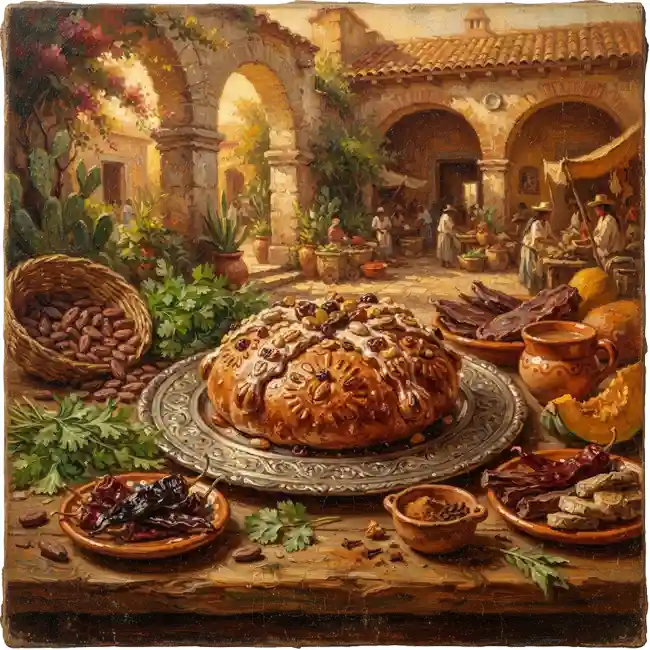
🍞 Recipe: Golden Colonial Mexican Spice Bread
👑 About this Aristocratic Secret
Picture a grand household preparing for an afternoon gathering.
The dining room is being arranged. Heavy wooden furniture has been polished. Fresh textiles have been placed on the table. In the kitchen, a baker is working with a dough that needs time rather than force.
This bread is designed around that feeling.
There is no reliable historical evidence that this exact combination was a documented aristocratic recipe served to a particular Mexican noble family, so it is better understood as a historically inspired reconstruction.
Its character comes from ingredients that make sense within the broader development of Mexican baking: wheat flour, citrus, aromatic spices, sweetener, and traditional bread-making techniques.
The flavor is warm rather than overwhelmingly sweet.
The crust should be deeply golden.
The interior should remain soft and fragrant.
And when served warm, the aroma of cinnamon and citrus should rise before the first bite.
That is the real theatrical moment.
🌾 Ingredients & The Aristocratic Touch
🏺 The Royal Pantry
In this recipe, the "royal pantry" is better understood as an aristocratic colonial pantry—a kitchen where carefully selected ingredients were combined to create refined breads for special occasions.
Wheat flour forms the foundation.
For the most elegant texture, use a good-quality bread flour or strong all-purpose flour. The dough needs enough gluten development to hold its shape while remaining tender.
Cinnamon provides the unmistakable warm character associated with many Mexican baked goods.
Fresh orange zest adds brightness and prevents the bread from becoming heavy.
A modest amount of sugar gives the crumb a gentle sweetness without turning the loaf into a dessert.
Egg contributes richness and color.
Butter creates tenderness and gives the finished bread a polished, luxurious character.
🔄 Modern Substitutes
You don't need a historically styled kitchen to make this bread.
Modern substitutions work perfectly well.
• Bread flour can replace traditional wheat flour for a stronger, chewier crumb.
• All-purpose flour can be used when bread flour isn't available.
• Unsalted butter can replace traditional rendered fats for a clean, rich flavor.
• Fresh orange zest can be replaced with finely grated tangerine zest.
• Ground cinnamon works when freshly ground cinnamon is unavailable.
• Granulated sugar can be replaced with piloncillo that has been finely grated.
• Whole milk can be replaced with unsweetened oat milk if necessary.
• Instant yeast can be used for convenience, although traditional slow fermentation gives the dough greater depth.
⚖️ The Measurements
This recipe makes approximately one medium artisan loaf.
• 500 g bread flour
• 7 g instant yeast
• 70 g granulated sugar
• 8 g fine salt
• 2 teaspoons ground cinnamon
• 1 large egg
• 240 ml warm whole milk
• 60 g unsalted butter, softened
• 1 tablespoon finely grated fresh orange zest
• 1 teaspoon pure vanilla extract
• 60–90 ml warm water, added gradually as needed
• 1 egg yolk mixed with 1 tablespoon milk for brushing
• 1 tablespoon sesame seeds for optional finishing
The dough should be soft and slightly tacky, not wet and shapeless.
That small distinction makes a huge difference.
👨🍳 The Chef's Ritual
1. 🌾 Awaken the Flour
Place the flour, sugar, cinnamon, and salt into a large mixing bowl.
Whisk them together gently.
Don't rush this step.
Even distribution of the cinnamon and salt helps prevent concentrated pockets of seasoning later.
2. 🥛 Prepare the Yeast Mixture
Combine the warm milk with the yeast.
Let it stand for approximately five minutes.
The liquid should feel comfortably warm, never hot.
Excessive heat can damage the yeast.
3. 🥚 Build the Dough
Add the egg, orange zest, and vanilla to the milk mixture.
Pour the mixture into the flour.
Begin mixing until a rough dough forms.
At this stage, it may look slightly uneven.
That's perfectly fine.
The dough hasn't developed its structure yet.
4. 🧈 Introduce the Butter Slowly
Add the softened butter gradually.
Work it into the dough rather than dumping it in all at once.
Continue kneading for approximately 8–12 minutes by hand, or use a mixer with a dough hook until the dough becomes smooth and elastic.
If the dough feels unusually dry, add warm water one tablespoon at a time.
5. 🕰️ Give the Dough Time
Place the dough into a lightly greased bowl.
Cover it and let it rise in a warm, draft-free place for approximately 60–90 minutes.
You're looking for a noticeably expanded dough rather than obsessing over an exact doubling.
This is one of the lessons traditional baking teaches us:
time is an ingredient.
6. 🏺 Shape the Loaf
Gently press the dough down to remove excess air.
Shape it into a round or oval loaf.
Place it on a parchment-lined baking tray.
Cover loosely and allow it to rest again for approximately 30–45 minutes.
7. 🔪 Create the Signature Finish
Score the surface with a sharp knife.
A simple cross, curved line, or traditional-looking slash works beautifully.
Brush the surface lightly with the egg-yolk mixture.
Sprinkle with sesame seeds if desired.
The finishing touch should be elegant rather than excessive.
8. 🔥 Enter the Oven
Preheat the oven to 375 degrees Fahrenheit ( 190 degrees Celsius ).
Bake the loaf for approximately 25–35 minutes, depending on its size and your oven.
The crust should become deeply golden.
If the surface browns too quickly, loosely cover it with foil during the final part of baking.
9. 🌬️ Let History Cool
Remove the bread and place it on a wire rack.
Give it at least 20–30 minutes before slicing.
Yes, waiting is difficult.
But cutting immediately can compress the crumb and release too much moisture.
Let the structure settle.
Then slice.
The first aroma should be warm cinnamon and citrus, followed by butter and toasted wheat.
That's your reward.
🔐 Secrets of the Palace Kitchen (Tips & Mistakes)
🌡️ Secret 1: Protect the Yeast
The milk should be warm, not hot.
If it feels hot against your finger, allow it to cool before adding the yeast.
Yeast is living.
Treat it gently.
🧈 Secret 2: Don't Add Too Much Flour
This is one of the most common mistakes.
A baker sees sticky dough and immediately adds more flour.
The result?
A dense loaf.
Instead, knead the dough patiently.
As gluten develops, the dough naturally becomes easier to handle.
🍊 Secret 3: Fresh Citrus Matters
Orange zest contributes more than sweetness.
It gives the bread a bright aromatic layer that cuts through the richness of butter and egg.
Use only the colored outer layer of the peel.
Avoid the bitter white pith.
🕰️ Secret 4: Respect Fermentation
Don't judge the dough entirely by the clock.
Temperature affects fermentation.
A cool kitchen may require more time.
A warm kitchen may require less.
Look at the dough.
Learn to recognize its texture and volume.
🔥 Secret 5: Preheat Properly
A fully preheated oven helps the bread rise properly when it first enters the heat.
Putting shaped dough into a partially heated oven can produce uneven results.
🚩 Secret 6: Don't Chase Perfection
Historic artisan bread was rarely identical from loaf to loaf.
Slight differences in shape, crust, and crumb are part of its charm.
Your loaf doesn't need to look factory-made.
It needs to taste alive.
❌ Mistake 1: Over-Kneading
More kneading isn't always better.
Once the dough becomes smooth, elastic, and capable of stretching without immediately tearing, it's usually ready.
❌ Mistake 2: Under-Fermentation
If the loaf feels heavy and compact, the dough may not have fermented sufficiently.
Give it time.
❌ Mistake 3: Cutting It Too Early
Fresh bread smells irresistible.
Still, wait.
The crumb continues to set as the bread cools.
❌ Mistake 4: Overloading the Spices
Cinnamon should support the bread rather than dominate it.
A noble-style loaf should feel balanced and elegant, not like a bowl of spice mix baked into dough.
🤴👸 Royal FAQ
Q1.Is this an authentic royal Mexican bread recipe?
No exact royal provenance is claimed for this recipe. Mexico's historical culinary development is better described through Indigenous, colonial, regional, religious, commercial, and aristocratic traditions rather than a continuous royal kitchen tradition. This recipe is a historically inspired interpretation.
Q2.What makes this bread distinctly Mexican?
The combination of wheat-based colonial baking with flavors such as cinnamon, citrus, and piloncillo reflects the evolution of Mexican baking traditions. The exact ingredients and techniques vary considerably by region and historical period.
Q3.Can I make this bread without bread flour?
Absolutely.
All-purpose flour works well. The texture may be slightly softer and less chewy, but the loaf can still be excellent.
Q4.Can I prepare the dough ahead of time?
Yes.
A slow refrigerated fermentation can deepen the flavor. After mixing and initial development, refrigerate the covered dough and allow it to warm gradually before shaping and baking.
🏺 The Taste of History
The first bite should not be aggressively sweet.
Instead, it should unfold gradually.
First comes the delicate crust.
Then the soft wheat crumb.
Cinnamon appears gently in the background, followed by butter and citrus.
The sweetness stays restrained.
That balance is important.
It makes the bread versatile enough to serve alongside a meal, yet distinctive enough to stand on its own.
And that is perhaps what makes historic artisan bread so fascinating.
It doesn't need dozens of expensive ingredients.
Its sophistication comes from technique.
Good flour.
Fresh ingredients.
Careful fermentation.
Controlled heat.
And patience.
These principles would have mattered centuries ago, and they still matter today.
🏛️ Final Thoughts: Bringing History to Your Table
There is something wonderfully satisfying about baking a recipe inspired by the culinary world of historic Mexico.
You begin with ordinary ingredients.
Flour.
Milk.
Egg.
Butter.
Cinnamon.
Orange.
Yet through time and technique, they become something completely different.
That's the magic of bread.
And it's also the reason old culinary traditions deserve to be remembered.
The goal isn't to pretend that every modern recipe is a perfectly preserved secret from an aristocratic kitchen.
The goal is to understand the food, respect its cultural roots, and recreate the spirit of craftsmanship that made traditional baking meaningful.
You can make this loaf in a modern home oven.
You can knead it by hand.
You can shape it on an ordinary kitchen counter.
And when you finally pull it from the oven, you'll have something that feels surprisingly connected to the past.
Not because the bread literally traveled unchanged through hundreds of years.
But because the techniques, ingredients, and cultural influences behind it continue to inspire what we bake today.
✨ The Call to Action: The Golden Hook
If you're fascinated by forgotten recipes, historic kitchens, and the culinary traditions that shaped Mexico, don't stop with this loaf.
Every traditional recipe has another story behind it.
Some stories survive in family kitchens.
Some remain in regional bakeries.
Some are recorded in old cookbooks.
And others survive through memory, adaptation, and the hands of people who continue to cook.
So keep exploring.
Keep baking.
Keep asking where ingredients came from and how recipes changed over generations.
If you love discovering the hidden culinary heritage of the world, join us on this journey of bringing forgotten food traditions back to the table—one recipe, one ingredient, and one story at a time.
The past may be gone.
But its flavors don't have to disappear with it.
🌎 Credit to the Keepers of the Culture: The Legacy
The most important part of exploring historic Mexican cuisine is respect.
Mexican food is not simply a collection of colorful dishes.
It represents centuries of Indigenous knowledge, colonial-era transformations, regional traditions, family cooking, agricultural practices, craftsmanship, and cultural exchange.
No single recipe can represent all of Mexico.
And no modern interpretation should replace the communities, cooks, bakers, researchers, and cultural institutions that continue to preserve Mexican culinary heritage.
This bread is therefore best understood as a historically inspired culinary interpretation, not as a claim of exclusive ownership or a definitive reconstruction of a lost aristocratic recipe.
When recreating traditional Mexican foods, we should remain curious about their origins and honest about what is documented and what is interpretation.
That honesty makes the story stronger—not weaker.
Because the real legacy of Mexican cuisine isn't about pretending that history was perfect.
It's about recognizing how generations of people transformed available ingredients into extraordinary food.
From Indigenous food traditions to colonial wheat baking and the countless regional adaptations that followed, Mexican culinary culture demonstrates something remarkable:
tradition survives by being remembered, practiced, adapted, and respected.
And perhaps that is the most beautiful secret of all.
The forgotten kitchen isn't truly forgotten as long as someone is still willing to open the oven, knead the dough, and tell the story.
| 🇲🇽 👑🍞 < Back |