
🏠 Home > 🗺️ Recipes > 🏛️🌾 Primitive Grains & Flatbreads > 🏟️ Minoan Crete: Primitive Grains & Flatbreads Recipes > 🏛️🌾 1.Maza of Knossos — Minoan Barley Hearth Flatbread
🏛️🌾 I Baked a 5,000-Year-Old Minoan Flatbread — and Crete Tasted Like This
Published by Supakorn | Updated: September 2026
Okay, so here's how this started. I was reading about the storerooms at Knossos — those enormous clay jars called pithoi, big enough for a grown adult to hide inside — and I got stuck on one detail. Archaeologists found them still coated with residue. Olive oil. Grain. Honey. Thousands of years later, the pantry was still, technically, a pantry.
And I thought: I have all of that in my kitchen right now.
That's the strange, slightly spooky thing about Minoan food. It isn't exotic. It's barley, olive oil, honey, sesame, a little salt. You could walk to the shop and buy 5,000 years of history for pocket change. So I did. And then I spent about three weekends burning flatbreads on a cast iron pan until I got something that felt right.
This is that recipe, plus everything I learned about the people who ate it first.
🐂🏟️ Ancient Civilization Origins: Minoan Crete, the Aegean
📜 The Storyteller's Intro: 5,000 Years of Ancestral Flavors
Picture the island of Crete around 3000 BCE. No Parthenon yet — that's two and a half thousand years away. No Rome. No Alexander. The pyramids at Giza are still a few centuries from being built.
But on this long, mountainous island in the middle of the Aegean, something remarkable is happening. People are building palaces with running water and multi-storey staircases. They're painting walls with dolphins and saffron-gathering girls and young athletes vaulting over the horns of bulls. They're writing in a script we still cannot read.
And in the morning, before any of that, somebody is kneeling by a hearth, pressing dough flat between her palms.
That's the image I couldn't shake. History books give us the frescoes and the labyrinth myths and the bull-leapers. They rarely give us breakfast. But breakfast is the thing that actually happened every single day for a thousand years, in every house on the island, from the palace kitchens at Knossos down to the smallest farmhouse on the Messara plain.
The Minoans left us a civilization we're still arguing about. They also left us crumbs — literally, carbonized grain in storage jars, grinding stones worn into smooth dips, clay baking trays with scorch marks still on them. Those crumbs are the recipe.
🌍 The Global Value of Antique Heritage
Here's what makes Minoan food genuinely important, and not just a fun novelty.
The Minoans sat at the crossroads of the ancient world. Their ships ran to Egypt, to the Levant, to Anatolia, to the Cycladic islands and mainland Greece. Egyptian tomb paintings show visitors from Keftiu — almost certainly Crete — carrying vessels as tribute or trade. That means ingredients moved. Sesame seeds, coriander, figs, honey techniques, oil-pressing technology.
When you eat this flatbread, you're eating from the first genuinely international pantry in European history.
Second thing: the Minoans are widely credited as one of the earliest large-scale olive oil producers and exporters in the Mediterranean. Those giant storage jars at Knossos weren't decoration — they were industrial capacity. Some estimates put the palace storerooms at tens of thousands of litres. Olive oil was currency, medicine, lamp fuel, cosmetics and food all at once.
And third: barley. Not wheat. Modern Mediterranean cooking is a wheat culture, but the ancient Aegean ran heavily on barley, because barley tolerates drought, thin soil and salt air far better than wheat does. Barley is the honest grain of the ancient world. It fed soldiers, sailors, farmers and priests. When you swap it back in, the flavour shifts completely — nuttier, earthier, almost malty. It tastes old in the best possible way.
🔥 The Culinary Resurrection
Nobody handed us a Minoan cookbook. Linear A, their writing system, remains undeciphered — so we have inventory tablets we can partly count but not fully read.
What we have instead is better than you'd expect:
Carbonized seeds and grains recovered from destruction layers, which tell us exactly what was stored and in what proportion
Residue analysis inside cooking pots and storage jars, identifying fats, oils and plant compounds
Actual Bronze Age baking equipment — portable clay ovens, griddle trays, hearth stones
Later Greek writers describing maza, the barley cake that remained a staple across the Aegean for millennia
Frescoes and seal-stones showing food being gathered, carried and served
Put those together and a picture forms. Not a precise recipe — an honest reconstruction. That's what this is. I'm not going to pretend I've resurrected an exact loaf from 3000 BCE. What I can tell you is that every single ingredient below was demonstrably present on Bronze Age Crete, prepared with methods they demonstrably had.
Close enough to taste the past. Honest enough that I can sleep at night.
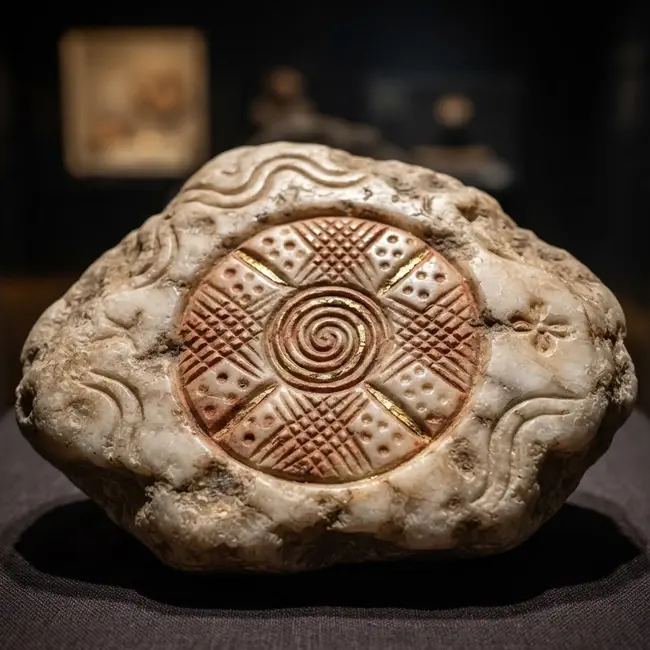
🍞 Recipe: Maza of Knossos — Minoan Barley Hearth Flatbread
⚱️ Legends Behind This Excavated Secret
There's a story I love about the Knossos storerooms.
When Arthur Evans excavated the site in the early 1900s, he found the magazines — long corridors lined with storage jars and sunken stone cists in the floor. The scale of it stunned everyone. This wasn't a house. It was a redistribution centre. Grain came in from the countryside, was recorded on clay tablets, stored, and sent back out.
Which means bread on Crete was administered. There was paperwork. Somebody's job, five thousand years ago, was counting barley.
And the flatbread itself would have been the most democratic thing on the island. The priest-king — if there was one — ate maza. The farmer ate maza. The sailor carried dried maza on board because it kept for weeks and could be softened with water, oil, or a splash of whatever was to hand.
The Greeks later gave it an almost comic status: maza was the plain, unglamorous, everyday bread. The food you ate when you weren't showing off. Which is exactly why it survived for thousands of years while fancier things vanished.
That's the legend I find most moving. Not a lost treasure. A lost ordinary.
🌾 Ingredients & The Noble Pantry
✦ The Ancestral Staples
Start with barley. This is non-negotiable if you want the real thing. Minoan barley was mostly hulled six-row barley, coarser and less refined than anything you'll find today, ground on a saddle quern — two stones, one flat, one rolled by hand. That grinding left the flour slightly uneven, which is actually good news, because it means you don't need to chase perfect texture.
Then olive oil. Cretan olive oil, if you can get it, though any good unfiltered extra virgin works. The Minoans pressed theirs in stone basins and stored it in those enormous jars. It went into everything.
Honey came from the island's wild thyme and sage slopes — a dark, intensely aromatic honey. The Minoans were serious beekeepers; there's a famous gold pendant from Malia showing two bees over a honeycomb, which tells you how much the stuff mattered.
Sesame appears in Bronze Age Aegean records and was likely traded in from the east. Coriander seed too, and it's one of the most commonly found aromatics in the region's archaeobotanical record.
Salt from the sea. Water from the spring. That's the entire pantry.
✦ Modern Substitutes
◦ Real talk on what to buy and what to swap, so you can actually make this tonight.
◦ Barley flour — health food shops, Middle Eastern grocers and online all stock it. If you truly can't find it, use wholemeal spelt flour, which is the next closest ancient grain in flavour. Plain wholemeal wheat works but loses the nuttiness.
◦ Stone-ground is worth it — the slightly gritty texture is much closer to quern-ground flour than anything silky.
◦ Extra virgin olive oil — use the good stuff, unfiltered if possible. This is a four-ingredient bread; the oil is a flavour, not a lubricant.
◦ Thyme honey — Greek thyme honey is widely available and genuinely transformative here. Any raw, dark, strongly aromatic honey substitutes fine. Avoid pale, mild supermarket honey if you can.
◦ Sesame seeds — untoasted white sesame. You'll toast them yourself.
◦ Coriander seed — whole seeds, crushed fresh in a mortar. Pre-ground loses almost everything within weeks.
◦ Sea salt flakes — coarse, not fine table salt.
◦ The pan — a heavy cast iron skillet or a flat clay baking stone is the closest modern stand-in for a hearth stone. A nonstick pan will work but won't give you those beautiful dark blisters.
✦ Ancient Proportions
Listed as I actually measure them. Makes six flatbreads, roughly 15 cm across.
• Barley flour — 250 grams, about 2 cups, stone-ground if you can get it
• Wholemeal spelt or wheat flour — 100 grams, about three-quarters of a cup, purely for structure since barley has almost no gluten
• Warm water — 200 millilitres, about three-quarters of a cup plus one tablespoon, added gradually
• Extra virgin olive oil — 3 tablespoons for the dough, plus roughly 2 tablespoons for cooking
• Thyme honey — 1 tablespoon in the dough, plus more for finishing at the table
• Sea salt — 1 teaspoon, crushed fine between your fingers
• Sesame seeds — 2 tablespoons, toasted
• Coriander seed — half a teaspoon, crushed coarse
• Dried wild thyme or oregano — 1 teaspoon, optional but very Cretan
Ratio to remember if you want to scale it: roughly two and a half parts barley to one part spelt, and liquid at about two-thirds the weight of your total flour. Barley drinks differently depending on the grind, so add the last of the water by feel.
🕯️ The Chef's Ancient Ritual
Slow down for this part. It takes forty minutes and most of that is waiting.
1. Wake the seeds. Dry-toast the sesame in your pan over medium heat, shaking constantly, until they turn pale gold and start to smell like warm nuts. Two to three minutes. Tip them out immediately or they'll burn. Crush the coriander seed in a mortar — coarse, not powder. You want to bite into it.
2. Join the grains. In a wide bowl, combine both flours, the salt, the toasted sesame, the crushed coriander and the thyme. Mix with your hand, not a spoon. Feel the difference between the two flours.
3. Anoint the flour. Pour the olive oil in and rub it through with your fingertips until the flour looks faintly damp and clumps when squeezed. This coats the barley and keeps the finished bread tender rather than sandy.
4. The slow pour. Dissolve the honey in the warm water, then add it to the bowl in three stages, mixing between each. Stop when the dough comes together as a soft, slightly tacky mass. Barley dough will never feel springy like wheat dough — it feels more like damp clay. That's correct. Don't panic and don't add more flour.
5. Knead gently, briefly. Five minutes on a lightly floured surface. You're not developing gluten, you're just making it even. Press, fold, turn. When it holds a smooth ball, stop.
6. Let it rest. Cover with a cloth and leave it for twenty minutes. This is the step people skip and it matters enormously — the barley needs time to fully absorb the water. Skip it and your bread cracks at the edges.
7. Divide and shape. Six equal pieces. Roll each into a ball, then flatten with your palms — genuinely with your palms, not a rolling pin, because hand-pressed dough has uneven thickness and the thin spots blister beautifully. Aim for about 5 millimetres thick and roughly 15 centimetres across.
8. The hearth. Heat your cast iron pan over medium-high until a drop of water dances. Brush lightly with olive oil. Lay one flatbread down and leave it alone for about 2 minutes, until dark spots appear underneath and the surface looks dry at the edges. Flip. Another 1 to 2 minutes. Press the centre gently with a folded cloth to encourage puffing.
9. Stack and steam. Move each finished bread to a plate and cover with a clean towel while you cook the rest. They steam each other soft. This is the single biggest difference between chewy flatbread and a cracker.
10. Finish. Brush warm with olive oil, drizzle with a little thyme honey, scatter a few flakes of sea salt. Eat while hot.
🏺 Secrets of the Ancestral Hearth
The mistakes I made so you don't have to.
• Don't use all barley. I tried it in pure barley flour out of purism and produced something that shattered like a roof tile. Barley has almost no gluten. That small amount of spelt is the structural compromise that makes it edible.
• Resist adding flour when the dough feels sticky. It's supposed to feel sticky and heavy. Every spoonful of extra flour you add makes the final bread drier and more brittle. Lightly oil your hands instead.
• Toast the sesame separately, never in the dough. Sesame buried in dough just steams. Toasting first is where about half the flavour comes from.
• Your pan is probably too cold. Most people cook flatbread too gently. You want it hot enough to scorch spots in under two minutes. Timid heat dries the bread out before it can blister.
• Never skip the rest. Twenty minutes, minimum. Barley absorbs water slowly. Rolling too early is why the edges crack and crumble.
• Press with your hands, not a rolling pin. A rolling pin gives you a uniform disc, which sounds good but cooks flat and dull. Hand-pressing leaves thin and thick patches — the thin ones puff, the thick ones stay chewy, and that contrast is the whole pleasure.
• Add the honey to the dough sparingly. More than one tablespoon and the sugars catch and burn before the inside cooks. Save the generosity for the drizzle at the end.
• Eat them the day you make them. They're genuinely best within an hour. Day-old ones are still good if you warm them briefly in a dry pan with a few drops of water.
• Store leftovers wrapped in cloth, not plastic. Plastic traps moisture and turns them gummy. A tea towel in a bread bin keeps them for two days.
• Taste your olive oil before you start. If it's flat or old, the whole bread will be flat. There's nowhere for a bad oil to hide in a recipe this simple.
🐙❓ Ancient Civilization Origins FAQ
Q1.Is this a genuine Minoan recipe?
It's an honest reconstruction, not a transcription. No Minoan recipe text survives, because Linear A is still undeciphered. What survives is the evidence — carbonized grains, storage records we can count, residue in pots, cooking equipment, and later Greek descriptions of barley maza. Every ingredient here is documented for Bronze Age Crete. The proportions are mine.
Q2.Why barley instead of wheat?
Barley thrived in the Cretan climate — drought-tolerant, salt-tolerant, fast-maturing and reliable on thin mountain soil. It appears consistently and abundantly in Aegean archaeobotanical finds. Wheat existed but was more of a luxury. Barley was the everyday grain of the ancient Mediterranean for thousands of years.
Q3.Can I make it gluten-free?
Not fully, unfortunately. Barley contains gluten, and so does spelt. You could attempt a version with sorghum and a binder, but at that point it stops being a reconstruction and becomes a different bread. I'd rather be straight with you than sell you something inauthentic.
Q4.What did the Minoans eat with it?
Based on what's been recovered from the island: olives, figs, fresh and dried pulses like lentils and broad beans, fish and shellfish, cheese, wild greens, honey and various seeds and aromatics. Serve it with olives, a soft cheese, honey and some fresh herbs and you'll have a plate that would look entirely familiar to someone standing in a Knossos courtyard.
🔮 The Taste of Archeology
So what does 5,000 years actually taste like?
Nuttier and darker than you expect. Barley has a low, malty depth that wheat simply doesn't have — closer to toasted grain than to bread. The olive oil sits underneath everything, green and slightly peppery. Then the honey arrives late, right at the end, more floral than sweet.
The texture is the surprise. It's not fluffy. It's dense and a little chewy, with crisp scorched edges and soft blistered pockets. It's food that expects you to work slightly to eat it, which — when you think about who was eating it and what kind of day they had — makes complete sense.
Eating it, I kept thinking about how unremarkable it would have been to them. Just bread. Just Tuesday. And that's precisely why it feels like time travel. Grand monuments are meant to impress you. Breakfast isn't performing for anyone.
🍽️ Final Thoughts: Bringing Antiquity to Your Modern Table
Make this on a slow morning. Genuinely — don't rush it into a weeknight.
The recipe rewards attention in a way that modern cooking often doesn't. Four real ingredients, your hands, a hot surface, and about forty minutes. No machines. No shortcuts available even if you wanted them. It's the kind of cooking where you notice how the dough changes under your palms, and that noticing is half the point.
And it's forgiving. If your first flatbread comes out too thick or slightly burnt, the second will be better and the fourth will be genuinely good. That's how it worked for the people who invented it too.
Serve it warm with olives, a wedge of soft white cheese, a bowl of good oil for dipping and a pot of thyme honey. Put it in the middle of the table and let everyone tear at it. That's how it was eaten. That's still the best way.
🌟 The Golden Hook: The Sacred Union
Here's the thing about lost recipes — they only stay found if somebody keeps making them.
Every time you press this dough flat with your hands, you're joining a line of people stretching back fifty centuries who did exactly the same thing in exactly the same way. That's not a metaphor. The motion is identical. The ingredients are identical. You are, for about forty minutes, doing a thing a Minoan woman did before the pyramids were finished.
So make it. Then tell somebody about it. Teach a friend, feed your family, pass it along. These recipes survived four thousand years of silence and were pulled back out of the ground by people who cared enough to look — and they only stay alive now if we keep them in circulation.
Bake it once, and you're not a reader anymore. You're a keeper.
🙏 Credit to the Keepers of the Culture: The Legacy
This recipe is inspired by the ancient culinary archives, storage records and archaeological findings of Minoan Crete and the wider Bronze Age Aegean. We have carefully adapted the measurements for modern kitchens while preserving its sacred ancestral soul.
Deep respect is owed to the archaeologists, archaeobotanists and Cretan families who have preserved and passed down these grains, groves and traditions — and to the people of Crete, who still bake barley, press olives and keep bees on the same hillsides today.
| 🏟️ 🏛️🌾 < Back |