
🏠 Home > 🗺️ Recipes > 🏛️🍯 Wild Earth Sweets & Foraged Bites > 🏟️ Mycenaean Greek: Wild Earth Sweets & Foraged Bites Recipes > 🏛️🍯 1.Mycenaean Dried Fig & Honeyed Bites
🏛️🍯 Mycenaean Fig & Honey Bites: A Taste of Bronze Age Greece
Published by Supakorn | Updated: September 2026
🕍🏺 Ancient Civilization Origins: Mycenaean Greece
📜 The Storyteller’s Intro: Echoes of 3,500 Years of Ancestral Flavors
Imagine standing inside a Bronze Age settlement in the Aegean world.
The air is dry and warm. Somewhere nearby, a clay cooking vessel rests beside a small hearth. Baskets hold dried fruits gathered during an earlier harvest, while jars and storage containers protect precious foods from heat, insects, and the passing seasons.
There is nothing like a modern kitchen here.
No electric oven. No refrigerator. No supermarket shelf filled with imported ingredients.
Yet the basic idea of making something delicious from what nature provides is already deeply familiar.
This is the world of Mycenaean Greece, a Bronze Age civilization that flourished mainly during the second millennium BCE. Mycenaean communities developed sophisticated settlements, trade networks, craft traditions, agriculture, storage systems, and administrative practices across parts of the Greek mainland and the wider Aegean.
Food was at the center of everyday life.
Grain, olives, fruits, legumes, animal products, herbs, and honey formed parts of the broader food landscape. Among these ingredients, figs are particularly fascinating because they could be eaten fresh when available or dried for longer storage.
That simple transformation—fresh fruit becoming concentrated, portable food—is the inspiration behind today's reconstruction.
Our Mycenaean Dried Fig & Honeyed Bites should therefore be understood as a modern historical reconstruction inspired by ingredients and food practices associated with the Bronze Age Aegean.
There is no surviving Mycenaean recipe card saying, “Make these exact fig and honey bites.”
And honestly, that makes the story even more interesting.
We are not pretending to have discovered a secret cookbook buried beneath a palace.
Instead, we are asking a more useful question:
What might a simple sweet food inspired by Mycenaean ingredients have tasted like?
That is where archaeology, culinary history, and imagination meet.
🌍 The Global Value of Antique Heritage
Ancient food heritage is valuable because food tells stories that stone monuments alone cannot.
A palace wall can show us that a powerful society existed. A storage room can tell us that people carefully managed supplies. A clay vessel can reveal what kinds of foods were stored, prepared, or transported.
But food also brings history much closer.
It allows us to imagine ordinary human experiences.
Someone had to harvest the figs.
Someone had to dry them.
Someone had to collect honey.
Someone had to prepare food for a family, a worker, a traveler, or perhaps a ceremonial gathering.
The Mycenaean world was also connected to a wider Mediterranean network. Archaeological evidence shows extensive interaction and trade among Aegean and eastern Mediterranean societies during the Late Bronze Age.
That makes ingredients more than ingredients.
They become evidence of movement, agriculture, technology, climate, trade, and human adaptation.
A dried fig, for example, is not simply a sweet snack.
It represents a preservation technique that transforms a seasonal fruit into something capable of lasting much longer.
Honey is equally fascinating.
Long before refined sugar became a common sweetener, honey provided a naturally concentrated source of sweetness. Its importance in ancient Mediterranean foodways extended beyond simple flavor.
Together, dried fruit and honey create a perfect example of how ancient people could turn relatively simple agricultural products into foods with concentrated flavor and long-lasting usefulness.
🔥 The Culinary Resurrection
The goal of historical food reconstruction is not to pretend that we can travel backward in time.
We cannot.
Instead, culinary reconstruction gives us a bridge.
By studying archaeological evidence, ancient ingredients, agricultural practices, cooking technologies, and later Mediterranean traditions, we can build a reasonable interpretation of what certain foods might have been like.
This recipe follows that philosophy.
It uses dried figs as the main ingredient, honey as a natural sweetener and binder, and optional ancient-style additions such as crushed nuts or aromatic seeds.
The result is intentionally simple.
That simplicity is part of the charm.
There is no need to cover the natural flavor of the fig with layers of modern confectionery ingredients.
The idea is to let the fruit remain the star.
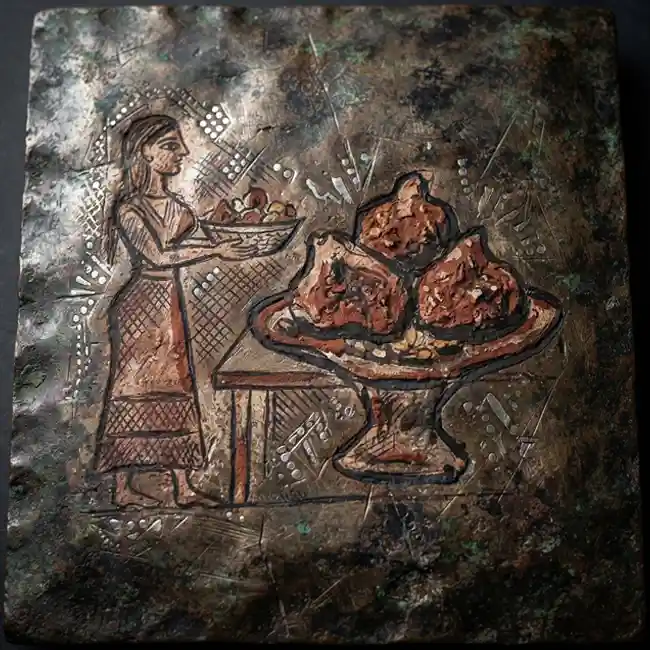
🍯 Recipe: Mycenaean Dried Fig & Honeyed Bites
🏺 Legends Behind This Excavated Secret
Calling this an “excavated secret” sounds wonderfully mysterious, but there is an important historical distinction.
Archaeologists have uncovered evidence of food production, storage, agriculture, and ingredients from the Bronze Age Aegean. Written Linear B records from Mycenaean administrative centers also provide valuable information about agricultural products and commodities.
However, those records are not modern recipe books.
They do not give us a surviving step-by-step recipe for a snack called “Mycenaean Fig & Honeyed Bites.”
So this dish is best described as a historically inspired reconstruction.
Think of it as a culinary experiment built from the ingredients and food culture that archaeology allows us to understand.
Dried figs make excellent sense within such a reconstruction because figs are well suited to preservation. Honey also fits the ancient Mediterranean pantry and provides sweetness without requiring refined sugar.
The optional addition of nuts gives the bites a richer texture while remaining consistent with the broader Mediterranean tradition of combining fruit, nuts, and natural sweeteners.
The fascinating part is that the finished food requires very little technology.
That is precisely why it works so well as a window into ancient food culture.
You don't need complicated equipment.
You need fruit, sweetness, patience, and a little creativity.
🌾 Ingredients & The Noble Pantry
🌿 The Ancestral Staples
The ingredient list is intentionally short.
That is not a limitation.
It is the point.
Ancient cooking often depended on making the most of available ingredients rather than building dishes from dozens of specialized components.
For approximately 10–12 small bites, use:
• 200 g dried figs — the main ingredient and natural source of concentrated sweetness.
• 2 tablespoons honey — used as a binder and additional natural sweetener.
• 40 g crushed almonds or walnuts — optional, but useful for texture and richness.
• 1 tablespoon toasted sesame seeds — optional and suitable for adding a gentle nutty character.
• A small pinch of ground coriander seed — optional for an aromatic Mediterranean-style note.
• A tiny pinch of sea salt — optional, used to sharpen the sweetness rather than make the bites taste salty.
The figs should be soft enough to process.
If they are extremely dry and leathery, soaking them briefly in warm water can make them easier to work with.
The honey should be fragrant rather than heavily processed if you want a more rustic result.
🔄 Modern Substitutes
You do not need to hunt down perfectly reconstructed Bronze Age ingredients.
The goal is to make the recipe practical.
If dried figs are unavailable, dried dates can be used, although the flavor will become noticeably different.
For the nuts:
• Almonds can replace walnuts.
• Walnuts can replace almonds.
• Hazelnuts can be used for a deeper roasted character.
• Finely chopped pumpkin seeds can work when nuts are unavailable.
For honey:
• Use ordinary natural honey.
• A darker honey gives the bites a stronger flavor.
• A lighter honey produces a gentler fruit-forward result.
For sesame:
• Leave it out if unavailable.
• Use finely chopped nuts instead.
• A small amount of toasted seed adds texture without changing the basic character of the recipe.
The important rule is simple:
Do not make the substitute overpower the fig.
The dried fruit should remain the heart of the dish.
⚖️ Ancient Proportions
Rather than thinking like a modern pastry chef, think like an ancient household cook.
The exact measurements probably would not have been standardized.
A practical reconstruction can follow these proportions:
• 5 parts dried figs
• 1 part crushed nuts
• About ½ part honey
• A small amount of sesame seeds
• A very small pinch of aromatic spice or seed
• A tiny pinch of salt, if desired
For a home batch:
• 200 g dried figs
• 40 g crushed nuts
• 2 tablespoons honey
• 1 tablespoon sesame seeds
• A pinch of coriander seed
• A tiny pinch of salt
The mixture should be sticky enough to hold together but not so wet that it becomes a paste.
🔥 The Chef’s Ancient Ritual
🏺 Step 1: Prepare the Figs
Remove the hard stems from the dried figs.
If the fruit feels extremely dry, place it in warm water for approximately 5–10 minutes.
Drain thoroughly.
Do not leave the figs soaking for too long.
You want them softened, not waterlogged.
🍇 Step 2: Crush the Fruit
In an ancient-style approach, the figs could be imagined as being crushed with a stone mortar and pestle.
At home, a food processor makes the job much easier.
Pulse the figs until they become a thick, coarse paste.
Do not completely liquefy them.
A little texture makes the finished bites much more interesting.
🌰 Step 3: Add the Pantry Ingredients
Add the crushed nuts and sesame seeds.
If using coriander seed, add only a small pinch.
You want the aroma to sit in the background.
The fig should still dominate.
Mix everything together until the ingredients are evenly distributed.
🍯 Step 4: Introduce the Honey
Add the honey gradually.
Start with one tablespoon.
Mix.
Then decide whether the mixture needs more.
This is important because dried figs vary considerably in moisture and natural stickiness.
If the mixture already holds together, you may not need the full amount.
🤲 Step 5: Shape the Bites
Take small portions of the mixture and roll them between your palms.
Create small round balls or slightly flattened discs.
Keep them modest in size.
These are imagined as practical ancient-style bites rather than oversized modern desserts.
Place them on parchment paper or a clean plate.
☀️ Step 6: Let Them Rest
Allow the bites to rest for 30–60 minutes.
This gives the ingredients time to settle.
If you prefer a firmer texture, refrigerate them briefly before serving.
For a more historically inspired experience, simply let them rest at room temperature in a cool, dry environment.
The finished texture should be chewy, dense, and pleasantly sticky.
🧱 Secrets of the Ancestral Hearth
🔥 Secret 1: Do Not Overload the Honey
More honey does not automatically mean better flavor.
Too much can make the mixture excessively sticky and mask the natural sweetness of the fig.
Add it slowly.
🌾 Secret 2: Respect the Texture
One of the easiest mistakes is processing the figs until they become completely smooth.
A slightly coarse mixture feels more rustic and gives every bite different textures.
🌰 Secret 3: Toast the Nuts Carefully
If you choose to toast the nuts, keep the heat gentle.
You want fragrance, not bitterness.
Let them cool before crushing.
🍯 Secret 4: Choose the Right Fig
Soft dried figs are ideal.
Very dry figs require more preparation.
If your figs are hard, a short warm-water soak can make the recipe much easier.
🧂 Secret 5: Salt Is Optional
A tiny amount of salt can make the sweetness feel brighter.
But this is not meant to become a salty snack.
Use very little.
🏺 Secret 6: Keep the Recipe Simple
This may be the most important rule.
Don't turn a Bronze Age-inspired recipe into a modern dessert covered with chocolate, cream, refined sugar, and dozens of toppings.
Those ingredients may be delicious, but they move the dish away from the historical idea.
The magic is in restraint.
⚔️❓ Ancient Civilization Origins FAQ
Q1.Is this an authentic Mycenaean recipe?
Not in the strict archaeological sense.
There is no known surviving Mycenaean recipe that documents this exact fig-and-honey preparation. This dish is a modern historical reconstruction inspired by ingredients and food practices associated with the Bronze Age Aegean.
Q2.Did Mycenaeans eat honey?
Honey was known and used in the ancient Aegean world, and Mycenaean Linear B records include references to honey. Its exact culinary uses varied, so it is better to discuss honey as part of the broader food economy rather than claim a specific recipe without evidence.
Q3.Were dried figs part of ancient Greek food culture?
Figs have a long history in the Mediterranean and became an important food in ancient Greek societies. Drying was an effective way to preserve seasonal fruit and make it available beyond the harvest period.
Q4.Can I make this recipe with modern kitchen equipment?
Absolutely.
A food processor can replace a mortar and pestle, while ordinary kitchen bowls and utensils can replace ancient vessels. The goal is to explore the ingredients and techniques rather than recreate Bronze Age technology perfectly.
👅 The Taste of Archeology
Take a bite.
First comes the fig.
It is intensely fruity, naturally sweet, and pleasantly chewy.
Then comes the honey.
Instead of tasting like a separate sugary layer, it rounds out the fruit and gives the mixture a deeper sweetness.
The crushed nuts introduce a gentle contrast.
Suddenly, the bite has texture.
A tiny amount of aromatic seed can add another layer, creating an earthy background that keeps the sweetness from becoming one-dimensional.
And that is perhaps the most interesting part of this recipe.
It does not taste like a modern candy.
It tastes closer to concentrated fruit.
There is something honest about that.
You can imagine why preserved foods mattered in a world where harvest seasons determined availability.
A dried fig was small, portable, durable, and full of energy.
Combine it with honey and nuts, and you have a food that feels surprisingly sophisticated despite its simplicity.
That is the taste of archaeology.
Not necessarily exotic.
Not necessarily strange.
Sometimes ancient food feels familiar because humans have always understood the basic pleasure of fruit, sweetness, texture, and aroma.
🏛️ Final Thoughts: Bringing Antiquity to Your Modern Table
You don't need to own an archaeological artifact to experience a small piece of ancient food history.
You can begin with a handful of dried figs.
That's what makes this kind of culinary reconstruction so enjoyable.
The kitchen becomes a tiny historical laboratory.
As you mix the figs and honey, you can think about preservation.
As you crush the nuts, you can think about ancient tools.
As you taste the finished bite, you can think about how surprisingly little the basic human desire for good food has changed.
Of course, we should never confuse a modern reconstruction with an archaeological fact.
The exact recipe remains unknown.
And that uncertainty is part of the story.
Rather than inventing certainty, we can use evidence to create a respectful interpretation.
The result is not a perfect time machine.
It is something better suited to the modern world: a delicious conversation with the past.
So make a small batch.
Share it with friends.
Tell them where the inspiration comes from.
Then let the conversation begin.
✨ The Golden Hook: The Sacred Union
There is something beautiful about bringing an ancient ingredient combination back into a modern kitchen.
The dried fig represents preservation.
The honey represents natural sweetness and abundance.
The nuts represent texture and nourishment.
Together, they create a small edible reminder that food heritage survives through people.
Every time someone learns about an ancient ingredient, prepares it respectfully, and shares the story behind it, a tiny part of culinary heritage becomes visible again.
You are not claiming to possess a secret recipe from a lost palace.
You are participating in something more meaningful:
keeping curiosity about ancient food alive.
That is the real golden hook.
The past does not always need to be reconstructed perfectly to be remembered.
Sometimes it only needs someone willing to listen to the evidence, respect the culture, and bring the story to the table.
🏺 Credit to the Keepers of the Culture: The Legacy
Any modern interpretation of ancient food should begin with respect.
The Mycenaean world belongs to the archaeological and cultural heritage of the Aegean and Greece. Modern readers should distinguish between documented evidence, scholarly interpretation, and creative culinary reconstruction.
This recipe is presented as a historical food reconstruction, not as a newly discovered ancient manuscript or a proven original Mycenaean recipe.
Credit belongs to the archaeologists, historians, researchers, museum professionals, conservators, and cultural institutions whose work allows us to understand Bronze Age societies.
It also belongs to the generations of Mediterranean communities whose agricultural knowledge and food traditions helped preserve ingredients such as figs, nuts, seeds, and honey across centuries.
When we recreate an ancient-inspired dish, the goal should not simply be to make something sound mysterious.
The goal should be to make history more approachable while respecting what is known—and being honest about what remains unknown.
That distinction matters.
Because the most valuable culinary secret of the ancient world may not be a hidden ingredient at all.
It may be the knowledge that food can carry memory across thousands of years.
And with every carefully prepared bite, that memory gets another chance to be tasted.
| 🏟️ 🏛️🍯 < Back |