
🏠 Home > 🗺️ Recipes > 🏛️🧪 Sacred Infusions & Botanical Tonics > 🏯 Sanxingdui: Sacred Infusions & Botanical Tonics Recipes > 🏛️🧪 1.Sanxingdui-Inspired Ritual Grain Tea Elixir
🏛️🧪 Ritual Tea Elixirs Inspired by the Mysteries of Sanxingdui
Published by Supakorn | Updated: September 2026
🐲🏺 Ancient Civilization Origins: Sanxingdui, Southwest China
📜 The Storyteller’s Intro: Echoes from a Forgotten Bronze Age
Imagine standing on the ancient plains of what is now Sichuan, Southwest China, thousands of years ago.
The air is cool. Mist hangs over the fields. Beyond the settlements, the mountains rise into the distance while cooking fires begin to glow as evening approaches.
Somewhere inside a ceremonial settlement, vessels are being prepared.
There are grains, fruits, herbs, seeds, and fragrant plants gathered from the surrounding landscape. Nothing is wasted. Every ingredient has a practical purpose, but food can also carry meaning far beyond nourishment.
This is the atmosphere surrounding the mysterious world of Sanxingdui, an ancient civilization famous for its extraordinary bronze masks, ritual objects, jade, pottery, and evidence of complex ceremonial life.
Sanxingdui flourished in the Chengdu Plain of present-day Sichuan and is generally associated with the ancient Shu cultural tradition. Archaeological discoveries from the site have transformed our understanding of early civilizations in ancient China.
But there is an important distinction to make.
There is no securely documented ancient Sanxingdui recipe preserved in a surviving cookbook that tells us exactly how to make a beverage called a “Sanxingdui Tea Elixir.”
So this article takes a different approach.
Instead of pretending that a modern recipe is a literal archaeological discovery, we are going to create a Sanxingdui-inspired culinary reconstruction based on ingredients, agricultural traditions, ancient Chinese foodways, and the mysterious ritual atmosphere associated with the civilization.
Think of it as a culinary doorway into the past rather than a claim that we have uncovered an untouched recipe from an ancient kitchen.
And honestly, that makes the story even more fascinating.
🌏 The Global Value of Antique Heritage
Sanxingdui is valuable not simply because its artifacts look spectacular.
Its importance lies in what the archaeological record tells us about cultural exchange, craftsmanship, ritual practice, agriculture, technology, and social organization in ancient Southwest China.
The famous bronze masks and monumental objects reveal an artistic tradition unlike anything most modern visitors expect when they think about ancient China.
The site also reminds us that ancient civilizations were not isolated islands.
People moved.
Ideas traveled.
Plants were cultivated, exchanged, processed, and transformed into food.
The ingredients available to an ancient community depended on climate, agriculture, trade, seasonality, and local ecology.
That makes food history especially exciting.
A small bowl or cup can tell us something about everyday life that a monumental bronze object cannot.
What did people cultivate?
What did they roast?
What did they grind?
What did they preserve?
What flavors were familiar to them?
And what ingredients carried ceremonial importance?
These questions allow food enthusiasts to approach archaeology from a surprisingly intimate direction.
Instead of simply looking at an artifact behind glass, we can imagine the sensory world around it: steam rising from a vessel, roasted grains cracking under a stone grinder, herbs releasing their aroma into hot water, and families gathering around a fire.
🔥 The Culinary Resurrection
The idea behind this Sanxingdui-inspired elixir is simple.
Take several ingredients associated with the broader ancient food landscape of China and combine them in a gentle, aromatic infusion suitable for a modern kitchen.
The result is not presented as an authentic excavated formula.
It is a historically inspired recipe.
That distinction matters.
Good food heritage writing should respect archaeology rather than invent evidence.
Our modern version uses roasted grain, dried fruit, fragrant botanical ingredients, and warm spices in proportions designed for contemporary taste.
The result is earthy, lightly sweet, aromatic, and comforting.
It feels old-fashioned without requiring an ancient cooking vessel or a museum-sized bronze mask on the kitchen counter.
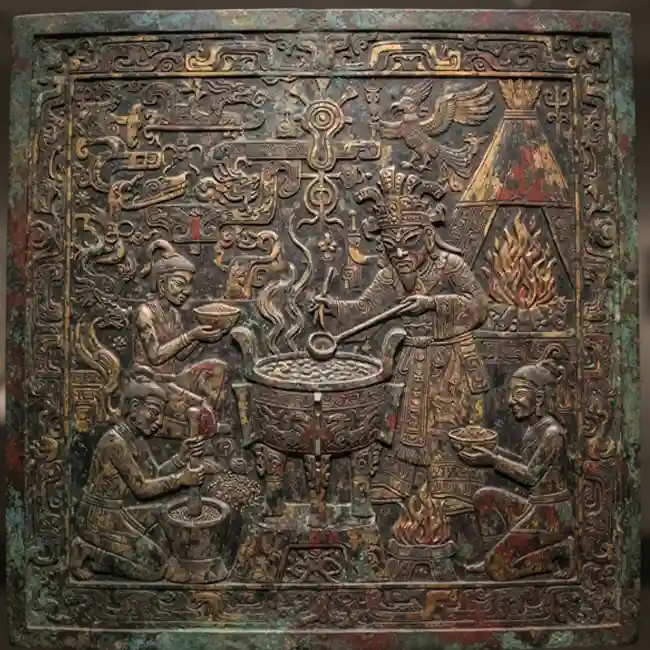
🍵 Recipe: Sanxingdui-Inspired Ritual Grain Tea Elixir
🗿 Legends Behind This Excavated Secret
The phrase “excavated secret” sounds dramatic, but the real archaeological story is already dramatic enough.
Sanxingdui became famous because archaeologists discovered large ritual pits containing extraordinary objects, including bronze sculptures, masks, jade pieces, ivory, pottery, and other materials.
These discoveries opened a window into a sophisticated ancient society whose beliefs and artistic traditions remain the subject of continuing research.
Yet archaeology does not give us a complete recipe book from those ritual pits.
That is where culinary reconstruction becomes interesting.
Rather than claiming that ancient Sanxingdui people prepared this exact drink, we can ask:
What kind of warm, grain-based aromatic infusion could make sense within an ancient Southwest Chinese food environment?
Roasted grains are a particularly useful starting point.
Grains have deep roots in Chinese agricultural history, while roasted and infused ingredients offer a practical way to create flavor without complicated equipment.
Dried fruits provide natural sweetness.
Fragrant herbs contribute aroma.
A small amount of ginger adds warmth.
Together, these ingredients create something that feels surprisingly timeless.
The recipe below is therefore best understood as a modern interpretation inspired by ancient culinary landscapes, not a literal archaeological formula.
🌾 Ingredients & The Noble Pantry
🏺 The Ancestral Staples
The pantry begins with ingredients chosen for their ancient-feeling character and their practicality in a modern kitchen.
Roasted millet — 2 tablespoons
Millet is an especially useful grain for an ancient-inspired recipe. It has a long history of cultivation across northern and central parts of ancient China and other regions of East Asia.
Roasting it gives the infusion a gentle nutty aroma.
Roasted rice — 1 tablespoon
Rice connects naturally with the agricultural environment of ancient Southwest China, where rice cultivation became important over the course of early Chinese history.
A small quantity adds body without overpowering the millet.
Dried jujube — 2 pieces
Jujube contributes a naturally sweet, fruity character.
Slice the fruit before brewing so its flavor can move easily into the water.
Fresh ginger — 3 thin slices
Ginger provides warmth and brightness.
Use only a little. The goal is a fragrant background note rather than a fiery ginger drink.
Dried chrysanthemum flowers — 1 teaspoon
These provide floral aroma and a beautiful golden infusion.
For strict historical accuracy, remember that the inclusion of chrysanthemum here is a culinary interpretation rather than evidence of a documented Sanxingdui tea formula.
Dried citrus peel — 1 small strip
Citrus peel adds a subtle aromatic bitterness and balances the sweetness of the jujube.
Use a small piece because too much can dominate the entire infusion.
Water — 500 milliliters
Filtered water is ideal for a clean modern preparation.
🔄 Modern Substitutes
Ancient-inspired cooking should not become a treasure hunt that requires specialty ingredients from five different countries.
If something is difficult to find, make a sensible substitution.
◦ Millet: Substitute lightly roasted sorghum or another mild whole grain.
◦ Rice: Use brown rice for a deeper toasted flavor or white rice for a lighter profile.
◦ Jujube: Use dried dates or unsweetened dried apple when jujube is unavailable.
◦ Fresh ginger: A small amount of dried ginger can work, although fresh gives a cleaner aroma.
◦ Chrysanthemum: Chamomile can provide a similarly gentle floral character, though it changes the historical and botanical profile.
◦ Dried citrus peel: Use a thin strip of dried orange peel.
◦ Whole-grain roasting: If you purchase already roasted grains, skip the dry-roasting stage.
The principle is simple: preserve the flavor structure rather than obsessing over impossible historical precision.
⚖️ Ancient Proportions
For one generous serving:
◦ 4 parts water
◦ 2 parts roasted millet
◦ 1 part roasted rice
◦ 2 pieces dried jujube
◦ 3 thin slices ginger
◦ 1 part dried chrysanthemum
◦ ½ part dried citrus peel
For a larger pot, simply multiply the ingredients while keeping approximately the same relationship.
The grain should remain the foundation.
The fruit provides sweetness.
The flowers and citrus create aroma.
The ginger supplies warmth.
That balance is what makes the drink feel layered rather than simply like sweetened hot water.
🔥 The Chef’s Ancient Ritual
Now comes the fun part.
You do not need a bronze ritual vessel.
A small saucepan or heatproof teapot works perfectly well.
🌾 Step 1: Awaken the Grains
Place the millet and rice in a dry skillet over low heat.
Stir continuously.
You are looking for a gentle toasted aroma rather than a dark roast.
Once the grains smell nutty and fragrant, remove them from the heat.
Do not rush this stage.
A low temperature gives you much more control.
🍑 Step 2: Prepare the Fruit
Slice the dried jujube into smaller pieces.
Remove any hard pits if necessary.
The smaller pieces expose more surface area and allow their natural sweetness to move into the infusion.
🌿 Step 3: Build the Aromatic Base
Place the roasted grains, jujube, ginger, chrysanthemum, and dried citrus peel into a saucepan.
Add 500 milliliters of water.
Bring the mixture slowly toward a gentle simmer.
Avoid aggressive boiling.
Ancient-inspired food is all about patience, and this recipe rewards exactly that.
🔥 Step 4: Let the Hearth Speak
Reduce the heat.
Allow the mixture to simmer gently for approximately 8–10 minutes.
The water should gradually become golden and fragrant.
You should notice the roasted grain first, followed by fruit, citrus, floral notes, and finally ginger.
If the aroma becomes too sharp, lower the heat.
🏺 Step 5: Rest Before Serving
Turn off the heat and let the infusion rest for another 3–5 minutes.
Strain into cups.
Taste it before adding anything else.
If the jujube is naturally sweet enough, there may be no need for additional sweetener.
That keeps the character of the roasted grains at the center.
🌄 Step 6: Serve the Ancient-Inspired Way
Serve warm in simple ceramic cups.
For a more atmospheric presentation, place the pot on a wooden tray with a small bowl of dried fruit beside it.
The visual idea is intentionally understated.
Ancient food does not need excessive decoration.
Let the ingredients tell the story.
🔥 Secrets of the Ancestral Hearth
The best results come from respecting a few simple principles.
◦ Do not burn the grains. Dark brown grains can quickly become bitter.
◦ Keep the heat gentle. A slow infusion creates a smoother flavor.
◦ Do not overload the flowers. Too many floral ingredients can make the drink taste medicinal.
◦ Use citrus peel carefully. A small amount creates complexity; too much creates harsh bitterness.
◦ Slice dried fruit. Whole fruit releases flavor more slowly.
◦ Taste before sweetening. Jujube already contributes natural sweetness.
◦ Let the drink rest. A few minutes of resting time allows the flavors to settle.
◦ Use fresh water. Water quality can noticeably affect delicate infusions.
◦ Roast grains separately if necessary. Different grains brown at different speeds.
◦ Avoid claiming historical certainty. This is one of the most important rules of archaeological-inspired cooking.
◦ Think in flavor layers. Toasted, fruity, floral, citrusy, and warm notes should complement one another.
◦ Keep the recipe adaptable. Ancient kitchens worked with what was available; your modern kitchen can do the same.
One common mistake is trying to make the drink “stronger” by simply doubling every ingredient.
That can actually destroy the balance.
Instead, increase the steeping time slightly or adjust one ingredient at a time.
Another mistake is treating the recipe like modern sweet tea.
This infusion is supposed to be subtle.
The roasted grains should remain noticeable.
🏯 Ancient Civilization Origins FAQ
Q1.Is this an authentic ancient Sanxingdui recipe?
No. There is currently no surviving Sanxingdui recipe book establishing this exact drink as an ancient formula. This is a modern culinary reconstruction inspired by the ancient Sanxingdui cultural landscape and broader Chinese food traditions.
Q2.Did Sanxingdui people use grains?
Archaeological research into ancient Southwest China provides evidence for agricultural societies using various crops, while the broader ancient Chinese food tradition has a long history of millet and rice cultivation. However, the exact ingredients and preparation method of this particular recipe should not be attributed directly to Sanxingdui without specific evidence.
Q3.Was tea definitely prepared at Sanxingdui?
The archaeological evidence does not establish this specific beverage as a Sanxingdui tea tradition. The recipe uses the familiar modern concept of an herbal or grain infusion to recreate an ancient atmosphere rather than claiming a documented Sanxingdui tea ceremony.
Q4.Why call it a “ritual elixir”?
“Elixir” is used here as a poetic culinary term reflecting the mysterious ceremonial imagery associated with Sanxingdui. It does not mean that the drink was an ancient medicinal or supernatural substance.
🔎 The Taste of Archeology
The first sip is gentle.
You notice toasted grain before anything else.
It has a warm, almost nutty character.
Then the jujube appears with a soft dried-fruit sweetness.
The ginger arrives quietly rather than aggressively.
Behind everything sits a floral note, followed by a small flash of citrus.
That combination is what makes the recipe interesting.
It does not taste like an ordinary cup of modern tea.
It tastes more like a grain infusion crossed with a botanical tisane.
And that is exactly what makes it useful for an archaeological food story.
The experience is not about pretending that one sip can transport us perfectly into the Bronze Age.
It cannot.
Instead, the flavor encourages us to think about something more realistic:
How did ancient people turn ordinary agricultural ingredients into meaningful food?
How much flavor could be created with fire, water, grains, dried fruit, and patience?
And how much of ancient cuisine may have disappeared simply because nobody wrote the recipe down?
🏠 Final Thoughts: Bringing Antiquity to Your Modern Table
There is something wonderfully satisfying about recreating an ancient-inspired recipe at home.
You roast a few grains.
You slice some dried fruit.
You add fragrant botanicals.
Then you wait.
Nothing about the process requires expensive equipment.
That simplicity is part of the charm.
Sanxingdui reminds us that ancient civilizations were not merely collections of spectacular artifacts.
They were communities filled with farmers, craftspeople, cooks, families, ritual specialists, and ordinary people making meals from the resources around them.
The archaeological record gives us fragments.
Modern culinary reconstruction connects those fragments with imagination—while keeping the boundary between evidence and interpretation clear.
So prepare this Sanxingdui-inspired grain tea slowly.
Use a beautiful ceramic cup.
Sit somewhere quiet.
Take a sip.
And imagine the ancient landscape of Southwest China—not as a fantasy recreated perfectly, but as a distant world whose surviving clues still invite us to ask questions.
That is where food history becomes truly delicious.
✨ The Golden Hook: The Sacred Union
Ancient food heritage belongs to everyone.
Every recovered vessel, every grain, every agricultural clue, and every surviving culinary tradition adds another piece to humanity's enormous food story.
The goal is not to lock ancient recipes behind a museum door.
It is to keep curiosity alive.
When we recreate historical foods responsibly, we create a connection between archaeology and everyday life.
We remember that civilization was built not only through monuments and palaces, but also around cooking fires.
So make this recipe.
Share the story.
Talk about where the ingredients came from.
And, most importantly, remember that some mysteries should remain mysteries until better evidence appears.
The most meaningful culinary revival is not about pretending we know everything.
It is about caring enough to keep searching.
🏺 Credit to the Keepers of the Culture: The Legacy
This recipe is inspired by the archaeological heritage of Sanxingdui and the ancient Shu cultural tradition of Southwest China. The recipe is a modern culinary interpretation rather than a direct transcription of an excavated ancient formula.
The measurements have been adapted for contemporary home kitchens while drawing inspiration from ancient agricultural ingredients, traditional Chinese foodways, and the ceremonial atmosphere associated with Sanxingdui.
A note on historical authenticity: archaeological evidence can reveal ingredients, vessels, agricultural practices, and cultural connections, but it does not automatically preserve complete cooking instructions. Where evidence is incomplete, this article clearly treats the recipe as a creative reconstruction rather than presenting speculation as historical fact.
The legacy of ancient cuisine survives not only in artifacts, but also in our willingness to learn, question, preserve, and respectfully reinterpret the food stories of civilizations that came before us.
| 🏯 🏛️🧪 < Back |