
🏠 Home > 🗺️ Recipes > 🧊🍵 Glacial Herbal Elixirs (Primitive Drinks) > ☀️ Southern African Coastal Caves: Glacial Herbal Elixirs (Primitive Drinks) Recipes > 🧊🍵 1.Klasies Coastal Wild Aloe Nectar
🧊🍵 Wild Aloe Nectar: Reimagining an Ancient Coastal Food Tradition
Published by Supakorn | Updated: November 2026
Imagine standing near a rugged coastline more than 110,000 years ago. The ocean rolls against weathered sandstone cliffs, the wind carries the scent of salt across the land, and a small fire flickers inside a sheltered cave. Beyond the entrance, early humans search the surrounding landscape for edible plants, shellfish, roots, seeds, and other foods that can help sustain their families.
In this world, every meal begins with observation. Which plants are safe? Which parts are edible? When is a plant ready to harvest? How can its natural flavors be enjoyed with little more than fire, stone, and patience?
Our journey into 110,000 BP Wild Aloe Nectar explores these questions through a modern, prehistoric-inspired culinary experience. Drawing inspiration from the ancient coastal environment associated with Klasies Cave in southern Africa, this recipe celebrates the possibilities of wild plant foods and the resourcefulness of early human communities.
There is an important distinction to keep in mind: archaeologists have uncovered evidence of ancient human life and resource use at Klasies River, but there is no established evidence that people prepared a specific wild aloe nectar recipe there 110,000 years ago. The recipe below is a contemporary culinary interpretation, not a verified reconstruction of a prehistoric dish.
That distinction does not make the experience any less fascinating. It gives us an opportunity to explore ancient food traditions responsibly while bringing the spirit of prehistoric foraging into a modern kitchen.
🧬🌍 Prehistoric Ancestral Palate: Southern Africa 110,000 Years Ago
❄️ The Pleistocene Chronicles: Coastal Survival and Ancient Fire
Around 110,000 years ago, southern Africa was part of a changing Pleistocene world. Climate conditions shifted over time, coastlines changed with sea levels, and human communities adapted to landscapes that could offer both abundance and hardship. Rather than imagining every prehistoric cave covered in snow, picture a windswept coastline, rocky shelters, shifting dunes, and patches of vegetation surviving beneath an enormous African sky.
At Klasies River, caves and rock shelters preserve an extraordinary archaeological record of early human activity. The surrounding environment offered access to marine resources, terrestrial animals, and plant foods. For people living in this world, survival depended on understanding seasonal changes, recognizing useful natural resources, and sharing knowledge across generations.
Inside a sheltered space, the scent of woodsmoke might mingle with salty air. A small fire could provide warmth, light, and a means of preparing certain foods. Outside, waves crashed against the coast while seabirds circled above the rocks. Every return from gathering or hunting brought uncertainty: some days offered plenty, while others demanded patience and careful use of stored resources.
This is the atmosphere behind our wild aloe nectar concept. It is a culinary journey into an ancient landscape, inspired by the relationship between early humans and their environment rather than a claim that a documented nectar recipe has survived for thousands of generations.
🧙 The Primeval Legacy of Human Survival
The earliest human food traditions were built on practical knowledge. People needed to identify nutritious resources, distinguish edible plants from dangerous ones, and make the best use of what their surroundings provided.
Food was much more than fuel. Sharing a meal could strengthen social bonds, support children, and help communities care for injured or vulnerable members. Knowledge about where to find resources and when to collect them was valuable, especially when food availability changed with the seasons.
The ancestral palate was also shaped by necessity. Naturally sweet plant foods could provide an appealing contrast to savory animal foods, while roots, fruits, seeds, and leafy plants added variety to a diet that depended on local conditions. However, the exact foods consumed by any particular community varied according to habitat, season, and availability.
Wild aloe offers an interesting modern connection to this story. Aloe plants grow in parts of Africa and are associated with dry environments, but not every species or plant part is suitable for eating. Their distinctive appearance makes them compelling subjects for a prehistoric-inspired recipe, yet responsible preparation requires modern botanical knowledge.
The lesson is simple: ancient survival depended on understanding nature, not eating every wild plant that looked useful. Today, we can honor that resourcefulness by combining curiosity about prehistoric foodways with careful ingredient selection.
🔄 The Paleolithic Resurrection
Imagine bringing an ancient culinary idea into your kitchen without pretending that every detail is historically proven. That is the spirit of the Paleolithic resurrection.
Early humans used fire in different ways across different periods and locations. Heated surfaces, glowing embers, and hot stones offer useful models for understanding how simple cooking techniques can transform food. Nevertheless, the evidence does not establish that a particular aloe nectar preparation was made at Klasies Cave during this period.
Our modern version takes inspiration from the broader principles of early food preparation: minimal ingredients, natural flavors, gentle heating where appropriate, and a close connection between the food and its environment.
Instead of trying to reproduce an imagined prehistoric ritual exactly, we will create a contemporary wild aloe nectar-inspired preparation using a verified food-grade ingredient. The result is intended to evoke the rugged coastal world of the Pleistocene while remaining practical and transparent about what is modern interpretation.
🍃 Recipe: Klasies Coastal Wild Aloe Nectar
🐚 Echoes from the Glacial Ice
Ancient caves can feel like natural archives. Their sediments, stone tools, animal remains, and other archaeological evidence help researchers investigate how people lived, obtained food, and interacted with their surroundings.
The Klasies River cave sites are particularly important for understanding early human behavior in southern Africa. Their archaeological record provides evidence of past human activity and the use of coastal resources. Such discoveries help us explore the broader story of prehistoric diets without assuming that every modern ingredient or recipe can be traced directly to the site.
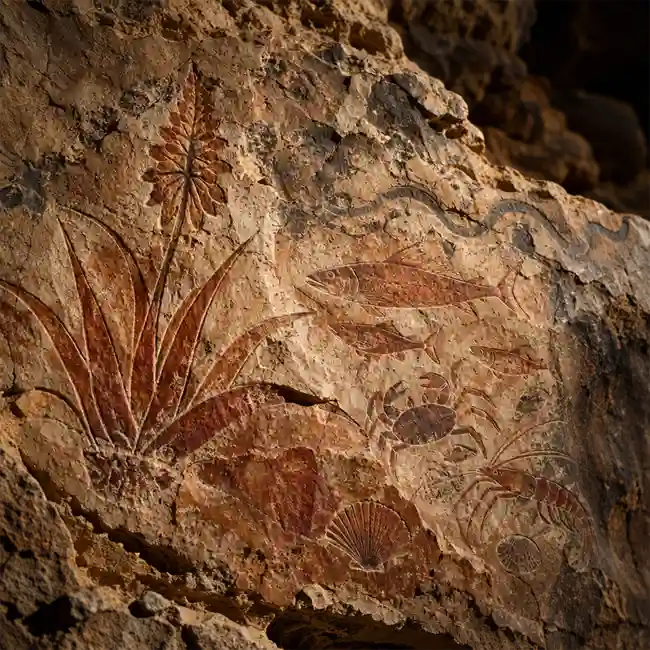
Rock art and engraved objects from different prehistoric contexts also remind us that human relationships with food, animals, landscapes, and symbols were complex. However, images of food-related rituals should not be attributed to a particular cave or community unless the evidence supports that interpretation.
Our recipe borrows the atmosphere of this ancient coastal setting. Think weathered stone, filtered daylight, natural textures, and a simple preparation that celebrates one carefully selected plant ingredient. There is no need to invent a lost ritual when the real archaeological story is fascinating enough.
🌿 Wild Foraged Essentials & The Hunter’s Pantry
🌱 The Primitive Staples
A prehistoric coastal pantry would have depended on the resources available in its particular landscape. For a modern interpretation inspired by southern Africa, consider these broad categories of ancestral foods:
✦ Wild plant foods: Edible leaves, fruits, seeds, and roots can provide variety and nutrients. Their availability depends on local ecology and season.
✦ Animal foods: Meat and other animal-derived foods supplied protein and fat to many hunter-gatherer communities, although diets varied widely.
✦ Coastal resources: Shellfish, fish, and other marine foods could be important in coastal environments where they were accessible.
✦ Naturally occurring plant gels and juices: Some plants contain moist tissues that inspire modern culinary experiments, but suitability for consumption must be established for each species and plant part.
✦ Fresh water: Safe drinking water is essential for any food preparation, whether in a modern kitchen or a hypothetical prehistoric setting.
For our featured recipe, aloe is the central inspiration rather than a verified ingredient from the Klasies archaeological record.
🥣 Modern Kitchen Substitutes
The following ingredients create a simple, contemporary interpretation of the idea of wild aloe nectar. They are not presented as historically documented ingredients from 110,000 years ago.
◦ Food-grade inner aloe gel: Use 30 grams of commercially prepared, food-grade aloe gel specifically labeled for consumption. Avoid products containing aloe latex or added medicinal ingredients.
◦ Safe drinking water: Use 180 milliliters of potable water to create a light, spoonable or pourable consistency.
◦ Fresh lemon juice: Add 5 milliliters for a bright, fresh flavor. This is a modern culinary addition, not a claimed prehistoric ingredient.
◦ Honey: If desired, add 5 grams for gentle sweetness. Honey is included as an optional modern ingredient, not as evidence of a particular Klasies recipe.
Important safety note: Never collect an unidentified wild aloe plant and assume it is edible. Aloe species differ, and the yellow latex found near the outer leaf can contain compounds with strong laxative effects and potential health risks. Use only a verified food-grade product intended for consumption. If the product's species, processing, or safety instructions are unclear, leave it out.
📏 Paleolithic Proportions
For one small serving, use these practical ratios:
◦ 30 grams food-grade inner aloe gel.
◦ 180 milliliters potable water.
◦ 5 milliliters fresh lemon juice.
◦ 5 grams honey, optional.
The basic ratio is one part aloe gel to six parts water by weight-to-volume approximation. Adjust the water slightly if your particular gel is thicker or thinner.
For two servings, use 60 grams aloe gel, 360 milliliters water, 10 milliliters lemon juice, and up to 10 grams honey.
For four servings, use 120 grams aloe gel, 720 milliliters water, 20 milliliters lemon juice, and up to 20 grams honey.
These ratios are designed for a light, refreshing modern preparation. They are not reconstructed prehistoric measurements, and the recipe should not be treated as a medicinal remedy.
🔥 The Primitive Culinary Ritual
The preparation is intentionally simple. You do not need special equipment, a fireplace, or an elaborate cooking setup.
1. Prepare your workspace. Wash your hands and use clean utensils. Check the product label to confirm that the aloe gel is food-grade and suitable for consumption.
2. Measure the ingredients. Place the aloe gel in a clean bowl or blender. Remove any product that looks discolored, contaminated, or inconsistent with the manufacturer's description.
3. Add the water gradually. Pour in the potable water while stirring. The mixture should become light and fluid rather than thick and sticky.
4. Introduce the fresh flavor. Add the lemon juice and stir again. If you prefer a slightly sweeter result, add the optional honey and mix until evenly dispersed.
5. Blend gently if needed. A short blend can produce a more uniform texture. Avoid excessive blending if you want to retain some of the gel's natural body.
6. Taste and adjust. Add a little more water if the flavor is too concentrated. Keep the ingredient ratios modest, and do not use additional aloe to compensate for an unpleasant taste.
7. Serve fresh. Transfer the preparation to a clean cup or small bowl and consume it according to the product's storage and serving instructions.
If you want to evoke the atmosphere of an ancestral hearth, serve the preparation beside a warm meal in a simple ceramic or stone-textured bowl. Keep the aloe preparation itself cool unless the product instructions explicitly allow heating.
Do not place a sealed container over a fire, heat aloe in an improvised stone vessel, or use stones of unknown composition for cooking. Heated rocks can crack or explode if they contain moisture, and some materials may release unwanted substances when heated.
🌋 Secrets of the Ancestral Fire
The fire was one of humanity's most important technologies, providing warmth, light, protection, and opportunities to prepare food. Recreating its atmosphere today is easy, but safe cooking requires a few modern precautions.
Here are some practical techniques to keep your prehistoric-inspired culinary adventure enjoyable.
• Control the heat: Use a modern stovetop or a suitable outdoor cooking appliance when heating ingredients. A steady, moderate temperature is easier to control than an open flame.
• Keep the aloe preparation gentle: This recipe does not require cooking. Heating is unnecessary, and you should follow the food-grade product's instructions rather than assuming heat makes an unsuitable aloe product safe.
• Choose safe cooking vessels: Stainless steel, food-safe ceramic, and other cookware intended for cooking are better choices than unidentified stones or improvised containers.
• Respect natural ingredients: Strong bitterness, unusual discoloration, or an unfamiliar plant odor should never be ignored. Do not taste-test unidentified wild plants to determine whether they are edible.
• Preserve freshness: Prepare only what you intend to consume. Refrigerate leftovers promptly in a clean, covered container and follow the manufacturer's storage guidance.
• Keep raw foods separate: If serving this preparation alongside meat or seafood, use separate utensils and surfaces to prevent cross-contamination.
• Avoid unnecessary additions: A short ingredient list makes it easier to appreciate the aloe's texture and the fresh, lightly tart flavor of the finished preparation.
The real secret of ancestral cooking is not a mysterious flame technique. It is the combination of patience, observation, resourcefulness, and respect for the ingredients.
🧊 Paleolithic Wisdom & Secrets FAQ
Q1. Was wild aloe nectar really consumed at Klasies Cave 110,000 years ago?
There is currently no established archaeological evidence confirming this exact recipe. Klasies River is an important site for studying early human life in southern Africa, but this aloe nectar is a modern, prehistoric-inspired interpretation rather than a proven ancient dish.
Q2. What nutrients does aloe nectar provide?
The nutritional value depends on the particular aloe product and its processing. Food-grade inner aloe gel may contain substantial water, but its calories, carbohydrates, and other nutrients vary. Check the product's nutrition label rather than assuming that aloe is a significant source of vitamins or minerals.
Q3. Can I forage aloe directly from the wild?
Not safely without reliable botanical identification and specific knowledge of the plant's edible parts. Different aloe species have different properties, and aloe latex can cause serious digestive effects. For this recipe, choose a commercially prepared, food-grade product with clear labeling.
Q4. What does wild aloe nectar taste like?
Food-grade aloe gel is often mild, with a distinctive slippery or gelatinous texture. Depending on the product, it may have subtle vegetal notes. Lemon adds brightness, while a small amount of honey can soften the flavor. The finished result is closer to a light, fresh plant-based preparation than a thick fruit nectar.
🍃 The Taste of Primeval History
The appeal of prehistoric-inspired food lies in its simplicity. A few carefully chosen ingredients can create an experience that feels connected to the natural world without requiring complicated equipment or elaborate techniques.
In this recipe, the mild character of food-grade aloe provides the foundation, water creates a light consistency, and lemon contributes a fresh, tart note. Optional honey adds a gentle sweetness. Together, these ingredients offer a contemporary interpretation of the idea of finding nourishment in the landscape.
There is no need to claim that this preparation reproduces an ancient flavor exactly. We cannot know what a specific aloe-based dish from 110,000 years ago would have tasted like, or whether such a dish was prepared at Klasies Cave at all.
What we can appreciate is the broader human story: generations of people observing plants, learning from experience, sharing food knowledge, and adapting to changing environments.
This recipe celebrates that spirit of discovery. It brings the imagination of the ancient coastal world into the present while leaving room for archaeological evidence to speak for itself.
🏡 Final Thoughts: Taming the Ice Age in Your Modern Kitchen
You do not need to live beside a prehistoric cave to explore the food traditions of early humanity. Your own kitchen can become a place for experimentation, learning, and appreciation of the natural ingredients that have shaped human diets over thousands of generations.
Start with a simple recipe. Choose ingredients carefully, learn where they come from, and pay attention to their texture, aroma, and flavor. Explore the history of hunter-gatherer communities, the archaeology of coastal settlements, and the many ways people adapted to the environments around them.
The story of Klasies River reminds us that early humans were resourceful and responsive to their surroundings. Their lives were shaped by practical knowledge, social relationships, and the changing availability of natural resources.
Our wild aloe nectar is not a time capsule containing a forgotten recipe. It is an invitation to explore those themes through modern cooking.
Keep the ingredients simple, use safe food-grade products, and let curiosity guide your next culinary experiment. The best way to honor the ingenuity of our ancestors is to approach their story with both imagination and respect for the evidence.
🛡️ The Sacred Tribe: Claim Your Ancestral Heritage
Are you fascinated by ancient food traditions, primitive cooking methods, wild plant ingredients, and the everyday lives of early humans?
Welcome to a community of curious food explorers who appreciate the relationship between nature, history, and the human appetite.
Here, every ingredient has a story to investigate. Every ancient landscape offers new questions. Every modern recipe inspired by the past provides an opportunity to learn something new.
Explore prehistoric recipes, discover the principles of hunter-gatherer food traditions, and experiment with simple ingredients in your own kitchen. Share your discoveries, question popular assumptions, and celebrate the ingenuity that helped human communities adapt to challenging environments.
The ancestral journey continues with every thoughtful meal. Bring your curiosity, respect the natural world, and become part of the story.
🏺 Credit to the Keepers of the Paleolithic Legacy
This culinary interpretation honors the archaeological record of early human life in southern Africa, including the important discoveries associated with Klasies River. Its atmosphere draws inspiration from Pleistocene coastal landscapes, ancient subsistence practices, and the enduring human relationship with naturally occurring food resources.
The wild aloe nectar recipe is a modern adaptation created for contemporary kitchens. It is not a verified reconstruction of a meal prepared 110,000 years ago, and no specific prehistoric aloe recipe is implied by the archaeological evidence discussed here.
By combining historical curiosity with responsible ingredient selection and modern food-safety practices, we can explore the world of our distant ancestors without confusing imaginative storytelling with established fact.
To the people who studied the land, learned from its seasons, and passed practical knowledge to future generations, this recipe is a tribute to humanity's enduring spirit of discovery.
| ☀️ 🧊🍵 < Back |