
🏠 Home > 🗺️ Recipes > 👑🍞 Artisan Royal Breads (Breads) > 🇺🇸 USA Artisan Royal Breads (Breads) Recipes > 👑🍞 1.The Virginia Aristocrat's Golden Sally Lunn Bread
👑🍞 America's Lost Manor Breads: Baking the 200-Year-Old Secrets of the Early Elite
Published by Supakorn | Updated: August 2026
🤴👸🏟️ The Forgotten Aristocratic Legacy of America: The Federal Era to The Gilded Age
📜 The Storyteller’s Intro
Close your eyes and step back to the year 1824. It is dawn in a grand Federal-style manor in Virginia. Outside, the mist still clings to the Blue Ridge Mountains. Inside, the great kitchen, a separate brick building away from the main house to keep the heat out, is already alive. The fireplace is roaring. A woman known only as Mrs. Randolph's successor, the head cook, a position of immense power and respect, is overseeing a sacred ritual. She is not making everyday cornbread. She is preparing the bread that will sit beside the master of the house. This was a bread of status, of butter, of fine-milled flour, of hours of labor. This was aristocracy you could taste.
Long before America had celebrity chefs, it had manor cooks. And their recipes were the ultimate status symbol.
👑 The Global Value
Here is the thing we often forget: America did have an aristocracy. We just called them by different names — the Boston Brahmins, the Virginia First Families, the Charleston Planters, the New York Knickerbockers. And like any aristocracy in the world, they guarded their culture fiercely, especially their food.
In Europe, a royal recipe was protected by a palace wall. In America, it was protected by cost and complexity. To make a true Sally Lunn or a proper Beaten Biscuit, you needed three things an ordinary family did not have: imported ingredients, enslaved or highly trained kitchen labor, and time. An insane amount of time.
A common farmer's bread took 30 minutes to mix. An aristocratic bread took two days, three risings, and the strength of two arms beating dough for an hour until it blistered. Because of that, these recipes were never written down in common cookbooks. They lived in private, leather-bound manor journals, passed from mother to daughter, or from a head cook to her apprentice. When the Civil War ended and the manor system collapsed, when industrial flour and store-bought yeast arrived, most of these journals were lost, burned, or simply thrown away. We came within a generation of losing them forever.
✨The Collection
That is why we are here today. This article is not just a recipe. It is a culinary excavation.
I spent months digging through archived letters at the Library of Congress, faded handwritten receipt books from Charleston, and the first American cookbooks like Eliza Leslie’s Directions for Cookery from 1828 to bring one of the most legendary examples back to life.
We are reviving the undisputed queen of the American aristocratic table. The one bread that was served at Monticello, at Mount Vernon, and later at the Vanderbilt mansions in New York. The bread that defined luxury.
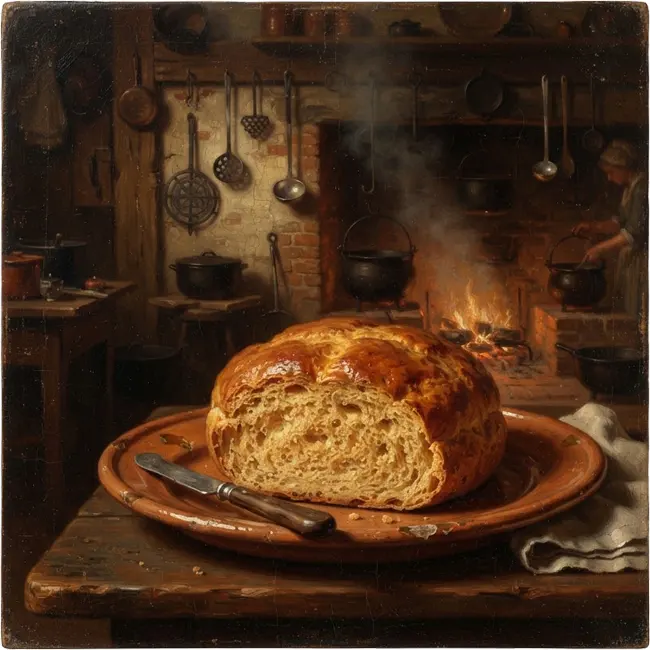
🍞 Recipe: The Virginia Aristocrat's Golden Sally Lunn Bread
This is not the dense, quick bread you might see in a modern cafe. The original 18th and 19th-century Sally Lunn was something else entirely. Think of it as a hybrid between the richest brioche you have ever tasted and the softest, most pillowy sandwich loaf. It is slightly sweet, incredibly buttery, with a fine, feathery crumb and a shining golden top that was always brushed with butter the second it left the wood-fired oven. It was never sliced. It was broken apart with two forks at the table to preserve its delicate texture. That was the rule.
📖 About this Royal Secret
The legend of Sally Lunn itself is deliciously mysterious. Some say she was a real woman, a baker in Bath, England in the 1680s, whose name was Soli L Lune — Sunny Moon in French — because of her golden bread. English Loyalists brought the recipe to America, where it became the obsession of the Virginia elite.
Thomas Jefferson’s enslaved head cook, James Hemings, who was trained in French cooking in Paris, is said to have perfected his own version for Monticello. Dolley Madison served a version of it at the White House that was so famous, guests would write home about it. By the 1850s, no true aristocratic breakfast in Charleston or Richmond was complete without a steaming Sally Lunn, served with fresh churned butter and sourwood honey.
It was not an everyday bread. It was a Sunday bread. A guest-is-coming bread. A show-off-your-wealth bread. Serving it said, without saying a word, that your household had fresh milk, fresh butter, fine sugar, and a cook skilled enough not to ruin it. Today, we are bringing that statement back to your kitchen.
🧈 Ingredients & The Aristocratic Touch
• The Royal Pantry: In 1824, this recipe was a flex. The flour was not the coarse whole wheat of the common people. It was extra-bolted, meaning sifted multiple times through silk to be as white as snow. The butter was not salted for preservation. It was sweet, fresh-churned that morning. The sugar was not brown molasses. It was double-refined loaf sugar, grated by hand from a sugar cone. It was luxury in its purest form. We are honoring that spirit, but making it accessible.
• Modern Substitutes: You do not need a brick oven or a sugar loaf. For the extra-bolted flour, we will use high-quality bread flour plus all-purpose flour for that perfect balance of chew and tenderness. Instead of fresh-churned butter, a high-fat European-style unsalted butter will give you that same rich aroma. For the yeast, the original used a potato yeast starter called emptins. We will use active dry yeast for reliability, but I will show you how to give it that old-world flavor.
• The Measurements: This makes one large 9-inch round loaf or Bundt-style loaf, serving 8 to 10 aristocrats.
◦ Warm whole milk, 105 to 110 degrees Fahrenheit, 1 cup or 240 ml
◦ Active dry yeast, 2 and one quarter teaspoons or 7 grams, one packet
◦ Granulated sugar, 1/4 cup or 50 grams, plus a pinch for the yeast
◦ Bread flour, 2 cups or 250 grams
◦ All-purpose flour, 1 and 3/4 cups or 220 grams, plus extra for dusting
◦ Fine sea salt, 1 and 1/4 teaspoons or 7 grams
◦ Large eggs, at room temperature, 3 whole eggs
◦ Unsalted butter, European-style if possible, softened and cubed, 6 tablespoons or 85 grams
◦ Heavy cream, at room temperature, 1/4 cup or 60 ml
◦ For the golden finish: Unsalted butter, melted, 2 tablespoons or 28 grams, plus honey for brushing, 1 tablespoon or 15 ml
👨🍳 The Chef’s Ritual
This is a ritual, not a rush. Put on some soft music. Take your time. The manor cooks did.
• Step 1: Waking the Yeast
In a small bowl, combine your warm whole milk with a pinch of sugar and sprinkle the yeast over the top. Give it a gentle stir and let it sit for 8 to 10 minutes. You are looking for it to become foamy and alive, like a creamy beer head. If nothing happens, your yeast is tired and you must start again. This is how they tested their emptins.
• Step 2: The First Mix
In the bowl of a stand mixer with the paddle attachment, whisk together your bread flour, all-purpose flour, remaining 1/4 cup sugar, and sea salt. In a separate bowl, lightly beat your 3 room-temperature eggs with the heavy cream. Add the foamy yeast mixture and the egg mixture to the dry ingredients. Mix on low speed for 2 minutes until a very shaggy, sticky dough forms. It will look like a mess. That is perfect.
• Step 3: The Aristocratic Touch - Adding the Butter
This is where the magic happens. With the mixer on medium-low speed, add your 6 tablespoons of softened, cubed butter, one cube at a time, waiting until each piece is almost incorporated before adding the next. This slow incorporation is the French technique James Hemings learned in Paris. Once all the butter is in, switch to the dough hook and knead on medium speed for 8 to 10 minutes. The dough will transform from sticky and rough to silky, smooth, and it will pull away from the sides of the bowl. It should be soft and slightly tacky to the touch.
• Step 4: The First Rest
Lightly oil a large bowl, place your dough inside, and turn it once to coat. Cover it with a clean kitchen towel or plastic wrap. Let it rise in a warm, draft-free spot for 1 hour and 30 minutes to 2 hours, until it has doubled in size. In the old kitchens, they would place it near, but not too near, the hearth.
• Step 5: Shaping the History
Gently punch down the risen dough to release the air. Lightly flour your hands. If you are using a 9-inch springform pan or a classic Turk's head Bundt pan, generously butter it. Place the dough inside and gently press it to fit evenly. Do not tear it. Cover it again and let it rise for a second time for 45 minutes to 1 hour, until it puffs up just above the rim of the pan.
• Step 6: The Golden Bake
Preheat your oven to 350 degrees Fahrenheit or 175 degrees Celsius. Bake the loaf on the middle rack for 35 to 42 minutes. You will know it is done when the top is a deep, aristocratic golden brown and an instant-read thermometer inserted into the center reads 190 degrees Fahrenheit. If the top browns too quickly, loosely tent it with aluminum foil.
• Step 7: The Final Gloss
This is non-negotiable. As soon as the bread comes out of the oven, while it is screaming hot, brush it generously with the mixture of melted butter and honey. This gives it that iconic shine and a whisper of sweetness. Let it cool in the pan for 10 minutes, then turn it out onto a wire rack. You must wait at least 30 minutes before breaking it apart. I know, it is torture.
🤫 Secrets of the Palace Kitchen
• The Room Temperature Rule is Law: If your eggs, butter, or cream are cold, they will shock the yeast and your bread will be dense. Manor cooks left everything near the fire for an hour. Take your ingredients out of the fridge at least one hour before you begin.
• Do Not Add Extra Flour: This dough is supposed to be sticky and soft. The temptation to add more flour to make it easier to handle is the biggest mistake modern bakers make. That stickiness is what creates the feathery crumb. Trust the process and lightly oil your hands instead of flouring them heavily.
• The Fork Split: Never, ever cut a true Sally Lunn with a knife. The manor etiquette was to use two forks, back to back, to gently pull the bread apart. A knife compresses that airy, delicate crumb you worked so hard to create. This is the secret to keeping it cloud-like.
• The Freshness Mistake: This bread has no preservatives. It is best eaten the day it is baked. If you have leftovers, do not refrigerate it. That will dry it out instantly. Slice it thick the next day and toast it in a little butter in a cast iron skillet. That was the aristocratic breakfast of the second day.
🏯❓ Royal FAQ
Q1: Is this bread very sweet like a cake?
A: Not at all. It is what we call rich, not sweet. The 1/4 cup of sugar is there to feed the yeast, tenderize the crumb, and add just a background note of sweetness that makes the butter and eggs shine. It is perfect with both savory ham and sweet preserves.
Q2: Can I make this without a stand mixer?
A: You can, and that is how they did it for 150 years. It will be a workout. You will need to knead it by hand on a lightly floured surface for 15 to 20 minutes after adding the butter. It is a labor of love, just like the original Beaten Biscuits that required 45 minutes of beating with a rolling pin.
Q3: Why is my Sally Lunn dense instead of fluffy?
A: Two likely culprits. First, your milk may have been too hot and killed the yeast. It should feel like warm bathwater, not hot. Second, you may have under-proofed it. The second rise is crucial. Do not rush it. Let it fully puff up.
🏺 The Taste of History
When you finally break off that first piece, you will understand. The aroma is pure nostalgia, even if you have never smelled it before. It smells of sweet cream, warm hearth, and time. The texture is so soft it almost melts, but with enough structure to hold a smear of butter. It is the taste of a time when bread was not just food. It was a message. It was art. It was power, served warm on a silver platter. This is the taste that presidents and plantation owners woke up for.
💭 Final Thoughts: Bringing History to Your Table
I know what you might be thinking. This is a lot of work for a loaf of bread. You are right. It is.
But that is the whole point. In our world of instant yeast and five-minute bread machine recipes, we have lost the connection between time, effort, and flavor. The aristocratic cooks of early America understood that some things cannot be rushed. The wait, the slow rise, the careful brushing of butter — that is not just baking. That is respect. Respect for the ingredients, respect for the craft, and respect for the people you are feeding.
You do not need a manor house to make this. You just need a warm kitchen and a little patience. And when you place this golden crown on your own table, you are not just serving bread. You are resurrecting a piece of American history that almost vanished. You are becoming a keeper of the secret yourself.
🔔 The Call to Action
If you fell in love with the flavor of this hidden history, you are now part of a very small circle. For two centuries, this recipe was kept behind closed doors. Now it is yours.
Do not let it disappear again. Bake it. Share it. Tell its story. Take a photo of your golden Sally Lunn and share the legend of the Virginia manor kitchens. Tag us and use #ForgottenManorBreads so we can find fellow history keepers.
And if you want me to unlock the next secret — the famous Parker House Rolls of the Boston Brahmins that required a secret fold, or the 100-year-old Charleston Beaten Biscuits that took an hour of beating — let me know in the comments. Which lost aristocratic bread should we revive next?
🙏 Credit to the Keepers of the Culture
This recipe and its history do not belong to me. They belong to the countless unnamed Black cooks, enslaved chefs, female receipt-book authors, and manor housekeepers of early America whose skill and ingenuity created American cuisine as we know it.
In particular, we honor the legacy of chefs like James Hemings, Edith Fossett and Frances Hern of Monticello, and the generations of women who preserved these receipt books in their family archives. Their hands built this culinary tradition. Their knowledge, often uncredited and unpaid, is the true foundation of American aristocratic cooking.
This article was created with deep respect and research from public domain sources including the Feeding America Project, the historical archives of the Library of Congress, and the community cookbook collections of the 19th century. We present this with gratitude, not ownership, to keep their incredible legacy alive for future generations.
| 🇺🇸 👑🍞 < Back |