
🏠 Home > 🗺️ Recipes > 👑🥗 Aristocratic Garden Greens (Salads) > 🇺🇸 USA Aristocratic Garden Greens (Salads) Recipes
🇺🇸 👑🥗 USA Aristocratic Garden Greens (Salads) Recipes
Published by Supakorn | Updated: August 2026
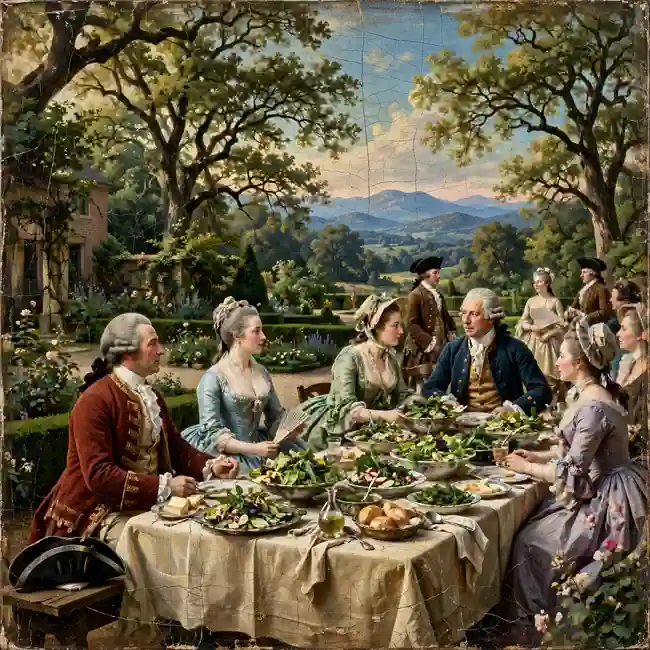
👑📜 The Storyteller’s Intro: The Secret Garden Behind America's Elite Table
There is a small historical problem with the phrase “USA Aristocratic Garden Greens” that is worth explaining before we open the imaginary old culinary manuscript.
The United States has never had a hereditary royal court comparable to the monarchies of Europe. So rather than pretending America had a thousand-year-old royal salad tradition, the more accurate approach is to use “aristocratic” as a storytelling term for elite, wealthy, prominent, and socially powerful households, while tracing the deeper food traditions of the land back much further.
And that makes the story even more fascinating.
If this were a culinary grimoire, its pages would not begin with an American king sitting beneath a golden canopy. They would begin with Indigenous communities cultivating, gathering, preserving, and sharing foods across North America for thousands of years.
The Smithsonian describes Native American foodways as an intimate relationship with food sources that developed over thousands of years, with planting, harvesting, feasting, and seasonal traditions deeply connected to community and the natural world.
So, for this series, imagine the “200–1,000 years” theme as a historical storytelling window into America's much older landscape and the later elite households that inherited, adapted, imported, or transformed garden traditions.
The story can be imagined through several major chapters:
• Ancient Indigenous foodways — long before the United States existed, Native communities cultivated, gathered, hunted, and managed diverse food landscapes.
• The Indigenous agricultural era — crops such as corn, beans, and squash became deeply important in many communities. The famous “Three Sisters” system demonstrates how food production could be ecological, communal, and practical at the same time.
• The colonial garden era — European settlers established kitchen gardens containing vegetables, herbs, medicinal plants, and imported species.
• The plantation and gentry era — wealthy households increasingly used carefully maintained gardens not simply for survival, but also for hospitality, appearance, status, and refined dining.
• The Federal and early American elite era — prominent households continued developing kitchen gardens and formal landscapes while American dining culture became increasingly sophisticated.
• The heritage-garden revival — modern historic sites now preserve old varieties, garden designs, cooking demonstrations, and agricultural traditions.
This is where our imaginary “secret garden greens” become interesting.
A salad was not necessarily the simple bowl of lettuce many modern diners picture.
Historically, the garden could provide a much wider vocabulary of leaves, herbs, flowers, shoots, roots, vegetables, fruits, and edible plants. Colonial kitchen gardens were intensely cultivated spaces containing plants used for food, medicine, and seasoning.
At the same time, gardens could communicate social position.
A beautifully maintained garden required land, labor, planning, seeds, tools, water, and time. In elite environments, the garden could become part kitchen, part landscape, part status symbol.
The National Park Service notes that colonial gardens supplied food and seasoning while also serving medicinal and aesthetic purposes. In eighteenth-century Virginia, gardening was considered important to health, wealth, and sustenance.
So the secret behind an “aristocratic garden green” is not necessarily one mysterious ingredient.
The real secret is access to the garden itself.
🗺️ The Royal Culinary Tourism: Mapping Flavors to Historic Landscapes
If you want to explore the history behind American garden greens, don't think of the United States as having one single culinary palace.
Think of it as an enormous edible map.
From the Atlantic coast to New England, the Chesapeake, the Appalachian interior, the Mississippi Valley, the Great Lakes, the Southwest, and the Pacific Northwest, different landscapes produced different food traditions.
That makes culinary tourism particularly interesting.
You can travel through historic America almost as though you were following the pages of an old garden journal.
🌿 New England: The Colonial Kitchen Garden
New England is one of the best places to imagine the early colonial garden.
At Roger Williams National Memorial, the National Park Service describes seventeenth-century New England kitchen gardens as raised, rectangular beds positioned close to homes. These gardens were intensively cultivated and contained plants used for food, seasoning, and medicine.
The garden was practical.
But practicality could become elegance when a wealthy household had the resources to cultivate more varieties.
Imagine walking through a historic garden in spring:
• Young leaves appearing after winter.
• Culinary herbs releasing fragrance when touched.
• Garden beds arranged in geometric patterns.
• Edible flowers adding visual character.
• Vegetables growing alongside herbs.
• Fruit trees defining the edge of the landscape.
The garden itself becomes part of the dining experience.
For travelers interested in historic American gardens, colonial food culture, heritage vegetables, and early American culinary history, New England provides one of the richest places to begin.
🌊 The Chesapeake: Gardens of the Colonial Elite
Move south toward the Chesapeake, and the landscape changes.
Large plantations and wealthy households created different relationships between agriculture, gardens, kitchens, and dining rooms.
Historic garden traditions in Virginia reveal something important: garden production could serve both everyday household needs and elite hospitality.
The National Park Service describes colonial gardens as places where herbs, vegetables, flowers, shrubs, and trees were cultivated for food, flavoring, medicine, and beauty.
That combination is exactly what makes the aristocratic garden concept so compelling.
The garden was not merely a vegetable patch.
It could become a carefully managed extension of the household.
🏛️ Washington and the Garden as a Symbol
One of the most recognizable connections between American political history and garden culture appears at the presidential level.
Even before President John Adams moved into the White House in 1800, he requested that a vegetable garden be planted. During the nineteenth century, the White House grounds included a kitchen garden that produced much of the household's fresh fruit and vegetables.
That history gives us an important clue.
Fresh garden produce was not necessarily considered rustic or unsophisticated.
At the highest levels of American society, having access to fresh vegetables, fruits, and herbs could itself be a sign of organization, land access, skilled gardening, and household resources.
🚣 Cradle of Royal Delicacies — Coastal & River Landscapes
America's coastal and river regions deserve their own chapter because water shaped food culture.
The Atlantic coast offered an extraordinary mixture of environments:
• Tidal wetlands.
• Forest edges.
• River valleys.
• Agricultural fields.
• Coastal gardens.
• Orchards.
• Marshlands.
• Small household plots.
• Large estate landscapes.
These environments created opportunities for food traditions that combined cultivated plants with wild and locally available foods.
And this is where the concept of “garden greens” becomes broader than lettuce.
A historic American green could exist within a larger seasonal meal featuring vegetables, herbs, legumes, grains, fruits, and gathered foods.
Indigenous foodways were particularly important to the development of American food culture. Smithsonian sources note that many foods now associated with broader American cooking have Indigenous roots or were influenced by Native American culinary traditions.
One especially powerful example is the Three Sisters tradition.
Corn, beans, and squash were grown together in many Indigenous communities. The plants complemented one another agriculturally: beans could climb corn stalks, while squash spread across the ground and helped suppress weeds and retain moisture.
Although a Three Sisters garden should not simply be mislabeled as an “aristocratic salad,” it represents something much deeper.
It shows that American food history cannot honestly be told as a story beginning with wealthy European households.
The land already possessed sophisticated agricultural knowledge.
Later colonial and elite food traditions developed within landscapes that had already been shaped by Indigenous peoples for generations.
For culinary travelers, this makes places connected with Indigenous agriculture, colonial settlement, historic farms, and preserved landscapes particularly meaningful.
The destination is not merely a restaurant.
It is the landscape itself.
⛰️ Kingdom of Wild Aromatics & Heritage — Mountains and Deep Forests
Now leave the coast and travel inland.
The Appalachian Mountains, eastern forests, Great Lakes region, and other wooded landscapes offer another side of the American garden story.
Here, the boundary between cultivated garden and surrounding landscape could become less obvious.
Herbs, berries, wild plants, nuts, roots, and seasonal greens could contribute to local food knowledge.
The historic garden was therefore not always isolated from nature.
It existed within nature.
This is one reason the phrase “garden greens” works so beautifully as a modern umbrella term for this storytelling project.
The idea suggests freshness, seasonality, and proximity to the land.
Historic gardens also tell us something about social organization.
At Fort Vancouver, for example, the National Park Service documents a historic garden in which access to the garden's produce and pleasant surroundings was connected with higher status among officers, their families, and selected visitors.
That detail is fascinating.
Food can create social boundaries.
Who grows it?
Who harvests it?
Who prepares it?
Who eats it?
Who gets invited to the table?
These questions can reveal more about a society than a single recipe ever could.
A wealthy household might display refined garden produce to guests, while the labor required to create that abundance remained largely invisible.
That is one of the “secrets” hidden behind the aristocratic garden concept.
The elegance on the plate could represent an enormous amount of work behind the scenes.
🌲 Heritage Landscapes as Culinary Destinations
Today, travelers interested in this history can explore preserved gardens, historic farms, reconstructed kitchens, Indigenous agricultural demonstrations, colonial sites, and heritage landscapes.
One excellent example is the National Colonial Farm in Maryland, where historic varieties of herbs, flowers, and vegetables are cultivated within an eighteenth-century agricultural setting.
These places provide something modern restaurants cannot always provide:
context.
You don't simply see the plant.
You see where it grew.
You see the tools.
You see the garden design.
You see the relationship between the kitchen and the landscape.
And suddenly a bowl of greens becomes a historical document.
🥗 Secret Names from the Aristocratic Garden
For this fictionalized culinary collection, the following names can serve as evocative “hidden menu” titles inspired by American landscapes and historic garden traditions.
They are creative historical-style names, not claims that these exact dishes were documented royal recipes.
🌿 The Colonial Garden Whisper
A delicate concept centered on tender garden leaves, aromatic herbs, seasonal vegetables, and the restrained elegance associated with an eighteenth-century kitchen garden.
🌽 Three Sisters Garden Harvest
Inspired by the enduring Indigenous agricultural relationship between corn, beans, and squash.
Its significance lies less in aristocratic luxury and more in the sophistication of Indigenous agricultural knowledge.
🍎 Chesapeake Estate Garden Greens
A fictional elite-household salad concept inspired by the productive gardens and orchards associated with historic Chesapeake estates.
🌱 The New England Herb Garden Bowl
A storytelling creation inspired by colonial kitchen gardens where herbs served culinary, medicinal, and practical household purposes.
🌼 Gentry Garden Flower & Green Salad
A decorative garden-inspired concept reflecting the historical connection between cultivated flowers, ornamental landscapes, and elite hospitality.
🌲 Appalachian Woodland Greens
A fictional heritage dish inspired by the relationship between cultivated gardens and surrounding woodland landscapes.
🥬 The Hidden Governor's Garden
A dramatic storytelling title representing the idea of privileged access to the freshest produce within an elite household.
🏛️ Presidential Kitchen Garden Harvest
Inspired by the long tradition of vegetable and fruit gardening associated with the White House grounds. The modern White House Kitchen Garden continues this tradition by providing produce and herbs for the first family and guests.
These names work best as heritage-inspired culinary storytelling, rather than being presented as authenticated recipes from a nonexistent American royal court.
That distinction actually makes the content stronger.
🍽️ The Aristocratic Way of Eating: Garden, Kitchen, Table
What did elite dining look like?
It was not simply about eating expensive ingredients.
It was also about organization.
A large household could involve gardeners, cooks, kitchen workers, household managers, servants, farmers, and suppliers.
The garden had to be planned.
Seeds had to be obtained.
Plants had to be tended.
Harvesting had to happen at the right moment.
The kitchen had to receive produce while it was fresh.
And the dining room had to transform those ingredients into hospitality.
In other words, freshness itself could be a form of luxury.
A household that could reliably bring delicate greens from garden to kitchen possessed something that distant markets could not always guarantee.
Seasonality also mattered.
Spring might bring young leaves and herbs.
Summer could provide an abundance of vegetables and garden produce.
Autumn offered roots, fruits, seeds, and preserved foods.
Winter demanded planning.
This seasonal rhythm explains why historic gardens were so important.
The garden was part of the household's food security.
It was also part of its identity.
🔐 The Hidden Truth Behind “Aristocratic” American Cuisine
Perhaps the biggest secret is that American elite cuisine was never created by one group alone.
It developed through encounters between:
• Indigenous food traditions.
• European agricultural practices.
• African culinary knowledge and labor.
• Caribbean influences.
• Immigrant foodways.
• Regional farming traditions.
• Local wild foods.
• Expanding trade networks.
• Changing ideas about health and refinement.
Therefore, calling a historic American dish “aristocratic” should never erase the people whose knowledge, labor, agriculture, and ingredients made elite dining possible.
The garden may have belonged to an estate.
But the knowledge behind the food could come from many cultures.
That is the deeper story worth preserving.
❓🛣️ Royal FAQ: Unlocking Palace Kitchen Mysteries
Q1.Did the United States really have royal salads?
No. The United States has no hereditary royal culinary court comparable to European monarchies.
For this series, “aristocratic” is the more historically appropriate term, referring broadly to elite households, wealthy families, prominent estates, political leaders, and other privileged dining environments.
Q2.Are USA Aristocratic Garden Greens 1,000-year-old American recipes?
Not as documented United States recipes.
The United States itself is much younger than 1,000 years, but the continent contains Indigenous foodways with histories extending thousands of years.
The Smithsonian documents Indigenous agricultural traditions and foodways developed over many generations, including the Three Sisters agricultural system.
So the 200–1,000-year framing is best understood as a historical storytelling concept connecting older Indigenous landscapes with later colonial and elite American food traditions, rather than as a claim that a specific American aristocratic salad recipe survived intact for a millennium.
Q3.Why were gardens important to wealthy historic households?
Gardens provided food, herbs, medicine, beauty, and social prestige.
The National Park Service explains that colonial gardens served practical purposes while also reflecting household prosperity and well-being.
In some historic elite environments, access to garden produce and garden spaces could even reinforce social status.
Q4.What makes a historic American salad different from a modern salad?
The word “salad” should not be treated as a fixed historical category.
Older garden-based meals could involve leaves, herbs, flowers, vegetables, fruits, grains, legumes, and seasonal produce.
The modern image of a salad as a standardized bowl of lettuce is only one interpretation of a much broader garden-food tradition.
🧠 Final Thoughts: The Timeless Allure of Aristocratic Gastronomy
The most interesting thing about USA Aristocratic Garden Greens is that the story is not really about luxury.
It is about access.
Access to land.
Access to gardens.
Access to fresh produce.
Access to skilled labor.
Access to cooks.
Access to seeds and plants.
And, ultimately, access to the table.
But beneath that elite layer lies an even older story.
Long before wealthy American households built ornamental gardens, Indigenous communities had already developed sophisticated relationships with plants, agriculture, seasons, and landscapes.
The Three Sisters are one powerful reminder of this heritage.
Later colonial gardens introduced new plants and European gardening systems. Historic gardens mixed food, medicine, beauty, and household practicality.
Elite households then transformed gardens into symbols of refinement and hospitality.
And eventually, institutions such as the White House continued the tradition of growing fresh food close to the household.
That is the real culinary treasure map.
If you're planning a historical food journey through the United States, don't simply search for famous restaurants.
Look for:
• Historic colonial gardens.
• Indigenous agricultural heritage sites.
• Preserved estates.
• Historic farms.
• Heritage seed gardens.
• Living-history kitchens.
• Botanical collections.
• Presidential landscapes.
• Regional food museums.
• Traditional food demonstrations.
These locations allow you to experience the landscape behind the plate.
And this is only the beginning.
The next chapters can move from the broad garden tradition into individual USA Aristocratic Garden Greens, exploring one historic-inspired dish at a time—its imagined household setting, regional identity, cultural influences, ingredients, and the story behind its place at an elite American table.
The recipes can wait.
First, we uncover the garden.
👑 Credit to the Keepers of the Culture (The Legacy)
No exploration of historic American food should be presented as though a single aristocratic household invented the entire culinary tradition.
The true legacy belongs to many keepers of knowledge.
It belongs to Indigenous communities whose agricultural traditions, plant knowledge, seasonal practices, and foodways existed across North America long before the United States was established.
It belongs to generations of gardeners who saved seeds, cultivated vegetables, cared for herbs, and maintained productive landscapes.
It belongs to cooks and household workers whose skills transformed garden harvests into meals.
It belongs to farmers who preserved regional varieties.
It belongs to historians, archaeologists, museum curators, Indigenous knowledge keepers, gardeners, and cultural organizations working to protect America's complicated food heritage.
The Smithsonian's documentation of Indigenous foodways emphasizes the deep relationship between people, food sources, nature, community, and seasonal traditions.
Historic preservation organizations likewise keep colonial gardens, kitchens, farms, and landscapes alive so modern visitors can understand that food history is more than a collection of recipes.
So when we use the evocative phrase “USA Aristocratic Garden Greens,” let it be a doorway rather than a false historical claim.
Behind that doorway is a much larger American story:
• Indigenous knowledge.
• Colonial gardens.
• Estate landscapes.
• Seasonal harvests.
• Household labor.
• Elite hospitality.
• Regional identity.
• And generations of people who kept the garden alive.
That is the legacy worth honoring.
And perhaps that is the greatest secret hidden in the old garden after all:
the most extraordinary ingredient was never luxury—it was the living connection between people, land, season, and table.
👑🥗 The Lost Elite Salads of America: Secrets From The Gilded Age Court
👉 Discover Elite American Aristocratic Garden Greens
| 🌐 👑🥗 < Back | 🇺🇸 👑🍲 < Previous | Next > 🍞👑 🇺🇸 |