
🏠 Home > 🗺️ Recipes > 👑🍲 Royal Court Broths (Soups) > 🇺🇸 USA Royal Court Broths (Soups) Recipes > 👑🍲 1.Early American Aristocratic Oyster & Herb Soup
👑🍲 Forgotten Aristocratic Soups of Early America: A Historic DIY Recipe
Published by Supakorn | Updated: August 2026
🤴🏛️ The Forgotten Aristocratic Legacy of the United States: Early American Elite Kitchens
When we talk about “royal recipes,” America presents an interesting problem. The United States never had a hereditary royal court in the European sense, so there is no authentic American royal dynasty whose palace kitchen can be documented in the same way as the kitchens of European monarchies.
That is why, for an American setting, “Aristocratic” or “elite household” is a much more historically appropriate expression than “Royal.”
Yet that does not mean early American cuisine lacked grandeur.
In the 17th and 18th centuries, wealthy plantation owners, prominent merchants, political families, governors, military officers, and other prosperous households could maintain impressive kitchens. Their cooks had access to ingredients, imported seasonings, preserved foods, fine tableware, and culinary techniques that were not equally available to everyone.
This article takes inspiration from that world.
Rather than claiming that one specific soup was literally served to an American king or queen, we are going to reconstruct the feeling, ingredients, and cooking philosophy of an affluent early American kitchen and turn it into a practical recipe you can make today.
🕯️ The Storyteller’s Intro: A Quiet Evening in an Early American Kitchen
Imagine stepping back into the late 18th century.
Outside, the evening air is cool. Candles flicker along the walls of a large colonial household. The dining room has already been prepared, but the kitchen remains alive with quiet activity.
A heavy iron pot sits over a controlled fire.
Inside, onions are slowly softening in butter. Fresh herbs release their fragrance. A rich stock simmers gently rather than violently. Nearby, carefully selected oysters wait to be added at precisely the right moment.
There is nothing rushed about the cooking.
A skilled cook understands that an excellent soup does not need to shout. Its flavor develops gradually through patience, proportion, and careful heat.
This is the atmosphere behind our Early American Aristocratic Oyster & Herb Soup.
The recipe is a modern historical reconstruction rather than a claim that one particular aristocratic household preserved this exact formula. Its purpose is to capture the kind of refined soup that could plausibly have appeared on an affluent American table when coastal ingredients, dairy, herbs, and carefully prepared stock were combined into a sophisticated first course.
And honestly, that makes the recipe even more interesting.
You are not simply copying an old recipe.
You are cooking with the imagination of history.
🌎 The Global Value: Why These Recipes Nearly Disappeared
Historical food is often lost for a surprisingly simple reason: people stop writing down everyday cooking.
Grand feasts may appear in diaries, newspapers, household records, cookbooks, or letters. But many practical recipes were passed from cook to cook by memory.
That was especially true for soups.
A household cook might know exactly how much onion to use, when to add herbs, how long to simmer stock, and how to judge the correct consistency without ever writing down a measurement.
Over generations, those details disappeared.
American cuisine also developed through many overlapping traditions. Indigenous ingredients and techniques interacted with European culinary traditions, African foodways, Caribbean influences, and regional farming practices. Coastal areas developed their own relationship with seafood, while inland kitchens relied more heavily on poultry, grains, vegetables, and preserved meats.
So when we discuss “forgotten aristocratic recipes,” it is important not to imagine a single secret American palace cuisine.
Instead, think of regional elite cooking—food prepared in prosperous households where cooks had greater access to ingredients and equipment.
That distinction makes the history more honest while still allowing us to explore the romance of the period.
📜 The Collection: Bringing an Old Culinary Spirit Back to Life
This recipe collection begins with one particularly evocative dish: a creamy oyster and herb soup inspired by the ingredients available to prosperous households along the American Atlantic coast.
The combination makes historical sense.
Oysters were important foods in coastal America and were available in abundance in some regions. Butter, onions, herbs, cream, milk, and stock were familiar ingredients in European-influenced cooking. When combined carefully, they create a soup that feels luxurious without requiring modern extravagance.
The result is delicate rather than heavy.
Think of it as a soup designed for a formal dinner table—a warm opening course that prepares the palate for what comes next.
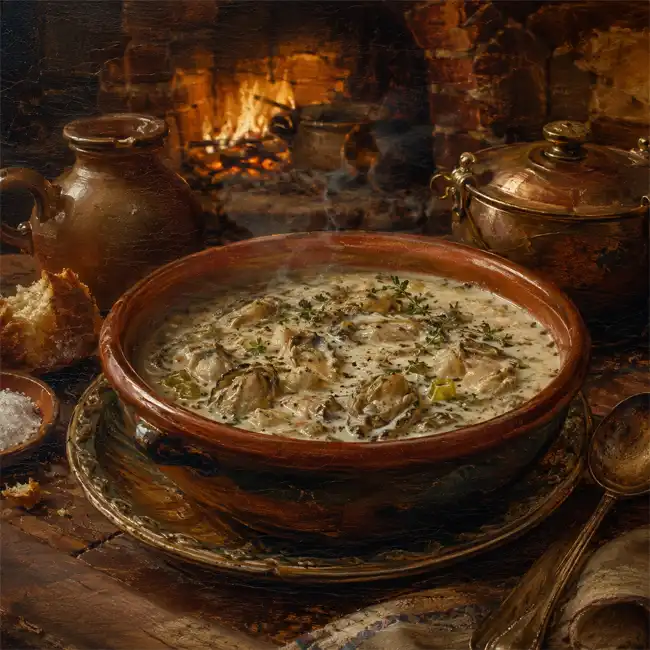
🍲 Recipe: Early American Aristocratic Oyster & Herb Soup
🕰️ About This Aristocratic Secret
Imagine this soup appearing at the beginning of a formal dinner in a prosperous coastal American household.
It would not necessarily have been called an “aristocratic soup” at the time. America did not operate under a formal hereditary aristocracy like European monarchies. Instead, this recipe represents the kind of refined dish that could suit an affluent household seeking to impress guests.
Oysters give the soup its distinctive coastal character.
Butter provides richness.
Onion creates the savory foundation.
Fresh herbs bring brightness.
Milk and cream soften everything into a silky, elegant finish.
The key is restraint.
A historical-style refined soup should not taste like a modern bowl overloaded with spices. The ingredients should remain recognizable, balanced, and gentle.
That is the secret.
Luxury comes from harmony, not excess.
🧺 Ingredients & The Aristocratic Touch
🏺 The Royal Pantry — Reimagined as an Aristocratic Pantry
Picture the pantry of a prosperous early American household.
There are sacks of flour and grains, jars of preserved vegetables, dried herbs, butter stored carefully in a cool place, fresh dairy when available, and seafood brought in from nearby coastal waters.
The pantry would not have looked like a modern supermarket.
That is precisely what makes the cooking philosophy fascinating.
Instead of relying on dozens of ingredients, the cook needed to understand how to make a relatively small number of ingredients work beautifully together.
For this reconstruction, oysters are the star.
Fresh oysters provide a naturally briny depth, while unsalted butter creates the luxurious foundation. Onion adds sweetness, and herbs prevent the soup from becoming overly rich.
The final result should feel refined without becoming complicated.
🌿 Modern Substitutes
• Fresh oysters: Use high-quality shucked oysters. If fresh oysters are unavailable, refrigerated oysters can work, provided they are properly handled and suitable for cooking.
• Unsalted butter: Salted butter can be used, but reduce the additional salt.
• Heavy cream: Half-and-half can create a lighter version.
• Whole milk: Essential for the creamy body. Lower-fat milk works but produces a thinner result.
• Fresh thyme: Dried thyme can substitute at roughly one-third of the fresh amount.
• Fresh parsley: Dried parsley is acceptable, although fresh parsley gives a brighter finish.
• Celery: Optional, but useful for creating a more complex savory foundation.
• Fish or seafood stock: A mild homemade seafood stock works beautifully. A low-sodium store-bought version is convenient.
• Nutmeg: Use only a tiny amount. It should sit quietly in the background rather than dominate the soup.
📏 The Measurements
This recipe makes approximately 4 generous servings.
• 450 g fresh shucked oysters
• 500 ml mild seafood stock
• 350 ml whole milk
• 150 ml heavy cream
• 45 g unsalted butter
• 1 medium yellow onion, finely diced
• 1 celery stalk, finely diced
• 2 tablespoons all-purpose flour
• 1 teaspoon fresh thyme leaves
• 2 tablespoons finely chopped fresh parsley
• 1 small bay leaf
• 1/8 teaspoon freshly grated nutmeg
• 1/2 teaspoon fine salt, plus more if needed
• 1/4 teaspoon freshly ground black pepper
• 1 tablespoon finely chopped chives for finishing
• 60 ml reserved oyster liquor, strained
The proportions are intentionally balanced.
The stock and oyster liquor create the savory foundation, dairy provides the creamy character, while butter and flour create the body.
👨🍳 The Chef’s Ritual
1. Prepare the Oyster Liquor
Begin by carefully straining the oyster liquor through a fine sieve.
This removes unwanted shell fragments while preserving the natural briny flavor.
Set the oysters aside in the refrigerator while you prepare the soup base.
Do not rush this stage.
The oyster liquor is one of the ingredients that gives the soup its identity.
2. Build the Aromatic Foundation
Place a heavy saucepan over medium-low heat.
Add the butter and allow it to melt gently.
Add the diced onion and celery.
Cook for approximately 6–8 minutes, stirring occasionally.
You are looking for softness rather than browning.
The vegetables should become tender and fragrant while retaining a pale color.
This is one of those moments where patience matters more than heat.
3. Create the Gentle Roux
Sprinkle the flour over the softened vegetables.
Stir continuously for about 1–2 minutes.
The mixture should become smooth and lightly cooked.
Do not let the flour become dark.
This is meant to create a delicate creamy soup, not a deeply browned gravy.
4. Add the Stock Slowly
Gradually pour in the seafood stock while whisking.
Add the strained oyster liquor.
Keep whisking until the mixture becomes smooth.
Add the bay leaf and thyme.
Allow the soup to simmer gently for approximately 8–10 minutes.
Avoid a violent boil.
A quiet simmer gives you much better control.
5. Introduce the Dairy
Lower the heat.
Slowly add the milk and cream.
Stir continuously as the soup warms.
At this point, the kitchen should begin to smell remarkably rich and comforting.
Add the nutmeg, black pepper, and a small amount of salt.
Remember that oyster liquor can naturally contain significant salinity, so seasoning should be gradual.
6. Add the Oysters at the End
Now comes the important part.
Add the oysters and cook gently for approximately 3–5 minutes, depending on their size.
They should become plump and cooked through without turning rubbery.
Do not boil the soup aggressively after adding the oysters.
That single mistake can transform an elegant seafood soup into something much heavier and tougher.
7. Finish Like a Formal Kitchen
Remove the bay leaf.
Taste carefully.
Adjust the salt only if necessary.
Stir in the fresh parsley.
Ladle the soup into warm bowls.
Finish with a small sprinkle of chives.
The final appearance should be creamy, pale, fragrant, and understated.
That understated appearance is part of its charm.
🔐 Secrets of the Palace Kitchen — Aristocratic Tips & Mistakes
🥄 Secret 1: Never Let the Soup Boil Hard
Cream-based soups can become unstable when aggressively boiled.
Keep the heat gentle.
A refined soup should simmer quietly.
🦪 Secret 2: Treat the Oysters as a Delicate Ingredient
Oysters do not need prolonged cooking.
Add them near the end and cook only until they are properly heated and cooked through.
🧂 Secret 3: Season in Stages
Do not dump all the salt into the pot at once.
The seafood stock and oyster liquor may already contain salt.
Taste after the dairy has been incorporated and again after the oysters are cooked.
🌿 Secret 4: Herbs Should Support, Not Dominate
Thyme and parsley should add fragrance without overpowering the oysters.
Too many herbs will make the soup taste more like a modern herb chowder than a restrained historical-style dish.
🧈 Secret 5: Butter Creates the Background Luxury
You do not need an enormous amount of butter.
The goal is a smooth foundation that supports the seafood.
🥛 Secret 6: Add Dairy Over Moderate Heat
Very high heat can cause dairy-based soups to behave badly.
Once the milk and cream are added, keep the temperature controlled.
❌ Mistake 1: Overcooking the Oysters
Rubbery oysters are usually the result of excessive heat or cooking time.
❌ Mistake 2: Making the Soup Too Thick
This should be a soup, not a seafood paste.
The flour is there to create gentle body.
If it becomes excessively thick, loosen it with a little warm stock or milk.
❌ Mistake 3: Using Too Much Nutmeg
Nutmeg should be almost mysterious.
You should notice the warmth without immediately identifying it.
❌ Mistake 4: Overloading the Recipe With Modern Seasonings
Garlic, hot peppers, smoked spices, and strong seasoning blends can certainly produce delicious soup, but they change the character of this historical reconstruction.
If the goal is an old-fashioned aristocratic-inspired experience, restraint is your friend.
🛕❓ Royal FAQ — A More Historically Accurate Aristocratic FAQ
Q1.Was this really a royal American recipe?
No. The United States did not have a hereditary royal court. This recipe is a historical-style reconstruction inspired by affluent early American coastal cooking, rather than a documented recipe belonging to an American king or queen.
Q2.Why use the word “Aristocratic”?
“Aristocratic” is used here as a stylistic description for wealthy or socially prominent households. It is more historically appropriate for early America than claiming the existence of an American royal kitchen.
Q3.Can I make this soup without oysters?
Yes. You can replace the oysters with cooked chicken, mushrooms, or additional vegetables. However, the character of the dish will change considerably.
Q4.Can I make a lighter version?
Absolutely. Reduce the cream and replace part of it with additional whole milk. The soup will be lighter while maintaining its historical-inspired character.
🥣 The Taste of History
The first spoonful should arrive gently.
At the front, you notice the creamy texture.
Then comes the subtle sweetness of onion.
A mild coastal saltiness follows.
The thyme appears quietly in the background, while parsley and chives provide freshness at the finish.
It is not an aggressively flavored soup.
That is exactly the point.
The character comes from balance.
This is the kind of dish that invites you to slow down.
It reminds us that historical cooking was not always about spectacular presentation. Sometimes sophistication came from understanding a few ingredients deeply and allowing them to work together.
The oyster remains recognizable.
The dairy softens rather than overwhelms.
The herbs add perfume.
And the stock ties everything together.
That is what makes this Early American Aristocratic Oyster & Herb Soup feel special.
It is not luxury because it contains endless ingredients.
It is luxury because every ingredient has a purpose.
🏡 Final Thoughts: Bringing History to Your Table
There is something wonderful about recreating historical food at home.
You do not need a colonial mansion.
You do not need an antique kitchen.
And you certainly do not need to pretend that your dining room is a royal palace.
What you need is curiosity.
A heavy pot, good ingredients, gentle heat, and a little patience can transport an ordinary evening into something that feels completely different.
This soup is especially enjoyable because it connects several layers of American culinary history.
Coastal seafood.
European-influenced cooking techniques.
Household gardens.
Dairy.
Fresh herbs.
And the tradition of making a meal feel special through careful preparation.
The recipe is deliberately adapted for a modern kitchen, so you can actually cook it rather than simply read about it.
That is the real purpose of historical food.
It should not remain trapped inside old books.
It should live again.
🗝️ The Call to Action: The Golden Hook
If you love forgotten recipes, old kitchens, and the stories hidden behind traditional food, keep exploring.
Every historical recipe has another story waiting behind it.
Some stories survived in cookbooks.
Some survived through family traditions.
Some were transformed by migration and regional adaptation.
And others disappeared almost completely.
By recreating historically inspired dishes responsibly, we can bring those culinary memories back into everyday life without pretending that every modern reconstruction is an untouched original.
So prepare your pot.
Gather your herbs.
Choose your ingredients carefully.
And let your kitchen become a small doorway into the past.
If you love the taste of history, join us in preserving the world’s culinary stories—one forgotten dish at a time.
🌎 Credit to the Keepers of the Culture: The Legacy
Historical American cuisine belongs to a much larger story than wealthy households alone.
The food of early America developed through the contributions and experiences of Indigenous peoples, European settlers, Africans and African Americans, Caribbean communities, coastal fishing communities, farmers, household cooks, enslaved cooks, free cooks, immigrants, and generations of families who adapted recipes to the ingredients available around them.
That history deserves respect.
A recipe should never be presented as belonging exclusively to an imagined aristocratic kitchen when its ingredients, techniques, or traditions have deeper and more complicated origins.
Oysters, corn, beans, herbs, grains, seafood, game, vegetables, and countless other foods have stories that stretch far beyond the dining rooms of wealthy households.
In particular, the culinary knowledge developed by enslaved African Americans and their descendants played an enormous role in the formation of American food culture. Much of that expertise was historically under-credited even though it shaped regional cuisines that remain influential today.
For that reason, this recipe should be understood as a modern historical reconstruction inspired by early American elite dining, not as a claim of exclusive ownership or an authenticated aristocratic manuscript.
The most meaningful way to preserve food history is to acknowledge the people who contributed to it.
And perhaps that is the greatest secret hidden inside an old kitchen.
The recipe itself is only part of the story.
The real treasure is the human knowledge behind it.
| 🇺🇸 👑🍲 < Back |