
🏠 Home > 🗺️ Recipes > 👑🥪 Royal Starters (Appetizers) > 🇺🇸 USA Royal Starters (Appetizers) Recipes > 👑🥪 1.The Newport Diamond - Gilded Age Chesapeake Crab & Sweet Corn Blossom
👑🥪 The Aristocratic Starters America Tried to Forget
Published by Supakorn | Updated: August 2026
👑🏛️ The Forgotten Aristocratic Legacy of America: The Gilded Age
✨ The Storyteller's Intro
Close your eyes and travel back to the winter of 1892, inside a Newport mansion on Bellevue Avenue. Outside, a blizzard rages off the Atlantic. Inside, the gas lamps glow warm against mahogany panels, a string quartet plays softly, and forty feet of dining table is set with Haviland porcelain and Tiffany silver. This is not just dinner. This is a statement. In the kitchen, a French-trained chef and a team of twelve whisper in a private language of sauces and stocks, guarding recipes that will never be written down. These are the starters that decided fortunes, marriages, and social standing. And tonight, we are unlocking that kitchen door.
🌍 The Global Value
America never had a king or queen, but for fifty glorious years, it had something just as exclusive: The American Aristocracy. Families like the Astors, Vanderbilts, and Morgans created their own royalty. Their food was their crown. These recipes were deliberately kept secret, passed only from chef to chef under strict oath, served only behind closed doors at Delmonico's in New York, the Boston Brahmin clubs, and the summer cottages of Newport. Because they were never printed in cookbooks for common people, over ninety percent of these noble starters were almost lost forever when the age of servants ended. What we know today comes from faded handwritten notes, butler diaries, and menu cards found in attic trunks.
📜 The Collection
This article is not just a recipe. This is a resurrection. We are bringing back to life one of the most stunning and nearly extinct symbols of American high society: the noble starter. A dish that perfectly captures the ambition, the wealth, and the incredible refinement of America's Gilded Age, reimagined so you can create it in your own modern kitchen.
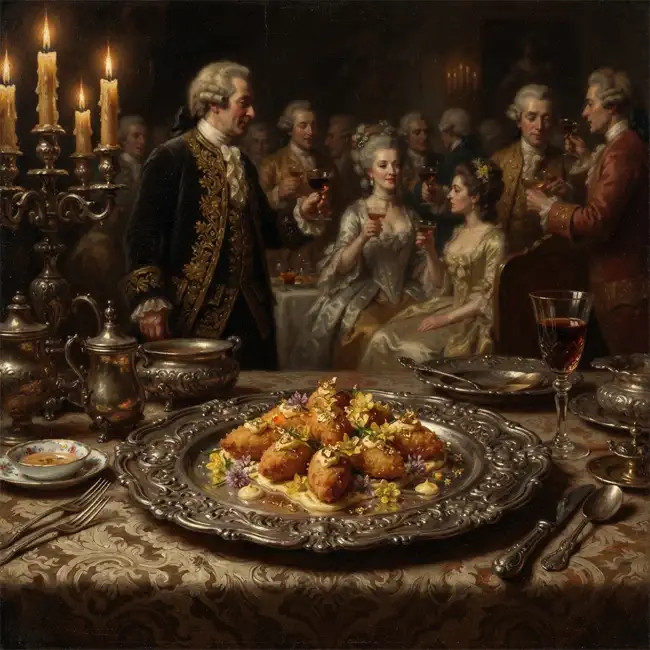
🦀 Recipe: The Newport Diamond - Gilded Age Chesapeake Crab & Sweet Corn Blossom
👑 About this Royal Secret
If you were invited to Mrs. Caroline Astor's legendary Four Hundred Ball, this is the dish that would have greeted you. Known in private kitchen ledgers as "Crab à la Newport," this was the absolute favorite starter of Alva Vanderbilt. It was never served at a regular dinner; it was reserved only for the first course of a debutante ball or a political alliance dinner.
The legend goes that Chef Charles Ranhofer of Delmonico's created it in 1885 for a young Consuelo Vanderbilt, who was homesick for the sea. He combined the most expensive ingredient of the American coast, jumbo lump crab from the Chesapeake, with sweet corn, which Native Americans had taught the first colonists to revere as white gold. It was a quiet way of saying, "We are American aristocracy, rooted in this land, but as refined as any European court." One bite was creamy, oceanic, sweet, and incredibly luxurious. It told every guest at the table that they were among the chosen few.
🛒 Ingredients & The Aristocratic Touch
• The Royal Pantry:
True American aristocracy was not about importing everything from Europe. It was about taking the absolute best of the American harvest and treating it with French technique. For this recipe, the aristocrats insisted on three non-negotiable luxuries: fresh jumbo lump crab meat that has never been frozen, because freezing destroys its royal texture; fresh sweet summer corn, whose milk is sweeter than any sugar; and real heavy cream from a single farm. These were ingredients that showed you had access to the fastest trains and the best purveyors in the country.
• Modern Substitutes:
We honor the original, but we make it possible today. If you cannot find jumbo lump Chesapeake crab, fresh Dungeness crab meat or high-quality lump crab meat in a refrigerated jar will work beautifully. Do not use imitation crab. If sweet corn is out of season, you can use high-quality frozen sweet corn kernels and a pinch of natural cane sugar to bring back that summer sweetness. For the cream, a full-fat coconut cream can be used for a dairy-free version, though it will give a slightly different, tropical note.
• The Measurements:
For the Blossom Base:
◦ Unsalted butter, 3 tablespoons
◦ Small shallot, finely minced, 1 piece
◦ Fresh sweet corn kernels, cut from about 4 large ears, 2 cups
◦ All-purpose flour, 2 tablespoons
◦ Whole milk, 1 cup
◦ Heavy cream, 1 cup
◦ Sea salt, 1 teaspoon
◦ White pepper, one quarter teaspoon
◦ Pinch of freshly grated nutmeg
◦ Fresh jumbo lump crab meat, carefully picked over for shells, 1 pound / 450 grams
◦ Fresh chives, finely snipped, 2 tablespoons
◦ Lemon zest, finely grated, from 1 lemon
For the Aristocratic Crisp:
◦ Thin slices of brioche bread, crusts removed, 4 slices
◦ Unsalted butter, melted, 2 tablespoons
◦ Pinch of sea salt
👨🍳 The Chef’s Ritual
• Step 1: Awaken the Sweetness. In a heavy-bottomed saucepan, melt the 3 tablespoons of butter over medium heat until it foams. Add the minced shallot and sweat it gently for 2 minutes. You are not browning it; you are making it translucent and sweet, like a secret being whispered.
• Step 2: The Golden Foundation. Add the 2 cups of fresh corn kernels to the pan. Sauté for 4 to 5 minutes, stirring often, until the corn becomes bright yellow and you can smell its sweet perfume filling the kitchen. Sprinkle the 2 tablespoons of flour over the top and stir for one full minute to cook out the raw taste. This is the old palace roux.
• Step 3: The Silken Bath. Slowly pour in the 1 cup of whole milk and 1 cup of heavy cream, whisking constantly to keep it perfectly smooth. Bring it to the most gentle simmer, never a hard boil. Let it cook, stirring softly, for 6 to 8 minutes until it thickens enough to coat the back of a spoon. It should be as thick as velvet.
• Step 4: The Noble Infusion. Remove the pan from the heat. Season with 1 teaspoon of sea salt, one quarter teaspoon of white pepper, and that tiny pinch of nutmeg. This is the Gilded Age signature. Let it cool for 5 minutes. Then, with the greatest care, fold in the 1 pound of jumbo lump crab meat, 2 tablespoons of chives, and the lemon zest. Do not stir vigorously. You must keep those beautiful lumps of crab whole. They are diamonds.
• Step 5: The Crown Toast. Preheat your oven to 350 degrees Fahrenheit / 175 degrees Celsius. Brush the brioche slices with melted butter and sprinkle with a pinch of sea salt. Cut each slice into two perfect triangles. Place them on a baking sheet and bake for 8 to 10 minutes until golden brown and crisp. These are the edible plates for your noble starter.
• Step 6: The Presentation. To serve like an Astor, spoon the warm crab and corn blossom into small, beautiful ramekins or porcelain cups, just three quarters full. Place one golden brioche triangle elegantly on the side of each ramekin. Garnish with a few extra chives. Serve immediately while warm.
🤫 Secrets of the Palace Kitchen
• The Cold Hands Rule: The old Delmonico's chefs always chilled their hands in ice water before picking through crab meat. Warm hands break the lumps and make the crab oily. Keep your hands cold and be patient.
• Never Boil The Cream: The biggest mistake that ruins this aristocratic texture is boiling the cream base. A hard boil will split the sauce and make it grainy. Keep it at a lazy, barely-there simmer where only one or two bubbles pop at a time. This is how you get that pure, white, palace-kitchen finish.
• The Corn Milk Secret: After you cut the kernels off the cob, take the back of your knife and scrape down the bare cobs. A sweet, milky liquid will come out. This is called corn milk. Add it to your saucepan. This was the secret ingredient that made the Vanderbilt chefs' version taste sweeter than anyone else's without adding sugar.
• Serve Small: Aristocratic starters were never large. They were three or four perfect bites. This is meant to excite the palate, not fill it. Use small dishes. Abundance was shown through quality, not quantity.
🤴👸❓ Royal FAQ
Q1: Can I make this ahead of time for a dinner party?
A: You can make the corn and cream base up to one day ahead and keep it covered in the refrigerator. But you must add the crab meat at the last moment, just before warming and serving. If the crab sits in the base overnight, it will become tough and lose its delicate, noble sweetness.
Q2: Why is my sauce not as thick as I expected?
A: This is almost always because the flour was not cooked long enough or the simmer was too short. Make sure you cook the flour for a full 60 seconds after adding it, and let the cream mixture simmer gently until it truly coats the spoon. Patience is the aristocratic virtue.
Q3: Is this recipe gluten-free?
A: It can be easily. Simply replace the 2 tablespoons of all-purpose flour with 1 tablespoon of cornstarch mixed with 2 tablespoons of cold milk before adding. And serve it with gluten-free toasted bread or in small lettuce cups for an even more delicate presentation.
📖 The Taste of History
What you have just made is more than a creamy crab dish. You have tasted the ambition of a young nation that wanted to prove it could be as elegant as the old world, but with its own ingredients. It is sweet, oceanic, creamy, and comforting all at once. It is the flavor of American history at its most opulent, a flavor that was locked away in mansion kitchens for over a century and is now alive again in your home.
🕯️ Final Thoughts: Bringing History to Your Table
Do not be intimidated by the word aristocratic. The true secret of the Gilded Age chefs was not that their food was complicated, but that they respected their ingredients with immense care. By following these gentle steps, by not rushing the simmer and by treating that beautiful crab meat like treasure, you have done exactly what the palace chefs did. You have proven that anyone, with care and respect for history, can bring a legendary, noble taste back to life. This is history you can eat.
💌 The Call to Action
If you fell in love with this whisper from America's secret dining rooms, you are now a keeper of the legacy. Share this forgotten starter with someone who loves history as much as good food. Leave a comment below and tell us, which American city's aristocratic food secrets should we unlock next? Join us as we continue to save the world's most precious culinary stories from disappearing forever.
🙏 Credit to the Keepers of the Culture
This recipe is a tribute to the incredible culinary heritage of the United States. Our deepest respect goes to the Indigenous peoples who first cultivated corn as a sacred staple, to the watermen of the Chesapeake Bay who have harvested crab with skill for generations, and to the African American and immigrant chefs, butlers, and kitchen staff of the Gilded Age whose unnamed genius and hard work truly created American high cuisine. Their hands and their stories are the real aristocracy of American food, and we honor them.
| 🇺🇸 👑🥪 < Back |