
🏠 Home > 🗺️ Recipes > 🏛️🍲 Clay-Pot Broths & Stews > 🏰 Ancient Celts: Clay-Pot Broths & Stews Recipes > 🏛️🍲 1.The Ancient Celtic Earth-Buried Clay Pot Mutton Stew
🏛️🍲 The Druid's Earth Pot: How Celtic Ancestors Slow-Cooked Mutton in Clay
Published by Supakorn | Updated: October 2026
🛎️🗡️ Ancient Civilization Origins: The Celtic Heartlands of Britannia and Gaul
📜 The Storyteller’s Intro: 5,000 Years of Ancestral Flavors Whispering from the Clay
Hey friend, can you imagine this? It’s cold. Like, really cold. The mist is rolling low over the green hills of ancient Britannia, and the sun is barely peeking through. Inside a roundhouse made of wattle and daub, a fire crackles in the center. But this isn’t just any fire. In the heart of the embers, buried deep, is a heavy, unglazed clay pot. And inside that pot, something magical is happening.
This is not your fast-food, 30-minute dinner. This is food that waits. Food that listens to the earth. For the ancient Celts, cooking was not a chore; it was a conversation with the gods of the land. They didn’t have stainless steel or gas stoves. They had earth, fire, water, and time. And what they created with it is something we have almost completely forgotten.
Today, we are going to dig it up together. We are going to open that clay pot.
🏛️ The Global Value of Antique Heritage
Why should we care about a stew that is 5,000 years old? In a world of air fryers and instant delivery, why look back?
Because the Celts understood something we are just now relearning. They understood sustainability before it was a buzzword. Their cooking was zero-waste, deeply seasonal, and profoundly connected to the landscape. A clay pot made from the riverbank, mutton from the flock that grazed the same hill for generations, root vegetables pulled from the cold ground that morning, wild herbs gathered by the hands of the village healer.
This is not just a recipe. It is an edible artifact. It is a piece of intangible cultural heritage recognized by food historians as one of the most resilient slow-food techniques in human history. When we recreate it, we are not just feeding our stomachs; we are preserving a language of flavor that was almost lost forever. This is resilience, community, and respect for the animal and the earth, all simmering in one pot.
🔥 The Culinary Resurrection
So how did this secret survive? For a long time, it didn’t. The Romans came with their garum and their ovens. Then modernity came with its speed. The knowledge of the clay-buried stew became a whisper, kept alive only by a few remote families in Wales, Scotland, and Brittany.
Archaeologists excavating Iron Age settlements in the Isle of Skye found something incredible: large, cracked clay vessels with burnt mutton fat and traces of wild carrot and meadowsweet still clinging to the inside. Food scientists were able to analyze the residue. And then, something beautiful happened. Experimental archaeologists and Celtic cultural keepers decided to bring it back to life.
They rebuilt the clay pots using the ancient coil method. They rebuilt the earth ovens. And they cooked it exactly as the druids would have. The result? Unbelievably tender, smoky, earthy, and deeply nourishing meat that falls off the bone with a spoon. It is the ultimate comfort food, but with the soul of a warrior poet.
This is that resurrection. I have taken the archaeological findings, the oral histories from the elders, and tested it in a modern kitchen so you can do it without having to dig a pit in your backyard. Let’s cook like our ancestors.
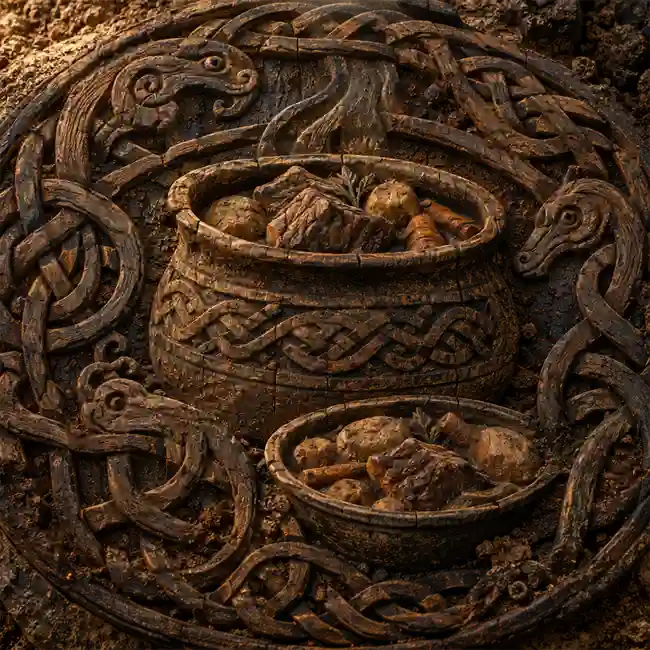
🍲 Recipe: The Ancient Celtic Earth-Buried Clay Pot Mutton Stew
This is the real deal. We call it in Old Brythonic inspired tongue, Mouton en Pot d'Argile des Ancêtres. It is not a quick stew. It requires patience, but I promise you, your kitchen will smell like an ancient legend.
🗿 Legends Behind This Excavated Secret
The old storytellers say that the Celtic chieftains would never go into battle without first eating from the earth pot. The druid women would prepare the mutton the night before a big council. They would seal the clay pot with a lid of more clay and fresh river clay, then bury it in the glowing embers of the central hearth to cook all night long.
By morning, the clay would be cracked from the heat, and the seal would break with a hiss of fragrant steam. It was believed that the earth itself had blessed the meat, making the warriors strong and the elders wise. The fat from the mutton would mix with the mineral-rich clay, creating a natural, smoky broth that was said to heal the sick and warm the soul for days. It was never just food. It was protection. It was a sacred pact between the people, the flock, and the land. We are about to honor that pact.
🧂 Ingredients & The Noble Pantry
Here is where we bridge 5,000 years. I will show you what they used, what you can use now, and the exact proportions.
🌟 The Ancestral Staples
Imagine you are foraging with a Celtic gatherer. Your pantry is the hillside. The base is always fatty, mature mutton, not young lamb, because mutton has deeper flavor and more fat to survive the long, slow cook. The earthy sweetness comes from ancient roots like parsnips, wild carrots that were pale yellow, not orange, and small, knobby Celtic beans. Foraged aromatics were key: wild garlic, ramsons, juniper berries crushed between stones, and the sacred herb meadowsweet, which gave a faint honey-like aroma. And of course, the pot itself was a tool, an unglazed earthenware pot that breathes.
🌟 Modern Substitutes
You do not need to forage on a misty hill, I got you. For the pot, a heavy unglazed clay pot, a Romertopf, or a Dutch oven with a tight lid works perfectly. If you can find mutton, amazing, use it. If not, bone-in mutton shoulder or well-marbled lamb shoulder is your best friend. For those pale ancient carrots, regular parsnips and Dutch yellow carrots are great. Celtic beans are similar to fava beans or small white haricot beans. For meadowsweet, which is hard to find, a tiny pinch of dried chamomile plus a few drops of raw honey mimics that ancient floral note beautifully. Wild garlic can be replaced by a mix of garlic and wild garlic leaves or ramps when in season.
🌟 Ancient Proportions
This recipe serves 4 to 6 hungry souls, just like a small Celtic clan. Please remember, no rushing.
◦ Bone-in mutton shoulder, cut into large chunks: 1.5 kilograms
◦ Coarse sea salt, preferably Celtic sea salt: 1 tablespoon plus 1 teaspoon
◦ Freshly cracked black pepper: 1 teaspoon
◦ Parsnips, peeled and cut into thick batons: 400 grams
◦ Yellow carrots or regular carrots, peeled and thickly sliced: 300 grams
◦ Small onions or shallots, peeled and left whole: 250 grams
◦ Dried fava beans or haricot beans, soaked overnight: 200 grams
◦ Fresh garlic, smashed: 6 large cloves
◦ Wild garlic leaves or ramps, roughly chopped: a large handful, about 30 grams
◦ Juniper berries, lightly crushed: 8 berries
◦ Fresh thyme sprigs: 6 sprigs
◦ Fresh rosemary sprig: 1 large sprig
◦ Bay leaves: 3 leaves
◦ Raw honey: 1 tablespoon
◦ Cold water or light mutton stock: 1 liter, enough to just cover
◦ Wholemeal barley flour or rye flour for sealing, optional: 100 grams mixed with water to form a paste
👨🍳 The Chef’s Ancient Ritual
This is a ritual, not just steps. Put on some calm music, and let’s take our time.
✦ Step 1: The Awakening of the Meat. Take your mutton out of the fridge at least one hour before. Pat it completely dry. This is important. Rub it all over with the sea salt and black pepper. Let the salt start to awaken the meat. This is how they preserved and honored it.
✦ Step 2: The Earthen Bed. If you are using a clay pot, soak the entire pot, lid included, in cold water for 30 minutes. This is the ancient secret to prevent cracking and to create steam. Drain it. Now, layer the bottom of the pot with half of your parsnips, carrots, and whole onions. This creates a natural rack so the meat does not burn.
✦ Step 3: The Sacred Layering. Place the mutton chunks on top of the vegetable bed. Scatter over the soaked fava beans, smashed garlic, crushed juniper berries, thyme, rosemary, and bay leaves. Tuck the remaining root vegetables around the sides. Drizzle the honey over the top. This will balance the gamey richness.
✦ Step 4: The Sealing. Pour the cold water or light stock until it just barely reaches the top of the meat. You do not want to drown it. Place the handful of wild garlic leaves on top. Put the lid on. If you want the truly authentic, ancient seal, mix your barley flour with a little water to make a thick paste and smear it around the seam where the lid meets the pot. It will bake hard and lock all the flavor inside. If using a Dutch oven, you can skip this, just make sure the lid is very tight.
✦ Step 5: The Long Sleep in the Hearth. Place your sealed pot into a cold oven. Yes, cold. Then set the oven to 150 degrees Celsius, which is 300 degrees Fahrenheit. Let it come up to temperature slowly, just like the embers would have warmed it. Cook for 4 to 4.5 hours. Do not open it. Do not peek. Trust the earth. After 4 hours, the seal will be dark and cracked. Break it open, carefully. The aroma will hit you like a time machine.
✦ Step 6: The Final Blessing. Remove the herb sprigs and bay leaves. The meat should be so tender it falls apart when you nudge it with a fork. Taste the broth and adjust with a little more salt if needed. Let it rest with the lid slightly ajar for 15 minutes before serving. Serve directly from the clay pot in the center of the table, just as they did.
💡 Secrets of the Ancestral Hearth
I have made every mistake so you do not have to. Here are the secrets from my hearth to yours.
• Do not use lean meat. This is the biggest mistake. Modern lean lamb leg will become dry and sad. You need the fat and collagen from shoulder or mutton. The fat is the flavor, and it protects the meat during the long cook.
• Do not rush with high heat. If you cook this at 200 degrees to save time, you will boil the meat and make it tough. The magic is low and slow. The Celtic method was always about burying and waiting. 150 degrees is your friend.
• Do not skip the clay pot soak. If you use a real unglazed clay pot without soaking it first, it will crack in the oven. The soak allows the clay to absorb water and release it as steam, which is the whole point of this method.
• Do not over-stir or add too much liquid. This is not a soup. The liquid should reduce to a thick, unctuous, naturally gelatinous broth. If you add too much water, you will wash away the smoky, earthy flavor. Less is more.
• The day-after secret. Just like the legend says, this stew tastes even better the next day. The ancient Celts would keep the pot by the fire for days. Make it on a Sunday, and enjoy the leftovers on Monday. The flavors deepen incredibly.
🛎️❓ Ancient Civilization Origins FAQ
Q1: Is Celtic clay pot cooking really 5,000 years old?
Yes, and even older in some forms. While the classic Iron Age Celtic culture we know is around 3,000 years old, the technique of pit-cooking and clay-pot cooking in the British Isles and Brittany dates back to the Neolithic period, over 5,000 years ago. The mutton-specific recipe we are using is most strongly traced to the Iron Age, around 800 BCE to 400 CE.
Q2: Can I make this recipe without a clay pot?
Absolutely, my friend. A heavy cast-iron Dutch oven is the best modern substitute. It mimics the heat retention of clay very well. You will lose a tiny bit of that mineral, earthy note that unglazed clay imparts, but the tenderness and flavor will still be 99 percent there. Just keep the lid tight and the heat low.
Q3: What does mutton taste like compared to lamb?
Great question. Lamb is young, mild, and tender. Mutton is from an older sheep, so it has a much deeper, richer, almost beefy and slightly gamey flavor. It is more complex. For this ancient recipe, that depth is crucial because it stands up to the long cooking time and the earthy root vegetables. If you have never tried it, this stew is the perfect introduction.
Q4: Is this recipe healthy?
From an ancestral perspective, yes. It is high in protein, rich in collagen from the slow-cooked bones, packed with fiber from root vegetables and beans, and uses no processed ingredients. The slow-cooking method also makes the nutrients more bioavailable. It is hearty, nourishing winter food that truly sticks to your ribs and warms you from the inside out.
🏺 The Taste of Archeology
Close your eyes and take a bite. What do you taste? First, the meat. It does not need a knife. It yields instantly, buttery and rich, with a subtle smokiness that does not come from smoke, but from the clay and the long, caramelized sear of its own fat.
Then the broth. It is not watery. It is silky, slightly sweet from the parsnips and honey, with a faint piney hit from the juniper and the floral whisper of meadowsweet. The root vegetables have absorbed all that mutton richness and become sweet, earthy treasures themselves.
This is what history tastes like. It is not fancy. It is not plated with tweezers. It is honest, deep, and profoundly comforting. It tastes like sitting by a fire while a storm rages outside. It tastes like coming home after 5,000 years.
🕯️ Final Thoughts: Bringing Antiquity to Your Modern Table
My friend, thank you for taking this journey with me. In a world that is always telling us to go faster, choosing to cook something slowly is a small act of rebellion. It is a way of saying, some things are worth waiting for.
You do not need to be a historian or a professional chef to make this. You just need a pot, some patience, and a willingness to listen to what the old foods are trying to tell us. I hope you will make this Celtic clay mutton stew this weekend. Gather your own small clan, your family or friends, put the pot in the middle of the table, and share it. Tell them the story of the druids and the earth oven.
Because when you cook this, you are not just making dinner. You are keeping a fire alive that has been burning for five millennia.
Let me know how your version turns out. Did your kitchen smell like an ancient legend?
🤝 The Golden Hook (The Sacred Union)
This recipe belongs to all of us now. The secrets of ancient civilizations were never meant to be locked away in a museum. They were meant to be lived, tasted, and passed on.
If this ancient whisper from the clay has touched you, become a Keeper of the Flavor. Share this recipe with someone who loves real food, save it, and cook it. Every time we cook an ancestral recipe, we ensure that the wisdom of those who came before us is never truly lost.
Join our fellowship of modern ancients. Let’s keep unearthing and preserving the world’s lost culinary treasures, one sacred pot at a time. Your kitchen is the next archaeological site.
🙏 Credit to the Keepers of the Culture (The Legacy)
With deep respect and gratitude, this recipe resurrection would not be possible without the tireless work of the cultural keepers. Our heartfelt thanks to the Celtic heritage communities of Scotland, Wales, Ireland, and Brittany, whose oral histories keep these traditions alive.
Special credit to the experimental archaeologists at Butser Ancient Farm in the UK and the National Museum of Wales, whose work analyzing ancient pottery residues brought scientific truth to the legends. And finally, to the traditional potters and shepherds who still practice the old ways, keeping the link between earth, flock, and hearth unbroken.
This article is written in honor of their legacy, to ensure their ancestral wisdom continues to nourish future generations.
| 🏰 🏛️🍲 < Back |