
🏠 Home > 🗺️ Recipes > 🏛️🍖 Hearth-Roasted Mains > 🏰 Ancient Celts: Hearth-Roasted Mains Recipes > 🏛️🍖 1.The Champion's Torc Allaid (Herb-Crusted Wild Boar of the Iron Age Hearth)
🏛️🍖 How the Ancient Celts Roasted Wild Boar: A Forgotten Herbal Feast Reborn
Published by Supakorn | Updated: October 2026
⚔️⛓️ Ancient Civilization Origins: Celtic Europe (Iron Age Gaul, Britannia & Ériu)
🔥 The Storyteller's Intro: 2,000 Years of Hearthfire, Legend & Smoke
Pull up a stool, friend, and get close to the fire.
Picture this. It's about 2,000 years ago, deep in the misty oak forests of Iron Age Europe. Hillforts stand on the ridges, wrapped in earth walls. Inside a big roundhouse with a thatched roof, smoke curls up toward a hole at the peak. Bronze cauldrons hang from iron chains. Warriors sit in a circle on animal hides, with polished torcs gleaming at their necks, while a bard sings about heroes who lived long before any of them.
In the middle of it all, slowly turning over glowing oak embers, is the star of the night: a wild boar, rubbed with forest herbs, dripping fat into the fire and filling the whole hall with a smell you could probably find blindfolded.
That's the world of the ancient Celts, the tribes who stretched from Ireland and Britain across Gaul (modern France) and into Central Europe. They didn't leave us cookbooks. They left us something better: stories, bones, cauldrons, and legends where food was never just food.
Today we're going to bring that roast back to life.
🌍 The Global Value of Antique Heritage
Here's what makes Celtic food culture so special. To the Celts, the wild boar wasn't simply dinner. It was sacred.
Boar figures show up all over Celtic Europe. Bronze boar statues have been found in Britain and Gaul, boar crests topped warrior helmets, and boar-headed war trumpets called carnyx sounded across battlefields. The Gaulish god Moccus was linked to the pig, and in the Irish and Welsh myths, magical boars run through the stories as tests of courage, strength, and fate.
Greek and Roman writers noticed this too. Posidonius, whose descriptions survive in later writers like Athenaeus, wrote about Celtic feasts where people sat in circles and ate roasted and boiled meat, and where the best cut, the "champion's portion," went to the bravest warrior at the table. Diodorus Siculus described Gauls roasting meat on spits over fires and boiling it in great cauldrons.
So this recipe isn't only about flavor. It's a piece of world heritage that ties food to honor, community, and the forest itself. Every culture has its own sacred feast, and for the Celts it was the boar.
⚒️ The Culinary Resurrection
Now, I'll be honest with you, because real food history needs honesty: no word-for-word Celtic recipe has survived. The Celts mostly passed knowledge down by speaking it, not writing it.
What we do have is a lot of evidence:
• Archaeology: pig and boar bones from Iron Age settlements and feasting sites, plus cauldrons, spits, and fire-dogs (iron stands used to hold spits over a hearth)
• Botany: seeds and plant remains that show which herbs, nuts, and fruits grew and got eaten
• Salt: the famous Iron Age salt mines at Hallstatt in Austria, where people cured meat (especially pork) in large amounts
• Literature: early Irish tales, written down later by medieval monks, that describe great feasts in detail
Put all of that together and you get this reconstruction: a slow-roasted wild boar crusted in wild garlic, juniper, thyme, and honey, roasted with crab apples and root vegetables. It's what a Celtic chieftain's hearth could have served, made to work in your oven.
Think of it as a resurrection, not a reinvention.
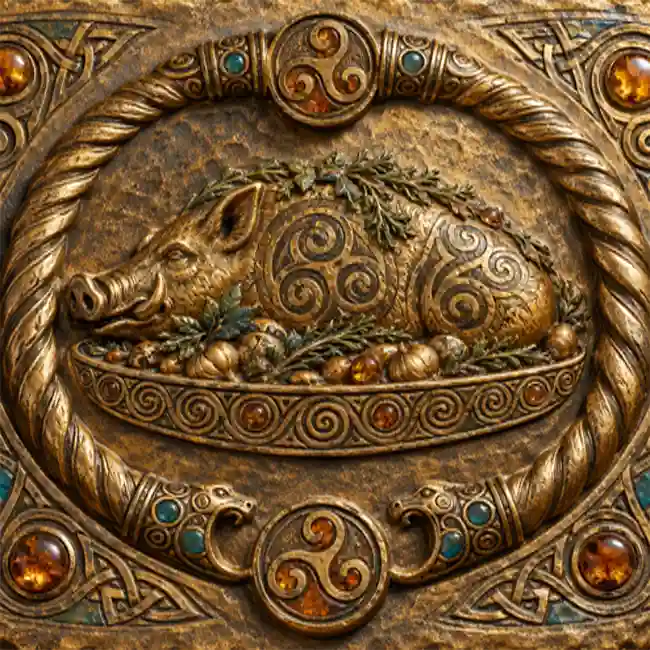
🐗 Recipe: The Champion's Torc Allaid (Herb-Crusted Wild Boar of the Iron Age Hearth)
In Old Irish, "torc allaid" means "wild boar." "Torc" is the boar itself, and "allaid" means wild, untamed, of the forest.
📜 Legends Behind This Excavated Secret
There's an old Irish tale called Scéla Mucce Meic Dathó, The Story of Mac Da Thó's Pig, preserved in the medieval Book of Leinster. It's one of the most dramatic food stories ever told.
A king named Mac Da Thó owns a famous hound that two rival provinces both want. To get out of the mess, he invites both sides to a huge feast. The centerpiece is an enormous pig, fattened for years and roasted whole. Then the question comes up: who gets to carve it?
In Celtic culture, carving the roast was an honor, and so was taking the champion's portion. Warrior after warrior stands up to boast of his deeds, and each one gets shut down by someone braver. The feast turns into a battle of words, and then into a real battle.
The lesson the bards loved: the roast reflected who you were. Your place at the table showed your rank, your courage, and your honor.
Another tale, Fled Bricrenn (Bricriu's Feast), turns on the same idea. A troublemaking host promises the champion's portion to three different heroes, and chaos follows.
When you serve this roast, you're carrying a bit of that legend to your own table. You decide who gets the champion's portion. (Choose carefully. History shows it can get heated.)
🌿 Ingredients & The Noble Pantry
🌲 The Ancestral Staples
A Celtic cook didn't go shopping. She walked into the forest, the meadow, and the riverbank. Here's what her pantry probably held:
◦ Wild boar: hunted in the dense oak and beech forests, leaner and deeper in flavor than farm pork
◦ Wild garlic (ramsons): carpeting woodland floors every spring, with a gentle garlicky punch
◦ Juniper berries: from the evergreen shrubs on the hills, piney and peppery, perfect with rich game
◦ Wild thyme and mint: growing on sunny slopes and in damp meadows
◦ Honey: the main sweetener of the ancient world, collected from wild and kept hives
◦ Crab apples: small, sour wild apples that cut through fatty meat
◦ Hazelnuts: a huge part of the northern European diet for thousands of years
◦ Sea salt or mined rock salt: traded across the continent and very valuable
◦ Root vegetables: wild carrots and parsnip ancestors, plus celtic beans and peas
◦ Animal fat or butter: for basting and richness
🛒 Modern Substitutes
You don't need to hunt in a forest. Here's how to make it work in a normal kitchen:
◦ Wild boar shoulder or leg: order from a specialty butcher or game supplier. Swap: heritage-breed pork shoulder (Tamworth, Berkshire, or Gloucestershire Old Spot are close in spirit)
◦ Wild garlic leaves: in season in spring. Swap: 2 regular garlic cloves plus a handful of chives for each handful of wild garlic
◦ Juniper berries: sold in the spice aisle or online. Swap: a little extra black pepper with a sprig of fresh rosemary for the piney note
◦ Fresh wild thyme: Swap: common garden thyme works perfectly
◦ Crab apples: Swap: small tart apples like Granny Smith or Bramley
◦ Raw local honey: any good honey works, and darker honeys like heather or buckwheat add depth
◦ Parsnips and carrots: heirloom varieties if you can find them
◦ Hazelnuts: Swap: walnuts, or leave them out if you have a nut allergy
◦ Coarse sea salt: flaky or Celtic grey sea salt is a lovely nod to the past
◦ Lard or butter: Swap: olive oil if you prefer, even though it isn't authentic
⚖️ Ancient Proportions (Serves 6–8)
The Boar
◦ Wild boar shoulder or leg, bone-in: 2 to 2.5 kg (4.5 to 5.5 lb)
The Forest Herb Crust
◦ Coarse sea salt: 1.5 tablespoons (about 15 g for every 1 kg of meat)
◦ Juniper berries, lightly crushed: 1 tablespoon (about 12 berries)
◦ Black peppercorns, cracked: 1 teaspoon
◦ Wild garlic leaves, chopped: 1 large handful (about 40 g), or 4 regular garlic cloves, minced
◦ Fresh thyme leaves: 2 tablespoons
◦ Fresh mint leaves, finely chopped: 1 tablespoon
◦ Hazelnuts, toasted and roughly crushed: 50 g (about 1/3 cup)
◦ Softened lard or butter: 3 tablespoons
The Honey Glaze
◦ Honey: 4 tablespoons
◦ Unfiltered apple juice: 120 ml (1/2 cup)
◦ Apple cider vinegar: 1 tablespoon
◦ Fresh thyme sprigs: 3
The Hearth Bed
◦ Tart apples or crab apples, quartered: 4 medium (or 10 to 12 crab apples)
◦ Parsnips, cut into chunks: 3 medium
◦ Carrots, cut into chunks: 4 medium
◦ Onions, quartered: 2 large
◦ Water or light stock: 250 ml (1 cup)
Ratio tip: keep the salt at roughly 1.5% of the meat's weight. If you have more or less meat, scale the salt the same way. Everything else can be adjusted to taste.
🕯️ The Chef's Ancient Ritual
Think of this as a ceremony, not a chore. The Celts didn't rush a sacred feast, and you shouldn't either.
1. The Night of Salt (12 to 24 hours before) Pat the boar completely dry. In a mortar, crush the sea salt, juniper berries, and peppercorns into a coarse, fragrant mix. Rub it into every part of the meat, including the crevices around the bone. Place it uncovered on a rack in the fridge overnight. The salt pulls moisture to the surface and then carries flavor deep inside, much like the Iron Age salt-curing traditions.
2. Waking the Beast (1 hour before cooking) Take the boar out of the fridge and let it come toward room temperature. A cold roast cooks unevenly, while a rested one roasts evenly from edge to bone.
3. Weaving the Forest Crust In a bowl, mash the softened lard or butter with the wild garlic, thyme, mint, and crushed hazelnuts until you have a rough green paste. Score the fat side of the boar in a crosshatch pattern, about 1 cm deep, then press the herb paste all over, pushing it into the cuts. This is your forest armor.
4. Lighting the Hearth Preheat your oven to 220°C (425°F). Spread the apples, parsnips, carrots, and onions in a deep roasting pan and pour in the water or stock. Set the boar on top. The vegetables act like a natural roasting rack, and they'll soak up all those juices.
5. The First Flame (20 minutes) Roast at high heat for 20 minutes to brown the crust and lock in color, like the first blast of a freshly stoked fire.
6. The Long Vigil (2.5 to 3.5 hours) Lower the oven to 160°C (325°F) and cover the pan loosely with foil. Let it roast slowly. Every 45 minutes, open the oven and spoon the pan juices over the meat, the same way a Celtic cook would baste a turning spit.
7. The Honey Anointing While the boar roasts, warm the honey, apple juice, vinegar, and thyme sprigs in a small pan for 5 minutes until slightly syrupy. In the last 30 minutes of cooking, remove the foil, raise the heat to 200°C (400°F), and brush the glaze over the boar twice, 15 minutes apart. Watch the crust turn deep amber.
8. The Test of Readiness Use a meat thermometer. Wild boar must reach at least 71°C (160°F) in the thickest part, away from the bone. For a pull-apart, tender shoulder, keep cooking until it reaches about 88–90°C (190–195°F).
9. The Sacred Rest (20 minutes) Move the boar to a board, tent it with foil, and let it rest. The juices settle back into the meat, and patience pays off here.
10. The Champion's Carving Carve at the table, in front of everyone, the way it was always meant to be done. Serve thick slices with the roasted apples and vegetables, and spoon the pan juices over the top. Then decide who gets the champion's portion.
🔮 Secrets of the Ancestral Hearth
These are the lessons the old fire teaches, including the mistakes most people make the first time:
• Never skip the overnight salt. Wild boar is lean, and a dry-brine is the difference between juicy and leathery. Most first-timers rush this step and regret it.
• Don't treat boar like farm pork. It has much less fat, so cooking it hot and fast dries it out. Low and slow is the ancient way and the right way.
• Always cook wild game fully. Wild boar can carry parasites that farmed pork usually doesn't. Never serve it pink, and always use a thermometer to reach at least 71°C (160°F).
• Crush your juniper, don't grind it. Lightly cracked berries release their oils slowly. Powdered juniper can turn bitter and overpowering.
• Glaze late, never early. Honey burns quickly. If you brush it on at the beginning, you'll get a blackened, bitter crust instead of a shiny amber one.
• Score the fat, not the meat. Cut only through the fat layer. Slicing into the meat lets precious juices escape.
• Keep liquid in the pan. If the pan dries out, add a splash of water. A dry pan means burnt drippings and a smoky kitchen.
• Fresh herbs beat dried ones here. Dried thyme works if you must, but use about a third of the amount. Dried wild garlic loses most of its magic.
• Rest it like you mean it. If you carve straight away, the juices run all over the board instead of staying in the meat.
• Save the pan juices. Strain them, skim the fat, and simmer for a few minutes. That's your Iron Age gravy, and it's liquid gold.
🏰❓ Ancient Civilization Origins FAQ
Q1:Did the ancient Celts really eat wild boar?
Yes. Pig and boar bones are common at Iron Age sites across Celtic Europe, and classical writers described Celtic feasts centered on roasted and boiled meat. Wild boar also had deep spiritual meaning, showing up in art, weapons, and mythology.
Q2:Is this an exact 2,000-year-old recipe?
Not word for word. The Celts didn't write recipes down. This is a careful reconstruction based on archaeological finds, plants known to grow in Iron Age Europe, and food descriptions from early texts. It's as close as we can respectfully get.
Q3:Can I make this with regular pork?
Absolutely. A heritage-breed pork shoulder is a great substitute. It has more fat, so it's more forgiving, and you can cut the cooking time by around 20–30 minutes. Use the same internal temperature guide.
Q4:What did the Celts serve alongside roasted boar?
Most likely flatbreads or porridge made from barley, emmer, or spelt, plus beans, peas, wild greens, roasted roots, hazelnuts, and seasonal fruit like apples and berries. Dairy foods such as butter and soft cheese were important too.
🏛️ The Taste of Archeology
When you take that first bite, take a second to notice it: the smoky salt, the piney sharpness of juniper, the green warmth of wild garlic, and the soft sweetness of honey and roasted apple.
Those aren't random flavors. They're the forest of ancient Europe on a plate. Every ingredient here was something a Celtic family could have gathered, traded for, or raised. Every step echoes a hearth that burned two thousand years ago.
Archaeologists dig up bones and pottery. You get to dig up flavor, and that may be the most delicious kind of history there is.
🍽️ Final Thoughts: Bringing Antiquity to Your Modern Table
You don't need a roundhouse, a bard, or a bronze cauldron to bring this feast to life. Your oven, a good roasting pan, and a little patience are enough.
This recipe is perfect for:
• Autumn and winter gatherings, when hearty, slow-cooked food feels right
• Holiday feasts, if you want something more memorable than the usual roast
• History lovers and fantasy fans who want to taste the world behind the legends
• Weekend cooking projects with family, where everyone gets a job, from crushing juniper to carving
So here's my challenge, friend: make it this season. Salt it the night before, let it roast slowly, glaze it at the end, and carve it at the table while you tell the story of Mac Da Thó's pig. Watch everyone lean in.
That's the real magic. Ancient food doesn't only feed people. It gathers them.
🔗 The Golden Hook (The Sacred Union)
Every lost recipe that gets cooked again is a small act of preservation. When you make this roast, you join a growing circle of home cooks, history lovers, and curious eaters who refuse to let the world's food heritage fade away.
Here's how you can become part of the circle:
• Cook it and share it. Post a photo of your Champion's Torc Allaid and tell us who earned the champion's portion.
• Leave a comment. Did you use wild boar or heritage pork? Wild garlic or regular garlic? Your tweaks help other readers.
• Pass on the story. Tell your guests the legend while you carve. Stories are how the Celts kept their culture alive, and it's how we keep it alive now.
• Subscribe and follow along. More forgotten recipes from lost civilizations are on the way, from Mesopotamian stews to Viking-age breads and Egyptian honey cakes.
• Share your family's old recipes. Every family has a dish that's been handed down. Tell us about yours, because it could be someone else's lost recipe.
Together, we're not just cooking. We're keeping the hearthfire of human history burning. 🔥
🙏 Credit to the Keepers of the Culture (The Legacy)
This recipe stands on the shoulders of many people, past and present, who protected the memory of Celtic life:
🔸 The ancient Celtic peoples of Ireland, Britain, Gaul, Iberia, and Central Europe, whose hunting skills, farming wisdom, and feasting customs inspired every step of this dish
🔸 The bards and storytellers (filid) who carried the great tales by memory for generations
🔸 The medieval Irish scribes who wrote those tales into manuscripts like the Book of Leinster and the Lebor na hUidre (Book of the Dun Cow), saving stories like Mac Da Thó's Pig and Bricriu's Feast
🔸 Classical writers such as Posidonius, Diodorus Siculus, and Athenaeus, whose outside accounts gave us rare glimpses of Celtic dining
🔸 Archaeologists and archaeobotanists whose excavations of Iron Age settlements, salt mines, and feasting sites showed us what the Celts actually ate
🔸 Experimental archaeology centers such as Butser Ancient Farm in England, which rebuild and test Iron Age ways of living, cooking, and farming
🔸 Living Celtic communities in Ireland, Scotland, Wales, Brittany, Cornwall, and the Isle of Man, who still keep the languages, music, and food traditions alive today
This is a respectful, research-based reconstruction made to honor that heritage. It isn't a claim to a lost original. If you're a historian, archaeologist, or keeper of Celtic tradition with insights to share, we'd truly love to hear from you.
Sláinte agus beatha. Health and life to you, and to everyone gathered around your table. 🐗🌿
| 🏰 🏛️🍖 < Back |