
🏠 Home > 🗺️ Recipes > 🏛️🍖 Hearth-Roasted Mains > 🏰 Ancient Celts: Hearth-Roasted Mains Recipes
🏰 🏛️🍖 Ancient Celts: Hearth-Roasted Mains Recipes
Published by Supakorn | Updated: October 2026
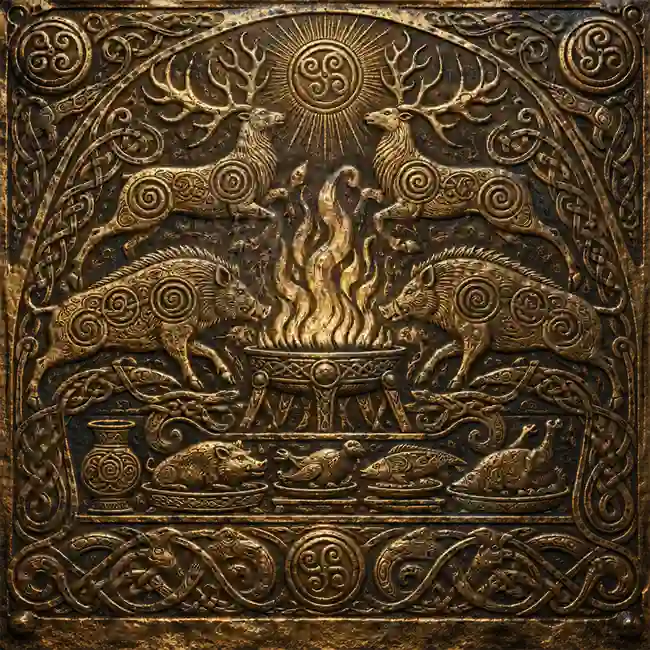
⚔️📜 The Storyteller's Intro: 5,000 Years of Ancestral Flavors
Pull up a sheepskin, friend, and get close to the fire. It's cold outside, the wind is coming off the hills, and a whole haunch of pork is turning slowly on an iron spit in front of you. Fat hisses as it drips onto the coals. Someone is telling a story about a hero who once fought for the best cut of meat at a king's feast. Welcome to a Celtic hearth.
When people talk about lost ancient recipes, they usually mean Rome, Egypt or Mesopotamia, where clay tablets and papyrus kept detailed notes. The Celts left us something different. They hardly wrote anything down. Their food history survives in fire pits, bronze cauldrons, butchered bones, iron spits and old epic tales, plus a few amazed reports from Greek and Roman visitors. That makes Celtic cooking feel more like a mystery to piece together than a cookbook, and that's exactly why it's so much fun.
One thing to clear up first: the "Celts" as we usually picture them belong to the Iron Age. But the lands they lived in, and the hearth traditions they took over, go back about 5,000 years. Here's a simple timeline of those ancestral flavors:
🔥 The Deep Roots: Neolithic Europe (c. 4000–2500 BCE)
◦ Farmers in Ireland, Britain and continental Europe raised cattle, pigs and sheep.
◦ Great monuments like Newgrange in Ireland's Boyne Valley were built around 3200 BCE, older than the Egyptian pyramids.
◦ Large animal-bone deposits found near ceremonial sites show that big shared roasts were already part of sacred gatherings.
🛡️ The Bronze Age Hearth (c. 2500–800 BCE)
◦ Bronze cauldrons and flesh-hooks (long forks for pulling meat out of boiling pots) became prized feasting gear.
◦ Across Ireland and Britain, thousands of burnt mounds called fulachtaí fia point to outdoor cooking with stones heated in the fire.
◦ Feasting turned into a way to show off status. Whoever could feed the most people had the most power.
⚒️ The Hallstatt Era (c. 800–450 BCE)
◦ This early Iron Age culture is named after Hallstatt in Austria, a village famous for its ancient salt mines.
◦ Salt meant meat could be cured and kept, which changed how food was stored and traded.
◦ Chieftains were buried with grand feasting sets, so they'd keep hosting in the afterlife.
🌀 The La Tène Golden Age (c. 450 BCE – 1st century CE)
◦ This is the swirling-art, chariot-driving, hillfort-building Celtic world most people imagine.
◦ Iron firedogs (decorated stands that held roasting spits over the hearth) appear in wealthy households.
◦ Classical writers start describing Celtic feasts, and the image of the meat-loving Celtic warrior comes from this period.
📖 The Insular Echo: Early Medieval Ireland and Britain (c. 400–1100 CE)
◦ Monks in Ireland wrote down older oral tales, keeping feast scenes that probably go back centuries before them.
◦ Early Irish law texts list which cuts of meat belonged to which social rank, so food literally showed your place in society.
📜 Iconic Excavated Menus: The Celtic Feasting Hall Collection
Here's the fun part. The Celts didn't leave written recipes, so these dish names come from what archaeology and old texts tell us about how they cooked and ate. Think of them as historically grounded reconstructions. Each one is tied to a real find or a real record.
🐗 The Warrior's Spit (Prestige Roasts)
• The Champion's Portion Pork Thigh (Curadmír): In Irish epics, the best cut of the feast went to the bravest warrior, and men really did fight over it. The prize was usually a whole pork thigh roasted over the fire.
• Mac Da Thó's Hearth-Roasted Pig: Named after the Old Irish tale Scéla Mucce Meic Dathó, in which a giant pig fattened for seven years is served at a feast that famously turns into a brawl.
• Firedog Spit-Roasted Wild Boar: Inspired by the ornate iron firedogs with ox-head ends found in Britain, including the famous Capel Garmon firedog from Wales.
• Hallstatt Salt-Cured Pork Shoulder: Based on evidence of large-scale pork curing linked to the Bronze and Iron Age salt mines of Hallstatt, Austria.
• Gaulish Smoked Ham of the Sequani: Roman writers praised hams from Gaul, which were good enough to be shipped all the way to Rome.
🔥 The Stone and Pit Kitchen
• Fulacht Fiadh Pit-Seethed Venison: Meat cooked in a water-filled trough heated with fire-hot stones. In a 1950s Irish experiment, archaeologist M.J. O'Kelly cooked a leg of mutton this way and it came out tender.
• Hot-Stone Seared Salmon of Knowledge: A nod to the legend of Fionn mac Cumhaill, who burned his thumb on a salmon roasting by the River Boyne and gained all the world's wisdom.
• Clay-Wrapped Ember-Baked Wildfowl: Duck or goose packed in clay and buried in hot ashes, a simple method that leaves almost no trace except fire-reddened soil.
🥘 The Chieftain's Cauldron
• Flesh-Hook Cauldron Beef: Named after the Dunaverney flesh-hook, a beautiful Bronze Age Irish feasting tool decorated with little bronze birds.
• Hochdorf Feast Mutton Stew: Inspired by the huge bronze cauldron found in the Hochdorf chieftain's grave in Germany (c. 530 BCE), set up to host nine guests in the afterlife.
• Bog-Butter Basted Lamb: Ireland's peat bogs have given up hundreds of lumps of ancient "bog butter," which suggests dairy fat was valuable, stored carefully, and probably used in rich cooking.
🌿 The Wild Larder Sides
• Ember-Roasted Hazelnut and Wild Garlic Crumble: Hazelnut shells turn up at Celtic and pre-Celtic sites from end to end.
• Hearth-Baked Emmer and Spelt Flatbread: Ancient grains were ground on saddle querns and later rotary querns, then baked on flat stones.
• Charred Bean and Pea Pottage: Celtic beans, peas and barley gave people solid fuel through the winter.
🗺️ Life Around the Celtic Hearth: Eating, Living and Traveling in Their Footsteps
So what was everyday life around the fire actually like? Take away the movie version and you get something warmer and more human.
🏠 The Roundhouse: Heart of the Home
• Most Celts lived in roundhouses: circular homes with thatched conical roofs and an open hearth right in the middle.
• No chimney. Smoke drifted up through the thatch, which also helped smoke-cure meat hanging from the rafters. It was a clever setup.
• The hearth was the kitchen, heater, light source and social center all in one.
🍽️ How the Celts Ate
• Greek writer Posidonius (preserved by Athenaeus) described Gauls sitting on animal skins or hay around low tables.
• They reportedly picked up whole joints of meat in their hands and cut pieces off with small knives.
• Seating went by rank, with the most honored guest in the center.
• Hospitality was close to sacred. Turning away a traveler was a serious disgrace in Celtic society.
🐄 Everyday Food vs. Feast Food
• Everyday: porridge, flatbreads, dairy, pulses, wild greens, and a bit of preserved meat.
• Feast days: whole roasted pigs, beef from the cauldron, game and fish. These were huge displays of generosity.
• Cattle were wealth, so killing one was a big deal and usually meant a celebration or festival.
🎉 Seasonal Feasts
• Samhain (around 1 November): the end of harvest, when livestock that couldn't be kept over winter were slaughtered and feasted on.
• Imbolc (early February): linked to the first ewe's milk and spring renewal.
• Beltane (1 May): herds moved to summer pastures, and big bonfires were lit.
• Lughnasadh (1 August): the first-harvest celebration, with games, gatherings and shared food.
🧳 Celtic Heritage Travel: Where to Taste History Today
• Butser Ancient Farm, Hampshire, England: reconstructed Iron Age roundhouses with live hearths and food workshops.
• Castell Henllys, Pembrokeshire, Wales: roundhouses rebuilt on their original Iron Age foundations.
• Craggaunowen, County Clare, Ireland: a crannóg (lake dwelling) and a working fulacht fiadh.
• Irish National Heritage Park, County Wexford: walk through 9,000 years of Irish history in one afternoon.
• Bibracte (Mont Beuvray), Burgundy, France: a huge Gaulish hillfort town with a great museum.
• Keltenmuseum Hochdorf, Germany: see a full-size replica of the chieftain's grave and his feasting gear.
• Heuneburg Open-Air Museum, Germany: one of the earliest Celtic "proto-cities," above the Danube.
🚣 Rivers of the Celts: The Danube, the Boyne and the Waterways of Ancient Flavor
Rivers were the Celtic world's highways, fridges and fish markets all at once. If you follow them, you're following the story of Celtic food.
🌊 The Danube: Cradle of Celtic Culture
• Many historians trace the early heartland of Celtic culture to the upper Danube region of southern Germany and Austria.
• The Heuneburg hillfort above the Danube was trading with the Mediterranean world back in the 6th century BCE.
• The Danube valley brought salt, metals and new cooking ideas into Celtic kitchens.
• Travel tip: cycle the Danube Cycle Path through Bavaria and stop at Celtic museums on the way.
🐟 The River Boyne: Where Legend Meets the Hearth
• The Boyne Valley (Brú na Bóinne) in Ireland is a UNESCO World Heritage Site, home to Newgrange, Knowth and Dowth.
• This is where the Salmon of Knowledge legend takes place. Salmon was the most honored fish in Irish tradition.
• Salmon runs on Irish rivers gave reliable seasonal feasts.
• Travel tip: visit Newgrange around the winter solstice, then try local smoked salmon in nearby Drogheda or Slane.
🏞️ The Thames, Seine and Loire
• The Thames: Iron Age offerings like the famous Battersea Shield were placed in its waters, a sign that rivers were sacred.
• The Seine: home of the Parisii tribe, who gave Paris its name.
• The Loire: Gaulish tribes along the Loire took part in busy river trade.
🛶 The Shannon and the Crannógs
• Ireland's longest river and its lakes were dotted with crannógs, artificial island homes.
• Crannóg hearths cooked eel, trout, waterfowl and freshwater game.
• Travel tip: take a slow boat trip on the Shannon for an easygoing look at ancient lake life.
🏜️ Celts of the Dry Highlands: Galatian Plateaus and Celtiberian Meseta
You might not expect this one. Celts in the desert? Well, nearly. Celtic groups pushed into some surprisingly dry, sunbaked landscapes, and their hearth cooking adapted.
🌄 The Galatians of Central Anatolia
• Around 278 BCE, Celtic tribes crossed into Anatolia (modern Türkiye) and settled the high, semi-arid Central Anatolian plateau.
• They became known as the Galatians, and kept Celtic customs for centuries.
• Life on the steppe-like highlands centered on sheep, goats and cattle, so roasted mutton and lamb mattered a great deal.
• Ancient writers describe Galatian chieftains holding enormous public feasts for whole communities.
• Travel tip: visit the Museum of Anatolian Civilizations in Ankara (ancient Ancyra, the Galatian capital), then head out to ancient Gordion.
☀️ The Celtiberians of the Spanish Meseta
• On the dry, windswept central plateau of Spain lived the Celtiberians, a blend of Celtic and Iberian cultures.
• Their most famous stronghold, Numantia near modern Soria, held out against Rome for years.
• Archaeology points to diets built on livestock, cereals and roasting over open flames, which fits the harsh, open landscape.
• Travel tip: explore the ruins of Numantia, then try roast lamb in Castilian villages nearby, a tradition that may echo very old pastoral habits.
✝️❓ Ancient Civilization FAQ: Unlocking Palace Kitchen Mysteries
Q1:Did the ancient Celts really eat mostly meat?
Not quite. Meat, especially pork and beef, was a status food and the star of the feast. Everyday meals leaned on grains like barley, emmer and spelt, plus dairy, beans and wild plants. Picture a weekday bowl of porridge and a festival-night pork roast.
Q2:How did the Celts roast meat without ovens?
They had several clever ways:
◦ Spit-roasting over the central hearth, often on iron firedogs.
◦ Seething meat in water heated by fire-hot stones (the fulacht fiadh method).
◦ Wrapping food in clay or leaves and burying it in embers.
◦ Stewing in large bronze cauldrons hung from chains over the fire.
Q3:What exactly was the "champion's portion"?
The curadmír was the choicest cut at a feast, usually the thigh of a roasted pig. Taking it was a public claim to be the greatest warrior in the room. Irish tales like Fled Bricrenn (Bricriu's Feast) are built around the chaos this caused. Classical writers in Gaul described the same custom, so it was clearly widespread.
Q4.Where can I experience authentic Celtic cooking today?
Your best bets are open-air archaeology parks like Butser Ancient Farm, Castell Henllys and Craggaunowen, which often run hearth-cooking demos and seasonal festivals. Samhain and Lughnasadh events across Ireland, Scotland, Wales and Brittany also bring old food traditions back to life.
🧠 Final Thoughts: The Timeless Allure of Antique Gastronomy
Celtic food culture comes down to one image: people sitting around a fire, sharing meat, swapping stories and showing they belong together. It wasn't only about eating. A Celtic feast showed who you were, who you honored, and how generous your household could be.
The Celts didn't leave cookbooks, but they left something that may be better: clues. A blackened stone trough in an Irish field. A bronze flesh-hook decorated with tiny birds. A firedog with ox heads staring into the flames. An old tale about a pig so big it nearly started a war. Put these together and you can almost smell the smoke.
And this is only the starter course, my friend. In the next articles we'll go deeper into these ancient kitchen secrets, rebuilding these hearth-roasted mains step by step for a modern kitchen, no roundhouse needed. Stay tuned, keep your fire warm, and get ready to cook like a Celtic chieftain.
🏛️ Credit to the Keepers of the Culture (The Legacy)
Every bite of history here exists thanks to the people who kept it alive. Our thanks go to:
◦ The ancient Celtic peoples: the Gauls, Britons, Gaels, Galatians, Celtiberians and many others whose hearths, traditions and stories made all of this possible.
◦ The Irish monastic scribes: who preserved epic tales in manuscripts like Lebor na hUidre (The Book of the Dun Cow) and the Book of Leinster.
◦ Classical observers: Posidonius, Diodorus Siculus, Strabo and Athenaeus, whose records, biased as they sometimes were, give us rare views of Celtic dining.
◦ Archaeologists and experimental researchers: including M.J. O'Kelly and the many teams whose patient digging and hands-on experiments brought ancient cooking back to life.
◦ Museums and heritage guardians: the National Museum of Ireland, the British Museum, Keltenmuseum Hochdorf, Bibracte, Butser Ancient Farm and many others.
◦ Today's Celtic nations and communities: Ireland, Scotland, Wales, Brittany, Cornwall, the Isle of Man and Galicia, where language, music, festivals and food still keep the ancestral fire burning.
Respect the past, share the table, and keep the hearth alive. 🔥
🏛️🍖 How the Ancient Celts Roasted Wild Boar: A Forgotten Herbal Feast Reborn
👉 Revive Ancient Celts' Hearth-Roasted Mains
| 🌐 🏛️🍖 < Back | 🏰 🌾 < Previous | Next > 🍲 🏰 |