
🏠 Home > 🗺️ Recipes > 🏛️🌾 Primitive Grains & Flatbreads > 🏰 Ancient Celts: Primitive Grains & Flatbreads Recipes > 🏛️🌾 1.Ancient Celtic-Inspired Wild Oat Flatbread
🏛️🌾 Celtic Wild Oat Flatbread: Rediscovering the Flavors of an Ancient World
Published by Supakorn | Updated: October 2026
🛡️🌿 Ancient Civilization Origins: The Ancient Celtic World
📜 The Storyteller’s Intro: Echoes from the Ancestral Hearth
Imagine standing on a mist-covered hillside in ancient Britain or Ireland, where the morning air smells of damp earth, woodsmoke, and freshly gathered plants. Beyond a cluster of timber houses, someone tends a small fire while another prepares a simple mixture of ground grain and water. There are no modern ovens, no measuring cups, and no neatly packaged flour. Just the ingredients available from the surrounding landscape and the knowledge passed from one generation to the next.
This is the atmosphere that inspires our exploration of Celtic wild oat flatbread.
Long before modern bakeries filled their shelves with carefully shaped loaves, communities across prehistoric and ancient Europe relied on grains, gathered plants, and practical cooking techniques to sustain daily life. Flatbreads offer a fascinating way to imagine that world because they require relatively few ingredients and can be cooked on a heated stone or simple cooking surface.
However, there is an important historical distinction. The ancient Celtic world covered different regions and periods, and the surviving evidence does not establish one standardized recipe called Celtic wild oat flatbread. The recipe in this article is a historically inspired reconstruction, not a recovered archaeological formula.
That distinction does not make the experience less meaningful. Instead, it allows us to approach ancient food with curiosity, respect, and a little culinary imagination.
🌍 The Global Value of Antique Heritage
Ancient food traditions reveal far more than what people ate. They help us understand how communities adapted to their environments, shared knowledge, managed seasonal resources, and transformed humble ingredients into nourishing meals.
The Celtic world was not one unified country with a single cuisine. Celtic languages and cultural traditions appeared across different parts of Europe, while communities developed distinct local customs over centuries. The food available to a household depended on its location, agricultural practices, climate, social circumstances, and trading connections.
Grains were particularly important to many communities in prehistoric and ancient Europe. Archaeological evidence from different regions shows the cultivation and use of cereals long before the historical period commonly associated with the Celts. Yet the exact grains consumed varied considerably, and oats should not automatically be treated as the defining cereal of every ancient Celtic community.
Wild plants also deserve a place in this broader story. People gathered edible resources alongside cultivated foods, although the precise plants used depended on local ecology and knowledge.
Today, exploring heritage-inspired oat flatbread connects us with several enduring ideas:
• Resourcefulness: Making nourishing food from a small number of accessible ingredients.
• Seasonal awareness: Understanding that food choices were closely connected to the surrounding landscape.
• Practical craftsmanship: Learning how texture, moisture, and heat can transform simple grain into a satisfying meal.
• Cultural continuity: Recognizing that traditional food knowledge survives through both documented practices and careful modern interpretation.
Preserving ancient food heritage means keeping these lessons alive without pretending that every modern reconstruction is an authentic artifact from the past.
🔥 The Culinary Resurrection
What happens when a humble ancient grain meets a modern kitchen?
A simple flatbread becomes an invitation to experiment with older cooking principles. You can grind oats, mix them with water, shape a small round, and cook it on a hot skillet. The process is straightforward, but each stage reveals something interesting about the relationship between ingredients and technique.
Oats are especially appealing for this project because they have a distinctive nutty aroma and produce a hearty, earthy flavor. Unlike wheat flour, oat flour does not form an elastic gluten network. That means an oat-based flatbread can be more delicate, crumbly, and challenging to turn unless its moisture and thickness are carefully controlled.
Our version draws inspiration from the idea of early grain cakes and rustic hearth cooking. It uses modern, accessible ingredients while keeping the technique deliberately simple.
Think of it as a culinary bridge between past and present: not a claim that we have uncovered a lost Celtic secret, but a practical way to explore the textures and flavors that make ancient food traditions so fascinating.
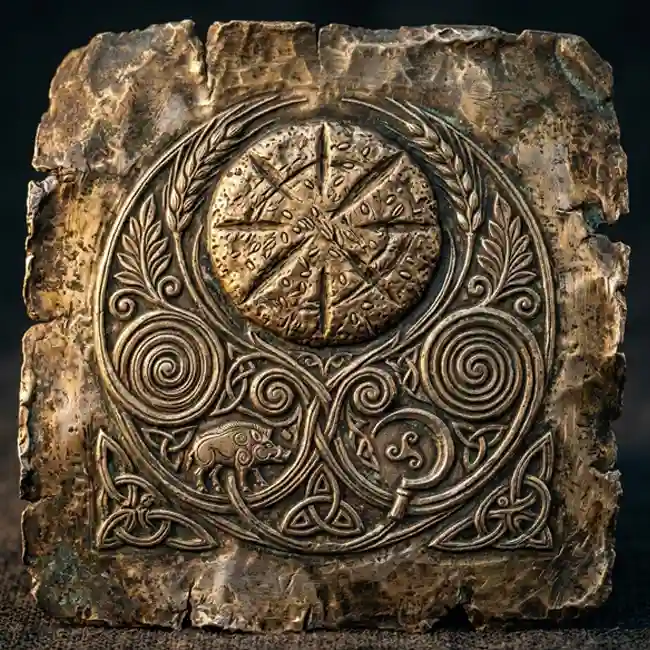
🍞 Recipe: Ancient Celtic-Inspired Wild Oat Flatbread
Discover the humble flavors of the ancient Celtic world with this rustic wild oat flatbread, inspired by early European grain traditions and ancestral hearth cooking. Made with simple ingredients and time-honored techniques, this hearty flatbread celebrates the resourcefulness of ancient communities, bringing earthy oat flavors, golden toasted edges, and a taste of history to your modern kitchen. Recreate this ancient-inspired recipe at home and explore the fascinating culinary heritage of the Celtic world, one rustic bite at a time.
🏺 Legends Behind This Excavated Secret
Every ancient recipe seems to invite a question: what did people eat before modern kitchens, packaged flour, and written cookbooks became commonplace?
Imagine a household preparing food after a long day of working the land. Grain is ground into a coarse meal, water is added until the mixture holds together, and small rounds are pressed by hand. Rather than waiting for a loaf to rise, the cook places each round on a heated surface and watches it firm up.
This scene is a plausible reconstruction of simple grain cooking, not a documented account of a particular Celtic household. There is no verified archaeological discovery establishing the precise formula for a named Celtic wild oat flatbread, and we should not mistake an evocative story for historical proof.
Still, the underlying cooking principles make sense. Flatbreads and other unleavened grain foods can be prepared without specialized equipment, making them useful models for understanding practical food preparation in earlier societies.
The word wild also needs a little care. Wild oat species exist, but they are not interchangeable with modern cultivated oats. The recipe below uses ordinary edible oat flour, which is easier to source and handle safely. Its connection to ancient Celtic food culture is interpretive rather than a claim that the exact ingredients have been scientifically verified for a specific Celtic community.
The result is a hearty, uncomplicated flatbread with a subtle toasted-grain aroma and a satisfying rustic texture.
🌾 Ingredients & The Noble Pantry
🌿 The Ancestral Staples
In a traditional-style pantry, ingredients were valuable because they served a purpose. Grain provided substance, water brought the mixture together, and heat transformed a coarse preparation into something edible.
For our modern interpretation, oats take center stage. They provide a warm, nutty flavor that works beautifully with savory accompaniments or simple toppings.
Oats also behave differently from wheat. Since oat flour lacks wheat's gluten structure, it will not develop the same stretchy dough. Instead, the mixture should resemble a soft, moldable paste that can be pressed into flat rounds.
For the best result, choose finely ground oat flour or grind plain rolled oats in a food processor. Very coarse oats can be used, but the bread may crack more easily and have a rougher texture.
🥣 Modern Substitutes
The following ingredient list makes approximately six small flatbreads.
• Oat flour — 200 g: The main ingredient. Use certified gluten-free oat flour if you need to avoid gluten cross-contact.
• Warm water — 180–220 ml: Start with the lower amount and add more gradually until the dough holds together. Different oat flours absorb different amounts of water.
• Fine salt — 2 g, optional: Adds flavor. Salt is a modern recipe choice here, not a claim about a particular ancient Celtic formula.
• Extra oat flour — 1–2 tablespoons, if needed: Use this when the mixture becomes too sticky to shape.
• A small amount of cooking oil, optional: Useful for lightly greasing a modern skillet. It is not necessary if you have a suitable dry, nonstick cooking surface.
For a more textured flatbread, replace up to one-quarter of the oat flour with coarsely ground oats. For a softer result, use finely milled flour and add water slowly.
Avoid substituting ordinary wheat flour if you want the finished bread to remain oat-based. A small amount of wheat flour may make shaping easier, but it changes the recipe and introduces gluten.
⚖️ Ancient Proportions
These proportions are designed for a dependable modern result, rather than presented as measurements recovered from antiquity.
• Oat flour: 100% — The foundation of the recipe.
• Water: 90–110% — For every 100 g of oat flour, use approximately 90–110 ml of water, adjusting for absorption.
• Salt: 1% — Optional, based on the weight of the oat flour.
• Additional oat flour: up to 5% — Only when needed to make the dough easier to handle.
For a six-flatbread batch, begin with 200 g of oat flour and 180 ml of warm water. Mix thoroughly, then add extra water one tablespoon at a time if the dough feels dry.
The goal is a cohesive mixture that can be pressed into rounds without crumbling apart. It should not be runny, and it does not need to be kneaded like wheat bread.
🔥 The Chef’s Ancient Ritual
The beauty of this recipe is its simplicity. You do not need a bread machine, a stand mixer, or a traditional stone oven. A bowl, your hands, and a skillet are enough to create a delicious result.
🥄 Step 1: Awaken the Grain
Place the oat flour in a mixing bowl. Add the optional salt and stir to distribute it evenly.
Pour in 180 ml of warm water while mixing with a spoon. The mixture may initially look uneven, but keep stirring until the flour is hydrated.
Let it rest for 5–10 minutes. This gives the oats time to absorb the water and makes the mixture easier to shape.
✋ Step 2: Bring the Dough Together
Check the texture with your fingers. If it falls apart when pressed, add a little more water. If it sticks heavily to your hands, sprinkle in a small amount of oat flour.
Gather the mixture into a soft mass. There is no need to knead aggressively; too much handling will not create the elastic structure associated with wheat dough.
Divide it into six equal portions.
🍪 Step 3: Shape the Flatbreads
Place each portion between two sheets of baking parchment, or shape it directly on a lightly dusted board.
Press each piece into a round approximately 10–12 cm across and 4–6 mm thick.
Keep the edges reasonably even. Thick areas take longer to cook, while extremely thin sections may become brittle before the center is ready.
If a flatbread cracks, press the edges together with slightly damp fingers. Small imperfections are part of the charm of handmade oat bread.
🔥 Step 4: Prepare the Hearth
Heat a heavy skillet over medium-low to medium heat. If necessary, wipe the surface with a very thin layer of cooking oil.
Avoid excessive heat. Oats can brown on the outside before the interior has properly set, especially when the rounds are thick.
Test the skillet with a small piece of dough. It should begin to cook steadily without immediately turning dark.
🍞 Step 5: Cook with Patience
Place a flatbread in the skillet and cook for approximately 3–4 minutes on the first side.
When the surface looks drier and the underside develops light golden-brown patches, turn it carefully with a wide spatula.
Cook the second side for another 2–4 minutes, adjusting the heat as needed. Thicker rounds may require additional time.
The finished bread should feel firm, with a lightly crisp exterior and a tender, dense center. Because the dough contains no yeast, it will not rise into a fluffy loaf.
Check that the center is fully cooked rather than leaving it damp or pasty. Cooking time varies with thickness, moisture, and pan temperature.
🌤️ Step 6: Rest and Serve
Transfer the cooked flatbreads to a clean plate or cooling rack. Let them rest for a few minutes before serving.
This short rest allows the texture to settle. The bread will remain rustic and hearty rather than becoming soft and airy.
Serve warm with butter, fresh herbs, cooked vegetables, soft cheese, or a spoonful of fruit preserve. These are modern serving suggestions, not claims about an exact ancient Celtic menu.
For a more historically inspired presentation, keep the accompaniments simple and focus on the grain itself.
🛡️ Secrets of the Ancestral Hearth
Even a recipe with only two essential ingredients can go wrong. Fortunately, a few practical adjustments make oat flatbread much easier to prepare.
🔥 Mistake 1: Using Too Much Water at Once
Oat flour absorbs liquid differently depending on how finely it is milled and how it has been processed.
Start with the lower amount of water.
Allow the mixture to rest before deciding whether it needs more.
Add water gradually until the dough holds together when pressed.
A short resting period can make a surprisingly large difference to the texture.
🌾 Mistake 2: Expecting Wheat-Bread Elasticity
Oat dough does not behave like ordinary wheat dough. It may crack at the edges, feel slightly crumbly, or resist stretching.
Press rather than stretch the dough.
Shape it between parchment sheets if it is delicate.
Keep the rounds moderately thick so they are easier to turn.
Do not keep adding flour simply because the dough lacks elasticity. Too much extra flour can make the final bread dry and brittle.
🔥 Mistake 3: Cooking Over Excessive Heat
A scorching skillet may create dark patches while leaving the center undercooked.
Begin with medium-low to medium heat.
Reduce the temperature if the surface browns too quickly.
Give thicker rounds additional cooking time.
A little patience produces a more even result.
🍪 Mistake 4: Making the Flatbreads Too Large
Large, thin rounds can split during turning. Smaller pieces are easier to handle and cook more consistently.
Aim for six modest flatbreads rather than one enormous round. Once you understand the dough, you can experiment with different sizes.
🌿 Mistake 5: Treating Modern Reconstruction as Proven History
This is the most important lesson of all.
The recipe is inspired by ancient grain cooking, but its exact ingredients, proportions, and cooking sequence have not been established as an authentic Celtic formula.
Describe it as ancient Celtic-inspired or historically inspired.
Avoid claiming that archaeologists uncovered this exact recipe.
Do not assume all Celtic communities ate the same foods.
Use safe, commercially prepared edible oats instead of experimenting with unidentified wild plants.
Historical accuracy is part of the pleasure of heritage cooking. Being clear about what we know and what we are reconstructing makes the story more trustworthy.
🕍❓ Ancient Civilization Origins FAQ
Q1:Did ancient Celts really eat wild oat flatbread?
There is no established evidence for one standardized recipe specifically called Celtic wild oat flatbread. This version is a modern reconstruction inspired by early European grain cooking. The actual foods consumed varied by region and period.
Q2:Were oats a staple of every ancient Celtic household?
No. Ancient Celtic communities lived across diverse landscapes and did not share one uniform diet. Grain choices varied according to local agriculture, climate, and access to resources. Oats have a long history in Europe, but their importance should not be generalized to every Celtic community.
Q3:Can I make this flatbread without an oven?
Yes. A skillet is ideal for this recipe. Cook the small rounds over moderate heat, turning them once the first side has set and developed light golden patches.
Q4:Is this recipe suitable for a gluten-free diet?
Oats are naturally gluten-free, but they can become contaminated during growing, processing, or packaging. If gluten avoidance is important to you, select oats or oat flour certified gluten-free and check the labels of any accompaniments.
👅 The Taste of Archaeology
The first bite is earthy, gently nutty, and pleasantly substantial. Rather than offering the airy softness of a modern yeast loaf, the flatbread has a compact texture that makes it satisfying alongside other foods.
Toasting creates a warm grain aroma, while the thin edges can become slightly crisp. The center remains tender when the dough has enough moisture and the bread is cooked carefully.
Its flavor is deliberately uncomplicated. There are no elaborate spices competing with the oats, no complicated filling, and no need for a long list of ingredients.
Try one piece plain before adding toppings. You will get a clearer sense of the grain's natural flavor.
Then experiment with fresh herbs, soft cheese, roasted vegetables, or a little fruit preserve. These additions turn the bread into a versatile part of a modern meal while allowing the oat flavor to remain the star.
The most rewarding part of this recipe may be the contrast between its simplicity and the questions it raises. How did earlier communities process grain? How did cooks recognize the right texture? How did useful techniques travel between households and generations?
One flatbread cannot answer all those questions, but it can give you a hands-on appreciation of the ingenuity behind everyday food.
🏡 Final Thoughts: Bringing Antiquity to Your Modern Table
Ancient food does not always need to be complicated, expensive, or difficult to recreate. Sometimes, the most interesting culinary experiences begin with a bowl of flour, a little water, and a hot cooking surface.
This Celtic-inspired wild oat flatbread celebrates that simplicity. Its ingredients are accessible, its method is approachable, and its rustic flavor makes it easy to pair with everyday meals.
More importantly, the recipe offers a way to explore ancient European food culture without confusing imagination with archaeological fact. We can appreciate the possibilities of early grain cooking while remaining honest about the limits of historical evidence.
If you are building a collection of forgotten ancient recipes, this flatbread makes a useful starting point. It encourages experimentation, rewards careful attention to texture, and reminds us that food history is not only about grand feasts. It is also about the ordinary meals that sustained communities through changing seasons.
Make a batch on a quiet afternoon. Notice how the dough changes as it absorbs water. Listen for the gentle sizzle in the pan, watch the golden patches develop, and enjoy the aroma of toasted oats filling your kitchen.
You may not be recreating the exact meal of an ancient Celtic family, but you are engaging with a timeless idea: transforming a simple grain into something nourishing through skill, patience, and care.
✨ The Golden Hook: The Sacred Union
Every food tradition carries a story, and every generation has a chance to keep that story alive.
By exploring ancient-inspired recipes, we become participants in a much larger conversation about agriculture, craftsmanship, cultural exchange, and the everyday lives of people who came before us.
The sacred union in this recipe is not a claim about an ancient religious ritual. It is a symbol of the relationship between the land, the grain, the cook, and the people gathered around the table.
You can help preserve that spirit by cooking thoughtfully, sharing what you learn, and passing recipes along with their historical context.
Try this oat flatbread with your family or friends. Tell them where the inspiration comes from, explain what remains uncertain, and invite them to imagine how earlier cooks might have worked with the ingredients available to them.
If you share your results online, consider using the phrase Celtic-inspired wild oat flatbread. It describes the recipe honestly while helping other curious cooks discover this corner of ancient food heritage.
The past does not have to remain behind glass in a museum. Sometimes, it can begin a new conversation right at your kitchen table.
📚 Credit to the Keepers of the Culture: The Legacy
This recipe is offered as a modern, historically inspired interpretation of ancient European grain cooking. It is not presented as an authenticated Celtic recipe recovered from an archaeological site.
The historical context of ancient Celtic communities draws on the work of archaeologists, historians, and researchers who study prehistoric and Iron Age Europe, including evidence from settlement sites, agricultural remains, artifacts, and other material records.
The broader history of cereals and early food preparation also reflects generations of archaeological research into how communities cultivated, processed, and consumed plant foods. Such evidence can help establish which resources people used, but it does not always reveal exact recipes, ingredient proportions, or cooking instructions.
To explore this subject further, readers can consult reputable collections and research resources, including:
✦ The British Museum: Collections and educational resources on Iron Age Britain and the ancient peoples of Europe.
✦ National Museum of Scotland: Archaeological collections and interpretation relating to Scotland's prehistoric and Iron Age communities.
✦ The National Museum of Ireland: Collections documenting Ireland's archaeological heritage and the lives of earlier communities.
✦ Academic research on archaeobotany: Studies of ancient plant remains, cereal cultivation, food processing, and the development of agriculture.
These institutions and research fields offer starting points for understanding the material evidence behind ancient food traditions. They should not be interpreted as having authenticated the specific recipe presented here.
We also acknowledge the generations of farmers, millers, cooks, food historians, and cultural researchers whose work helps us appreciate the significance of everyday food.
Their knowledge reminds us that culinary heritage is more than a collection of ingredients. It is a record of adaptation, creativity, and shared human experience.
May every loaf we make encourage curiosity about the past, respect for the people who shaped it, and a deeper appreciation of the food traditions we continue to explore today.
| 🏰 🏛️🌾 < Back |