
🏠 Home > 🗺️ Recipes > 👑🍲 Royal Court Broths (Soups) > 🇦🇺 Australia Royal Court Broths (Soups) Recipes
🇦🇺 👑🍲 Australia Royal Court Broths (Soups) Recipes
Published by Supakorn | Updated: September 2026
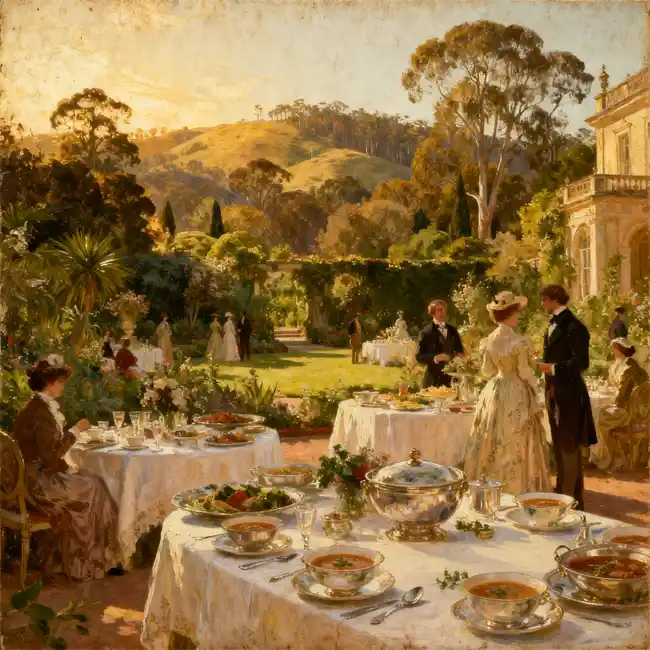
👑📜 The Storyteller’s Intro: The Hidden Soup Traditions of Australia’s Old Elite
If you imagine an ancient Australian palace filled with royal chefs preparing secret soups for kings, queens, and courtiers, there is one important historical detail to clear up first: Australia does not have a centuries-old indigenous royal court tradition comparable to the royal courts of Europe or Asia.
And honestly, that makes Australia’s culinary story even more fascinating.
The real story is much more layered. Australia’s food heritage reaches back more than 60,000 years through Aboriginal and Torres Strait Islander peoples, whose knowledge of Country, seasonal foods, plants, animals, waterways, and fire shaped sophisticated food traditions long before European settlement. Modern Australian food history then developed through successive waves of Indigenous knowledge, British colonial cooking, pastoral estates, migration, regional agriculture, and multicultural influences.
So when we talk about Australia Aristocratic Court Broths (Soups), the phrase is best understood as a storytelling window into the meals associated with Australia’s historic elite, colonial households, estate kitchens, governors’ circles, wealthy pastoral families, and formal dining culture rather than a literal royal kitchen.
That distinction matters.
Between roughly the early 19th century and the early 20th century, Australia experienced enormous changes in food availability and social life. Imported European culinary habits met unfamiliar Australian landscapes. Large households required substantial kitchens, cooks, servants, gardeners, butchers, bakers, and suppliers. Wealthy families could access ingredients that were less readily available to ordinary households, while rural estates often depended heavily on what could be produced locally.
Soup naturally belonged in this world.
It was practical, economical, adaptable, and capable of transforming vegetables, meat, poultry, grains, seafood, herbs, and stock into something elegant enough for a formal table.
But there is another, much older layer underneath this colonial story.
Indigenous Australian food traditions were based on detailed environmental knowledge developed over tens of thousands of years. Seasonal cycles determined when particular plants, fruits, seeds, seafood, and animals were available. Different regions developed different food cultures because Australia itself contains extraordinarily diverse environments, from tropical coastlines and rainforests to grasslands, deserts, mountains, wetlands, and temperate forests.
That means there was never one single “ancient Australian soup.”
Instead, there were countless regional relationships with food.
And this is where our culinary mystery begins.
Rather than pretending Australia had a forgotten royal soup book hidden beneath a palace floor, we can look at the aristocratic and high-society interpretation of broths and soups, while also recognizing the much deeper Indigenous food knowledge that influenced how Australians understand native ingredients today.
The imagined chapter titles almost write themselves:
✦ The Governor’s Winter Garden Broth
✦ The Colonial Estate Clear Soup
✦ The Highland Lamb and Root Vegetable Broth
✦ The Coastal Fisherman’s Refined Seafood Soup
✦ The Country House Chicken and Herb Broth
✦ The Bush Herb Consommé
✦ The Native Seed and Garden Vegetable Soup
✦ The Southern Estate Vegetable Potage
✦ The Northern Coastal Seafood Broth
These names should be viewed as historical-inspired culinary concepts rather than claims that a particular aristocratic household officially served a soup under that exact name.
That approach allows us to explore Australia’s culinary past without inventing a fake royal dynasty.
And perhaps that is the most intriguing secret of all.
🗺️ The Aristocratic Culinary Tourism: Mapping Flavors to Historic Landscapes
Australia is enormous, so trying to understand historic food through one city or one kitchen would miss the point.
The better approach is to follow the landscape.
Australian culinary identity has always been strongly connected to place. Today, tourism authorities highlight regional produce, native ingredients, seafood, farms, markets, Indigenous food experiences, and hands-on culinary activities as ways for visitors to understand Australia through food.
For anyone interested in aristocratic-inspired Australian soup history, that creates an interesting travel map.
🏛️ Sydney and New South Wales: The Colonial Table
Sydney provides one of the most obvious starting points.
As an early centre of European settlement, it became a meeting point for imported British traditions, local ingredients, maritime trade, agricultural production, and eventually a much broader multicultural food culture.
A historic dining story here might begin with the formal household soup course.
Imagine a large dining room, polished timber furniture, carefully arranged table settings, and a steaming tureen arriving before the principal course.
The soup itself might have been relatively restrained.
The emphasis was not necessarily on exotic ingredients. Instead, refinement could come from clarity, balance, texture, careful preparation, and the quality of the stock.
That makes dishes such as a Colonial Estate Clear Broth, Country House Vegetable Soup, or Herbed Poultry Broth useful historical-inspired concepts.
But modern Sydney adds another layer.
Visitors can now explore native Australian ingredients alongside contemporary Australian cuisine, creating a bridge between old colonial foodways and much older Indigenous traditions.
🌿 Victoria: Gardens, Estates, and the Cultured Dining Table
Victoria offers another fascinating chapter.
The state became strongly associated with agriculture, pastoral wealth, gardens, estates, markets, and sophisticated urban dining.
For a culinary traveller, this creates the perfect setting for imagining the aristocratic-inspired soup course.
A Victorian estate kitchen might be pictured around seasonal vegetables, poultry, garden herbs, root vegetables, legumes, and locally sourced meat.
The aristocratic character would come less from extravagance and more from organization.
A wealthy household could maintain kitchen gardens, employ experienced cooks, and structure meals around seasonal availability.
That is an important lesson in historical food culture.
Luxury was not always about rare ingredients.
Sometimes luxury meant having the people, land, time, and equipment required to prepare ordinary ingredients exceptionally well.
Modern Victoria also plays an important role in Australia's native-food revival, with native ingredients increasingly appearing in contemporary restaurants and food experiences. Tourism Australia specifically highlights ingredients such as wattleseed, lemon myrtle, finger lime, saltbush, and other native foods.
🚣 Cradle of Aristocratic Delicacies — Coastal Australia and River Country
If there is one landscape that should never be ignored when discussing Australian broths, it is the coast.
Australia has one of the world's great maritime food cultures.
Seafood has long been important to Aboriginal and Torres Strait Islander communities, and Australia's waters provide an extraordinary range of fish, shellfish, crustaceans, and other marine foods. Tourism Australia highlights barramundi, prawns, abalone, mussels, oysters, Moreton Bay bugs, mud crab, and other seafood as important components of Australia's food landscape.
This naturally leads us toward the idea of the Coastal Aristocratic Broth.
Imagine a formal country residence overlooking the sea.
The kitchen receives fresh seafood from nearby waters.
Instead of presenting everything as a rustic fisherman’s meal, an accomplished cook transforms the ingredients into a delicate broth.
The result could become:
• Southern Coastal Shellfish Broth
• Moreton Bay Seafood Consommé
• River Fish and Garden Herb Soup
• Northern Mud Crab Broth
• Colonial Harbour Fish Soup
• Estate Seafood and Vegetable Potage
Again, these are historical-inspired names rather than claims of documented royal recipes.
The real historical value lies in the connection between food and geography.
A soup made near the coast tells a different story from one prepared in the interior.
Coastal kitchens had access to marine ingredients. River communities could draw upon freshwater species and fertile surrounding lands. Agricultural districts supplied vegetables, grains, poultry, meat, and dairy.
Food followed geography.
And geography shaped social life.
This is also where culinary tourism becomes particularly interesting.
A traveller can explore Australian food heritage not simply by visiting restaurants but by visiting the landscapes that produced the ingredients.
That might mean:
• coastal seafood experiences
• oyster farms
• Indigenous-guided food tours
• regional farmers’ markets
• historic towns
• agricultural estates
• botanical gardens
• rainforest food experiences
• river and wetland regions
Modern Australian tourism increasingly emphasizes exactly this kind of farm-to-table and source-to-plate experience.
The old soup bowl therefore becomes a map.
Every ingredient points somewhere.
⛰️ Kingdom of Wild Aromatics & Heritage — Mountains, Forests, and the Deep Interior
Move away from the coastline and Australia's culinary personality changes dramatically.
The mountain regions, forests, grasslands, and inland landscapes introduced another set of possibilities.
Here, a hearty broth could become a practical expression of climate and geography.
Think root vegetables.
Think legumes.
Think native herbs.
Think slow-cooked meats.
Think garden produce preserved for cooler months.
Think of a large pot simmering while the household prepares for an evening meal.
A historical-inspired Mountain Estate Lamb Broth fits naturally into this setting.
So does a Highland Root Vegetable Soup, Forest Herb Broth, or Country Homestead Chicken Soup.
But the most interesting ingredient story may come from Australia's native plants.
Wattleseed, lemon myrtle, saltbush, finger lime, Kakadu plum, and other native foods are now increasingly used in contemporary Australian cuisine. Many have long histories of use by Aboriginal communities.
Wattleseed, for example, has traditionally been eaten or ground into flour, while lemon myrtle has long been valued by Aboriginal communities and is now used widely as a distinctive culinary ingredient.
These ingredients open the door to an entirely different style of soup storytelling.
Imagine a modern chef looking backward—not to imitate colonial cooking, but to reconnect with Australia's native pantry.
That could inspire:
• Lemon Myrtle Garden Broth
• Wattleseed Root Vegetable Soup
• Saltbush and Seasonal Vegetable Broth
• Native Herb Estate Soup
• Kakadu Plum-Inspired Savoury Broth
• Australian Bush Botanical Soup
The important point is cultural respect.
Native Australian ingredients should not simply be treated as mysterious “secret ingredients” stripped from their cultural context.
They belong to living Indigenous food traditions.
A responsible culinary journey therefore asks not only, “What did people eat?” but also, “Whose knowledge made this food possible?”
That question changes the entire story.
🔥 The Secret Language of the Aristocratic Soup Course
Why would soup have mattered to wealthy households?
Because the soup course could communicate sophistication without needing to shout.
A formal soup could establish the rhythm of an elaborate meal.
It could demonstrate the kitchen’s ability to control stock, texture, temperature, seasoning, vegetables, meat, poultry, or seafood.
It could also reflect seasonality.
A winter household might favour rich, warming broths.
A summer dining table could move toward lighter vegetable or seafood preparations.
A rural estate could use ingredients from its own gardens and surrounding farms.
This is where the phrase Imperial Kitchen Secrets becomes useful as an editorial hook—but not as a literal claim about an Australian empire.
The real “secret” is technique.
Historically, an impressive soup often depended on patience.
The cook needed to understand how ingredients behaved over time.
Stocks needed attention.
Vegetables needed careful preparation.
Meat required appropriate cooking.
Herbs needed restraint.
And the final bowl needed to taste balanced rather than simply powerful.
That philosophy still makes sense today.
In fact, modern Australian cuisine often celebrates exactly this combination of local produce, seasonality, experimentation, and respect for ingredients. Tourism Australia describes contemporary Australian cuisine as a fusion of global influences and native ingredients shaped by diverse landscapes and cultures.
🍲 Forgotten Aristocratic Soup Names Worth Remembering
For readers exploring the mystery of Australia's historic elite dining culture, these names provide a useful culinary map:
✦ The Governor’s Garden Broth — a refined vegetable-based concept inspired by formal colonial dining.
✦ The Southern Estate Lamb Broth — a hearty pastoral interpretation connected to Australia's farming regions.
✦ The Colonial Poultry and Herb Soup — a country-house style concept built around garden herbs and poultry.
✦ The Coastal Shellfish Consommé — an elegant interpretation of Australia's maritime pantry.
✦ The Riverbank Vegetable Broth — inspired by fertile river landscapes and seasonal produce.
✦ The Highland Root Vegetable Potage — a warming mountain-estate concept.
✦ The Native Botanical Broth — a modern interpretation incorporating responsibly sourced Australian native flavours.
✦ The Lemon Myrtle Garden Soup — inspired by one of Australia's best-known native culinary botanicals.
✦ The Saltbush Estate Broth — a contemporary heritage concept connecting native plants with regional cooking.
✦ The Bush Garden Soup — a broad concept celebrating Australia's diverse native food landscape.
These names work especially well as storytelling anchors because they connect a dish to a place, a social setting, and a historical atmosphere.
🧭 The Aristocratic Way of Eating and Living
Food tells us something about how people lived.
For wealthy colonial households, dining could be part of a larger domestic system.
There were gardens.
There were kitchens.
There were servants and cooks.
There were suppliers.
There were formal dining rooms.
There were seasonal routines.
And there was a strong distinction between everyday meals and occasions when hospitality mattered.
Yet Australian food culture also developed a strong resistance to excessive formality.
Modern Australian dining is widely characterized by relaxed social eating, outdoor meals, regional produce, café culture, and an emphasis on quality rather than rigid ceremony.
That creates an interesting contrast.
The historic elite table may have been formal.
The modern Australian table is often relaxed.
But both can share the same underlying principle:
Good food begins with good ingredients and a strong connection to place.
That is why a soup can tell a surprisingly large story.
A bowl can reveal climate, agriculture, trade, class, technology, culture, and geography.
🏯 Royal FAQ: Unlocking Palace Kitchen Mysteries
Q1.Did Australia have a historical royal court with secret soup recipes?
Not in the traditional sense implied by European or Asian royal courts.
Australia became a constitutional monarchy within the British system, but it did not develop an independent centuries-old Australian royal court with its own ancient palace cuisine.
For historical accuracy, it is better to discuss aristocratic households, colonial elites, governors’ residences, wealthy pastoral estates, formal dining culture, and high-society kitchens.
Q2.How old is Australia's food culture?
Australia's Indigenous food traditions extend back more than 60,000 years, making them vastly older than European settlement. Indigenous communities developed extensive knowledge of plants, animals, waterways, seasons, and food preparation across diverse environments.
European-style Australian food developed much later, particularly after British colonisation, and subsequently changed through immigration, agriculture, trade, and multicultural influences.
So Australia's food history is not one timeline.
It is many timelines layered together.
Q3.Which Australian ingredients are especially important to culinary heritage?
Several native ingredients have become prominent in modern Australian cuisine, including wattleseed, lemon myrtle, finger lime, saltbush, Kakadu plum, macadamia, native seafood, and other bush foods.
However, these ingredients should be understood within their Indigenous cultural contexts rather than presented merely as fashionable exotic ingredients.
Q4.Where can travellers explore Australia's culinary heritage?
Australia offers food experiences across coastal regions, agricultural districts, cities, rainforests, deserts, and Indigenous cultural destinations.
Travellers can look for Indigenous-guided food experiences, native ingredient tours, seafood foraging, farmers' markets, regional producers, botanical gardens, and restaurants that responsibly incorporate native Australian ingredients.
The best journeys often combine food with landscape.
Instead of asking only where a dish is served, ask where its ingredients came from.
That question can lead you far beyond the dining room.
🧠 Final Thoughts: The Timeless Allure of Aristocratic Gastronomy
The most fascinating thing about Australia Aristocratic Court Broths (Soups) is that the title itself forces us to look more carefully at history.
Australia did not inherit an ancient royal soup tradition stretching back a thousand years.
Instead, it possesses something arguably more complicated.
It has Indigenous food traditions extending across tens of thousands of years.
It has colonial culinary traditions brought from Europe.
It has pastoral and agricultural food cultures shaped by enormous rural landscapes.
It has maritime traditions connected to rivers, reefs, bays, and oceans.
It has migrant influences that transformed Australian cuisine.
And today, it has a rapidly evolving culinary identity that increasingly celebrates native ingredients and regional produce.
The “lost recipe” therefore should not be imagined as one dusty manuscript hidden inside an Australian palace.
The lost recipe is the relationship between food and place.
A bowl of broth can represent a garden.
A coastal soup can represent the sea.
A native herb can represent Country.
A pastoral broth can represent an estate.
A simple vegetable soup can represent generations of cooks making the best possible use of seasonal produce.
That is the real culinary mystery worth unlocking.
And this is only the beginning.
The next chapter can move away from historical storytelling and focus on individual dishes—one forgotten soup at a time—with ingredients, proportions, preparation methods, the Aristocratic Touch, and the kitchen secrets that give each bowl its distinctive character.
For now, the map is drawn.
The landscapes are marked.
The old kitchens are waiting.
And somewhere between the coast, the garden, the mountain, the forest, and the homestead, Australia's forgotten soup stories are still simmering.
👑 Credit to the Keepers of the Culture (The Legacy)
Any serious exploration of Australian food heritage should begin with respect for the Traditional Owners of the land.
Aboriginal and Torres Strait Islander peoples have maintained relationships with Country, waterways, plants, animals, seasons, and food knowledge across Australia for tens of thousands of years. Tourism Australia explicitly acknowledges the Traditional Owners and their continuing custodianship of culture and Country.
That legacy should never be reduced to a marketing trend.
Native ingredients such as wattleseed, lemon myrtle, saltbush, finger lime, macadamia, and Kakadu plum are not simply “ancient secret ingredients.” They exist within living cultural knowledge and contemporary Indigenous communities.
For travellers and food writers, the most meaningful approach is therefore to learn from Indigenous guides, cultural organisations, producers, and chefs when exploring native Australian cuisine.
The future of Australian food heritage does not depend on pretending that every recipe came from a palace.
It depends on telling the truth about the many people, landscapes, traditions, and generations that shaped the Australian table.
That is where the true legacy lives.
And perhaps that is the greatest secret of all: Australia's most valuable culinary treasures were never locked inside a royal kitchen. They have always been carried through Country, community, memory, and food.
👑🍲 The Lost Aristocratic Broth of Australia: A 500-Year Culinary Secret Unearthed
👉 Explore Signature Australian Royal Court Broths
| 🌐 👑🍲 < Back | 🇦🇺 👑🍷 < Previous | Next > 🥗👑 🇦🇺 |