
🏠 Home > 🗺️ Recipes > 👑🥪 Royal Starters (Appetizers) > 🇦🇺 Australia Royal Starters (Appetizers) Recipes
🇦🇺 👑🥪 Australia Royal Starters (Appetizers) Recipes
Published by Supakorn | Updated: September 2026
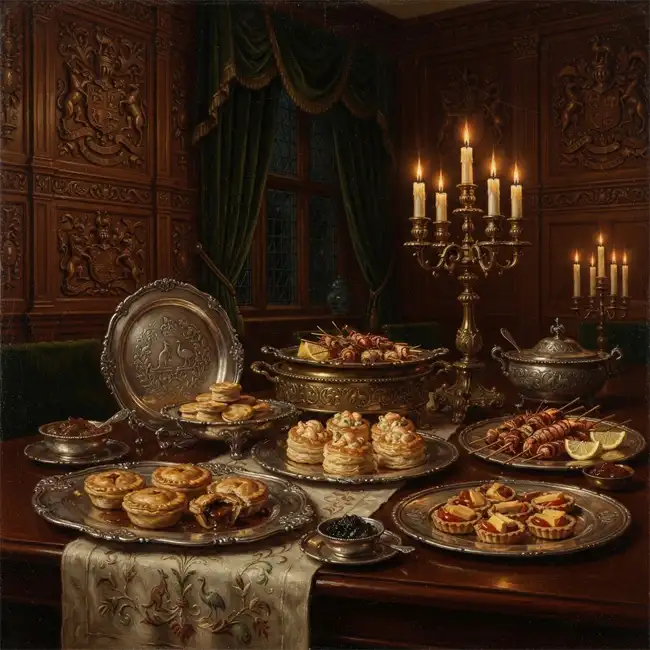
👑📜 The Storyteller’s Intro: The Starters Whispered About Before Dinner
Australia’s royal table is not a thousand-year procession of local kings, palace cooks, and sealed imperial recipe books. Its story is more intriguing—and more complicated—than that.
Australia is a constitutional monarchy, so the word “royal” belongs most naturally to official banquets, vice-regal households, Government Houses, visiting royal parties, and formal occasions shaped by British court customs. Alongside this ceremonial world stood wealthy pastoral families, colonial officials, merchants, military officers, and social elites whose dining rooms often imitated aristocratic Britain.
Yet the continent’s true food history begins much earlier. Aboriginal and Torres Strait Islander peoples have maintained sophisticated food knowledge connected to Country for tens of thousands of years. This knowledge cannot honestly be presented as “royal cuisine.” It belongs to distinct First Nations communities, cultural custodians, and living traditions. The National Museum of Australia describes a culinary journey extending across approximately 65,000 years of Indigenous culture.
So, when we unlock the story of Australia Royal Starters, we are really opening several historical doors.
🕰️ Era One: Ancient Food Knowledge Before the Colonial Table
• Long before formal European dining arrived, First Nations communities understood seasonal movement, controlled harvesting, fishing, hunting, plant foods, seed preparation, and the careful management of Country.
• Coastal communities drew food from tidal zones, rivers, estuaries, reefs, and mangroves.
• Inland food cultures followed water, flowering cycles, animal movements, roots, seeds, fruits, and insects.
• Ingredients now appearing on contemporary fine-dining menus—such as wattleseed, saltbush, finger lime, lemon myrtle, Kakadu plum, and warrigal greens—come from much older systems of knowledge.
• These ingredients should never be described as forgotten European discoveries. Respectful storytelling identifies their Indigenous origins and recognises that knowledge may be community-specific, protected, or unsuitable for unrestricted commercial use.
This is the oldest layer of Australian gastronomy, but it is not an aristocratic one. It forms a cultural foundation that modern chefs may engage with only through recognition, permission, responsible sourcing, and collaboration.
⚓ Era Two: Survival, Scarcity, and the Colonial Larder, 1788–1820s
When the First Fleet reached Sydney in 1788, ceremonial elegance was not the first concern. Food insecurity shaped the colony’s early years, and imported provisions were often poor or unreliable. Museums of History NSW notes that the settlement faced the threat of starvation during its earliest period.
Gradually, Government House dining rooms and the homes of senior officials became places where British social order was performed. A formal meal communicated rank, loyalty, wealth, and access to scarce ingredients.
Early starters were not always called “appetizers.” They might appear as first-course soups, fish, small savouries, dressed vegetables, patties, or cold preparations. At an important table, possible opening dishes included:
• Oyster patties in delicate pastry cases
• Small fish pies and savoury tartlets
• Potted or collared meats served in restrained portions
• Dressed crab or lobster presented on ornamental platters
• Clear broths, rich soups, and mock-turtle preparations
• Pickled vegetables and relishes from the household store
• Eggs dressed with herbs, anchovy-style seasonings, or savoury crumbs
• Local fish served according to familiar British dining conventions
The luxury was not always the ingredient itself. Sometimes the real sign of status was possessing a trained cook, imported tableware, ice, spices, fine flour, preserved condiments, and enough domestic labour to prepare several courses.
🏛️ Era Three: The Vice-Regal and Pastoral Elite Table, 1820s–1880s
By the nineteenth century, prosperous colonial households were developing gardens, dairies, orchards, poultry yards, smokehouses, and better-equipped kitchens. Historic Rouse Hill House preserves cookbooks and handwritten recipes accumulated across more than a century, revealing how food and generous hospitality shaped elite domestic life.
At Elizabeth Farm, associated with the Macarthur family, surviving letters and domestic spaces help visitors imagine the food served in an influential colonial household
The most fascinating starters from this era sit between imitation and adaptation. Colonial cooks brought British techniques but worked with Australian conditions. Imported culinary fashions encountered local seafood, game, produce, and warmer weather.
Among the evocative names and styles connected with elite colonial dining are:
• Oyster Patties: Small pastry shells suggesting refinement, abundance, and proximity to productive estuaries.
• Lobster Cutlets: Decorative portions shaped and crumbed for an elegant first course.
• Kangaroo Steamer: A renowned colonial adaptation related by food historians to British jugged-meat traditions. The National Museum of Australia notes that it has been described as one of the finest dishes of Australian colonial cookery.
• Fish in Savoury Jelly: A cool, elaborate presentation that displayed both kitchen skill and control over temperature.
• Curried Shellfish Tartlets: A reminder that colonial dining was influenced by maritime trade and British encounters with Asian cuisines.
• Pigeon or Game Patties: Compact savouries suited to a multi-course meal.
• Cold Fowl Mayonnaise: A carefully arranged dish rather than a casual sandwich filling.
• Stuffed Artichokes and Dressed Asparagus: Garden produce transformed into markers of cultivation and gentility.
• Mock Turtle Soup: A prestige imitation designed to reproduce the richness associated with an expensive banquet dish.
• Savoury Custards: Soft, seasoned preparations served in small dishes or ornamental moulds.
These were not necessarily secret recipes in the dramatic sense of being locked inside a palace vault. Their secrecy comes from disappearance. Some survived only in stained household notebooks, handwritten annotations, menu cards, newspaper columns, servants’ manuals, or cookbooks rarely opened today.
🌏 Era Four: Federation, National Identity, and Ceremonial Australia, 1880s–1940s
Approaching Federation in 1901, Australian cookbooks began to express a more recognisable local identity. The table still carried British formality, but regional produce and Australian naming became increasingly visible.
Elegant starters might now feature oysters from celebrated coastal districts, river fish, local lobster, poultry from country estates, asparagus from market gardens, and chilled fruit or vegetable preparations suited to the climate.
Dining was also becoming more public. Grand hotels, clubs, ocean liners, civic receptions, official luncheons, and military dinners produced printed menus as souvenirs. The Australian War Memorial holds around 1,300 historical menus that provide evidence of dining customs, status, ceremony, and changing tastes.
The hidden stars of this period include:
• Sydney rock oysters presented with restrained garnishes
• Tasmanian seafood savouries
• Chilled consommé for warm-weather formal dining
• Curried egg tartlets
• Sardine or fish-paste canapés
• Cucumber baskets filled with savoury mixtures
• Lobster medallions arranged for banquet service
• Cold chicken and herb moulds
• Miniature meat pies refined for reception tables
• Vegetable aspics decorated with garden herbs
👑 Era Five: Modern Royal Visits and the New Australian Table
Twentieth- and twenty-first-century royal hospitality gradually became less dependent on heavy European banquet conventions. The modern ceremonial table increasingly presents Australia through regional produce, clean flavours, multicultural influences, and a strong sense of place.
Today, an “Australian royal starter” might be understood as a small ceremonial dish designed to represent the nation. It could connect a coastline, farm, orchard, rainforest, or desert landscape to a formal guest experience.
The modern secret is not a single recipe. It is the art of expressing an enormous continent in a few carefully judged bites.
🗺️ The Royal Culinary Tourism: Mapping Flavors to Historic Landscapes
Australia’s historic food story becomes far more vivid when you leave the page and walk through the places where it unfolded.
Royal culinary tourism here is not limited to castles. The key landmarks are Government Houses, colonial homesteads, maritime precincts, old farms, kitchen gardens, dining rooms, hotel districts, ports, and regional markets.
• Sydney and Parramatta: Explore the early colony through historic houses, harbour landscapes, Government House traditions, and places such as Old Government House and Elizabeth Farm. Old Government House’s dining room was used by Governor Lachlan Macquarie for hospitality that carried both political and social meaning.
• The Rocks and Sydney Harbour: Imagine the contrast between working waterfront food, Aboriginal trading and fishing, merchant wealth, official dinners, and the oyster-rich estuaries surrounding the growing town.
• Canberra: Discover the ceremonial face of modern Australia through national collections, official institutions, historic menus, and exhibitions connecting food with national identity.
• Melbourne: Follow the legacy of gold-rush prosperity, grand hotels, civic banquets, fashionable dining rooms, and the multicultural influences that later transformed Australian starters.
• Hobart and the Derwent Valley: Connect cool-climate gardens, colonial architecture, orchards, seafood, and preserved foods with Tasmania’s distinctive heritage.
• Adelaide: Explore planned colonial elegance, central markets, garden produce, immigrant foodways, and access to native ingredients through responsible contemporary suppliers.
• Brisbane and southeast Queensland: Trace subtropical abundance through coastal seafood, macadamias, rainforest ingredients, and grand nineteenth-century residences.
• Perth and Fremantle: Link port history, Indian Ocean trade, seafood, wheat-growing districts, and later Mediterranean and Asian influences.
• Darwin and the tropical north: Encounter a food landscape shaped by First Nations cultures, monsoonal seasons, Asian connections, tropical plants, and maritime movement.
A thoughtful heritage itinerary does more than taste food. It asks who harvested it, who cooked it, who served it, who was invited to the table, and whose knowledge was left unnamed.
🚣 Cradle of Royal Delicacies: Harbours, Rivers, and Coastal Estates
Australia’s coasts and waterways supplied many of the ingredients most suited to an impressive first course. Seafood could look luxurious without requiring the heavy scale of a main dish.
Sydney Harbour and the surrounding estuaries are natural starting points. Oysters, fish, crustaceans, and shellfish could be transformed into patties, cutlets, soups, dressed platters, and cold banquet pieces. The harbour also connected kitchens to ships, imported goods, porcelain, spices, and new culinary ideas.
Farther south, Tasmania’s cold waters and colonial estates created another powerful heritage landscape. Historic visitors can connect seafood traditions with sandstone buildings, kitchen gardens, orchards, and old port communities.
Queensland’s coast offers a different palette. Mud crab has long been an important food for Aboriginal and Torres Strait Islander peoples, while macadamias originate in the rainforests of northeastern Australia. Tourism Australia highlights the longstanding Indigenous importance of coastal foods and the native origins of macadamias.
Potential heritage-inspired starter names from these landscapes include:
• Harbour Oyster Patties
• Colonial Lobster Cutlets
• Derwent Seafood Savouries
• Moreton Bay Shellfish Tartlets
• Coastal Fish and Herb Mould
• Port Phillip Garden Canapés
• Fremantle Spiced Fish Bites
• Macadamia-Crusted Coastal Savouries
These names should be treated as historical interpretations unless supported by a specific archival menu. That distinction keeps the storytelling exciting without presenting invention as documentary fact.
For travellers, the best coastal food journey combines historic architecture, maritime museums, Indigenous-led cultural experiences, seafood markets, and restaurants committed to transparent sourcing.
⛰️ Kingdom of Wild Aromatics & Heritage: Highlands, Forests, and the Interior
Australia’s mountains, forests, tablelands, and inland Country offer another collection of aromas—earthy seeds, citrus-like leaves, peppery berries, saline plants, orchard fruit, fungi, and game.
The Blue Mountains and New South Wales tablelands connect colonial travel routes, cool-climate gardens, old inns, and pastoral estates. Victoria’s high country carries stories of cattle stations, goldfields, migrant communities, and preserved foods. Tasmania’s forests and cool valleys offer mushrooms, herbs, orchard produce, and rich agricultural traditions.
In Western Australia, the southwest around Manjimup is known today for forest and farm produce, while the interior reveals food systems adapted to dramatically different ecological conditions. The tropical north brings Kakadu plum and other plants whose use is inseparable from Indigenous knowledge.
Tourism Australia identifies lemon myrtle, wattleseed, Kakadu plum, warrigal greens, saltbush, and finger lime among the native ingredients increasingly visible in contemporary Australian cuisine.
An aristocratic-inspired modern menu might suggest:
• Wattleseed Garden Tartlets
• Saltbush Vegetable Savouries
• Lemon Myrtle Coastal Bites
• Pepperberry Mushroom Patties
• Finger Lime Seafood Canapés
• Warrigal Greens Pastry Cases
• Macadamia and Herb Croquettes
• Highland Game Medallions
• Forest Mushroom Custards
• Kakadu Plum Glazed Savouries
These are not automatically ancient dishes. Most are contemporary concepts that place native ingredients inside European-derived forms such as tartlets, croquettes, patties, and canapés.
That difference matters. A native ingredient does not become “royal” simply because it appears on fine china. Its cultural origin remains connected to Country and to the people who have known, used, and cared for it across generations.
Responsible culinary tourism should therefore prioritise:
• Indigenous-owned or Indigenous-led experiences
• Accurate naming of communities and Country
• Ingredients sourced through ethical supply chains
• Permission before sharing restricted cultural knowledge
• Local guides who can explain landscape and seasonality
• Historic sites that acknowledge both colonial privilege and Indigenous continuity
❓🤴 Royal FAQ: Unlocking Palace Kitchen Mysteries
Q1.Did Australia really have secret royal appetizer recipes?
Not in the same way imagined in stories about ancient European palace kitchens. Australia’s royal and vice-regal food history is mainly preserved in menus, household cookbooks, letters, newspapers, institutional archives, and historic properties. The “secret” recipes are those that became obscure, remained handwritten, or disappeared when formal multi-course dining changed.
Q2.Was kangaroo commonly served at elite colonial tables?
Kangaroo appeared in colonial food culture and could be adapted through familiar British techniques. Kangaroo steamer became an especially notable example of colonial cookery. However, its presence varied by time, place, household, and social context. It should not be treated as the universal centrepiece of every grand Australian dinner.
Q3.Can native ingredients be called royal Australian ingredients?
That description should be used cautiously. Native ingredients have cultural histories far older than Australia’s monarchy or colonial institutions. They may appear in modern ceremonial dining, but their origins belong to Indigenous Country and knowledge systems. The most respectful language identifies the ingredient’s origin and credits Indigenous custodians where reliable information is available.
Q4.Where can travellers experience aristocratic Australian food history?
Historic homes, Government Houses, museums, heritage farms, maritime precincts, archives, and Indigenous-led food tours provide the strongest context. Rouse Hill House, Elizabeth Farm, Old Government House, national collections in Canberra, and heritage districts in Sydney, Melbourne, Hobart, Adelaide, Brisbane, Perth, and Fremantle are valuable starting points.
🧠 Final Thoughts: The Timeless Allure of Aristocratic Gastronomy
Australia’s royal starter tradition is not one unbroken cookbook. It is a layered archive.
At the front lies the polished ceremonial table: oyster patties, lobster cutlets, savoury moulds, decorated eggs, delicate fish dishes, garden vegetables, and carefully shaped canapés. Behind it stand colonial kitchens, domestic workers, market gardeners, fishing communities, pastoral estates, shipping routes, handwritten notebooks, and imported dining rules.
Beneath and beyond that colonial history lies something much older: the living food knowledge of Aboriginal and Torres Strait Islander peoples, grounded in Country rather than palace culture.
That is what makes the journey so compelling. Every hidden menu name opens a new trail—toward a harbour, homestead, rainforest, tableland, archive, market, or historic dining room.
Future pages in this collection can unlock each dish individually, separating documented heritage recipes from carefully labelled modern interpretations. Oyster patties may reveal the story of an estuary. Kangaroo steamer may expose the tensions of colonial adaptation. Wattleseed tartlets may begin a conversation about ethical sourcing and cultural credit.
👑 Credit to the Keepers of the Culture: The Legacy
This culinary history exists because people preserved it.
Respect is due to Aboriginal and Torres Strait Islander peoples, the Traditional Custodians of the lands and waters from which Australia’s oldest food knowledge comes. Their cultures are living, diverse, and connected to specific communities and Country.
Recognition also belongs to archivists, librarians, museum curators, historians, cooks, farmers, fishers, gardeners, domestic workers, recipe writers, heritage volunteers, and families who protected fragile menus and handwritten books.
Their work reminds us that culinary history is never only about what appeared on the plate. It is about land, labour, memory, access, identity, and the people whose knowledge made every meal possible.
👑🥪 The Lost Banquet: How I Found Australia's Hidden Aristocratic Recipes
👉 Discover Secret Australian Royal Starters
| 🌐 👑🥪 < Back | Next > 🍝👑 🇦🇺 |