
🏠 Home > 🗺️ Recipes > 👑🍨 Grand Finales (Desserts) > 🇧🇷 Brazil Grand Finales (Desserts) Recipes
🇧🇷 👑🍨 Brazil Grand Finales (Desserts) Recipes
Published by Supakorn | Updated: September 2026
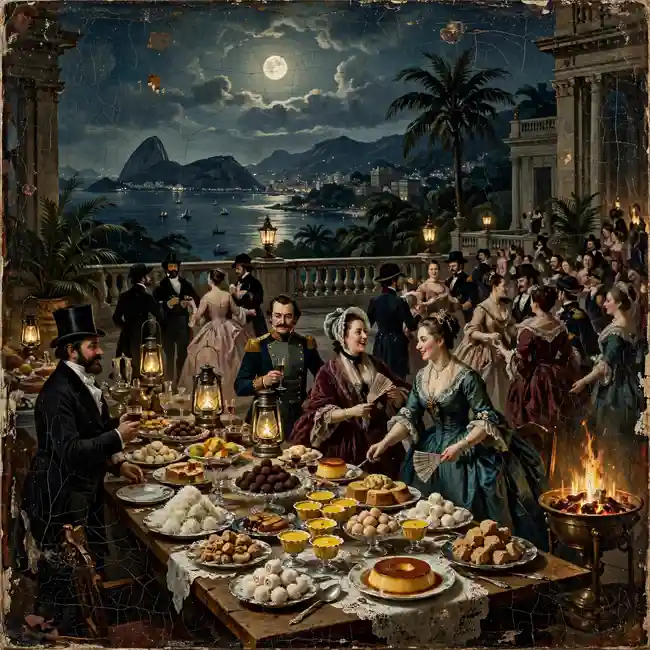
🤴📜 The Storyteller’s Intro: Secrets Once Reserved for Brazil’s Grandest Tables
Imagine stepping into a grand Brazilian residence centuries ago.
The afternoon sun is beginning to soften. The long meal is slowly coming to an end. Conversations drift through shaded rooms, porcelain plates are cleared away, and then comes the moment everyone has been waiting for: the grand finale.
Dessert.
But in Brazil, the story of dessert is much bigger than sugar, fruit, milk, and celebration. Brazilian sweets carry the memory of Indigenous ingredients, Portuguese culinary traditions, African influences, regional farming cultures, convent kitchens, imperial households, aristocratic dining rooms, and generations of families who transformed simple ingredients into unforgettable treasures.
For Brazil, the phrase “Royal Culinary Secrets” needs a little historical adjustment. Brazil does not have an ancient European-style royal culinary tradition stretching back a thousand years. However, Brazil did experience powerful elite culinary cultures through the Portuguese colonial period and later through the Empire of Brazil, especially during the nineteenth century.
That is why the world of Brazilian Grand Finales is best understood as a meeting point between imperial elegance, aristocratic hospitality, convent traditions, plantation-era wealth, regional ingredients, and popular celebrations.
The story stretches across several major historical periods.
🏛️ Indigenous Foundations Before European Colonization
Long before Portuguese ships arrived, Indigenous communities across what is now Brazil had developed sophisticated relationships with the land.
Cassava, native fruits, nuts, honey, maize, and countless forest ingredients were already part of everyday life.
These ingredients would eventually become essential to Brazilian dessert traditions. Cassava, for example, became one of the great foundations of Brazilian cooking. Native fruits introduced flavors that could not easily be reproduced anywhere else in the world.
The idea of sweetness in Brazil was therefore never limited to imported European ingredients. The landscape itself offered remarkable possibilities.
⚓ Colonial Brazil and the Arrival of Sugar Culture
From the sixteenth century onward, Portuguese colonization dramatically transformed Brazilian food culture.
Sugar became one of the defining forces of the colonial economy, particularly along the northeastern coast.
With sugar came an explosion of confectionery traditions.
Portuguese culinary techniques met Brazilian ingredients, while African knowledge and labor profoundly shaped the food systems that supported colonial society. Over time, kitchens became places where different cultures interacted, adapted, and created something new.
This was the era when sweet preserves, egg-based confections, coconut sweets, fruit pastes, and elaborate desserts began developing into recognizable Brazilian traditions.
For wealthy households, serving sweets could represent hospitality, refinement, status, and celebration.
⛪ Convent Kitchens and the Art of Refined Sweets
Religious institutions also played an important role in the history of confectionery.
Across Portuguese-influenced culinary traditions, convent kitchens became associated with elaborate sweets, particularly those using egg yolks, sugar, and carefully controlled cooking techniques.
Brazil inherited and adapted many of these traditions.
The result was not simply an imitation of European desserts. Local ingredients changed the character of the recipes. Tropical fruits, cassava, coconut, and regional sugar transformed imported culinary ideas into distinctly Brazilian expressions.
Some of the most fascinating stories surrounding historic Brazilian desserts come from this meeting between formal European techniques and the abundance of the Brazilian landscape.
👑 The Imperial Era and the Rise of Grand Dining
The nineteenth century brought another important chapter.
Brazil became the center of the Portuguese monarchy after the royal court relocated to Rio de Janeiro in the early nineteenth century. Later, Brazil became an empire.
This period introduced new forms of elite dining and expanded the influence of European culinary fashions.
Grand residences and formal gatherings increasingly connected food with social identity.
Desserts could become elaborate statements.
Imported porcelain, refined serving traditions, preserved fruits, molded sweets, pastries, creams, and carefully arranged final courses helped define the dining experience of affluent households.
Yet even at the most elegant tables, Brazil remained Brazil.
Local ingredients refused to disappear.
Coconut remained important. Tropical fruits remained irresistible. Cassava continued to shape regional food traditions. Native nuts and fruits continued to offer flavors unavailable in European kitchens.
This is what makes Brazilian historic desserts so fascinating.
The story is not about copying a palace menu from another continent.
It is about watching Brazil transform the idea of luxury into something uniquely its own.
🏡 The Aristocratic Table and Everyday Brazilian Life
Old Brazilian elite dining traditions were also connected to hospitality.
Meals were social occasions.
Families gathered. Guests stayed for conversation. Important celebrations could extend over long periods. Food was not simply consumed; it helped create relationships.
Desserts often represented the final gesture of generosity.
A preserved fruit could demonstrate patience.
A carefully prepared coconut sweet could demonstrate skill.
A beautifully arranged dessert table could communicate abundance.
And behind every formal dining tradition were countless cooks, household workers, farmers, confectioners, Indigenous communities, and regional food traditions whose knowledge helped shape Brazilian cuisine.
That is why the most respectful way to explore these desserts is not to imagine that history belonged only to emperors and aristocrats.
Brazilian culinary heritage belongs to a much larger community.
The grand tables may have preserved certain traditions, but the flavors were created through generations of cultural exchange.
🍬 The Hidden Stars of Brazil’s Grand Dessert Heritage
Before exploring Brazil through culinary tourism, it is worth meeting some of the legendary desserts and sweet traditions that help define the country.
🍮 Quindim
Quindim is one of Brazil’s most recognizable golden desserts.
Its brilliant yellow color immediately suggests richness and celebration. The dessert is strongly associated with egg yolks, sugar, and coconut.
Its history reflects the wider story of Brazilian confectionery: European techniques transformed through local ingredients and Brazilian cultural influences.
Today, quindim remains a symbol of elegance and nostalgia.
🥥 Cocada
Cocada represents another important side of Brazil’s sweet heritage.
Coconut became deeply connected with Brazilian confectionery, especially in coastal regions where tropical ingredients shaped everyday life.
The simplicity of cocada is part of its charm.
It demonstrates an important lesson from historic Brazilian kitchens: luxury does not always require a long list of ingredients.
Sometimes the secret is understanding one ingredient perfectly.
🌰 Doce de Leite
Milk-based sweets became another major part of Brazil’s culinary identity.
Doce de leite appears in different forms across South America, but Brazilian regional traditions developed their own personalities and textures.
Its comforting richness makes it feel both humble and luxurious.
It can belong to a family kitchen, a traditional celebration, or an elegant dessert presentation.
🍌 Bananas and Caramelized Fruit Traditions
Brazil’s extraordinary fruit diversity created countless possibilities for sweet dishes.
Bananas, guavas, papayas, pineapples, mangoes, and other fruits could be preserved, cooked, transformed into pastes, or presented as part of elaborate desserts.
Historic preservation techniques were especially important before modern refrigeration.
A fruit harvest could be transformed into something that lasted for months.
In this way, dessert became connected with the agricultural calendar.
🍯 Goiabada
Goiabada, the famous guava preserve, is one of Brazil’s great culinary icons.
Dense, fragrant, and intensely fruity, it represents the art of preservation.
In historic kitchens, turning fruit into a durable sweet was both practical and creative.
Today, goiabada remains deeply connected with Brazilian identity and regional food culture.
🧀 Romeu e Julieta
Few combinations feel as charmingly Brazilian as the pairing often called Romeu e Julieta.
The relationship between sweet guava paste and cheese demonstrates the Brazilian love of contrast.
Sweetness meets saltiness.
Fruit meets dairy.
Rustic ingredients become an elegant finish.
It may look simple, but its cultural importance is enormous.
🗺️ The Royal Culinary Tourism: Mapping Flavors to Historic Landscapes
To understand Brazil’s historic dessert traditions, you cannot stay inside a kitchen.
You have to travel.
Brazil is enormous.
Its culinary geography changes dramatically from one region to another. The landscapes that produced the ingredients also helped shape the desserts.
For travelers interested in Brazilian culinary heritage tourism, desserts provide an unusually delicious map.
🏙️ Rio de Janeiro: Imperial Memories and Grand Urban Tables
Rio de Janeiro holds a special place in Brazil’s imperial history.
During the nineteenth century, the city became deeply connected with the Portuguese royal court and later the Brazilian Empire.
For visitors interested in aristocratic and imperial culinary history, Rio offers a powerful setting.
Historic architecture, museums, old neighborhoods, cultural institutions, and traditional food establishments create opportunities to imagine the social world of earlier centuries.
A culinary traveler can explore how European dining fashions arrived in Brazil and gradually became Brazilian through local ingredients and cultural adaptation.
The dessert story here is connected with refinement, hospitality, and urban transformation.
🏛️ Minas Gerais: Sweet Heritage Among Historic Towns
Minas Gerais is one of the most important destinations for travelers interested in traditional Brazilian sweets.
Historic towns, colonial architecture, religious heritage, and regional food traditions create a powerful culinary atmosphere.
This is a landscape where preserved fruits, milk sweets, cheese traditions, and handmade confectionery feel connected to history.
Walking through an old town in Minas Gerais can feel like entering a living archive.
The dessert culture is not locked inside museums.
It survives through local shops, family traditions, regional celebrations, and artisanal producers.
For travelers searching for authentic historic Brazilian desserts, Minas Gerais deserves serious attention.
🌴 Bahia: Sugar, Coconut, and Afro-Brazilian Culinary Heritage
Bahia represents another essential chapter.
The region’s history is closely connected with sugar production, colonial society, African cultural influence, and tropical ingredients.
Coconut, sugar, fruit, and traditional techniques helped create a rich world of sweets.
For culinary travelers, Bahia offers more than a list of dishes.
It offers context.
Markets, historic districts, coastal landscapes, and traditional communities reveal how food developed through centuries of cultural interaction.
The story is beautiful, but it should also be approached honestly.
Brazilian culinary history includes colonial inequality and forced labor. The wealth of elite tables often depended upon systems that caused enormous human suffering.
Respectful food tourism should therefore celebrate creativity while recognizing the full historical context behind the cuisine.
That deeper understanding makes the journey more meaningful.
🚣 Cradle of Imperial Delicacies: Brazil’s Rivers, Coastlines, and Sweet Landscapes
Brazil’s coastlines and river systems helped create some of the country’s most distinctive culinary identities.
Waterways moved people, ingredients, and ideas.
Ports connected Brazil with Portugal, Africa, and other parts of the world.
Coastal regions provided coconuts and tropical fruits. River communities contributed local ingredients and preservation knowledge.
🥥 The Northeastern Coast
The northeastern coastline became one of the great centers of Brazilian sugar history.
This region played an enormous role in the development of confectionery.
Coconut sweets, fruit preserves, sugar-based desserts, and regional specialties became deeply rooted in local culture.
For travelers, the experience is not limited to eating.
Historic coastal cities provide architectural context. Old churches, colonial streets, markets, and cultural festivals help visitors understand how food developed within larger social histories.
🌊 The Amazon Basin and Native Fruit Traditions
Brazil’s northern regions introduce a completely different world of flavors.
The Amazon contains an extraordinary diversity of fruits, nuts, and plant ingredients.
While not every traditional sweet from the region belongs to an aristocratic history, the Amazon demonstrates something even more important: Brazilian culinary luxury can come directly from biodiversity.
A fruit unknown to most of the outside world can be more extraordinary than an imported ingredient.
For modern culinary tourism, exploring Indigenous food knowledge and regional ingredients should be done with respect for local communities and their cultural ownership.
The future of Brazilian gastronomy may depend on protecting these traditions rather than simply commercializing them.
⛰️ Kingdom of Wild Aromatics & Heritage: Mountains, Forests, and Hidden Sweet Traditions
Brazil may be famous for tropical beaches, but mountains, forests, interior regions, and highland communities also shaped the country’s food heritage.
🏔️ Minas Gerais and the Mountain Pantry
The landscapes of Minas Gerais encouraged food traditions based on preservation, dairy, fruit, and regional agriculture.
Historic households often needed ingredients that could survive seasonal changes and long distances.
Preserves became practical treasures.
Milk became the foundation of beloved sweets.
Cheese developed into an essential partner for fruit-based desserts.
For travelers interested in historic Brazilian food routes, this region offers one of the strongest connections between landscape and culinary identity.
🌳 Forest Ingredients and Native Knowledge
Brazil’s forests contributed ingredients that expanded the possibilities of dessert.
Native fruits, nuts, roots, and natural sweeteners created flavors that could never have been invented in European kitchens alone.
This is where the idea of an “imperial dessert secret” becomes more interesting.
The greatest secret may not have been hidden behind palace doors.
It may have been growing in the landscape.
Brazilian cuisine became extraordinary because different communities understood the land in different ways.
A modern visitor should approach these traditions with curiosity and respect.
The goal should not be to “discover” what local communities already know.
The goal should be to learn.
🤴👸 Royal FAQ: Unlocking Brazil’s Imperial Kitchen Mysteries
Q1.Was Brazil really home to royal and imperial dessert traditions?
Yes, but the story requires historical accuracy.
Brazil experienced the arrival of the Portuguese royal court in the early nineteenth century and later became the Empire of Brazil.
Elite households and formal dining traditions existed, and European culinary influences affected high-society dining.
However, many famous Brazilian desserts developed through broader cultural exchanges involving Indigenous, African, Portuguese, regional, and working-class traditions.
It would be inaccurate to label every historic Brazilian sweet as a palace recipe.
Q2.What makes Brazilian aristocratic desserts different from European desserts?
The ingredients.
Brazilian cooks adapted formal techniques to local realities.
Coconut changed confectionery.
Guava created entirely new possibilities.
Cassava offered textures unfamiliar to many European traditions.
Tropical fruits introduced powerful aromas and colors.
Brazilian desserts became distinctive because imported culinary traditions met local landscapes.
Q3.Which regions are best for historic Brazilian dessert tourism?
Several regions deserve attention.
Rio de Janeiro offers important imperial history.
Minas Gerais is famous for traditional sweets, dairy traditions, historic towns, and artisanal food culture.
Bahia provides essential insights into sugar history, coconut-based sweets, and Afro-Brazilian culinary heritage.
Northern regions offer remarkable opportunities to explore native fruits and biodiversity.
The best journey depends on whether you are more interested in imperial history, colonial architecture, regional sweets, or Indigenous ingredients.
Q4. Are these desserts still part of modern Brazilian life?
Absolutely.
That is one of the most beautiful things about Brazilian dessert culture.
Historic influences survive in modern homes, bakeries, celebrations, family gatherings, and regional food traditions.
A dessert can carry centuries of history while still feeling completely alive.
That is what makes culinary heritage powerful.
🧠 Final Thoughts: The Timeless Allure of Brazilian Aristocratic Gastronomy
Brazil’s grand dessert heritage is not a single locked recipe book.
It is a vast archive of memories.
Some chapters belong to imperial dining rooms.
Some belong to convent kitchens.
Some belong to historic towns.
Some belong to Indigenous knowledge.
Some belong to African-Brazilian culinary traditions.
Some belong to families who quietly preserved their favorite sweets for generations.
That is why exploring Brazil Grand Finales (Desserts) is so exciting.
Every dessert opens another door.
A golden quindim can lead to conversations about cultural exchange.
A piece of goiabada can lead to the history of preservation and agriculture.
A coconut sweet can reveal the importance of coastal landscapes.
A traditional milk dessert can take us toward the mountains and historic communities of Minas Gerais.
For travelers, this is an invitation to map Brazil through flavor.
For food lovers, it is an invitation to look beyond the obvious.
And for anyone fascinated by historic cuisine, the most exciting discovery may be this:
The greatest culinary secrets are rarely hidden because nobody knows them.
They become hidden because people stop asking about the stories behind them.
So this journey does not end here.
Think of this page as the first chapter of a larger Brazilian dessert archive.
In the pages to come, individual legendary desserts can finally step into the spotlight.
Each one deserves its own story.
Its own historical journey.
Its own cultural context.
And, eventually, its own carefully explored recipe.
Until then, keep your curiosity ready.
Brazil still has many sweet secrets waiting behind the next historic doorway.
👑 Credit to the Keepers of the Culture: Honoring Brazil’s Living Culinary Legacy
Brazilian culinary heritage deserves respect.
The flavors discussed in this journey were not created by one palace, one emperor, or one social class.
They were shaped through centuries of interaction among Indigenous peoples, African communities and their descendants, Portuguese traditions, immigrants, farmers, confectioners, family cooks, artisans, and regional communities across one of the world’s largest and most diverse countries.
The people who preserve these traditions today deserve recognition.
They include:
• Indigenous communities protecting knowledge connected with native ingredients and landscapes.
• Afro-Brazilian communities whose cultural influence is fundamental to Brazilian food history.
• Traditional family cooks passing techniques between generations.
• Artisanal confectioners preserving regional sweets.
• Farmers protecting historic crops and local ingredients.
• Cultural researchers documenting food traditions.
• Museum workers and historians connecting cuisine with the wider story of Brazil.
• Small communities maintaining local festivals and culinary customs.
• Modern chefs who explore heritage without forgetting its origins.
The highest form of culinary admiration is not simply copying a historic dish.
It is understanding where it came from.
It means recognizing the hands that carried the knowledge forward.
It means respecting cultural ownership.
It means protecting local ingredients and landscapes.
And it means remembering that food history belongs to real people.
Brazil’s grand finales are therefore more than desserts.
They are edible memories.
They are stories of migration, adaptation, celebration, hardship, creativity, and survival.
The imperial tables may have disappeared.
Old aristocratic houses may have changed.
Historic kitchens may now exist only in photographs, archives, and imagination.
But the flavors continue.
They survive whenever someone prepares a traditional sweet.
Whenever a family shares a dessert at the end of a meal.
Whenever a traveler enters a historic Brazilian town and discovers a local confectionery tradition.
Whenever a new generation asks an older generation:
“How did you make this?”
That question may be the most important culinary secret of all.
Because every time it is asked, the legacy continues.
And Brazil’s extraordinary story of sweetness lives on.
👑🍨 The Imperial Kitchen Secrets: Unveiling Brazil’s Lost Royal Desserts
👉 Discover Iconic Brazilian Grand Finales
| 🌐 👑🍨 < Back | 🇧🇷 👑🍝 < Previous | Next > 🍷👑 🇧🇷 |