
🏠 Home > 🗺️ Recipes > 👑🍱 Royal Court Side-Bites (Snacks) > 🇧🇷 Brazil Royal Court Side-Bites (Snacks) Recipes > 👑🍱 1.Imperial Golden Quindim
👑🍱 Quindim: The Forgotten Golden Dessert of Brazil's Imperial Court
Published by Supakorn | Updated: September 2026
Have you ever wondered what dessert an empress would actually crave? Not something mass-produced, not something you'd find in every bakery window — but a treat so rich, so labor-intensive, that only the wealthiest households could afford to make it? Well, grab a seat, because today we're digging into one of Brazil's most beautifully guarded culinary secrets: Quindim, the golden egg-yolk dessert that once graced the tables of Brazil's imperial elite.
This isn't your average recipe post. We're going back in time, dusting off the silverware, and bringing this Lost Royal Recipe back to life — right in your own kitchen.
🏰 The Forgotten Royal Legacy of Brazil: The House of Bragança
📖 The Storyteller's Intro
Picture this: it's the early 1800s, somewhere along the sugar plantations of Pernambuco and Bahia. Portugal's royal family, fleeing Napoleon's advancing armies, has just relocated the entire Portuguese court across the Atlantic to Rio de Janeiro. Brazil suddenly becomes home to kings, dukes, and countesses — and with them comes an entirely new standard of luxury dining. Sugar, once a humble crop, becomes a currency of prestige. Egg yolks, considered "wasteful" by peasant cooks who needed the whites for other purposes, become the star ingredient of the elite. Somewhere in a convent kitchen or an aristocratic household, someone combines yolks, sugar, and coconut into a dense, custard-like cake — and Quindim is born.
🌍 The Global Value
Here's the thing most people don't realize: Quindim wasn't always the cheerful little dessert you might spot at a Brazilian bakery today. In its earliest form, it was a luxury item, reserved almost exclusively for the tables of Brazil's aristocracy and the Portuguese-Brazilian imperial court under Emperor Pedro II. Egg yolks were considered precious back then — convents used the whites to starch clothing and clarify wine, leaving mountains of yolks that eventually found their way into extravagant, sugar-heavy sweets served only on special occasions. Over generations, as sugar and eggs became more accessible, the recipe slowly filtered down from palace kitchens to everyday households — and much of its original "royal" preparation ritual was lost along the way.
🔓 The Collection
That's exactly what we're bringing back today. This article isn't just a recipe — it's a restoration project. We've pieced together the techniques, ratios, and rituals that made Quindim a dish fit for royalty, and we're handing them straight to you. No fluff, no shortcuts that ruin the texture — just the real deal.
🍮 Recipe: Imperial Golden Quindim
📜 About this Royal Secret
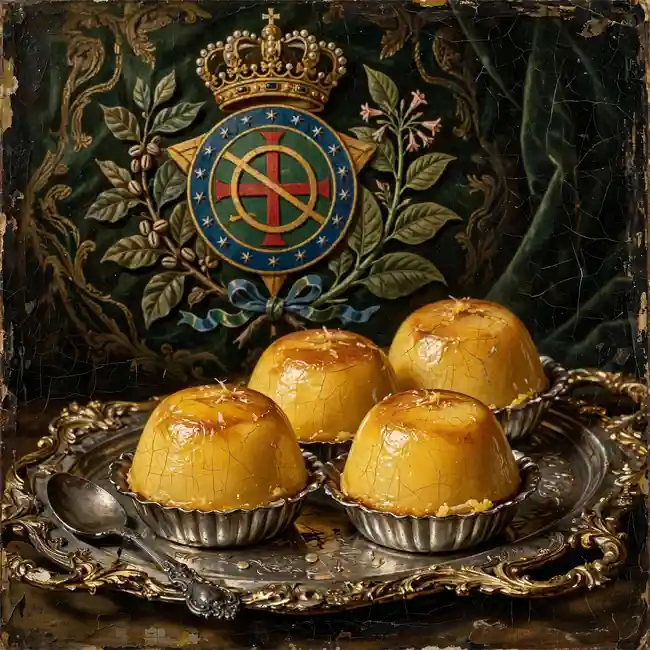
Legend has it that Quindim was a favorite treat served during formal receptions at the imperial court in Rio de Janeiro, often presented on ornate silver trays alongside coffee for visiting dignitaries. Its glossy, golden-yellow top wasn't just for looks — that shine was considered a sign of a cook's skill, since achieving that perfect glaze without curdling the eggs required real technique. Servants and convent bakers who mastered this dish were said to be highly prized in aristocratic households, sometimes even "borrowed" between noble families for special banquets. Whether that part is folklore or fact, one thing's for sure: this dessert was never meant to be rushed.
🥥 Ingredients & The Aristocratic Touch
• The Royal Pantry
Back in the day, every ingredient in this dessert represented wealth. Sugar was Brazil's biggest export and a literal symbol of status. Egg yolks, considered a "wasteful luxury" by working-class cooks, showed that a household could afford to throw away perfectly good egg whites. And coconut, harvested fresh along Brazil's tropical coastline, added a fragrant, exotic touch that impressed European guests unfamiliar with the ingredient. Together, these three elements created a dessert that practically announced, "this house has money."
• Modern Substitutes
Don't worry, you don't need a palace pantry to make this. Here's how to keep it accessible without losing that rich, authentic flavor:
◦ If you don't have fresh coconut, unsweetened shredded coconut works just fine — just make sure it's unsweetened, or your quindim will turn out overly sweet.
◦ Egg yolks are non-negotiable for authenticity, but if you're short a few, you can supplement with one whole egg for every 3 yolks missing (though the texture will be slightly lighter).
◦ No individual ramekins? A muffin tin works perfectly as a substitute for the traditional small brass molds used in old Brazilian kitchens.
• The Measurements
Here's what you'll need, based on a batch that yields about 8 to 10 individual portions:
◦ 12 large egg yolks
◦ 2 cups (about 400 grams) of granulated sugar
◦ 1 and a half cups (about 150 grams) of unsweetened shredded coconut
◦ 2 tablespoons of unsalted butter, melted (for greasing molds)
◦ A pinch of salt
◦ 1 tablespoon of sugar mixed with a touch of butter, for caramelizing the molds
🔨 The Chef's Ritual
1.Prepare the molds. Generously butter each ramekin or muffin cup, then dust with a thin layer of sugar, tilting the mold so it coats evenly. This creates that signature golden caramel crust once baked.
2.Whisk the yolks and sugar. In a large bowl, gently whisk the egg yolks with sugar until smooth. Take your time here — the imperial cooks believed that rushing this step led to a grainy, unglamorous texture.
3.Fold in the coconut. Add the shredded coconut and a pinch of salt, stirring until fully combined. The mixture should look thick, pale, and fragrant.
4.Strain for silkiness. For an ultra-smooth, palace-worthy finish, pass the mixture through a fine sieve before pouring. This step was traditionally reserved for the most important banquets.
5.Pour and prepare the bain-marie. Fill each prepared mold about three-quarters full, then place the molds inside a larger baking pan filled with hot water, reaching halfway up the sides of the molds.
6.Bake slowly. Bake at 350 degrees Fahrenheit / 175 degrees Celsius for about 40 to 50 minutes, or until the tops turn a deep golden color and a knife inserted comes out clean.
7.Cool and chill. Let the quindims cool at room temperature, then refrigerate for at least 2 hours before unmolding. Patience here is everything — rushing this step was considered a rookie mistake even in royal kitchens.
8.Unmold with care. Run a thin knife around the edges, then flip gently onto a plate. The glossy caramel top should sit proudly on display.
🗝️ Secrets of the Palace Kitchen (Tips & Mistakes)
• Never rush the whisking stage — beating too aggressively introduces air bubbles that ruin the dense, custard-like texture true Quindim is known for.
• Always use a water bath (bain-marie). Baking directly without one causes the eggs to overcook and turn rubbery instead of silky.
• Avoid sweetened coconut flakes. Old recipes relied on naturally sweetened fresh coconut, so using pre-sweetened shredded coconut throws off the entire balance.
• Let it chill fully before unmolding. Warm quindim falls apart; a properly rested one holds its shape beautifully.
• Don't skip the sugar-butter coating on the molds — this is what creates that iconic caramelized shell that made this dessert so visually striking at royal gatherings.
• If the top cracks while baking, your oven is likely too hot. Lower the temperature slightly and bake a touch longer for an even, glossy finish.
🤴👑 Royal FAQ
Q1.Is Quindim actually from Portugal or Brazil?
Great question! Quindim's roots trace back to Portuguese convent sweets, but it was refined and popularized in Brazil, especially during the colonial and imperial periods, making it a true Luso-Brazilian creation.
Q2.Can I make this dessert ahead of time for a dinner party?
Absolutely — in fact, it's better made a day in advance. Quindim tastes even richer after resting overnight in the fridge, which also makes it a stress-free make-ahead option for hosting.
Q3.Why does my quindim look pale instead of golden?
This usually means it needs a bit more baking time, or your oven temperature ran cool. The golden color develops from the caramelized sugar coating and properly baked yolks, so give it those extra few minutes.
Q4.Is this dessert very sweet?
It's rich, but not overwhelmingly sweet if made with unsweetened coconut. The natural nuttiness of the coconut balances beautifully with the sugar, giving it a more complex flavor than a typical dessert.
🕰️ The Taste of History (Summary)
At its core, Quindim is proof that some of the world's best recipes come from resourcefulness dressed up as luxury. What began as a clever use of "leftover" egg yolks in convent kitchens transformed into a dessert fit for emperors, dukes, and diplomats. Its glossy golden top, delicate custard interior, and subtle coconut aroma tell a story of colonial wealth, culinary skill, and a touch of royal theater — all wrapped up in one small, unforgettable bite.
🕊️ Final Thoughts: Bringing History to Your Table
Look, you don't need a palace kitchen, a team of servants, or a royal title to enjoy this dessert the way Brazil's aristocracy once did. With a little patience and the right technique, this centuries-old recipe can absolutely come alive on your own kitchen counter tonight. That's really the beauty of Lost Royal Recipes — they were never meant to stay locked away forever. They were meant to be shared, remembered, and enjoyed by anyone willing to put in a little love and effort.
🗝️ The Call to Action (The Golden Hook)
If you find yourself falling in love with the rich, golden history behind dishes like this one, you're not alone. There's an entire world of forgotten royal and aristocratic recipes just waiting to be rediscovered — from hidden palace desserts to imperial dinner staples that time nearly erased. Join us as we continue uncovering these culinary treasures, one recipe at a time, and help keep these stories alive for generations to come.
🙏 Credit to the Keepers of the Culture
This recipe and its history exist today because of the countless convent cooks, home bakers, and Afro-Brazilian and Portuguese-Brazilian culinary traditions that preserved and passed down these techniques over centuries — often without recognition. We owe a deep debt of gratitude to the generations of Brazilian home cooks and cultural historians who kept dishes like Quindim alive, ensuring that this small but mighty piece of imperial history never truly disappeared. This article is our small way of honoring that legacy and sharing it with a wider audience.
| 🇧🇷 👑🍱 < Back |