
🏠 Home > 🗺️ Recipes > 🍲 Soups > 🇩🇰 Denmark Soups > 🍲 1.Hønsekødssuppe
🍲 Cozy Danish Soup Classics, Lightened Up: Low-Carb Hønsekødssuppe with Meatballs & Dumplings
Published by Supakorn | Updated: November 2026
🇩🇰 Introduction – Discover Hønsekødssuppe: Authentic Danish Comfort Food
Picture a chilly evening in Copenhagen. The wind is coming off the harbor, and the candles are already lit. You step into a warm home and smell something rich and savory. On the table there's a big pot of golden broth full of tiny meatballs, soft dumplings, and bright vegetables. Welcome to hønsekødssuppe, Denmark's much-loved chicken soup and a real taste of hygge.
Plenty of people know Denmark for its colorful harbor houses, its bikes, its pastries, and its cozy way of life. Visitors who travel past the tourist spots soon find out that Danish home cooking is the real treasure. It's simple and honest, and it's made to warm you from the inside out. Soup has a special place there. For generations, Danish families have opened birthdays, confirmations, and big Sunday get-togethers with a steaming bowl of clear soup. It's the start of the famous celebration menu known as "suppe, steg og is", which means soup, roast, and ice cream.
Here's the problem if you're eating low-carb or keto: classic Danish soups usually come with flour-based dumplings, and the meatballs are often bound with flour or breadcrumbs. Do you have to skip them? Not at all!
This is an authentic, traditional hønsekødssuppe recipe adapted for the home kitchen and gently reworked to be low-carb. You still get the slow-simmered broth, the juicy little kødboller (meatballs), and the tender melboller (dumplings). The only real change is a few smart swaps, so it tastes just as cozy and fits your goals.
So grab your biggest pot, put on some music, and let's make a proper Danish soup together. Your kitchen is about to smell amazing. 🥣
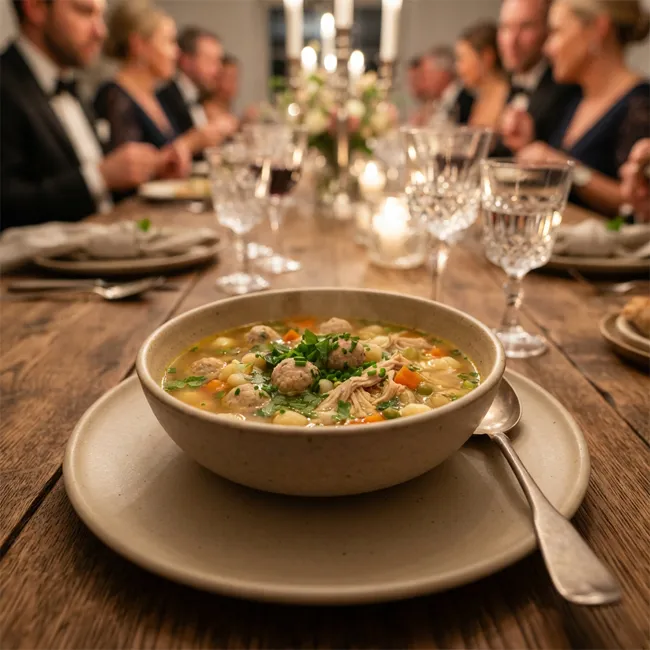
🍲 Authentic Hønsekødssuppe Recipe
📖 Culinary Background & Flavor Profile
Hønsekødssuppe translates to "hen meat soup," and it's about as old-school Danish as food gets. Traditionally, cooks simmered an older laying hen for hours. That gave a deeply flavored broth, and the meat went into the soup or got saved for other dishes. Nothing went to waste, which is classic Scandinavian thinking.
Here's what you can expect:
• The broth: Clear, golden, and full of savory chicken flavor, with soft notes of leek, celeriac, bay leaf, and thyme. It's light but satisfying.
• The meatballs (kødboller): Small, soft pork meatballs seasoned with onion, black pepper, and a hint of allspice. That warm spice is very Nordic.
• The dumplings (melboller): Soft, pillowy little dumplings that soak up the broth. Our almond-flour version keeps that tender bite with far fewer carbs.
• The vegetables: Sweet celeriac, a little carrot, and silky leek give you color and texture without loading up on starch.
Every spoonful has a bit of everything: rich broth, a juicy meatball, a soft dumpling, and fresh herbs. It's simple food made really well, and that's what makes it so good.
🧂 Essential Ingredients & Precise Measurements
Makes 6 generous servings
✦ For the Golden Chicken Broth:
◦ 1 whole chicken, about 1.6–1.8 kg (3.5–4 lb). Use a stewing hen if you can find one.
◦ 2.5 liters (about 10.5 cups) cold water
◦ 1 yellow onion, halved, skin on for extra golden color
◦ Green tops of 1 large leek, washed well
◦ 1 small piece of celeriac peel or 2 celery stalks
◦ 2 bay leaves
◦ 4–5 fresh thyme sprigs (or 1 teaspoon dried thyme)
◦ 10 whole black peppercorns
◦ 2 teaspoons sea salt (adjust at the end)
✦ For the Low-Carb Meatballs (Kødboller):
◦ 400 g (14 oz) ground pork, ideally 10–15% fat
◦ 1 small onion, very finely grated
◦ 1 large egg
◦ 2 tablespoons fine almond flour
◦ 3 tablespoons heavy cream or cooled broth
◦ 1 teaspoon sea salt
◦ ½ teaspoon freshly ground black pepper
◦ ¼ teaspoon ground allspice
✦ For the Low-Carb Dumplings (Melboller):
◦ 120 ml (½ cup) water
◦ 60 g (4 tablespoons) unsalted butter
◦ ¼ teaspoon sea salt
◦ 80 g (about ¾ cup) fine blanched almond flour
◦ 1 teaspoon psyllium husk powder (or ½ teaspoon xanthan gum)
◦ 2 large eggs, at room temperature
◦ 1 small pinch of ground nutmeg (optional, but very traditional)
✦ For the Soup Vegetables:
◦ 200 g (7 oz) celeriac, peeled and cut into small cubes
◦ 1 medium carrot, thinly sliced. Keep it to one to stay low-carb.
◦ White part of 1 large leek, sliced into thin rings
◦ 1 small handful fresh flat-leaf parsley, chopped
◦ 1 tablespoon fresh chives, finely snipped (optional garnish)
👩🍳 Step-by-Step Cooking Instructions
⭐ Part 1: Make the Broth
1.Start cold. Put the whole chicken in a large stockpot and cover it with the cold water. Starting with cold water helps you get a clearer, more flavorful broth.
2.Bring it up slowly. Heat over medium heat until it just reaches a simmer. As grey foam rises to the top, skim it off with a large spoon. This is the secret to a clear Danish broth.
3.Add the aromatics. Once the foam settles, add the onion halves, leek tops, celeriac peel or celery, bay leaves, thyme, peppercorns, and salt.
4.Simmer gently. Turn the heat to low and let the pot barely bubble, partly covered, for 1 hour 15 minutes to 1 hour 30 minutes (2.5 hours for a stewing hen). The chicken is done when the meat pulls away from the bone easily.
5.Remove and strain. Lift the chicken onto a cutting board to cool. Strain the broth through a fine sieve into a clean pot and throw away the aromatics.
⭐ Part 2: Prepare the Meatballs
1. Mix the meat. In a bowl, combine the ground pork, grated onion, egg, almond flour, cream, salt, pepper, and allspice. Stir firmly in one direction for about 2 minutes, until the mixture looks sticky and holds together.
2. Rest the mixture. Cover and chill for 15–20 minutes. Cold meat is much easier to shape.
3. Shape small meatballs. With two teaspoons or wet hands, form small balls about the size of a large marble, roughly 2 cm (¾ inch). You should get about 30–35.
⭐ Part 3: Prepare the Dumplings
1. Heat the base. In a small saucepan, bring the water, butter, and salt to a boil.
2. Add the dry mix. Take the pan off the heat. Tip in the almond flour, psyllium husk, and nutmeg all at once and stir quickly until a soft dough forms.
3. Cook the dough briefly. Put the pan back over low heat and stir for 1 minute to dry the dough slightly. Move it to a bowl and let it cool for 5–10 minutes.
4. Beat in the eggs. Add the eggs one at a time, beating hard after each one, until the dough turns smooth and glossy.
⭐ Part 4: Poach & Assemble
1. Set up a poaching pot. Bring a separate pot of lightly salted water to a gentle simmer. Don't let it boil hard.
2. Poach the meatballs. Drop in the meatballs in batches. Simmer for 4–5 minutes until they float and are cooked through. Lift them out with a slotted spoon.
3. Poach the dumplings. Dip two teaspoons in hot water and use them to scoop small dumplings into the same simmering water. Cook for 5–6 minutes until they float and feel firm. Lift them out gently.
4. Cook the vegetables. Bring the strained broth back to a simmer. Add the celeriac and carrot and cook for 8 minutes. Add the leek rings and cook for 3 more minutes, until everything is just tender.
5. Add the chicken. Pull the cooled chicken into bite-sized pieces, without skin or bones, and add about half of it to the soup. Save the rest for another meal.
6. Bring it all together. Slide in the meatballs and dumplings and warm through for 2 minutes. Taste and adjust the salt and pepper.
7. Finish fresh. Stir in the chopped parsley just before serving and scatter chives on top.
💡 Chef's Pro Tips & Common Mistakes to Avoid
🔸 Pro Tips for the Best Flavor:
◦ Use the onion skin. Leaving the skin on the onion gives the broth a gorgeous golden color without any additives.
◦ Go for a hen if you can. Stewing hens take longer to cook but make a much richer, more old-fashioned broth. Ask your butcher.
◦ Poach separately. Cook the meatballs and dumplings in their own water. That keeps your broth crystal clear, which is how Danish cooks have always done it.
◦ Season at the end. Broth concentrates as it simmers, so do your final salting just before serving.
◦ Make it ahead. Chill the broth overnight. The fat sets on top and is easy to lift off if you want a lighter soup. Many cooks say the flavor is even better the next day.
◦ Swap smartly. For a nut-free version, use 3 tablespoons of coconut flour in place of the almond flour in the dumplings. You may need a splash more water.
🔸 Common Mistakes to Avoid:
◦ Boiling the broth hard. A rolling boil makes the broth cloudy and the chicken tough. Keep it at a lazy simmer.
◦ Skipping the skimming. That first foam really matters. If you ignore it, the broth will look murky.
◦ Overworking the dumpling dough. Once the eggs are mixed in and the dough is glossy, stop. Overbeating can make the dumplings dense.
◦ Making the meatballs too big. Traditional kødboller are small and delicate. Big ones cook unevenly and feel heavy in a light soup.
◦ Adding too many carrots. Carrots are delicious but higher in carbs. One is enough for color and sweetness on a low-carb plan.
◦ Overcooking the leeks. Add them near the end so they stay silky and green instead of mushy.
🍽️ Pairings & Serving Suggestions
Hønsekødssuppe works as a light starter or a full meal. Here are some lovely ways to serve it:
• Seeded crispbread (knækbrød): Danish seed crackers made from flax, sunflower, pumpkin, and sesame seeds are naturally low in carbs and very traditional. They're perfect for dipping.
• Danish-style butter: Spread a little good salted butter on your crispbread. Simple and very Scandinavian.
• Fresh cucumber salad (agurkesalat): Thinly sliced cucumber in a light vinegar dressing with dill, sweetened with a sugar-free sweetener. Its tang cuts through the rich broth nicely.
• Hot drinks: A pot of chamomile, nettle, or mild black tea goes really well with this soup, especially on a cold day.
• Cold drinks: Sparkling mineral water with a slice of lemon and cucumber, or unsweetened elderflower-infused water for a Nordic touch.
• As part of a celebration menu: Serve it the classic Danish way as the first course before a roast. For a low-carb roast, try pork with crackling and buttery green beans.
Presentation tip: Use wide, shallow bowls so the meatballs, dumplings, and veggies are easy to see, then add a generous sprinkle of fresh herbs. It looks as cozy as it tastes.
🏳️🌈❓ Frequently Asked Questions (FAQ)
Q1.How long does low-carb Danish chicken soup last in the fridge?
Kept in an airtight container, the soup lasts 3–4 days in the fridge. For the best texture, store the dumplings separately so they don't soak up too much broth.
Q2.Can I freeze hønsekødssuppe with meatballs and dumplings?
Yes! The broth, chicken, and meatballs freeze very well for up to 3 months. The almond-flour dumplings can turn a bit softer after freezing, so for the best results make them fresh when you reheat the soup.
Q3.Can I use chicken thighs instead of a whole chicken?
Definitely. Use about 1.2 kg (2.6 lb) of bone-in, skin-on chicken thighs plus a few wings for body. Simmer them for about 1 hour. The broth will still be rich and flavorful.
Q4.Is this Danish soup recipe keto-friendly?
Yes. Swapping in almond flour, keeping the carrot to a minimum, and using celeriac and leek keeps the net carbs low. That makes it a good fit for most keto and low-carb eating plans. Your exact numbers will depend on the brands you use and your portion size.
Q5.What other Danish soups can be made low-carb?
Danish asparagus soup (aspargessuppe) is easy to adapt. Thicken it with cream and a little xanthan gum instead of a flour roux. Clear vegetable soups with meatballs also work well with the same almond-flour meatball recipe from this article.
⏱️ Recipe Quick Summary
✦ Dish: Low-Carb Hønsekødssuppe (Danish Chicken Soup with Meatballs & Dumplings)
✦ Cuisine: Danish / Scandinavian
✦ Prep Time: 35 minutes
✦ Cook Time: 1 hour 45 minutes
✦ Total Time: about 2 hours 20 minutes
✦ Servings: 6
✦ Diet: Low-carb, keto-friendly, gluten-free
✦ Difficulty: Easy to medium
✦ Key Flavors: Savory chicken broth, warm allspice, fresh parsley, sweet celeriac
✨ Final Thoughts & Kitchen Inspiration
There you have it, friend: a truly authentic Danish soup, made low-carb and still just as comforting. Making traditional food from another country at home isn't nearly as hard as it might seem. You don't need fancy gear or hard-to-find ingredients. All it takes is a good pot, a bit of patience, and a willingness to let flavors build slowly.
The real charm of hønsekødssuppe is how relaxed it is. You can let the broth simmer while you tidy up, read a book, or catch up with family. When the meatballs and dumplings go in, your home already feels a little more like a cozy Danish living room.
Don't be afraid to make it your own. Like more pepper? Add it. Love herbs? Pile on the dill or chives. Want more veggies? Toss in some cauliflower florets or green beans for extra low-carb goodness. The best version of this soup is the one your family asks for again and again.
Once you've tried it, we'd love to hear how it went! Share your results in the comments, tell us about any twists you added, and pass this recipe on to friends who need a warm, healthy bowl of comfort this season. Velbekomme! (That's Danish for "enjoy your meal!") 🥄
🏛️ Culinary Heritage & Cultural Credit to Denmark
Every bowl of hønsekødssuppe carries generations of Danish home-cooking wisdom, and the people who shaped it deserve credit.
The dish grew out of Denmark's farming traditions. Thrift and respect for ingredients guided everyday life there. When laying hens got older, families didn't waste them. They simmered them slowly into nourishing broth that could feed a whole household. The tender meat, the clear broth, and the simple root vegetables reflect a cooking philosophy built on patience, resourcefulness, and care.
Over time, this humble soup became a centerpiece of Danish celebrations. The traditional three-course festive meal, suppe, steg og is (soup, roast, and ice cream), has been part of birthdays, confirmations, weddings, and family milestones for well over a century. Clear soup with meatballs and dumplings was often the first course, served in fine tureens and shared around long candlelit tables.
Danish cookbooks also helped preserve and standardize these recipes. Frøken Jensens Kogebog, first published in 1901 by Kristine Marie Jensen, became one of the most trusted kitchen guides in Danish homes. It helped generations of cooks master classics like clear soups, meatballs, and dumplings. Its influence is still felt in Danish kitchens today.
The low-carb version here is offered with deep respect for that heritage. The swaps (almond flour for wheat flour, fewer starchy vegetables) are only meant to help more people enjoy this treasured dish, whatever their dietary needs. The heart of the recipe still belongs to Denmark: the slow-simmered broth, the delicate allspice-scented meatballs, the soft dumplings, and the warm spirit of hygge that comes with every bowl.
To the Danish grandmothers, home cooks, farmers, and cookbook authors who kept this tradition alive: tak, thank you, for sharing such a beautiful taste of your culture with the world. 🇩🇰💛
| 🇩🇰 🍲 < Back |