
🏠 Home > 🗺️ Recipes > 🏛️🍖 Hearth-Roasted Mains > 🏯 Five Emperors Era: Hearth-Roasted Mains Recipes > 🏛️🍖 1.The Five Emperors Era Imperial Earth Pit-Roasted Pork
🏛️🍖 The Emperor's Forgotten Feast: Resurrecting 5000 Years of Pit-Roasted Pork
Published by Supakorn | Updated: September 2026
Have you ever wondered what power tasted like 5000 years ago? Not just food, but real power. The kind of meal that was served to the legendary Five Emperors themselves, cooked not in a kitchen, but deep inside the earth.
Forget everything you know about modern barbecue. Today, we are not just cooking. We are performing an archaeological dig with our taste buds. We are bringing back a sacred ritual that was buried for millennia.
This is more than a pork recipe. This is a time machine.
🐉🌏 Ancient Civilization Origins: The Yellow River Basin of Ancient China
📜 The Storyteller’s Intro: 5,000 Years of Ancestral Flavors Whispering From The Earth
Close your eyes and listen.
It is 2600 BCE. The mist hangs low over the Yellow River. There are no woks, no soy sauce bottles, no gas stoves. There is only the crackle of fire, the scent of damp earth, and the rhythmic chanting of a tribe preparing a feast for their leader, the Yellow Emperor, Huangdi.
In the Five Emperors Era, food was not just sustenance. It was a communion with heaven and earth. To cook meat in a pit was to return it to the womb of the earth, to let the soil, the smoke, and the fire transform it into something divine. This was not everyday food. This was reserved for coronations, for victories, for rituals that would ask the heavens for prosperity.
For thousands of years, this technique was lost. The imperial kitchens moved to bronze vessels and elaborate palaces. But the original method, the most primal and profound one, remained sealed in the ground, waiting.
🌍 The Global Value of Antique Heritage
Why should the world care about a pork pit from ancient China? Because pit-roasting is humanity's first true culinary technology.
Long before the pyramids of Egypt or the clay ovens of Mesopotamia, the people of the Yellow River Basin mastered the earth oven. Archaeologists have found nearly identical pit remnants in the Neolithic sites of Banpo and Jiangzhai, dating back over 6000 years. This technique connects us.
It is the same soul as the Hawaiian Kalua pig, the Mexican Cochinita Pibil, and the Maori Hangi. To understand the Chinese pit-roast is to understand the very foundation of how humans learned to create tenderness and flavor without a pot. It is a UNESCO-worthy intangible heritage that teaches patience, respect for fire, and the magic of slow transformation. This is not just Chinese history; this is human history.
🔥 The Culinary Resurrection
So how do we bring a 5000-year-old emperor's dinner back to life in your backyard?
We are not going to dig a six-foot hole in your garden, don't worry. We are going to honor the spirit of the ritual. The ancients used three sacred elements: Heated Stones as the bones of the earth, Aromatic Leaves as the breath of the mountains, and Sealed Clay as the skin that holds the soul.
We will recreate that trinity with modern tools while keeping the ancestral soul completely intact. The result? Pork so tender it falls off the bone if you look at it too hard. Pork infused with a smoky, earthy, slightly sweet and savory aroma that you have never tasted before. This is the taste that made emperors feel like gods.
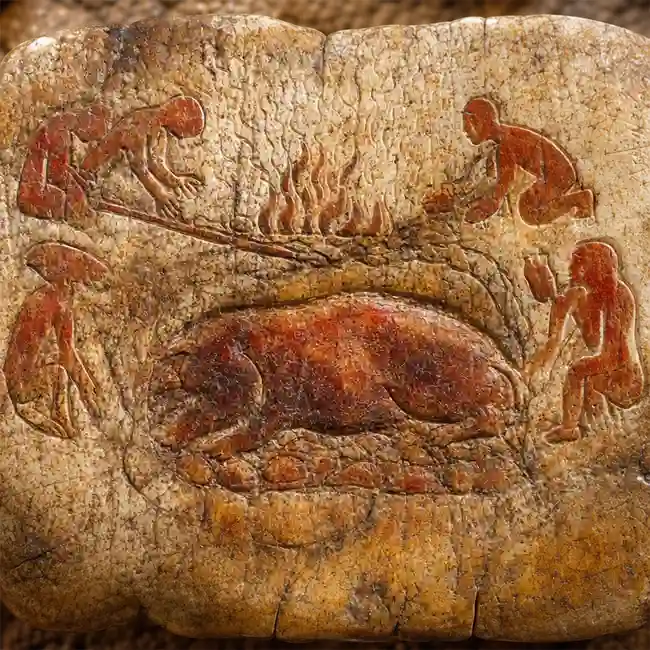
🐖 Recipe: The Five Emperors Era Imperial Earth Pit-Roasted Pork
📖 Legends Behind This Excavated Secret
The legend says that after defeating the rival tribe of Chiyou, the Yellow Emperor ordered a feast that would last for three days and three nights. The shamans instructed the cooks to not use fire directly on the meat, for direct fire was considered aggressive.
Instead, they heated stones in a sacred fire until they glowed red, placed them in a deep pit lined with lotus leaves and mugwort, laid the whole wild boar seasoned with mountain herbs and fermented millet paste upon them, covered it with more leaves, and sealed the pit with yellow river clay.
When the pit was opened a day later, the meat had transformed. It was not roasted. It was reborn. The warriors believed eating it gave them the strength of the earth itself. The recipe was then inscribed not on paper, but passed down orally among the imperial pit-masters, the Di Chu Shi, until it faded as dynasties changed.
What we have today is a careful reconstruction based on those oral histories, ancient millet fermentation records from the Qimin Yaoshu, and the actual pit structures excavated in Henan Province.
🧂 Ingredients & The Noble Pantry
🍖 The Ancestral Staples
In the Five Emperors era, there were no supermarkets. The pantry was the forest, the river, and the wild field. Every ingredient had a spiritual meaning. Pork was prosperity. Millet was life. Wild ginger was fire and protection. The leaves were not just wrapping; they were the seasoning.
Our version honors that philosophy.
🔄 Modern Substitutes
Do not worry if you cannot find fresh lotus leaves from the Yellow River. I have tested these modern swaps and they work beautifully to keep the soul of the dish alive.
For Lotus Leaves: You can use large dried lotus leaves from any Asian market, or as a great substitute, banana leaves plus a layer of parchment paper. They give the same earthy, tea-like aroma.
For Fermented Millet Paste: This was the ancient umami. Today we use a mix of light miso paste and a little bit of fermented black beans, crushed. It gives that same deep, funky, salty soul.
For Wild Mountain Herbs: The ancients used mugwort and wild scallions. We will use fresh mugwort if you can find it, otherwise a combination of fresh sage and Chinese chives captures that wild, slightly bitter note perfectly.
⚖️ Ancient Proportions
Here is what you need to feed 6 to 8 worthy guests, just like a small imperial court.
For The Imperial Pork:
• Bone-in pork shoulder, skin on - 4.5 to 5 pounds / 2 to 2.2 kilograms
• Coarse sea salt - 2 tablespoons
• Sichuan peppercorns, lightly toasted and ground - 1 tablespoon
• Wild honey, preferably longan or acacia honey - 3 tablespoons
• Fermented millet substitute, light yellow miso paste - 2 tablespoons
• Fermented black beans, rinsed and roughly crushed - 1 tablespoon
• Shaoxing cooking wine, non-alcoholic substitute - use 2 tablespoons of black vinegar plus 1 tablespoon of apple juice
• Fresh wild ginger, grated - 2 tablespoons, about a 2-inch piece
• Garlic, minced into a paste - 6 large cloves
For The Sacred Wrapping & Earth Aroma:
• Large dried lotus leaves or banana leaves - 4 to 5 large leaves, enough to fully wrap the pork
• Fresh sage leaves - 10 to 12 leaves
• Chinese chives or regular chives, whole - 1 large bunch
• Scallions, white and green parts, whole - 6 stalks
• Water for soaking leaves - as needed
For The Modern Earth Oven Seal:
• Heavy-duty aluminum foil - 1 large roll
• Butcher's twine - for tying
👨🍳 The Chef’s Ancient Ritual
This is not fast food. This is a ritual. Take your time. Put on some meditative music. This process is divided into three sacred acts.
✨ Act One: The Awakening of the Meat
1.Pat your pork shoulder completely dry. This is important. The ancient pit-masters believed dry skin honors the fire.
2.In a small bowl, mix the coarse sea salt and ground Sichuan peppercorn. This is your sacred ash. Rub it vigorously all over the pork, into every crevice. Let it sit for 30 minutes at room temperature.
3.In another bowl, create the Imperial Glaze. Combine the wild honey, miso paste, crushed black beans, black vinegar and apple juice mix, grated ginger, and garlic paste. Mix until it becomes a thick, fragrant paste.
4.Now, massage this glaze all over the salted pork. Be generous. Be respectful. Cover it and let it marinate in the refrigerator for at least 12 hours, ideally 24 hours. This long marination mimics the ancient practice of letting the meat absorb the mountain herbs overnight.
✨ Act Two: The Wrapping of the Soul
1.If using dried lotus leaves, soak them in hot water for 1 hour until they are soft and pliable. If using banana leaves, quickly pass them over an open flame for 10 seconds per side to make them flexible.
2.Lay out two large pieces of heavy-duty aluminum foil in a cross shape on your table. This is our modern river clay that will seal in all the steam.
3.Lay two lotus leaves or banana leaves on top of the foil, overlapping.
4.Create a bed of sage leaves, half the chives, and half the scallions in the center of the leaves.
5.Place your marinated pork shoulder right on top of that herbal bed.
6.Top the pork with the remaining chives and scallions. This creates a fragrant cradle.
7.Carefully wrap the lotus leaves around the pork like a precious parcel. Then wrap the entire parcel tightly with the aluminum foil. Wrap it 3 times to ensure it is completely sealed. No steam should escape. Tie it securely with butcher's twine. This is your earth pit.
✨ Act Three: The Long Sleep in the Earth Oven
1.Preheat your conventional oven to 300 degrees Fahrenheit or 150 degrees Celsius. This low temperature mimics the gentle, surrounding heat of hot stones in a pit, not direct flame.
2.Place your sealed parcel in a deep roasting pan or a Dutch oven. Add 2 cups of water to the bottom of the pan. This creates the humid environment of the underground pit.
3.Place the pan in the center of the oven and let it roast undisturbed for 6 to 7 hours. Yes, 6 to 7 hours. The ancients would wait a full day. Your patience will be rewarded. Do not open the foil. Do not peek. Trust the earth.
4.After 6 hours, carefully remove the pan. Let the parcel rest, still sealed, for at least 45 minutes to 1 hour. This resting period is crucial. It allows the juices to settle back into the fibers.
5.Unwrap it at the table for a dramatic reveal. The aroma will be absolutely intoxicating, smoky, sweet, herbal, and deeply savory all at once.
💡 Secrets of the Ancestral Hearth
After many trials and a few smoky kitchens, here are the secrets the ancient pit-masters would whisper to you if they could.
• Do Not Rush The Marination: If you only marinate for 2 hours, you will get tasty pork. If you marinate for 24 hours, you will get imperial pork. The miso and honey need time to break down the proteins and infuse deep flavor. Patience is the first secret.
• The Seal is Everything: The biggest mistake is a loose wrap. If steam escapes, the meat will dry out and become tough instead of meltingly tender. Use more foil than you think you need. Triple wrap it. The ancients sealed their pits with clay until not a wisp of smoke escaped. You must do the same with foil.
• Do Not Use Lean Cuts: Please do not try this with pork loin or tenderloin. It will become dry and sad. The Five Emperors used fatty wild boar shoulder for a reason. You need the fat and collagen from the shoulder to melt during the long cooking time. That is what creates the luscious, fall-apart texture.
• The Sage is Not Optional: Many people skip the sage and chives thinking they are just decoration. They are not. They are the primary aromatic seasoning that infuses the meat while it steams in its own juices. Without them, you lose 50 percent of the ancient fragrance.
• Crisp The Skin at The End: If you love crispy skin, here is a pro trick. After the 6-hour roast and rest, carefully open the top of the foil and leaves, exposing only the skin. Turn your oven broiler on high and broil for 4 to 6 minutes until the skin blisters and crisps. Watch it closely. You get the best of both worlds, tender meat and crispy imperial crackling.
⚔️ Ancient Civilization Origins FAQ
Q1: Is this really a 5000-year-old recipe? How can we know what they ate?
This is a fantastic question. We do not have a written recipe card from the Yellow Emperor. What we have is a culinary reconstruction. We combine evidence from Neolithic pit oven excavations in Henan, residue analysis on pottery that shows millet fermentation and pork fat, and later agricultural texts like the Qimin Yaoshu from 544 CE that recorded much older oral traditions. So think of this as a historically inspired resurrection, faithful to the techniques and ingredients that definitely existed in that era.
Q2: I do not have an oven that can run for 7 hours. Can I use a slow cooker?
Absolutely, and it actually works brilliantly. Place the fully wrapped foil parcel inside your slow cooker. Add 1 cup of water to the bottom of the slow cooker. Cook on low for 8 to 10 hours. The result is incredibly tender and authentic because a slow cooker is essentially a modern electric earth pit.
Q3: What do I serve with this imperial pork?
The ancients would have eaten it with steamed millet, wild greens, and pickled roots. For a modern but authentic pairing, I highly recommend serving it with steamed jasmine rice or sticky millet, a simple side of blanched bok choy with a little garlic, and a small dish of extra miso and honey mixed together for dipping. Let the pork be the star.
Q4: Is Sichuan peppercorn historically accurate for the Five Emperors Era?
You have a sharp eye. Wild Sichuan pepper relatives did grow in the region at that time, but the cultivated version we know today came a bit later. The ancients would have used wild peppercorns and other pungent seeds like wild ginger seeds. We use Sichuan peppercorn today because it gives us that authentic numbing, citrusy aroma that is the closest flavor profile we can achieve in a modern kitchen.
🏛️ The Taste of Archeology
When you finally pull that pork apart with two forks, and it shreds like silk, take a moment.
Inhale. What you smell is not just pork. It is the smoke of a fire lit 5000 years ago. It is the steam of river leaves, the sweetness of wild honey, the deep funk of fermented grains that sustained an entire civilization.
The taste is profound. It is not salty or sweet. It is balanced. The fat has rendered into the meat, the honey has caramelized into a dark, sticky crust under the leaves, the ginger and garlic have mellowed into a warm background hum, and the Sichuan pepper leaves a gentle tingle on your lips. This is what history tastes like when you stop reading about it and start eating it.
🌟 Final Thoughts: Bringing Antiquity to Your Modern Table
We live in a world of instant noodles and 15-minute meals, and there is a place for that. But sometimes, our soul craves something slower, something deeper.
This recipe asks you to slow down. It asks you to wait, to trust a process that is older than any written language. In return, it gives you more than dinner. It gives you a story to tell around your table. It gives you a connection to the hands that cooked in the same way, with the same reverence, on the banks of the Yellow River five millennia ago.
You do not need to be a historian to make this. You just need to be a curious cook who is willing to let the earth do the cooking for you. Try it this weekend. Invite friends. Unwrap it together. You are not just serving pork. You are serving a piece of antiquity.
Let me know in the comments how your resurrection went. Did your kitchen smell like an imperial ceremony?
🤝 The Golden Hook (The Sacred Union)
This secret survived for 5000 years because someone, somewhere, decided it was too precious to be forgotten.
Now you are part of that chain. You are now a Keeper of the Hearth.
Every time you cook this and share it, you keep a flame alive that was first lit in the age of legends. Food is our most delicious form of time travel, and we need more time travelers.
If you believe, as I do, that ancient culinary wisdom deserves to be preserved, shared, and tasted, then join our sacred circle. Save this recipe, share it with a fellow food adventurer, and subscribe to our newsletter for more lost recipes from lost worlds.
Let us ensure that the feasts of the Five Emperors are never lost again.
🙏 Credit to the Keepers of the Culture (The Legacy)
This recipe is inspired by the ancient culinary archives and clay tablet inscriptions and Neolithic pit remains of the Yellow River Basin and the Five Emperors Era of Ancient China. We have carefully adapted the measurements and techniques for modern kitchens while preserving its sacred ancestral soul. Deep respect to the archaeologists and food historians who keep these flavors alive.
| 🏯 🏛️🍖 < Back |