
🏠 Home > 🗺️ Recipes > 🏛️🍲 Clay-Pot Broths & Stews > 🏯 Five Emperors Era: Clay-Pot Broths & Stews Recipes > 🏛️🍲 1.Five Emperors Era Clay-Pot River Fish Soup
🏛️🍲 Clay-Pot Fish Soups from the Legendary Five Emperors Era
Published by Supakorn | Updated: September 2026
🐲🏺 Ancient Civilization Origins: Ancient China
🔥 The Storyteller’s Intro: Five Thousand Years of Ancestral Flavors
Imagine walking beside an ancient Chinese river more than four thousand years ago.
The morning mist hangs low over the water. Reed beds move gently in the breeze, fishermen return with baskets of small river fish, and somewhere beyond the settlement, smoke rises slowly from a clay hearth.
There are no stainless-steel pots.
No electric stove.
No measuring spoons.
No printed cookbook waiting beside the fire.
Instead, there is a shaped clay vessel, a handful of grains, fresh fish, wild herbs, spring water, and generations of practical knowledge.
That is the atmosphere behind this Five Emperors Era-inspired fish soup.
The phrase “Five Emperors Era” refers to a legendary period in early Chinese tradition associated with ancient rulers and foundational cultural stories. It should not be confused with a securely dated historical dynasty with surviving royal recipe books. Archaeology gives us something different but equally fascinating: evidence of ancient settlements, pottery, foodways, farming, fishing, and the development of sophisticated ceramic traditions.
Chinese Neolithic cultures flourished around major river systems, particularly the Yellow River and Yangzi River regions. Archaeological discoveries include numerous pottery vessels, with different regional shapes and technologies. Some eastern Chinese Neolithic traditions developed distinctive pottery forms, including tripod vessels that later remained important in Bronze Age China.
So, rather than pretending that an ancient tablet gives us an exact recipe, we can ask a more interesting question:
What might a simple clay-pot fish soup inspired by the food world of ancient China have tasted like?
The answer begins with the landscape.
Water supplied fish.
Fields supplied grains.
Gardens and wild landscapes supplied roots, greens, aromatic plants, and other edible ingredients.
Clay transformed those ingredients into something warm, nourishing, and remarkably simple.
And that simplicity is exactly what makes this ancient culinary reconstruction so appealing today.
🌏 The Global Value of Antique Heritage
Ancient food heritage is valuable because it tells stories that monuments alone cannot.
A palace can tell us about power.
A bronze vessel can tell us about craftsmanship and ritual.
A burial site can tell us about beliefs.
But food brings all of those worlds closer to everyday life.
Pottery is especially important when studying ancient Chinese food culture. Archaeological research shows that Neolithic communities produced pottery in different forms and used ceramic vessels in domestic and burial contexts. At Jiahu, for example, excavations revealed houses, kilns, pottery, stone and bone tools, and other evidence of a complex Neolithic community.
That does not mean every pottery vessel was a soup pot, nor does it prove a particular Five Emperors recipe.
Instead, it gives us a window into the technological world in which cooking with clay vessels was possible.
The broader lesson is fascinating: ancient cuisine was shaped by what people could grow, catch, gather, preserve, heat, and combine.
A bowl of fish soup may look humble.
Historically, however, it represents an entire chain of knowledge.
Someone needed to know where fish gathered.
Someone needed to prepare the fish.
Someone needed to control the fire.
Someone needed to understand how clay behaved under heat.
Someone needed to recognize which plants were edible.
And someone needed to remember what combinations tasted good.
That is culinary heritage in its most human form.
🐉 The Culinary Resurrection
Today, the phrase “lost recipe” often makes us imagine a secret manuscript hidden inside a forgotten palace.
The reality is usually more complicated.
For prehistoric and legendary periods, written recipes may not exist at all. What survives instead is archaeological evidence, environmental information, tools, vessels, botanical remains, animal remains, and later culinary traditions that help researchers understand how food systems developed.
This recipe follows that approach.
It is not presented as a literal recovered Five Emperors manuscript.
It is a culinary resurrection—a modern kitchen interpretation inspired by the ingredients, cooking technology, river environments, and simple food logic associated with ancient China.
The result is intentionally rustic.
Fish is simmered gently.
The clay pot becomes part of the experience.
Grain provides body.
Fresh aromatics brighten the broth.
And the cooking method relies on patience rather than complicated technique.
In other words, the recipe tries to capture the spirit of an ancient hearth without pretending that modern cooks can reproduce an undocumented recipe with archaeological certainty.
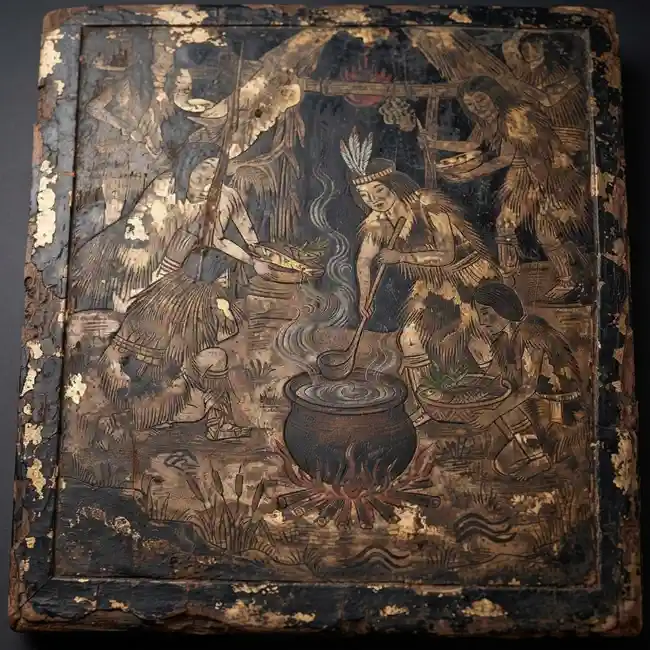
🍲 Recipe: Five Emperors Era Clay-Pot River Fish Soup
📜 Legends Behind This Excavated Secret
Let us imagine the scene.
A small settlement rests near a broad river.
The day's fish have been brought home.
The cook chooses a sturdy clay vessel and fills it with clean water. A small amount of grain is added first, creating a gentle foundation for the broth. Fish follows, along with fresh green aromatics and a few simple seasonings.
The pot is placed near the fire.
There is no rush.
The soup slowly changes.
The fish releases its natural richness into the water. The grain softens and thickens the broth. Aromatic plants contribute freshness. The clay vessel helps create a steady, gentle cooking environment.
This imagined scene is consistent with the broader archaeological picture of ancient Chinese communities living around river systems and developing pottery traditions. However, the specific combination below is a modern reconstruction, not a documented Five Emperors recipe.
Think of it as a bridge between archaeology and the home kitchen.
🏺 Ingredients & The Noble Pantry
🌾 The Ancestral Staples
The pantry of an ancient household would have looked very different from a modern supermarket.
There would be no long supermarket aisle filled with dozens of sauces and packaged seasonings.
Instead, the cook would work with a small number of familiar staples.
For this reconstruction, the core ingredients are:
◦ Fresh river fish — 500 g
Choose a mild white-fleshed fish such as carp, tilapia, perch, or another readily available freshwater fish.
◦ Water — 1.2 liters
Clean water forms the foundation of the soup.
◦ Millet — 40 g
Millet provides gentle thickness and represents the importance of ancient cereal cultivation in northern Chinese food traditions.
◦ Fresh ginger — 20 g
Used here as a practical modern aromatic. It gives the soup warmth and freshness.
◦ Spring onion — 2 stalks
Adds a clean green aroma.
◦ Fresh coriander or tender leafy herbs — 15 g
Optional, but useful for finishing the soup.
◦ Salt — 5 g, or to taste
Keep it restrained. The goal is a light, naturally flavored broth.
◦ White pepper — 1 g
Optional modern seasoning for additional warmth.
◦ Fresh garlic — 1 small clove
Optional. Use sparingly so that it does not dominate the fish.
The philosophy is simple: fish first, broth second, aromatics third, seasoning last.
🔄 Modern Substitutes
You do not need an archaeological expedition to make this soup.
A modern kitchen can recreate the experience surprisingly well.
• If you cannot find river fish, use sea bass, snapper, cod, or another mild white fish.
• If millet is unavailable, use hulled barley or a small amount of rice. Rice will create a smoother, softer broth.
• If you do not have a clay cooking pot, use a heavy-bottomed stainless-steel or enamel pot.
• If fresh ginger is unavailable, a small amount of dried ginger can work, although fresh ginger gives a brighter aroma.
• Spring onion can be replaced with chives or young green onion.
• Fresh herbs can be adjusted according to availability. The important idea is to use a small amount of fresh greenery rather than a large collection of modern spices.
• For a completely grain-free version, simply omit the millet and allow the fish broth to remain clear and light.
The objective is not perfect archaeological replication.
The objective is to experience the cooking logic of a very old food tradition using ingredients available today.
⚖️ Ancient Proportions
For approximately four servings:
• Fish: 500 g
• Water: 1.2 liters
• Millet: 40 g
• Fresh ginger: 20 g
• Spring onion: 2 stalks
• Fresh herbs: 15 g
• Salt: 5 g or according to taste
• White pepper: 1 g
• Garlic: 1 small clove, optional
A useful proportion to remember is:
10 parts water : 4 parts fish : about 1 part grain
The grain should never overwhelm the fish.
This is a fish soup, not a grain porridge.
🔥 The Chef’s Ancient Ritual
1. Prepare the Fish
Clean the fish carefully and remove scales, bones, and unwanted parts as appropriate for the fish you are using.
Cut larger fish into manageable portions.
Pat the fish dry.
If using whole small fish, you can leave the head and bones attached during simmering for additional flavor, then strain the broth before serving if desired.
2. Prepare the Grain
Rinse the millet thoroughly.
Place it into the pot with the water.
Bring the mixture slowly toward a gentle simmer.
Do not start with aggressive boiling.
Ancient-style cooking is about controlling heat with distance from the fire, and the modern equivalent is simply keeping the temperature moderate.
3. Build the Aromatic Foundation
Add sliced ginger, the white portion of the spring onion, and the optional garlic.
Let them simmer gently for approximately 10 minutes.
The water should become lightly fragrant without tasting strongly seasoned.
4. Add the Fish
Lower the fish carefully into the simmering broth.
Reduce the heat.
Cook gently for approximately 12–18 minutes, depending on the thickness of the fish pieces.
Avoid excessive stirring.
Fish can break apart easily, and a gentle cooking process keeps the broth cleaner.
5. Let the Clay-Pot Spirit Return
If you are using a traditional heat-safe clay cooking vessel designed for stovetop use, allow the soup to cook gently.
Do not place an ordinary decorative clay pot directly over intense heat.
For modern safety, use cookware specifically made for cooking.
The ancient spirit of the recipe comes from the slow, steady cooking method, not from risking cracked pottery.
6. Season at the End
Add salt gradually.
Taste the broth.
If desired, add a tiny amount of white pepper.
Finish with sliced spring onion and fresh herbs.
Serve immediately while the soup is warm.
🔥 Secrets of the Ancestral Hearth
The most interesting part of an ancient-style recipe is often what you do not do.
• Do not boil the fish aggressively.
• Violent boiling can break delicate fish apart and make the broth cloudy.
• Do not overload the soup with spices.
• The character should come from fish, grain, aromatics, and the cooking process.
• Do not add too much grain.
• Millet should give the broth subtle body rather than turn it into porridge.
• Do not rush the first simmer.
• Starting gently helps the ingredients release their flavors gradually.
• Do not treat “ancient” as meaning “primitive.”
• Ancient cooks still understood heat, texture, preservation, timing, and ingredient combinations through experience.
• Do not use an ordinary decorative clay vessel over a flame.
• Modern food-safe cookware is the sensible choice.
• Do not expect an exact archaeological flavor.
• The Five Emperors tradition belongs partly to legendary history, and no verified recipe card survives from that period.
• Do use fresh fish whenever possible.
• The cleaner the fish, the more delicate and elegant the broth becomes.
• Do taste throughout the cooking process.
• Ancient cooking depended heavily on observation rather than standardized measurements.
• Do keep the final bowl simple.
• The whole point is to experience how a few ingredients can become something deeply satisfying.
🀄🏺 Ancient Civilization Origins FAQ
Q1.Was this really a 5,000-year-old fish soup recipe?
Not literally. The Five Emperors belong to early Chinese legendary tradition, and there is no verified surviving recipe from that era that documents this exact soup. This article presents a historically inspired reconstruction based on ancient Chinese food environments, pottery traditions, river-based communities, and plausible cooking techniques.
Q2.Did ancient Chinese people cook food in clay pots?
Archaeology provides extensive evidence for pottery traditions in Neolithic China, including vessels from settlements and graves. Eastern Chinese Neolithic cultures produced distinctive pottery forms, while other regions developed their own ceramic traditions. These findings demonstrate a sophisticated ceramic culture, although a particular vessel cannot automatically be identified as a fish-soup pot.
Q3.Why use fish in this ancient recipe?
River systems were central to many Neolithic Chinese communities, particularly around the Yellow River and Yangzi River regions. Fish therefore provides a plausible ingredient for a historically inspired riverine food reconstruction, although the exact ingredients consumed varied by region and period.
Q4.Can I make it without a clay pot?
Absolutely. A heavy-bottomed cooking pot works perfectly well. The important feature is gentle simmering and controlled heat—not the appearance of the cookware.
🥣 The Taste of Archeology
The first spoonful should be surprisingly delicate.
The fish gives the broth a clean savory character.
The millet adds a soft graininess without making the soup heavy.
Ginger brings gentle warmth.
Spring onion provides freshness.
The herbs add a final green note.
There is something almost meditative about the result.
It does not taste like a modern restaurant soup loaded with layers of sauces and intense seasoning.
Instead, it feels elemental.
Water.
Fish.
Grain.
Fire.
A few plants.
Time.
That simplicity is precisely what makes the dish interesting.
Of course, we cannot place a modern spoonful into the hands of a person from the legendary Five Emperors tradition and ask whether it tastes authentic.
That would go beyond the evidence.
What we can do is recreate a style of cooking based on ingredients and technologies that fit the broader ancient Chinese archaeological landscape.
And sometimes that is more fascinating than pretending certainty where none exists.
🏡 Final Thoughts: Bringing Antiquity to Your Modern Table
Ancient food does not have to remain trapped behind museum glass.
You can bring a small part of its story into your own kitchen.
Start with fresh fish.
Use a simple grain.
Choose a few aromatic ingredients.
Keep the seasoning restrained.
Cook slowly.
And pay attention.
That last part may actually be the most important.
Modern kitchens give us incredible precision, but ancient cooking teaches another kind of skill: observation.
Is the broth simmering too hard?
Is the fish beginning to flake?
Does the grain need more water?
Does the soup need another pinch of salt?
These questions connect the modern cook with something surprisingly old—the habit of learning through the senses.
The Five Emperors tradition itself belongs to the deep legendary layers of Chinese cultural memory, while the archaeological record gives us tangible evidence of ancient communities, pottery, agriculture, river environments, and technological development. Neolithic China was not one uniform culture; different regional traditions developed distinctive pottery, settlement patterns, and material cultures.
So when you prepare this soup, think of it less as “the exact lost recipe” and more as a respectful culinary journey.
A bowl can become a small history lesson.
A clay pot can become a conversation starter.
And an ordinary fish can become a doorway into a world thousands of years removed from our own.
⚱️ The Golden Hook: The Sacred Union
Ancient cuisine survives in many forms.
Sometimes it survives in pottery.
Sometimes in archaeological remains.
Sometimes in written records.
Sometimes in stories passed from generation to generation.
And sometimes, it survives because someone decides to cook again.
That is the sacred union at the heart of historical food reconstruction: the meeting of evidence, imagination, and respect.
When we recreate ancient dishes, we should not claim more certainty than the evidence allows.
Instead, we can preserve the mystery.
We can acknowledge what archaeology tells us.
We can distinguish documented evidence from culinary reconstruction.
And we can still enjoy the incredible experience of bringing an ancient food tradition to the modern table.
Perhaps that is the real meaning of a lost ancient recipe.
It is not simply a dish that disappeared.
It is a piece of human curiosity waiting to be rediscovered.
So gather your ingredients, warm your pot, and let this simple fish soup become your own small connection to the deep culinary history of ancient China.
🏛️ Credit to the Keepers of the Culture: The Legacy
This recipe is a modern culinary reconstruction inspired by archaeological evidence from ancient Chinese Neolithic food cultures, pottery traditions, river-based communities, and the broader legendary heritage associated with the Five Emperors tradition.
It is not presented as a directly excavated or historically verified Five Emperors recipe. The measurements and cooking instructions have been adapted for modern kitchens while respecting the ancient ingredients, technologies, and foodways that inspire the reconstruction.
Suggested heritage note for publication:
“This recipe is inspired by the ancient culinary heritage of China, including Neolithic pottery traditions, river-based food cultures, and the legendary cultural memory of the Five Emperors. The ingredients, proportions, and cooking method have been carefully adapted for modern kitchens while preserving the spirit of an ancestral clay-pot cooking tradition.”
The archaeological record continues to teach us that ancient China contained diverse regional cultures rather than one single, uniform culinary tradition. Pottery traditions developed differently across the Yellow River, Yangzi River, and eastern coastal regions, making that diversity an important part of the story.
And that may be the most beautiful legacy of all:
The past does not need to be perfectly reconstructed to be meaningfully remembered.
Sometimes, all it takes is a warm bowl of soup.
| 🏯 🏛️🍲 < Back |