
🏠 Home > 🗺️ Recipes > 🏛️🍲 Clay-Pot Broths & Stews > 🏯 Five Emperors Era: Clay-Pot Broths & Stews Recipes
🏯 🏛️🍲 Five Emperors Era: Clay-Pot Broths & Stews Recipes
Published by Supakorn | Updated: September 2026
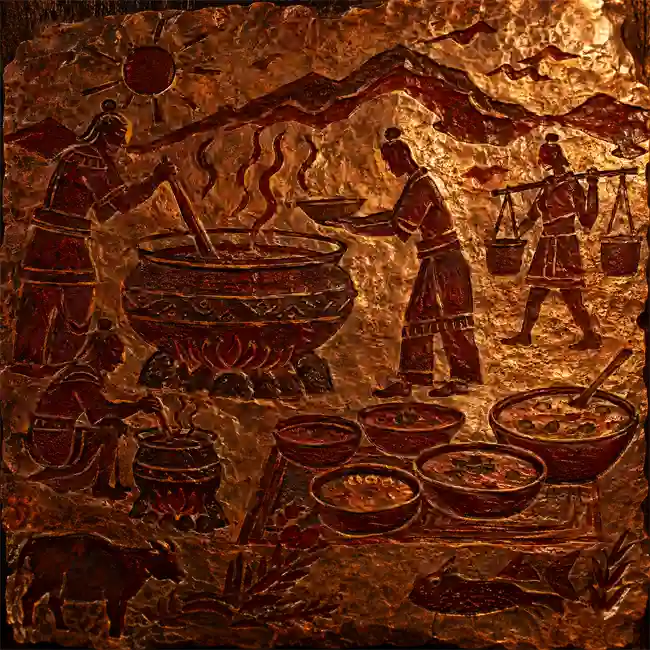
🐉📜 The Storyteller’s Intro: 5,000 Years of Ancestral Flavors
Imagine standing beside a settlement in ancient northern China more than 5,000 years ago.
There are no modern kitchens. No metal stockpots. No neatly printed recipe books. Instead, there are handmade clay vessels sitting over controlled fires, baskets of gathered plants nearby, grains being cleaned by hand, and families preparing food with tools that have survived long enough to tell us something about their everyday lives.
This is the world that inspires our exploration of Five Emperors Era: Clay-Pot Broths & Stews.
There is an important historical detail to clear up from the beginning. The Five Emperors are part of the traditional Chinese historical and cultural tradition rather than a securely documented dynasty in the modern archaeological sense. Traditional chronologies place the wider Three Sovereigns and Five Emperors era roughly between 2852 and 2070 BCE, although identities, dates, and stories vary among ancient sources.
So when we talk about food from the “Five Emperors Era,” we should not imagine that archaeologists have discovered a palace cookbook stamped with an emperor's seal.
What archaeology actually gives us is something more fascinating.
We have pottery, food residues, charred grains, animal bones, cooking vessels, settlement remains, storage facilities, grinding tools, and traces of ancient agricultural systems. Together, these clues allow researchers to reconstruct aspects of prehistoric Chinese foodways without pretending that every ancient dish can be recreated with certainty.
And this is where the humble clay pot becomes incredibly important.
🏺 Before the Palace, There Was the Cooking Pot
Long before the famous imperial kitchens of later Chinese history, Neolithic communities were already developing sophisticated ways to process food.
Archaeological research shows that northern Chinese Neolithic cuisines relied heavily on boiling and steaming, with ceramic vessels playing an important role in these cooking traditions. Some tripod pottery forms were particularly suited to heating food over fire.
This matters because a clay pot changes what people can do with ingredients.
Grains can be softened.
Meat can be simmered.
Roots and gathered plants can be cooked together.
Different ingredients can become one nourishing meal.
A tough ingredient that might be difficult to eat separately can become much more useful after hours of gentle cooking.
In other words, the ancient clay pot was not simply a container.
It was a piece of culinary technology.
🌾 A Food Culture Built Around Grain, Land, Animals, and Water
By the Late Neolithic period, communities in northern China were developing increasingly complex agricultural systems.
Millet was especially important. Archaeological evidence shows that broomcorn millet and foxtail millet were cultivated in northern China thousands of years ago, while later research has revealed sophisticated relationships between millet farming and pig husbandry.
At some settlements, people were not relying on one food source alone.
Their food world could include:
• Millet and other cultivated grains
• Rice in regions where wet agriculture was suitable
• Domesticated pigs
• Hunted animals
• Fish and aquatic resources
• Wild plants
• Tubers and roots
• Fruits and seeds
• Other gathered foods
The result was not a single standardized “Five Emperors menu.”
Instead, ancient food culture varied according to landscape, climate, agriculture, local traditions, and available resources.
That regional diversity is one of the most exciting things about studying ancient Chinese food.
📜 Iconic Excavated Menus: Archaeological Names from the Clay-Pot Kitchen
When modern readers hear the word “menu,” they naturally expect names such as soup, stew, porridge, or meat broth.
But prehistoric archaeology works differently.
There are generally no surviving recipe cards from 5,000 years ago telling us exactly what a cook called a particular broth. Instead, researchers identify ingredients and cooking practices through archaeological evidence.
Therefore, the names below are best understood as modern descriptive labels for archaeological food traditions, rather than claiming that these were official dish names written by Five Emperors–era cooks.
🏺 Featured Ancient Clay-Pot Broths & Stews
✦ Millet Hearth Porridge — A humble yet nourishing grain dish inspired by the importance of millet in Neolithic northern China, slowly softened in a clay vessel over a household fire.
✦ Five-Grain Clay-Pot Gruel — A reconstructed ancient-style grain preparation representing the diverse cereals and plant foods that could have entered early farming communities’ cooking traditions.
✦ Millet & Wild Greens Broth — A rustic plant-and-grain combination inspired by archaeological evidence for cultivated and gathered plants used by Neolithic communities.
✦ Clay-Pot Millet & Pig Stew — An ancient-inspired savory stew reflecting the close relationship between millet agriculture and domesticated pig husbandry documented at several Neolithic sites.
✦ Riverbank Fish & Grain Broth — A regional reconstruction inspired by prehistoric communities that combined aquatic resources with cultivated grains in river and wetland environments.
✦ Root & Millet Hearth Stew — A thick, slow-cooked preparation inspired by archaeological evidence for roots, tubers, grains, and other plant resources in ancient Chinese foodways.
✦ Ancient Millet Meat Broth — A simple clay-pot reconstruction combining grain with animal protein, reflecting the importance of both agriculture and animal resources in Neolithic diets.
✦ Neolithic Mixed-Grain Clay Pot — A rustic communal-style food concept representing the early culinary practice of soft-cooking grains in ceramic vessels.
✦ Yellow River Hearth Broth — An ancient-inspired regional dish built around millet and locally available ingredients, evoking the agricultural landscapes of the Yellow River basin.
✦ Five Emperors–Era Harvest Stew — A historically inspired reconstruction bringing together grains, plants, and animal foods to symbolize the seasonal abundance of an early farming settlement.
✦ Yangshao-Style Millet Clay-Pot Porridge — Inspired by the pottery-rich Yangshao archaeological tradition and the importance of millet-based foodways in northern Neolithic China.
✦ Ancient Village Clay-Pot Supper — A reconstructed communal food concept imagining how grains, vegetables, and available protein could have been slowly cooked and shared around a prehistoric settlement hearth.
🍲 Millet Grain Broths and Soft-Cooked Grain Foods
Millet was one of the most important staples in northern Neolithic China.
Archaeological evidence demonstrates extensive cultivation of broomcorn and foxtail millet, while studies of prehistoric cooking suggest that boiling and steaming were central techniques.
A clay vessel could therefore transform grain into soft, easily digestible food.
Modern archaeological descriptions might refer to such foods as:
• Millet Porridge
• Millet Grain Broth
• Soft-Cooked Millet
• Mixed Grain Gruel
These names are useful for understanding the food concept, but they should not be mistaken for preserved ancient menu titles.
🥣 Mixed Plant and Grain Cooking
Archaeological studies have identified evidence for a wide variety of plant foods being processed in Neolithic pottery.
At the Mijiaya site, researchers found evidence connected with crops, gathered plants, rice, millet, tubers, and other food resources.
This opens a fascinating possibility.
An ancient clay pot did not necessarily have to contain one ingredient.
A cook could combine different ingredients into a single warm preparation, producing a food that modern readers might describe as a mixed grain-and-plant broth or prehistoric vegetable stew.
The exact flavor is lost to history.
The cooking principle, however, is much easier to understand.
🐖 Millet-and-Pig Foodways
The relationship between millet agriculture and pigs is particularly important in the archaeology of Neolithic northern China.
Research at Dadiwan and other sites has provided evidence for intensive millet–pig systems dating back around 5,500 years, in which crop residues could support pigs while animal waste could contribute to agricultural fertility.
This does not mean we can label a particular archaeological pot “Five Emperors Pork Stew.”
That would go beyond the evidence.
But it does tell us that pigs were an important part of the agricultural and dietary system in parts of Neolithic northern China.
From a culinary perspective, this makes meat-and-grain cooking traditions an important subject when discussing the origins of ancient clay-pot foods.
🐟 Aquatic Ingredients and Regional Food Traditions
Not every prehistoric community lived in the same environment.
Some settlements were positioned near rivers, lakes, wetlands, or other productive water sources.
That meant fishing and aquatic foods could become part of local diets.
This is why it is better to think about ancient Chinese cuisine as a collection of regional food cultures rather than a single ancient menu.
The clay pot was adaptable.
The ingredients changed according to the landscape.
The cooking vessel remained useful.
🗺️ Following the Ancient Foodways: Villages, Rivers, and the Birthplace of Clay-Pot Cuisine
To understand ancient food, sometimes you have to stop looking at the plate and start looking at the map.
The food culture associated with the traditional Five Emperors world is connected to a much broader archaeological landscape covering different parts of ancient China.
The Yellow River basin is especially important for understanding early millet agriculture and Neolithic settlement.
The Yangtze River region tells a different story, particularly through the development of rice agriculture and distinctive pottery traditions.
The archaeological record includes cultures such as Yangshao, Hemudu, Dawenkou, Longshan, Majiayao, and related regional traditions, each contributing pieces to the larger picture of Neolithic China.
🏘️ Yangshao Landscapes and Everyday Cooking
The Yangshao tradition is especially famous for painted pottery and settlements across parts of the Yellow River region.
Museum collections and archaeological research reveal pottery vessels associated with both domestic and funerary contexts, showing how ceramic technology became deeply embedded in Neolithic life.
For a food historian, this is where things become exciting.
A cooking pot is not just an artifact.
It is evidence of:
• Household organization
• Food preparation
• Storage
• Fire management
• Agricultural production
• Craft specialization
• Community life
• Changing culinary technology
The ancient kitchen was therefore part of the larger social system.
🏡 What Was Everyday Life Like?
For most people, food preparation was probably far more physically demanding than it is today.
Imagine processing grain without modern machines.
Harvesting crops by hand.
Grinding ingredients.
Collecting fuel.
Preparing clay vessels.
Maintaining a fire.
Cleaning food.
Cooking slowly.
Sharing the finished meal.
Every stage required time and labor.
Archaeological research at Mijiaya suggests that cooking practices, pottery types, stoves, houses, food processing, labor allocation, and settlement organization were interconnected.
That means a clay-pot meal can tell us much more than what ancient people ate.
It can help us think about how communities worked together.
🚣 Along the Yellow River: Where Grain and Cooking Technology Met
The Yellow River basin is one of the most important landscapes for understanding prehistoric northern Chinese food culture.
Millet cultivation developed early across northern China, and evidence indicates that broomcorn and foxtail millet were established across several Neolithic cultural regions by around the sixth millennium BCE.
This is one reason millet belongs at the heart of our story.
The grain was not merely food.
It was part of an agricultural system.
It supported people.
It supported animals.
It interacted with soil management.
And eventually, it became connected with increasingly complex communities.
🌾 From Field to Cooking Fire
The ancient food journey might be imagined as a chain:
• Seed planted in cultivated ground
• Crop tended through the growing season
• Grain harvested
• Grain processed
• Grain stored
• Grain measured for household use
• Grain cooked over fire
• Food shared among family or community
That chain is a reminder that ancient cuisine began long before the cooking pot.
The clay vessel was simply the final stage of a much larger relationship between people, land, animals, water, and technology.
🏜️ Beyond the Central Plains: Ancient Foodways Across Changing Landscapes
The wider world of ancient China was never a single ecological zone.
North China contained farming landscapes, while other areas included mountains, wetlands, river valleys, forests, and regions that connected communities across long-distance exchange networks.
As crops and culinary practices moved, they did not necessarily travel together.
Recent archaeological research shows that millet cultivation expanded beyond northern China, while the distinctive East Asian traditions of boiling and steaming did not always accompany the crop into every region.
That small detail tells us something huge.
Food ingredients can travel without their original cooking traditions.
A grain can move.
A pot can stay.
A cooking technique can change.
A new community can take an old ingredient and create something completely different.
That is how food culture evolves.
🏛️ From Archaeological Pottery to Ancient Culinary Secrets
One of the most fascinating things about prehistoric Chinese cuisine is the gap between what we know and what we can never know completely.
We can identify:
• Ancient crops
• Animal remains
• Pottery forms
• Charred residues
• Plant microfossils
• Cooking technologies
• Agricultural systems
• Settlement structures
• Food-processing tools
But we cannot always identify:
• The original dish name
• The exact quantity of each ingredient
• The cook's personal technique
• The precise cooking time
• The original seasoning balance
• The ancient name of a particular household dish
This distinction matters.
Calling every archaeological food discovery a “lost recipe” can make a story sound exciting, but it can also blur the line between archaeological evidence and modern reconstruction.
A more responsible approach is to use archaeology as the foundation and imagination as the storyteller.
That lets us appreciate the mystery without pretending the evidence says more than it does.
🐉❓ Ancient Civilization FAQ: Unlocking Palace Kitchen Mysteries
Q1.Was the Five Emperors Era really 5,000 years ago?
The traditional Five Emperors chronology belongs to a much wider legendary period commonly placed around 2852–2070 BCE. However, these dates are traditional rather than equivalent to a securely documented historical dynasty with continuous archaeological records. Different ancient sources also provide different identities and traditions surrounding the Five Emperors.
So “5,000 years ago” is a useful broad description for the Neolithic world associated with the later part of this traditional timeframe, but it should not be treated as a precise archaeological date for an emperor's kitchen.
Q2.Did archaeologists discover an actual Five Emperors stew recipe?
No complete recipe from the Five Emperors period has been securely identified.
What archaeologists have discovered are cooking vessels, food residues, plant remains, animal bones, grains, and other evidence that reveal how prehistoric communities processed and prepared food.
At Mijiaya, for example, researchers combined pottery studies, plant microfossils, animal remains, isotopic evidence, and other techniques to reconstruct aspects of Neolithic foodways.
Q3.What ingredients were important in ancient northern China?
Millets were particularly important in northern Neolithic China. Archaeological evidence also points to rice in suitable regions, domesticated animals such as pigs, hunted resources, aquatic foods, and a variety of gathered plants.
The exact combination depended heavily on geography and period.
Q4.Why were clay pots so important?
Clay cooking vessels made it possible to process foods through boiling and steaming and helped transform grains, plants, and other ingredients into softer cooked foods.
Research on Neolithic China identifies ceramic vessels as major evidence for the development and geographical spread of boiling-and-steaming culinary traditions.
The pot was therefore both a cooking tool and a window into technological and social change.
🧠 Final Thoughts: The Timeless Allure of Antique Gastronomy
There is something wonderfully mysterious about a meal that disappeared thousands of years ago.
We may never know exactly what an individual family in the Five Emperors tradition tasted on a particular evening.
We may never know whether a cook preferred one grain over another, how long a particular broth simmered, or which local plant gave a household meal its distinctive aroma.
But archaeology gives us something almost as valuable.
It gives us clues.
A broken pot.
A blackened cooking surface.
A handful of charred grains.
An animal bone.
A grinding stone.
A settlement beside a river.
A storage pit.
A cooking hearth.
Piece by piece, these fragments allow us to see the ancient kitchen again.
The story of Five Emperors Era: Clay-Pot Broths & Stews is therefore not simply a story about soup.
It is a story about the beginning of culinary systems.
It is about people learning how to cultivate grain, manage animals, use fire, shape pottery, organize labor, preserve food, and turn separate ingredients into nourishing meals.
And perhaps that is the real secret of ancient cuisine.
The greatest culinary invention was not always a rare ingredient.
Sometimes it was simply the discovery that time, fire, water, grain, and a clay pot could transform ordinary food into something worth gathering around.
The detailed reconstructed recipes belong to the next chapter.
For now, the archaeological hearth remains glowing.
And the ancient pot is still waiting.
🏛️ Credit to the Keepers of the Culture: The Legacy
Exploring prehistoric Chinese cuisine comes with an important responsibility: respect the archaeological record, respect living cultural traditions, and clearly separate evidence from reconstruction.
The Five Emperors tradition has survived not because we possess a perfectly preserved ancient cookbook, but because stories, historical writings, archaeological discoveries, regional traditions, and generations of cultural memory have kept the ancient world alive.
Modern archaeological research continues to refine our understanding of Neolithic China.
Studies of pottery residues, plant remains, animal bones, agricultural systems, cooking technology, and settlement organization are gradually revealing how ancient communities actually lived and ate.
The heritage belongs to the landscapes and communities that preserved these traditions across generations.
So when we recreate an ancient-inspired dish today, the goal should not be to claim:
“This is exactly what Emperor Yao ate.”
A more honest and meaningful statement is:
“This dish is inspired by archaeological evidence for ancient Chinese ingredients, cooking technologies, and foodways.”
That distinction makes the story stronger, not weaker.
It allows history to remain mysterious where history is mysterious.
And it allows archaeology to speak where archaeology has evidence.
From the ancient Yellow River landscapes to Neolithic villages, from millet fields to blackened pottery, the story of clay-pot cooking remains one of humanity's oldest culinary stories.
The pot may have disappeared into the earth thousands of years ago—but its story is still being uncovered.
🏛️🍲 Clay-Pot Fish Soups from the Legendary Five Emperors Era
👉 Discover Five Emperors Era: Clay-Pot Broths & Stews
| 🌐 🏛️🍲 < Back | 🏯 🍖 < Previous | Next > 🍯 🏯 |