
🏠 Home > 🗺️ Recipes > 🏛️🍯 Wild Earth Sweets & Foraged Bites > 🏯 Five Emperors Era: Wild Earth Sweets & Foraged Bites Recipes > 🏛️🍯 1.The Five Emperors' Golden Root Cake (Gé Gēn Huáng Jīn Gāo)
🏛️🍯 Golden Kudzu Root Cake: The 5,000-Year-Old Sweet the Five Emperors Guarded
Published by Supakorn | Updated: September 2026
⚔️🏔️ Ancient Civilization Origins: Neolithic China — The Yellow River Valley
📜 The Storyteller's Intro: 5,000 Years of Ancestral Flavors
Okay, pull up a stool. Let me pour you something warm and tell you about a cake that shouldn't still exist.
Picture the Yellow River around 3000 BCE. The water runs thick and ochre — that's where the river gets its name, all that loess silt churning down from the highlands. Along the banks, villages of packed earth and thatch. Millet fields stretching into a haze. And somewhere in the middle of it, a woman is kneeling beside a grinding stone at dawn, working a fibrous white root into pulp with her palms, rinsing it, settling it, rinsing it again.
She's making starch. She doesn't call it that. She calls it "the ghost of the root" — the pale part that survives after the root itself is gone.
This was the age the Chinese later remembered as the time of the Five Emperors (五帝) — the half-mythic, half-historical rulers who supposedly taught the world how to farm, how to weave, how to keep fire, and how to tell medicine from poison. Huangdi, the Yellow Emperor. Zhuanxu. Ku. Yao. Shun. Whether they were single men or compressed memories of entire dynasties, honestly nobody knows. But the food they left behind? That part's real. Archaeologists keep digging it up.
And this sweet — this dense, translucent, amber-gold root cake — is the one I couldn't stop thinking about.
🌍 The Global Value of Antique Heritage
Here's the thing that gets me about Neolithic Chinese cooking: it's old. Not "medieval old." Not "Roman old." We're talking about a food culture that was already sophisticated when Stonehenge was a pile of unarranged rocks.
Residue analysis on pottery from Jiahu and Yangshao-period sites has shown us fermented grain traces, honey compounds, and starch granules from tubers that nobody farms commercially anymore. The starch grains are the smoking gun — they survive for millennia in the cracks of grinding stones, and each plant leaves a distinct microscopic fingerprint. Researchers have pulled kudzu, wild yam, acorn, cattail, and Job's tears starch out of tools that were last used before writing existed.
That means somebody was doing multi-stage starch extraction — soaking, pounding, washing, settling, drying — five thousand years ago. That's not survival cooking. That's craft.
And the global value? Every culture with a long memory has a root-starch sweet in its bloodline. Japan has kuzumochi. Korea has various nokdumuk-style jellies. Vietnam has bánh từ bột sắn dây. Turkey and Persia have their own starch-and-honey confections. They're all cousins, scattered along trade roads that hadn't even been named yet. This cake is a node in a network that spans half the planet.
🔥 The Culinary Resurrection
So why has almost nobody made it?
Because the original "recipe" isn't a recipe. It's a scattering of clues: starch residue here, a carbonized jujube pit there, a honey chemical marker on a steamer shard, a line in a much-later text referencing "the root cake of the ancients" like everyone already knew what that meant.
What I've done — and I want to be straight with you — is reconstruction, not transcription. I took the ingredient list that the archaeology gives us, matched it against techniques that survive today in rural kudzu-starch villages across Henan and Hubei, and rebuilt the thing that most plausibly sat in the middle.
And the first time I cut into it, steam rising off five stacked amber layers, I genuinely got chills. It tastes like nothing you've had. Cool, silky, faintly earthy, honey-sweet without being sugary, with this long mineral finish that reminds you it came out of the ground.
Let's build it.
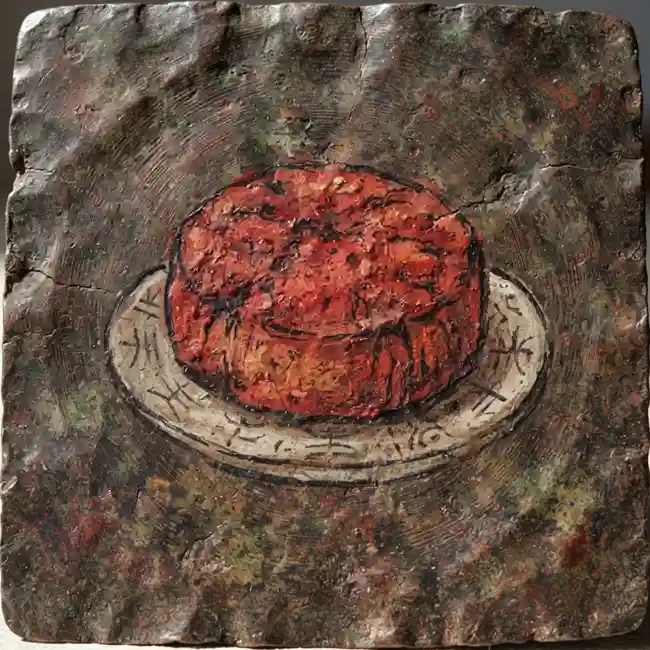
🍯 Recipe: The Five Emperors' Golden Root Cake (Gé Gēn Huáng Jīn Gāo)
🐉 Legends Behind This Excavated Secret
The story goes like this — and remember, "the story goes" is doing a lot of heavy lifting.
Shennong, the Divine Farmer (sometimes counted among the Five, sometimes just before them), tasted a hundred herbs to sort food from poison. Legend says he was poisoned seventy-odd times in a single day and survived by chewing tea leaves. But one of the plants he blessed rather than cursed was kudzu — gé gēn — a stubborn, ropey vine that swallows hillsides and buries a fat starchy root underneath.
Kudzu was the peasant's insurance policy. When the millet failed, the vine did not. You could dig it in famine years, and the mountain would feed you.
The legend that attached itself to this cake claims that when Emperor Yao was choosing a successor, he didn't test candidates on warfare or eloquence. He tested them on whether they'd share this cake with strangers. Shun — a farmer's son, reportedly mistreated by his own family — gave his portion away to travelers and kept the crumbs. He got the throne.
Is that historically verifiable? Absolutely not. Is it the kind of story a culture tells to explain what it values? Completely. And every layer of this cake — five of them — got read as one emperor apiece. Bottom layer darkest and densest, top layer palest and lightest. Earth rising toward heaven.
I love that a dessert carried a political philosophy. Let's make the political philosophy.
🥣 Ingredients & The Noble Pantry
✨ The Ancestral Staples
Everything here came from within walking distance of a Neolithic village, and I think that's worth sitting with for a second.
The kudzu root was dug in winter, when the vine pulls its sugars and starch down into storage. It was pounded on stone, washed through woven cloth, and the starch was left to settle in clay basins overnight — sometimes for days, with the water poured off and replaced repeatedly until the sediment ran pure white. That white powder is the soul of this cake.
Wild yam (shan yao, Chinese mountain yam) brought body and a faint creaminess that pure starch can't give you. Foxtail millet — the true founding grain of northern China, domesticated around 8,000 years ago — was toasted and ground fine to add nuttiness and a little structure.
Sweetness came from wild honey, robbed from cliff hives at real physical risk, which is why it was precious enough to be worth putting in a ceremonial cake. Jujubes (red dates) were dried on rooftops and pounded into a dark, caramel-toned paste. Black sesame and chestnuts rounded it out, both of which show up repeatedly in early Chinese archaeobotanical records.
And ginger, used less for flavor than for warmth — early Chinese food thinking was already organizing ingredients by whether they heated or cooled the body.
✨ Modern Substitutes
Look, I'm not sending you into the woods with a digging stick. Here's what actually works:
• Kudzu root starch — Buy it as Japanese kuzuko or Chinese gé fěn at any Asian grocer or online. If you truly can't find it, use tapioca starch for 70 percent of the weight plus arrowroot for 30 percent. Texture will be bouncier and less silky, but it works.
• Chinese mountain yam — Fresh nagaimo or Japanese yam is the easiest swap. In a pinch, use peeled taro, steamed and mashed, or even a steamed white sweet potato (sweeter, slightly orange-tinted result).
• Foxtail millet flour — Regular millet flour is fine. Job's tears flour, sorghum flour, or finely ground brown rice flour all behave similarly.
• Raw wild honey — Any unfiltered raw honey. Buckwheat or chestnut honey gives you that dark ancient vibe. For a vegan version, date syrup is genuinely the closer flavor match.
• Jujube paste — Sold ready-made in Asian shops. Or simmer dried jujubes until soft, pit them, and blend. Medjool date paste is an excellent stand-in.
• Osmanthus flowers — Dried osmanthus is worth ordering; it smells like apricots and old libraries. Substitute a pinch of dried chrysanthemum or simply leave it out.
• Chestnuts — Vacuum-packed cooked chestnuts save you an hour. Walnuts or roasted hazelnuts also work beautifully.
✨ Ancient Proportions
Measurements below make one cake in a 20 cm (8-inch) square pan, roughly 16 pieces. No pressure cooker, no molecular anything.
• Kudzu root starch — 200 grams, about 1 and 2/3 cups
• Cool filtered water — 620 millilitres, about 2 and 2/3 cups
• Chinese mountain yam, peeled, steamed, mashed smooth — 150 grams, about 1 cup packed
• Raw honey — 120 grams, about 1/3 cup plus 1 tablespoon
• Foxtail millet flour, lightly toasted — 55 grams, about 1/2 cup
• Jujube paste — 80 grams, about 1/4 cup packed
• Toasted black sesame seeds, lightly crushed — 30 grams, about 3 tablespoons
• Cooked chestnuts, roughly chopped — 50 grams, about 1/3 cup
• Fresh ginger juice, squeezed from grated ginger — 2 teaspoons
• Dried osmanthus flowers — 1 rounded teaspoon
• Fine sea salt — 1/4 teaspoon
• Neutral oil or toasted sesame oil, for the pan — 1 tablespoon
The ancestral ratio worth memorizing is simple: one part starch to roughly three parts water by weight, sweetened at about one part honey to two parts starch. Learn that and you can improvise this cake forever.
🕯️ The Chef's Ancient Ritual
Set aside 90 minutes and don't rush the layers. This is a slow, meditative cook — treat it like one.
1.The Purification. Whisk the kudzu starch into the cool water in a large bowl until absolutely no lumps remain. Let it stand 20 minutes, then strain through a fine sieve. Ancient cooks strained through hemp cloth; your sieve is doing the same job.
2.The Blending of Earth. Stir in the mashed yam, honey, millet flour, ginger juice, and sea salt. Whisk until it's the consistency of thin cream. Divide into two bowls: leave two-thirds plain (the "heaven" batter) and stir the jujube paste plus crushed black sesame into the remaining third (the "earth" batter).
3.Preparing the Vessel. Brush the pan with oil. Line with parchment if you're nervous. Bring water to a rolling boil in a steamer large enough to hold the pan with the lid closed.
4.The First Layer. Pour in roughly 1 cup of the dark earth batter — just enough for a thin layer. Steam uncovered-pan but lid-on for 6 to 7 minutes, until the surface turns from milky to translucent and is set to a firm jelly when touched.
5.The Rising Layers. Pour the next layer directly onto the hot set layer — about 1 cup of the pale batter this time. Steam 6 to 7 minutes. Repeat, alternating dark and pale, until you've built five layers total. Scatter the chopped chestnuts across the fourth layer before pouring the fifth so they suspend inside rather than sinking.
6.The Crown. After the final layer sets, sprinkle the dried osmanthus over the top and steam 2 more minutes to bloom the fragrance.
7.The Rest. Turn off the heat. Leave the cake in the covered steamer for 10 minutes, then remove and cool completely at room temperature for at least 2 hours. Do not refrigerate while warm — you'll get a chalky texture.
8.The Division. Dip a sharp knife in hot water, wipe, and cut in clean single strokes. Traditionally served in squares on a plain dish, with the first piece set aside for those who came before.
🔥 Secrets of the Ancestral Hearth
• Cold water only at the start. Kudzu starch seizes instantly in warm water and you'll never whisk the lumps out. Cold, always cold.
• Don't skip the 20-minute rest and strain. This single step is the difference between silky and gritty. It lets the coarsest granules drop out.
• Stir the batter bowl before every single pour. The starch settles fast. If you pour off the top, your layers will be thin and watery near the end. I've made that mistake and ended up with one gorgeous layer and four sad ones.
• Thin layers beat thick ones. A layer thicker than about 1 cm won't cook through, leaving a chalky white core. Five thin layers steam evenly.
• Wrap the steamer lid in a kitchen towel. Condensation dripping onto a setting layer creates pockmarks and uneven texture. Ancient cooks used a woven bamboo lid that breathed naturally; a towel mimics it.
• Judge doneness by translucency, not by the clock. When it goes from opaque milk to amber glass, it's ready for the next pour.
•Toast the millet flour first. Two minutes in a dry pan until it smells like popcorn. Untoasted millet flour tastes raw and slightly bitter in a cold dessert.
• Honey goes in the batter, not on the heat directly. Scorched honey turns acrid fast and will bully every other flavor in the cake.
• Never refrigerate overnight if you can help it. Kudzu starch retrogrades in the cold and goes firm and dull. Eat within 24 hours, stored covered at cool room temperature.
• If you must chill it, let slices sit out for 30 minutes before serving. Most of the silkiness comes back.
• Underseason and it tastes flat. That quarter teaspoon of salt seems trivial. It isn't. It's what makes the honey taste like honey.
🐉❓ Ancient Civilization Origins FAQ
Q1.Is this the exact recipe the Five Emperors ate?
No, and anyone claiming otherwise is selling something. There's no surviving written recipe from 3000 BCE China — writing itself doesn't appear until roughly a thousand years later. What we have is starch residue, carbonized plant remains, cooking vessel shapes, and continuous living technique. This is an evidence-based reconstruction, and I'd rather be honest about that than pretend.
Q2.Why kudzu instead of rice?
Rice was being cultivated in the south, but the Yellow River Valley in this period was millet and root country. Kudzu and wild yam were the reliable starch sources for northern communities, especially in lean years. Rice-based sweets came later and mostly from elsewhere.
Q3.Is it healthy?
It's genuinely gentle food. Kudzu starch has been used in Chinese and Japanese folk medicine for centuries as a cooling, settling remedy, and this cake has no refined sugar, no dairy, no wheat, and no eggs. It's naturally gluten-free and easily made vegan with date syrup. That said, it's still a sweet — enjoy it as one.
Q4.How did they steam anything without modern equipment?
Beautifully, actually. The Chinese steamer — the zeng, a pot with a perforated floor set over a boiling vessel — is one of the oldest cooking technologies in the world, with ceramic examples dating back 7,000-plus years. You're using the same machine they did. Yours is just shinier.
🏺 The Taste of Archeology
Here's what nobody warns you about: eating history feels different than reading it.
The first bite is cool and yielding, almost like a firm panna cotta but cleaner. Then the earthiness arrives — that unmistakable mineral note of root starch, the one that tastes faintly of wet stone and cold mornings. The jujube layers hit next, dark and raisiny. The chestnuts give you something to chew. And the osmanthus floats over all of it like a rumor.
There's no butter, no cream, no cane sugar, no vanilla, none of the flavor crutches we've leaned on for the last four hundred years. Just root, grain, honey, seed, and fire.
And when you taste it, you're tasting the actual sensory world of a person who lived before the pyramids. Same plants. Same method. Same steam.
That's not a recipe. That's a time machine with a spatula.
🏡 Final Thoughts: Bringing Antiquity to Your Modern Table
You don't need a degree in archaeobotany to make this. You need a steamer, a whisk, a free Sunday afternoon, and enough patience to wait six minutes five times in a row.
Make it once and it'll be a fun experiment. Make it twice and it starts becoming yours — you'll adjust the honey, swap the jujube for fig, add a layer, drop a layer. That's exactly what happened for five thousand years. Every cook who made this changed it slightly, and it survived precisely because it kept changing.
So change it. Feed it to people. Tell them where it came from while they're chewing.
That's how a recipe stays alive.
✨ The Golden Hook (The Sacred Union)
Here's my honest ask.
Most of the world's oldest recipes are dying quietly — not from censorship or catastrophe, but from the simple fact that nobody makes them anymore. A technique survives only as long as there are hands performing it.
So if you make this cake, you've just joined a chain of cooks that stretches back five millennia. Photograph it. Post it. Tell someone. Send it to the friend who watches too many food documentaries. Make it with your kids and let them mash the yam.
Every single person who steams these five golden layers is a keeper of something the world nearly forgot. That's not a marketing line — that's just literally how culinary heritage works.
Come sit at the ancient table. There's room.
🙏 Credit to the Keepers of the Culture (The Legacy)
This recipe is inspired by the ancient culinary archives, archaeobotanical starch-residue studies, and oral kitchen traditions of Neolithic China's Yellow River Valley — the world of the Five Emperors. We have carefully adapted the measurements for modern kitchens while preserving its sacred ancestral soul. Deep respect goes to the rural kudzu-starch makers of Henan and Hubei, who still wash root starch by hand exactly as their great-grandmothers did, and to the researchers whose patient work under microscopes gave these flavors back to us.
| 🏯 🏛️🍯 < Back |