
🏠 Home > 🗺️ Recipes > 🏛️🍯 Wild Earth Sweets & Foraged Bites > 🏯 Five Emperors Era: Wild Earth Sweets & Foraged Bites Recipes
🏯 🏛️🍯 Five Emperors Era: Wild Earth Sweets & Foraged Bites Recipes
Published by Supakorn | Updated: September 2026
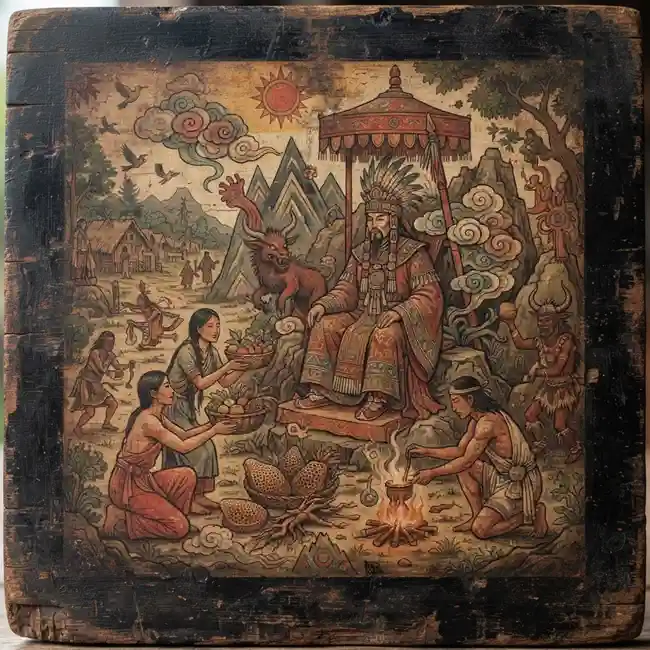
⚔️📜 The Storyteller's Intro: 5,000 Years of Ancestral Flavors
Okay, let's take a little trip back — like, way back. Before dynasties had names you'd recognize, before oracle bones were carved, before anyone wrote a single recipe down, there was a stretch of Chinese history so old that it lives mostly in legend. Historians call it the "Mythical Period," and it's split into two chapters: the Three Sovereigns and the Five Emperors (三皇五帝). We're zooming in on the second half — the Five Emperors era.
Traditional chronology places these five legendary rulers — Huangdi (the Yellow Emperor), Zhuanxu, Ku, Yao, and Shun — somewhere between roughly 2850 and 2070 BCE, right before the semi-legendary Xia Dynasty took over. That's nearly 5,000 years ago. No paper, no ink, no written menus. Just oral tradition, ancestral memory, and — eventually — archaeologists digging up the pottery bowls these people actually ate from.
And here's the fun part for food lovers: this era overlaps almost perfectly with two real, physically excavated Neolithic cultures along the Yellow River — the Yangshao culture (roughly 5000–3000 BCE) and the Longshan culture that followed it. So while the "Five Emperors" themselves are legendary figures, the food story isn't just myth. Archaeologists have literally scraped starch residue off 6,000-year-old pottery shards and found out what these early communities were actually eating.
One name you'll hear over and over in this story is Shennong, the "Divine Farmer." Legend says he wandered the wilderness tasting hundreds of wild plants — sometimes getting poisoned dozens of times in a single day — just to figure out which roots, leaves, and berries were safe for his people to eat. That's the origin story of Chinese foraging culture, agriculture, and herbal medicine, all rolled into one wandering, plant-tasting hero. Basically, the first-ever food critic, except the stakes were literally life and death.
So this isn't a polished palace-kitchen story with fancy plating. This is dirt-under-the-fingernails, foraged-from-the-forest, boiled-in-clay-pots survival food — and honestly, that's what makes it so fascinating.
📜 Iconic Excavated Menus: Wild Earth Sweets & Foraged Bites of the Five Emperors Era
Let's get into the actual food. Nothing here is a modern guess — every category below is tied to real archaeobotanical findings from Yellow River basin sites, or to consistently retold ancient legends about what people gathered, cooked, and nibbled on.
🌾 Grains & Porridges — The Everyday Staples
• Foxtail millet and proso millet — the true MVPs of the Yellow River diet, cooked into thick, warming porridge in round-bottomed clay pots
• Job's tears (coix) — a chewy, nutty ancient grain found in pottery residue at sites in Henan province
• Early rice, which had already started spreading into the region and was sometimes mixed with millet in the same pot
• Grain flour ground on stone mills, later steamed or boiled into a simple, filling mush
🌰 Roots, Tubers & Wild Bulbs — Foraged from the Earth
• Lotus root, dug from riverbank mud and boiled until tender
• Snake gourd root, a foraged tuber identified in ancient cooking-pot residue
• Wild yam, roasted in embers or added to porridge for a starchy boost
• Lily bulbs (baihe), slightly sweet and still eaten in China today — one of the longest-running ingredients in Chinese food history
• Acorns, pounded into a coarse flour or paste — humble, but a genuine famine-proof foraged staple
🍇 Wild Fruits & Gathered Treats
• Wild jujubes (the ancestor of today's Chinese red dates)
• Hawthorn berries, tart and bright red, gathered straight from wild shrubs
• Wild plums and wild peaches, foraged in season along the river valleys
• Wild nuts and seeds, cracked open by hand around the fire
🍯 The Earliest Sweetness — Before Sugar Existed
This is the part that makes the "Wild Earth Sweets" name make total sense. Refined sugar didn't exist yet — not even close. So where did the sweetness come from?
• Wild honey, gathered carefully (and probably painfully) straight from bee nests in hollow trees
• Naturally sweet foraged fruits like jujubes and hawthorn, eaten fresh or sun-dried for later
• Malt-based sweetness (yi, 饴), made by sprouting grain — one of the earliest documented sweeteners in Chinese food history, referenced in texts describing much older oral traditions
• Sweet roots and bulbs, like lily bulb, which added a gentle natural sweetness to otherwise plain porridge
No refined sugar, no fruit syrups from a jar — just what the land handed over, one careful forage at a time.
🗺️ Yellow River Valley: Travel Through China's Cradle of Civilization
If you're the type of traveler who likes tracing a story back to its roots (literally), the middle and lower Yellow River valley is basically an open-air time capsule.
• Banpo Museum, Xi'an — built directly over a real Yangshao-culture village site, with excavated pottery, storage pits, and house foundations you can walk right through
• Jiangzhai archaeological site — another Yangshao settlement showing early village planning and communal living
• Yangshao Village Site, Henan province — the original site that gave the whole culture its name, discovered back in 1921
• The Huangdi Mausoleum in Huangling, Shaanxi — a major pilgrimage and ancestor-worship site tied directly to the legendary Yellow Emperor, especially lively around Qingming Festival
• The wider loess plateau region — the fertile, wind-blown yellow soil that made all this early farming possible in the first place, and still shapes the landscape today
Walking these sites, it's wild to think that the ground beneath your feet is where someone, thousands of years ago, first boiled millet in a clay pot over an open fire.
🚣 Along the Mother River: Chasing the Yellow River's Ancient Foodways
The Yellow River isn't just a river in this story — it's basically a character. Every single food tradition we just talked about exists because of it.
• The river's seasonal floods deposited rich, fertile silt across the valley, which is exactly why millet farming took off here first
• Early settlements clustered along its banks and tributaries (like the Wei River), giving easy access to fish, waterfowl, and lotus-heavy wetlands
• Modern travelers can trace this same river today — from the Lanzhou stretch in the west, through the dramatic Hukou Waterfall, down to the fertile central plains around Henan and Shaanxi
• Local food culture along the river today still leans heavily on wheat and millet-based staples — a quiet, delicious echo of a 5,000-year-old pattern
It's genuinely rare to be able to trace a modern regional diet back to a specific river and a specific archaeological culture. The Yellow River gives you that.
🐲 🀄 Ancient Civilization FAQ: Unlocking Palace Kitchen Mysteries
Q1.Did the Five Emperors actually eat the food listed here, or is this pure legend?
It's a mix, and that's honestly the most interesting part. The Five Emperors themselves are legendary figures from oral tradition, so we don't have their personal dinner receipts. But the Yangshao and Longshan cultures that occupied the same era and region are real, physically excavated archaeological cultures — so the millet, wild tubers, and foraged fruits are backed by actual pottery residue and site evidence, not just storytelling.
Q2.Who was Shennong, and why does every ancient Chinese food article mention him?
Shennong is the legendary "Divine Farmer," credited with personally tasting hundreds of wild plants to figure out which ones were edible or medicinal. He's essentially the founding myth of both Chinese agriculture and Chinese herbal medicine — and by extension, the whole idea of foraging wild ingredients safely.
Q3.What's considered the oldest form of "sweet" in Chinese food history?
Long before refined sugar, sweetness came from wild honey, foraged fruits like jujube and hawthorn, and malt-based sweeteners made from sprouted grain. This is where the "wild earth sweets" idea really comes from — sweetness earned through foraging, not manufactured.
Q4.Can I actually find any of these ancient foraged ingredients today?
Surprisingly, yes. Lily bulbs, lotus root, jujubes, hawthorn, and millet are all still everyday ingredients in Chinese cooking today. Next time you spot them at a market, you're technically looking at a food lineage that stretches back roughly 5,000 years.
🧠 Final Thoughts: The Timeless Allure of Antique Gastronomy
There's something quietly humbling about all this. No refined sugar, no imported spices, no fancy tools — just millet, wild roots, foraged fruit, and a whole lot of trial-and-error courage from people like Shennong. And yet, so many of these ingredients — lotus root, lily bulb, jujube, millet — are still sitting in Chinese kitchens today, thousands of years later.
That's the real magic of "wild earth sweets and foraged bites": it's not a lost cuisine. It's a living one, quietly connecting a modern bowl of porridge to a riverbank campfire from 5,000 years ago. And this is really just the intro — the full recipe breakdown is coming next.
🏛️ Credit to the Keepers of the Culture (The Legacy)
Deep respect to the archaeologists and researchers working the Yangshao and Longshan sites along the Yellow River, whose careful excavation and residue analysis are the reason we can talk about this era with any real grounding at all. And equal respect to the generations of oral storytellers, and to classical texts like the Huainanzi and the Records of the Three Sovereigns, for keeping the legend of Shennong and the Five Emperors alive long enough for it to reach us today. This is their history first — we're just lucky enough to get to retell it. 🙏
🏛️🍯 Golden Kudzu Root Cake: The 5,000-Year-Old Sweet the Five Emperors Guarded
👉 Savor Five Emperors Era: Wild Earth Sweets & Foraged Bites
| 🌐 🏛️🍯 < Back | 🏯 🍲 < Previous | Next > 🧪 🏯 |