
🏠 Home > 🗺️ Recipes > 👑🍲 Royal Court Broths (Soups) > 🇬🇾 Guyana Royal Court Broths (Soups) Recipes > 👑🍲 1.Ancestral Guyanese Pepperpot — The Eternal Cassareep Broth
👑🍲 Inside Guyana's 500-Year-Old Broths: The Lost Recipes That Refused to Die
Published by Supakorn | Updated: September 2026
🏯 The Forgotten Aristocratic Legacy of Guyana: The Arawak Ancestral Era and the Dutch Great House Age
Let me tell you something wild before we get to the cooking part.
Somewhere in Guyana right now, there is almost certainly a clay or cast-iron pot on a stove that has not been fully emptied in decades. Not weeks. Decades. The same broth base gets topped up, re-boiled, fed with fresh meat, and passed down like a family heirloom — sometimes from grandmother to mother to daughter. In some households, people will tell you with a completely straight face that "this pot is older than me."
That pot is called pepperpot, and the dark, glossy, almost black liquid inside it is one of the oldest continuously prepared dishes in the Americas. We're talking a lineage that stretches back roughly five centuries — and honestly, probably a lot further than that, because the Indigenous peoples who invented it weren't exactly writing down cookbooks for European visitors.
This isn't a "royal" recipe in the powdered-wig, gold-cutlery sense. Guyana never had kings or queens. But it absolutely had an aristocracy of taste — Amerindian elders who controlled the cassava harvest, and later the Dutch and British great houses of Demerara and Essequibo where this broth became the centerpiece of the year's most important table. That's the story we're unlocking today.
📜 The Storyteller's Intro
Picture it: sometime in the 1500s, deep in the interior of what Europeans would later call Guiana. The air is thick, the rain is doing that thing where it falls in solid sheets, and there's no refrigeration within three thousand miles.
An Arawak woman is standing over a fire with a problem to solve. She has meat. She has heat. She has zero ways to keep either of them from spoiling by Thursday.
What she also has is bitter cassava — a root so loaded with natural cyanogenic compounds that eating it raw would genuinely kill you. Her people had already cracked that code generations earlier: grate it, press the juice out through a woven tube called a matapee, then boil that juice down for hours until the toxins cook off and what's left is a thick, dark, syrupy reduction that smells like burnt caramel and molasses had a very intense conversation.
That reduction is cassareep. And here's the genius part — it doesn't just taste incredible. It's antimicrobial. Meat simmered in it and reboiled daily simply doesn't spoil the way meat normally does in the tropics.
So she drops the meat in. Adds fire-dried peppers, wild cinnamon bark, cloves. Lets it go low and slow until the pot smells like the entire forest decided to become dinner. And then — this is the crucial bit — she doesn't throw the leftover liquid away. She keeps it. Feeds it tomorrow. And the next day.
Two hundred years later, that same pot logic walked straight into the kitchens of Dutch plantation great houses, where enslaved and Indigenous cooks prepared it for households that considered it the single most prestigious dish they could put on a Christmas morning table. The technique never changed. The address just kept moving.
🌍 The Global Value
Here's what makes this genuinely rare on a world scale.
Most "ancient" recipes you find online are reconstructions. Somebody found a 1780 manuscript, guessed at the measurements, and built something plausible. Lovely work, but it's archaeology with a spatula.
Pepperpot is different. It never stopped. There was no revival needed, because the chain of transmission was never broken — it went from Indigenous households to colonial kitchens to modern Guyanese homes to the diaspora in Toronto, Brooklyn, and London without a single gap. You are not recreating a dead recipe. You are joining a conversation that's been running for five hundred years.
And yet it very nearly did slip away from the wider world. For most of the twentieth century, pepperpot was almost impossible to make outside Guyana because you simply could not buy cassareep anywhere else. No cassareep, no pepperpot — there is no substitute that gets you there. That single bottleneck kept the dish essentially invisible to global food culture for generations, known only to people with a Guyanese aunty willing to smuggle a bottle in her luggage.
That's changed in the last decade or so. Cassareep now ships internationally. Which means, for the first time in history, this is a recipe you can actually make in an apartment in Bangkok or Berlin.
🍲 The Collection
So what we're doing here is restoring the flagship — the full, unhurried, great-house version of ancestral Guyanese pepperpot. The one that gets started the day before the celebration, sits overnight to deepen, and gets reheated in the morning while somebody's cousin argues about whether the pepper level is correct.
I'll walk you through the pantry, the substitutes that actually work, the exact ratios, the ritual itself, and the mistakes that quietly ruin the whole thing. Let's cook.
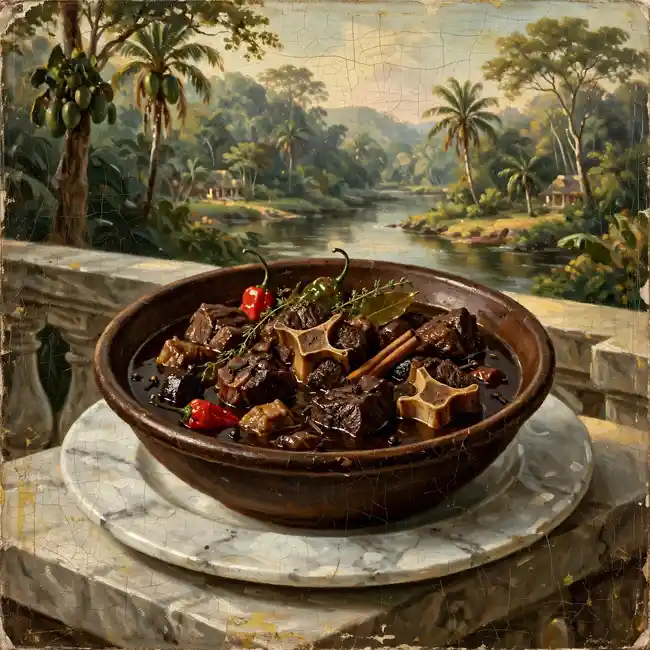
🥘 Recipe: Ancestral Guyanese Pepperpot — The Eternal Cassareep Broth
👑 About this Aristocratic Secret
In Guyana, pepperpot is not a Tuesday dish. It's the dish.
Traditionally it appears on Christmas morning, and the timing is deliberate — it's the reward at the end of a long night of preparation, eaten early, with thick homemade plait bread torn straight into the bowl. In great-house records from the colonial era, pepperpot was the dish brought out for the most important guests of the season, precisely because it announced two things at once: that the household had access to good cassareep, and that somebody in that kitchen had the patience to do it properly.
There's a quieter status signal in there too. The older the mother-pot, the more prestige. A family that could say "this base has been running since my grandmother's time" was making a statement about continuity, stability, and skill that no amount of imported silverware could match.
Weddings, funerals, homecomings, the return of someone who'd been living abroad for years — the pot comes out. It's the taste that says you're home now.
🧂 Ingredients and The Aristocratic Touch
✦ The Ancestral Pantry
The luxury here isn't truffles or saffron. It's time-intensive processing — ingredients that cost hours rather than money.
Cassareep is the crown of the whole thing. Real cassareep is bitter cassava juice reduced over low fire until it's the consistency of thin molasses, deep mahogany-black, smelling of caramelized earth and faint smoke. It's simultaneously sweet, bitter, savory, and slightly sour, and it does something to beef that nothing else on earth replicates. Buy the best you can find — a good bottle transforms the dish, a poor one leaves it flat and one-dimensional.
Then there's the wiri wiri pepper — a small, round, cherry-red Guyanese chili with a bright, almost fruity heat and a perfume you'll recognize instantly once you've smelled it. Guyanese cooks traditionally drop them in whole and unbroken, so they release aroma without unleashing full firepower.
And the meat. Not the fancy cuts — deliberately the slow cuts. Oxtail, cow heel, beef chuck, trotters. Collagen-heavy, gelatin-rich, and completely useless unless you're willing to give them five or six hours. That patience is the aristocratic touch.
✦ Modern Substitutes
Being realistic about what you can actually source:
• Cassareep — no true substitute exists, and I'd rather you wait than fake it. If you absolutely must approximate for a test batch, combine dark molasses with a small amount of tamarind paste and a splash of dark soy for color and depth. It will be a stew. It will not be pepperpot. Order the real thing online and do it right.
• Wiri wiri peppers — scotch bonnet or habanero, used whole and unpierced, gets you closest in aroma. Bird's eye chilies work for heat but lose the fruitiness.
• Cow heel or trotters — replace with extra oxtail, beef shank with bone, or a couple of split marrow bones for body.
• Cassia bark — regular cinnamon sticks are fine, just use slightly less as true cinnamon is more delicate.
• Fresh orange peel — dried orange peel from a spice shop works, use about a third the quantity.
• Beef entirely — a mixed poultry version using bone-in chicken thighs and wings is common in some households; reduce total simmer time to roughly ninety minutes.
✦ The Measurements
Serves 8 to 10 generously.
• Beef chuck or brisket, cut into large 5 cm chunks — 1.2 kg (about 2.6 lb)
• Oxtail, cut into segments — 900 g (about 2 lb)
• Cow heel or beef shank with bone — 500 g (about 1.1 lb)
• Cassareep — 250 ml (1 cup), plus 2 tablespoons held back for final adjustment
• Brown sugar — 3 tablespoons
• Cinnamon or cassia sticks — 3 sticks, roughly 8 cm each
• Whole cloves — 8 to 10
• Wiri wiri peppers, left whole and unbroken — 6 to 10 depending on your courage
• Fresh thyme — 8 to 10 sprigs, tied with kitchen string
• Garlic, smashed — 8 cloves
• Yellow onion, quartered — 2 medium
• Fresh orange peel, wide strips, white pith removed — from 1 orange
• Fresh lime or lemon juice, for washing the meat — 3 tablespoons
• Coarse salt — 2 teaspoons to start, adjusted at the end
• Water — 2.5 to 3 litres, enough to cover the meat by 3 cm
Serve with plait bread, thick-sliced white bread, or roti.
🔥 The Chef's Ritual
◦ Step 1 — Wash the meat, the Guyanese way. Place all meat in a large bowl, cover with cool water, add the lime juice, and rub the pieces thoroughly with your hands. Rinse twice under running water and drain well. This isn't superstition — it removes surface blood and any bone dust from butchering, and it's the difference between a clean-tasting broth and a murky one.
◦ Step 2 — Build the base. Set your heaviest pot over medium heat. Add the brown sugar and let it melt undisturbed until it darkens to the color of strong tea and just begins to smoke faintly at the edges. This takes two to three minutes and requires your full attention — walk away and it turns acrid.
◦ Step 3 — Sear. Add the beef chunks in batches, turning to coat them in the caramel and letting each side take on deep color. Don't crowd the pot. Transfer each batch out and continue until all beef is browned, then return everything to the pot along with the oxtail and cow heel.
◦ Step 4 — The pour. Add the cassareep and stir until every piece of meat is slick and glossy black. Let it bubble gently for two minutes so the cassareep tightens around the meat rather than just floating in the liquid. The kitchen will start smelling extraordinary right about now.
◦ Step 5 — Add the aromatics. In go the cinnamon sticks, cloves, garlic, onion, orange peel, and the tied bundle of thyme. Pour in enough water to cover the meat by roughly three centimetres. Add the salt.
◦ Step 6 — The long, patient simmer. Bring to a boil, then immediately drop the heat to the lowest steady simmer your stove can hold. You want lazy bubbles breaking the surface every few seconds — never a rolling boil. Cover partially and let it go for four to five hours, stirring gently every forty minutes or so.
◦ Step 7 — Introduce the peppers. In the final hour, lower the whole wiri wiri peppers into the pot. Whole. Unpierced. They'll perfume the broth without turning it into a punishment. If someone at the table wants more heat, they can burst one in their own bowl.
◦ Step 8 — Read the pot. It's ready when the oxtail meat retreats from the bone at a nudge, the cow heel has gone translucent and sticky, and the liquid has reduced to a glossy, spoon-coating darkness that clings. Taste. Adjust salt. If it needs more depth, stir in the reserved two tablespoons of cassareep.
◦ Step 9 — Rest it overnight. This is the step people skip and later regret. Cool the pot uncovered until it stops steaming, then leave it. The next morning, bring it back to a full boil for at least ten minutes before serving. It will be measurably better than it was last night. This is not a rumor.
🤫 Secrets of the Great House Kitchen (Tips and Mistakes)
• Never let it boil hard during the long simmer. Aggressive boiling shreds the meat fibers and clouds the broth. Old cooks judged doneness by the sound of the pot, not the clock — a soft, irregular plop is what you're listening for.
• The daily reboil is the entire preservation system. Traditionally the pot sits at room temperature and gets brought to a rolling boil once every single day. If you're going to skip a day, refrigerate it instead — don't gamble. Reboil for a full ten minutes when you return to it, not thirty seconds.
• Do not add vegetables. No carrots, no potatoes, no bell peppers. They break down, release water, and dilute the cassareep concentration that keeps the pot stable. This is a meat-and-broth dish by design, not by omission.
• Use a non-reactive pot. Cast iron enameled, heavy stainless, or clay. Bare aluminum reacts badly with the acidity of cassareep and can throw a metallic edge into the whole batch.
• Never introduce a clean spoon that's touched other food. Cross-contamination is the number one killer of long-running mother-pots. Dedicate one spoon to the pepperpot and keep it that way.
• Salt at the end, not the beginning. Five hours of reduction concentrates everything. What tasted perfectly seasoned at hour one will taste like seawater at hour five.
• Under-cassareeping is the most common beginner error. People get nervous about the color and hold back. The result is a brownish beef stew with a vague sweetness. Commit to the full cup — the dish is supposed to be near-black.
• Trim aggressively before cooking. Excess fat cap doesn't render into richness here, it just pools on top. Skim what surfaces during the first hour of simmering.
❓🛎️ Aristocratic FAQ
Q1.Is it actually safe to keep the same pot going for years?
When done exactly as tradition dictates — a genuine daily rolling boil, high cassareep concentration, no vegetables, no contaminated utensils — yes, and Guyanese families have proven it across generations. That said, if any of those conditions slips, refrigerate. Modern kitchens with modern schedules aren't always compatible with a traditional daily boil, and there's no shame in using a fridge.
Q2.Can I make this in a slow cooker or pressure cooker?
A slow cooker on low for eight hours works well, though you'll want to do the caramel and sear in a separate pan first. A pressure cooker gets you tender meat in about an hour but sacrifices the reduction and the layered depth. Use it if you're short on time, but the traditional method is meaningfully better.
Q3.How long does the flavor keep improving?
Days three through five are widely considered the peak. Day one is good. Day three is when people start making noises across the table.
Q4.What do I do if I genuinely cannot get cassareep?
Honestly? Wait. It ships internationally from Caribbean grocers and online spice retailers, it's inexpensive, and it keeps almost indefinitely at room temperature. Making pepperpot without it is like making a stew and calling it something it isn't.
⏳ The Taste of History
What lands in your bowl is genuinely unlike anything else in global cuisine. It's dark and glossy, and the first note is that bittersweet cassareep — earthy, faintly burnt-caramel, with a sourness underneath that keeps it from ever tasting like dessert. Then the cinnamon and clove arrive, warm and old-fashioned. Then the wiri wiri heat, bright and floral, showing up late and staying just long enough. The beef is completely surrendered, and the gelatin from the oxtail and cow heel gives the broth a lip-sticking body that makes the bread absolutely essential.
It tastes, unmistakably, like something that was figured out a very long time ago by people who knew exactly what they were doing.
🍽️ Final Thoughts: Bringing History to Your Table
Here's the thing I want you to walk away with: this recipe is not gatekept.
It looks intimidating. Five hours, an unfamiliar bottled ingredient, a preservation technique that sounds like a food safety violation. But strip away the mystique and it's genuinely one of the least fussy dishes you'll ever make. Caramel, sear, pour, cover, wait. There's no emulsion to break, no temperature to nail, no window you can miss. The pot does the work. You just have to not rush it.
You will probably not get a perfect result on your first attempt. Your cassareep balance might be shy. Your simmer might run a touch hot. That's completely fine — and it's also exactly how every Guyanese cook learned, standing next to someone who'd already made a hundred batches. Make it again in a month. It'll be better. Make it at the end of the year and it'll be the thing people ask you about.
Five centuries of cooks have already worked out the hard parts for you. All you're doing is showing up.
📣 The Call to Action (The Golden Hook)
If a taste like this moves you — if you believe the world's oldest recipes deserve better than to quietly disappear when the last person who remembers them stops cooking — then come be part of keeping them alive.
Cook it. Photograph it. Talk about it. Tell someone where it came from. Every time a recipe like this gets made in a new kitchen, on a new continent, it earns another generation. That's not a marketing line — it's literally the only mechanism by which any of this survives.
Follow along as we keep unlocking the world's forgotten culinary secrets, one nearly-lost pot at a time. There are hundreds more out there, and most of them are running out of keepers.
🙏 Credit to the Keepers of the Culture (The Legacy)
This dish does not belong to me, and it doesn't belong to any food website.
It belongs to the Indigenous peoples of Guyana — the Arawak, Carib, Wapishana, Macushi, and their neighbors — whose ancestors solved the bitter cassava problem, invented cassareep, and built a preservation system so effective it's still in daily use half a millennium later. That is one of the most underrated pieces of food technology in human history, and it has never received a fraction of the recognition it deserves.
It belongs equally to the enslaved African cooks of the Dutch and British colonial period, who carried the technique into the great-house kitchens, adapted it, and made it central to Guyanese identity under conditions no one should have had to endure.
And it belongs to the Guyanese grandmothers and aunties, at home and across the diaspora, who kept those pots alive through migration, hardship, and a century in which nobody outside the country was paying attention.
If you make this, make it with their names in mind. And if you have the chance to learn it directly from a Guyanese cook rather than from an article on the internet — take that chance every single time. What's written here is a map. They're the territory.
| 🇬🇾 👑🍲 < Back |