
🏠 Home > 🗺️ Recipes > 👑🍲 Royal Court Broths (Soups) > 🇬🇾 Guyana Royal Court Broths (Soups) Recipes
🇬🇾 👑🍲 Guyana Royal Court Broths (Soups) Recipes
Published by Supakorn | Updated: September 2026
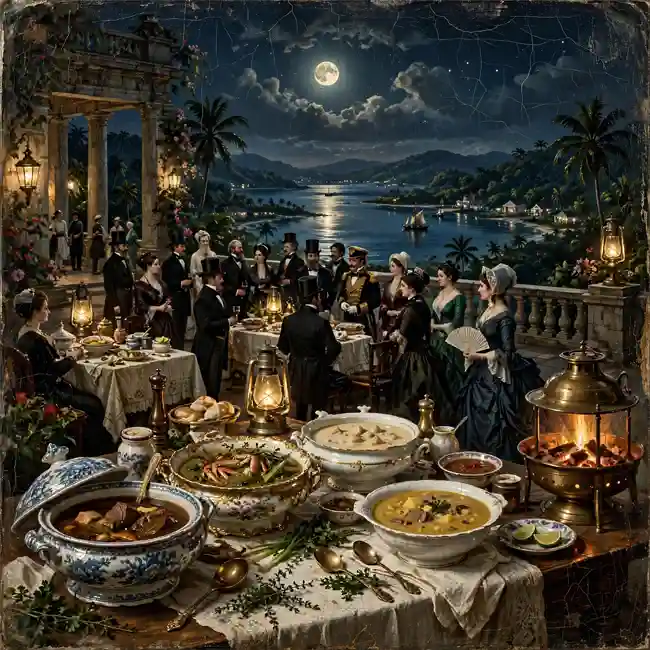
"This is the codex that opens the sealed pots — the 200-to-1,000-year-old broth secrets of Guyana's high houses, chieftains' longhouses and old aristocratic kitchens."
🤴📜 The Storyteller's Intro: What the Old Houses Whispered Over a Simmering Pot
Okay, let's get one thing straight before we start, because I don't want you emailing me about it later. 😄
Guyana doesn't have a crown. No palace with velvet ropes, no coronations, no royal family in a gilded carriage. It's a republic on the shoulder of South America, and it always tells you so with a straight face.
But "royal"? That's a different conversation entirely.
Because Guyana absolutely had courts. It had chiefs whose word decided who ate first. It had a Dutch plantocracy that dined on porcelain shipped across an ocean. It had British sugar barons whose kitchens were staffed by cooks who quietly outclassed them. And it had — still has — aristocratic families, the kind where a specific soup pot is spoken of the way other people speak of a title deed.
So when I say Guyana Royal Court Broths, I mean the soups that got served at the top of the table. The ones with rules. The ones where the recipe never left the house.
Here's how the timeline breaks down, roughly:
• 🏹 The Ancient Layer (roughly 1,000+ years back to the present): Long before any European ship found the Essequibo, the Lokono (Arawak), Kalinago (Carib), Warrau, Wapishana, Makushi, Patamona, Akawaio, Arekuna and Wai Wai peoples were running one of the most sophisticated broth cultures in the Americas. Their aristocracy wasn't gold-based — it was knowledge-based. The village leader and the piaiman (the shaman-healer) held authority, and the pot at the centre of the longhouse held the community. This is where cassareep was born, and cassareep is the single most important liquid in Guyanese history.
• ⚓ The Dutch Merchant-Lord Era (roughly 1600s–1814): Essequibo, Berbice and Demerara were Dutch trading colonies before they were British. A tight, wealthy planter class built forts like Kyk-Over-Al and Fort Zeelandia, ran the Council of Policy, and lived like minor European nobility in a rainforest. Their kitchens adopted Indigenous techniques fast — because the Indigenous techniques worked in that heat.
• 🎩 The British Sugar-Aristocracy Era (1814–1966): "Demerara" became a word that meant sugar and money worldwide. Great houses went up along the coast, and Georgetown grew into one of the most elegant wooden cities on Earth. The formal dining rooms were British. The pots in the back kitchen were African, Indigenous, Indian, Chinese and Portuguese — and the food that came out of those pots is what everybody actually remembers.
• ⛓️ The African Heritage Layer (1600s onward): Enslaved West and Central Africans arrived carrying a broth grammar of their own — one-pot cooking, ground provisions, coconut milk, palm-oil richness, dumplings, the deep respect for a slow simmer. Metemgee comes straight out of this lineage. This layer isn't a footnote; it's structural.
• 🌾 The Indentureship Layer (1838–1917): Indian, Chinese, Portuguese-Madeiran and other indentured labourers arrived after emancipation. Within two generations, some of these families became Georgetown's new merchant elite, with their own household soup traditions — dhal-based broths, clear pork-bone-and-watercress soups, garlic-heavy Madeiran cures.
• 🕊️ The Modern Heritage Layer (1966–today): Independence turned all of this into a national identity, and a handful of old families quietly kept the original methods intact. Those are the recipes people are hunting for now.
So what did "living aristocratically" actually look like around a Guyanese soup pot? A few things kept showing up:
• 🔥 The pot that never dies. In old Guyanese homes — and I mean old — the pepperpot vessel was never fully emptied. It was topped up, reboiled, fed. Some family pots were said to be decades in continuous life, passed down like an heirloom. The pot itself was the inheritance.
• 🍽️ Seniority ate first, always. Elders, then guests, then the household. In Amerindian villages, the hunter who brought the meat was honoured but rarely served first — that spot belonged to the elders.
• 🌶️ Heat as a marker of rank. The tiny wiri wiri pepper is Guyana's signature. In several traditions, the strength of the pepper in your bowl reflected your standing and your ability to take it. Bringing a guest a mild bowl was a subtle statement.
• 🤫 Recipes as private property. No written measurements. It was taught by hand, by smell, by the sound the pot makes when it's ready. That's exactly why so much of it is "lost."
🗺️ The Royal Culinary Tourism: Mapping Flavors to Historic Landscapes
Here's the fun part, and honestly the reason I fell down this rabbit hole in the first place — in Guyana, the map and the menu are the same document.
You can't understand the broths without understanding the geography, because Guyana is basically three countries stacked together: a narrow, dense coastal strip below sea level; a colossal interior of rainforest and rivers; and a wide-open savannah in the far southwest that looks like it belongs in Africa.
Each one cooks differently. Each one had its own elite. Each one guards its own pot.
There's an old Guyanese saying you'll hear everywhere: "If you eat labba and drink creek water, you'll always come back to Guyana." It's about bush meat and river water, sure — but really it's a promise. Taste the interior once and you're bound to the place.
Some route ideas if you're plotting a heritage-and-broth trip:
• 🏛️ Georgetown first, always. Stabroek Market's iron clock tower, St. George's Cathedral (one of the tallest wooden buildings anywhere), the white colonial mansions along Main Street, Castellani House, the Walter Roth Museum of Anthropology. This is where the aristocratic dining culture crystallised. Eat the coastal versions of everything here so you have a baseline.
• ⚓ Then Fort Island and the Essequibo. The Dutch Court of Policy building and Fort Zeelandia sit on a river island in the mouth of a river so wide it looks like a sea. This is where merchant-lord dining happened.
• 🌿 Then Bartica and Iwokrama. Bartica is called the "Gateway to the Interior" for a reason. Past it, the Essequibo narrows into rainforest and the food changes completely — smoked, peppered, cassava-driven.
• 🌾 Then the Rupununi. Lethem, Annai, Surama, Karanambu, Rewa, Yupukari. This is the oldest broth country in the nation and, to my mind, the real prize.
• 💧 And Kaieteur Falls somewhere in the middle, because you'd be mad not to. It's a single-drop waterfall roughly five times the height of Niagara, sitting in silence in the Pakaraima highlands.
🚣 Cradle of Royal Delicacies — The Coastal Belt, the Great Rivers & the Old Plantation Aristocracy
The coast is where Guyana's written aristocracy lived. Below sea level, protected by a Dutch-engineered seawall and a lattice of canals and kokers, with the Demerara, Essequibo, Berbice and Corentyne rivers pouring out into brown Atlantic water.
This is the region of great houses, of Demerara windows, of long verandahs and long lunches. And its broths reflect that — richer, more layered, more "composed."
🍲 The Standout Coastal Court Broths
• The Cassareep Pepperpot (the Sovereign Pot). Guyana's national dish and its greatest culinary secret. Cassareep is a black, syrupy reduction made from the juice of bitter cassava — a root that's genuinely toxic raw, and which Indigenous cooks learned to render safe over centuries using the matapee, a woven tube press. Boiled down, it becomes a preservative, a tenderiser and a flavour bomb all at once. It's why the pot could survive without refrigeration. Traditionally a Christmas-morning dish in elite coastal homes, served with plait bread, and never stirred with a wet spoon. That's the rule. Wet spoon spoils the pot.
• Metemgee (Metagee). Thick, golden, coconut-milk-drenched, loaded with ground provisions — cassava, eddoes, yam, sweet potato, plantain — with dumplings poached right in the broth. Afro-Guyanese in origin and, in the old houses, a Sunday statement dish. It sits right on the line between soup and stew, which is very much the point.
• Cow Heel Soup (the Sunday Sovereign). If there was one broth that signalled a household could afford time, it was this. Cow heel and cow foot need hours to break down into that unmistakable silky, lip-sticking gelatin. Add split peas, provisions, thyme, a whole wiri wiri floated on top and never burst. Elite Georgetown households treated it as a restorative — a tonic soup for elders and new mothers.
• Saturday Soup. The great democratic aristocrat of Guyanese food. Chicken or beef, split peas, ground provisions, corn on the cob, and duff — those dense boiled dumplings, sometimes rolled long and thin, sometimes plump. Every family on the coast has a version, and every family thinks theirs is the original. They're all wrong except your grandmother.
• Dhal Water (the Indo-Guyanese Mother Broth). From the indentureship families who became coastal merchants and landowners. Split peas simmered soft, then chunkayed — hot oil poured over garlic and cumin and crashed into the pot at the last second. The sizzle is the signature. In formal households it opens the seven-curry meal served on a lotus leaf.
• Chinese-Guyanese Clear Broths. Georgetown's Chinese merchant families brought slow-simmered pork bone, watercress and winter melon soups — restrained, clear, almost medicinal next to the coastal richness. A completely different philosophy of luxury: subtraction instead of addition.
• Fish Tea / Riverkeeper's Broth. Light, peppery, made from whatever the river gave up that morning — gilbaka, hassar, banga mary. In old riverside houses this was the pre-meal broth, drunk from a cup rather than eaten from a bowl.
🏞️ Where to Actually Go
• Georgetown — Stabroek Market, the Botanical Gardens, the Promenade Gardens, and the wooden colonial architecture that earned it the "Garden City of the Caribbean" name.
• Fort Island & Fort Zeelandia (Essequibo) — the Dutch administrative heart, reachable by speedboat from Parika.
• The Pomeroon River — old coconut and cassava country, where cassareep is still made properly.
• Berbice & New Amsterdam — quieter, older, with a colonial layout that's barely changed.
• Shell Beach — one of the region's great sea-turtle nesting coastlines, up near the Venezuelan border.
⛰️ Kingdom of Wild Aromatics & Heritage — The Rainforest Interior & the Rupununi Savannahs
Now this — this is where the thousand-year clock is actually running.
Head south and the coastal world disappears. You get the Iwokrama rainforest, the Pakaraima Mountains, the Kanuku Mountains (whose name in Makushi means "rich forest"), and then the Rupununi opens up: an enormous seasonal savannah of termite mounds, sandpaper trees, ité palms and horizon.
The Indigenous nations here — Makushi, Wapishana, Wai Wai, Patamona, Akawaio and Arekuna — never needed a European court. They had their own authority structures, their own protocol, their own ceremonial food. And their broths are, honestly, the oldest continuously cooked recipes in the whole country.
🔥 The Interior's Guarded Broths
• Tuma Pot. The great communal broth of the Makushi and Wapishana. A cassava-water base cooked with fish or game and fierce amounts of pepper, set in the middle of the group so everyone dips in together with cassava bread. There's no individual portioning. That's not an oversight — it's the entire philosophy. Eating from one pot means you're one household.
• Damurida. The fire-broth. Associated strongly with the Wai Wai and the deep south, this is peppers, cassava liquid and meat or fish reduced into something genuinely ferocious. Traditionally it was kept going for days, refreshed constantly, and treated as a sign of a well-run home. If you're offered damurida in the Rupununi, that's a real honour — and go slow.
• Smoked Game & River Broths. Interior kitchens smoke first, simmer second. The smoke is the seasoning. Combined with cassava liquid, wild peppers and forest herbs, it produces a depth you cannot fake with any imported ingredient.
• Cassava Bread & Farine as the "Cutlery." No spoons needed. Cassava bread scoops. Farine (toasted cassava granules) gets sprinkled in to thicken the broth in the bowl. It's an elegant system and it's about 1,000 years old.
🧭 Interior Heritage Stops
• Kaieteur Falls — the single most spectacular thing in the country, and sacred in Patamona tradition.
• Iwokrama Forest & the Canopy Walkway — one million acres under conservation management.
• Surama Village & Annai — Makushi community-run eco-lodges where you can actually be taught the food properly, from the people who own it.
• Karanambu & the Rupununi River — giant otters, giant water lilies, ranch history going back generations.
• Rewa & Yupukari — remote, river-focused, extraordinary.
• Orinduik Falls — stepped jasper terraces on the Brazilian border.
• Lethem — the southern frontier town and the gateway to the whole savannah.
⚔️⚜️ Royal FAQ: Unlocking Palace Kitchen Mysteries
Q1.Guyana is a republic — so how can these be "royal" broths?
Because "royal" here means courtly, not monarchical. Guyana's high tables were Indigenous chieftaincies and shamanic councils, then Dutch merchant-lord households, then British planter-class great houses, then the elite merchant families of the indentureship era. Each was a court in function if not in title, each had exclusive dishes, and each guarded them. The soups earned the word.
Q2.Can a recipe really be 1,000 years old?
Techniques, absolutely. The processing of bitter cassava into safe food and then into cassareep is a genuinely ancient Amerindian technology, and the tuma pot tradition is continuous rather than reconstructed. What's changed over the centuries is the cast of ingredients — chickens, cattle, split peas, coconut, garlic and cumin all arrived later. So think of it as an ancient skeleton wearing several different centuries of clothing.
Q3.Why were the recipes kept secret in the first place?
Three reasons, all practical. One: in households without written records, culinary knowledge was capital, and you didn't hand your capital to a neighbour. Two: bitter cassava processing is a genuine safety skill — getting it wrong is dangerous, so the knowledge was deliberately restricted to trained hands. Three: some preparations were tied to ceremony, healing or specific occasions, and sharing them casually would have been a breach of protocol, not just of family pride.
Q4.What actually makes a Guyanese broth taste Guyanese?
Four pillars, and if any one is missing it reads as generic Caribbean: cassareep for that dark bittersweet backbone; the wiri wiri pepper for fruity heat that doesn't scorch; ground provisions for body instead of flour; and time — genuinely long, unhurried, low simmering. There's no shortcut version. People have tried.
🧠 Final Thoughts: The Timeless Allure of Aristocratic Gastronomy
Here's what got me, in the end.
Most "lost royal cuisine" stories are about extinction — a dead court, a burned archive, a dish nobody can rebuild. Guyana's story isn't that. Guyana's court broths didn't vanish. They just went quiet, moved to the back kitchen, and kept simmering while everyone was looking at the front room.
The pepperpot pot on a Georgetown stove this Christmas morning is doing the same thing pots were doing on the Essequibo four hundred years ago. The tuma pot in a Rupununi village tonight is running an unbroken thousand-year program. That's not heritage in a museum case. That's heritage with steam coming off it.
So consider this the map, not the treasure.
Over the coming weeks I'm going to open these pots one at a time — full dedicated pages, one broth per post, with the real method, the real order of operations, and the household rules that never got written down. Starting with the Sovereign Pot itself, then Metemgee, then Cow Heel, then straight into the interior for Tuma and Damurida.
Bookmark the page. Bring an appetite and some patience — these things do not rush.
👑 Credit to the Keepers of the Culture (The Legacy)
None of this belongs to me, and it doesn't belong to anyone writing about it from a distance. It belongs to the people who kept it alive when nobody was clapping.
• To the Indigenous Nations of Guyana — the Lokono (Arawak), Kalinago (Carib), Warrau, Wapishana, Makushi, Patamona, Akawaio, Arekuna and Wai Wai. Cassareep, cassava bread, farine, tuma and damurida are your inventions and your intellectual heritage. The rest of the country's cuisine is built on your foundation, and that should be said first and loudest.
• To Guyana's African-descended communities — for metemgee, for the one-pot mastery, for the dumplings and the coconut milk and the ground provisions, and for preserving a whole culinary language under conditions designed to erase it. That is not a small thing.
• To the Indo-Guyanese, Chinese-Guyanese and Portuguese-Guyanese families — for dhal and the chunkay, for clear restorative broths, for garlic and vinegar cures, and for turning arrival into contribution.
• To the grandmothers, the aunties, the village cooks and the household cooks — the actual authors. No credits, no cookbooks, no royalties. Every single one of these dishes came through their hands.
• To Guyana itself — the only English-speaking country in South America, holding a rainforest most of the world will never see, and feeding the whole thing into one very old, very dark, very good pot.
Respect the source. Cook it properly. Say the names. 🇬🇾🙏
Want me to start with the full Cassareep Pepperpot deep-dive next, or would you rather I open the interior first with Tuma Pot & Damurida?
👑🍲 Inside Guyana's 500-Year-Old Broths: The Lost Recipes That Refused to Die
👉 Discover Rare Guyanese Royal Court Broths
| 🌐 👑🍲 < Back | 🇬🇾 👑🍷 < Previous | Next > 🥗👑 🇬🇾 |