
🏠 Home > 🗺️ Recipes > 👑🥪 Royal Starters (Appetizers) > 🇬🇾 Guyana Royal Starters (Appetizers) Recipes > 👑🥪 1.The Cassareep Crown — Demerara Heritage Pepperpot
👑🥪 Inside Guyana's Forgotten Aristocratic Kitchens: The Ancient Recipes Almost Lost to Time
Published by Supakorn | Updated: September 2026
🛡️🕌 The Forgotten Aristocratic Legacy of Guyana: The Cassareep Courts of Demerara
📜 The Storyteller's Intro
Picture this. It's somewhere around 1790, deep in the humid dark before dawn, and you're standing in a detached kitchen behind a great white plantation house on the Demerara coast. The main house is silent. But here, the fire has never actually gone out — not last night, not last week, not for as long as anyone in this kitchen can remember.
In the centre of the room sits a heavy clay pot. It's blackened, scarred, older than most of the people standing around it. And inside it is something thick and glossy and almost mahogany-dark, breathing out a smell that's impossible to describe if you've never met it: sweet like burnt sugar, sharp like clove, warm like cinnamon, and underneath it all a low, smoky, savoury hum that makes your stomach genuinely ache.
The cook lifts the lid, stirs once with a wooden spoon that is only ever used for this pot, and lowers the lid again. That's the whole ritual for the day. Tomorrow she'll do it again. And the day after that.
That pot is a pepperpot. And the reason it doesn't spoil in a tropical climate with no refrigeration, no ice, no electricity, has nothing to do with European technique at all. It's because of a syrup the Indigenous Amerindian peoples of this land — the Lokono, the Kalinago, the Warrau — had been perfecting for centuries before a single Dutch ship ever dropped anchor in the Essequibo.
Welcome to Guyanese heritage cooking, my friend. Grab a chair. This one's a good story.
🌍 The Global Value
Here's the thing that makes Guyana genuinely fascinating, and it's the reason I wanted to write this guide in the first place.
Guyana never had a royal court. No emperors, no palaces, no crown jewels. What it had instead was something arguably more interesting — a layered aristocracy of Dutch and later British planter families, colonial governors, and merchant elites who built enormous wealth from sugar. Demerara sugar. You've probably got a bag of it in your cupboard right now. That name comes from a river in Guyana.
And these families ate extraordinarily well. Their kitchens were staffed by Indigenous, African, and later Indian and Chinese cooks, each bringing techniques that had nothing to do with each other — and everything to do with each other once they were forced into the same room. What came out of those kitchens was food that existed nowhere else on earth.
But most of it never got written down. Recipes travelled by hand, by watching, by "you'll know when it looks right." When the plantation economy collapsed and families scattered, entire dishes just... evaporated. No cookbook, no record, nothing. What survived, survived because ordinary Guyanese households kept cooking it — often without knowing they were preserving something that had once been the pride of a governor's table.
That's the part that gets me. These weren't recipes lost in a fire. They were lost in silence.
📖 The Collection
So this guide is my attempt at a small resurrection. I'm going to walk you through the single most important dish in the Guyanese repertoire — the one that sat at the centre of every significant table in the colony for over two hundred years, and still anchors Christmas morning in Guyanese homes from Georgetown to Toronto to London.
I'll give you the real story behind it, the ingredients with honest ratios, substitutes that actually work if you can't get the original, the step-by-step method, and — most importantly — the little house-kitchen secrets that separate a decent pepperpot from one that makes people go quiet at the table.
You don't need special equipment. You don't need to be an experienced cook. You just need patience, which happens to be the one ingredient this dish demands absolutely.
Let's go.
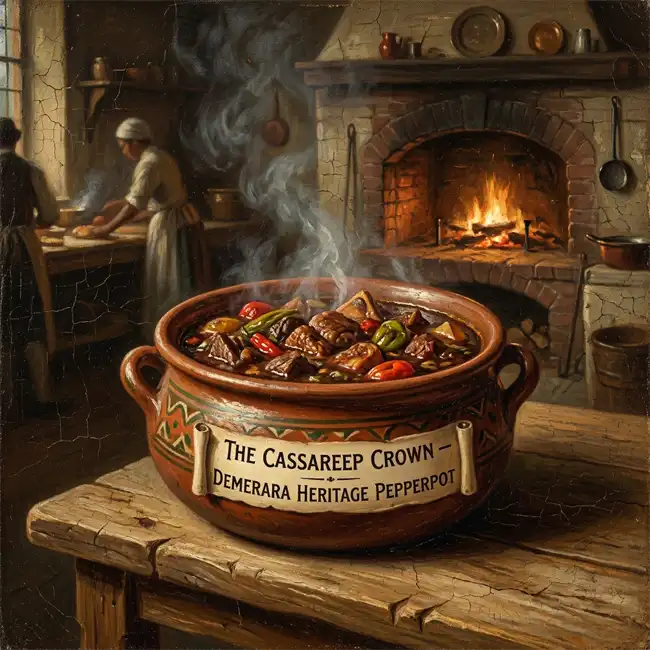
🍲 Recipe: The Cassareep Crown — Demerara Heritage Pepperpot
👑 About this Aristocratic Secret
Pepperpot is Guyana's national dish, and its lineage runs straight back to Amerindian cooking — specifically to a practice called the "perpetual pot," where a stew was kept alive over weeks and months, replenished with fresh meat as it was eaten, preserved entirely by cassareep.
When Dutch planters settled the Essequibo and Demerara in the 1600s, they encountered this dish and did what colonial elites always did with something brilliant: they adopted it wholesale. By the eighteenth century, pepperpot had become the centrepiece of the planter class's most important occasions. A governor's Christmas table without pepperpot would have been an embarrassment. Visiting captains and merchants were served it as a statement — look what this colony produces, look what only we have.
There's a lovely detail in the historical accounts: guests at wealthy Demerara houses would sometimes be told, almost boastfully, exactly how old the pot was. Six months. A year. Longer. Age was the flex. The older the pot, the deeper the flavour, the more the household could claim continuity and permanence in a place where almost nothing was permanent.
And today? Guyanese families still cook it at Christmas, still keep the pot on the stove for days, still eat it for breakfast on Christmas morning with thick slices of plait bread. Two hundred years later, the ritual survived the aristocracy that once claimed it. I find that quietly beautiful.
🧂 Ingredients & The Aristocratic Touch
✦ The Royal Pantry
The luxury in this dish isn't caviar or saffron. It's time, and it's cassareep.
Cassareep is the soul of pepperpot, and it deserves a proper introduction. It's made from bitter cassava — a root that is genuinely toxic when raw, containing cyanogenic compounds. Amerindian cooks worked out, over generations, how to grate it, press out the juice, and boil that juice down for hours with cinnamon, clove and sugar until it becomes a thick black syrup that is not only completely safe but powerfully antibacterial. That's the magic. That's why the pot doesn't spoil.
Think about what that represents. That's not a recipe — that's applied chemistry developed centuries before anyone had a word for it. Every time you open a bottle of cassareep, you're using Indigenous scientific knowledge.
The other aristocratic touch is the meat selection. Old pepperpot used cuts rich in collagen and bone — the parts that reward long cooking and give the stew its signature lip-sticking body. Prime steak would be a waste here. This dish honours the humble cuts and turns them into something regal.
✦ Modern Substitutes
◦ Cassareep — the one thing I'd really push you to buy properly. Caribbean grocers and online retailers stock it, it keeps for years, and one bottle makes many pots. If you genuinely cannot find it, the closest emergency blend is 4 parts molasses to 1 part tamarind paste with a pinch of ground clove and cinnamon, cooked down slightly. Be honest with yourself though — it's a stand-in, not a replacement, and it won't preserve the pot.
◦ Wiri wiri peppers — swap for whole scotch bonnet or habanero. Use them whole and unbroken.
◦ Oxtail — beef short ribs or beef shin work beautifully and cost less.
◦ Pork trotters or hock — pork belly with the skin on gives similar richness. Chicken feet also work if you want extra gelatin.
◦ Cow heel (traditional) — completely optional; skip it without guilt if it's not your thing.
◦ Dried orange peel — a strip of fresh orange zest, pith removed.
✦ The Measurements
Serves roughly 8 to 10 people generously. Ratios given so you can scale confidently.
◦ Beef chuck or beef shin, cut into large chunks — 1.5 kg
◦ Oxtail, jointed — 500 g
◦ Pork hock or trotters — 500 g
◦ Cassareep — 250 ml (roughly 1 cup, which is about 1 cup per 2.5 kg of total meat)
◦ Water or unsalted stock — 1.5 litres, or just enough to barely cover
◦ Cinnamon sticks — 2 whole
◦ Whole cloves — 8
◦ Dried orange peel — 1 strip, about 5 cm
◦ Fresh thyme — 5 sprigs
◦ Wiri wiri or scotch bonnet peppers — 3, left whole
◦ Brown sugar — 2 tablespoons
◦ Salt — 2 teaspoons to start, adjusted at the end
◦ Lime or white vinegar, for washing the meat — juice of 2 limes or 60 ml vinegar
🔥 The Chef's Ritual
1.Wash the meat the Caribbean way. Place all the meat in a large bowl, cover with cool water, add the lime juice or vinegar, and rub the pieces thoroughly with your hands. Rinse twice in fresh water and drain well. Skip this and you'll notice — it's not superstition, it genuinely cleans and freshens the meat.
2.Dry and season. Pat every piece properly dry with paper towel. Wet meat steams instead of browning. Season lightly with about half the salt.
3.Build the base. Set a heavy-bottomed pot — cast iron or a thick clay pot if you have one — over medium-high heat with a little oil. Brown the meat in batches, never crowding the pan. You want deep colour on each piece, not grey. This takes patience and about twenty minutes total, and it's where a huge amount of flavour is born.
4.Return everything to the pot. All the meat, all the accumulated juices. Nothing gets thrown away here.
5.Introduce the cassareep. Pour it over the meat and stir gently until every piece wears a dark, glossy coat. Let it bubble for two or three minutes. The kitchen will start smelling like history at roughly this point.
6.Add the aromatics. Cinnamon sticks, cloves, orange peel, thyme, brown sugar, and the whole peppers laid carefully on top. Do not stir aggressively now — you want those peppers intact.
7.Add liquid and bring it up slowly. Pour in just enough water to barely cover the meat. Bring to a gentle boil, then immediately drop the heat right down.
8.Simmer with real patience. Cover partially and let it go for 3 to 4 hours on the lowest steady simmer you can manage. Stir occasionally with a clean spoon, gently, always keeping the peppers whole. The liquid should reduce into something thick, dark and syrupy that clings to the meat rather than pooling around it.
9.Taste and correct. Adjust salt at the very end. If it's too sharp, a touch more sugar. If it's too flat, another spoon of cassareep. If it's too thin, uncover and let it reduce another twenty minutes.
10.Rest overnight. This is not optional advice — it's the actual recipe. Let it cool, leave it covered at room temperature or refrigerate, and reheat the next day. Day two pepperpot is a completely different, far better dish than day one.
🤫 Secrets of the Palace Kitchen (Tips & Mistakes)
• Boil the pot once every single day. This is the ancient rule and it's the entire preservation system. A daily rolling boil, even for five minutes, keeps a traditional pot safe and deepens flavour. If you're not doing daily boils, refrigerate it instead — don't half-commit.
• Never introduce water, oil or crumbs into the pot. Old kitchens were fanatical about this. One drop of raw water or a greasy spoon and the pot spoils. Keep a dedicated dry spoon for pepperpot and nothing else.
• Do not burst the peppers. Whole peppers release perfume and gentle warmth. A burst pepper releases raw fire and there is no undoing it. Fish them out once you're happy with the heat level.
• Don't rush the browning. The single most common beginner mistake. Pale meat means a flat, thin-tasting pepperpot no matter how long you simmer it afterwards.
• Use bone-in and collagen-rich cuts. Lean stewing beef alone will give you a dish that tastes correct but feels thin. The body comes from bone, skin and connective tissue.
• Go easy on cassareep the first time. It's assertive and slightly bitter. Start at the ratio given, taste, and add more. You can always add — you cannot subtract.
• Skim the fat after resting. Chill it and the fat cap lifts off cleanly. Removing most of it makes the dish taste cleaner and lets the spice come forward.
• Resist the urge to add extra spices. No cumin, no paprika, no bay leaf. Pepperpot's elegance is its restraint. Cassareep, cinnamon, clove, orange, thyme, pepper. That's the whole architecture.
• Serve it with plait bread or dense white bread. The bread isn't a side dish, it's a utensil. You need it to catch the gravy.
🕌❓ Aristocratic FAQ
Q1.How long can I actually keep a pepperpot going?
Traditionally, weeks or even months with disciplined daily boiling and strict spoon hygiene. For a modern home kitchen, I'd honestly recommend refrigerating and eating within five to seven days, reheating to a full boil each time you serve. The old method worked, but it worked in households where someone tended that pot without fail every single day.
Q2.Can I make it without cassareep?
You can make something dark, sweet and delicious — but it won't be pepperpot, and critically, it won't self-preserve. Cassareep is the defining ingredient and the whole preservation mechanism. If you're going to make this dish once, make it properly.
Q3.Is pepperpot spicy?
Less than you'd think. Whole unbroken peppers give aroma and background warmth rather than aggressive heat. You control it completely by how long they stay in and whether they stay intact.
Q4.What's the best cut if I only want to buy one type of meat?
Beef shin, without hesitation. It's affordable, packed with collagen, and after four hours it becomes meltingly tender while holding its shape. Add a couple of oxtail pieces if the budget allows — that's when it really sings.
🕰️ The Taste of History (Summary)
What you end up with is a dish that reads almost impossibly simple on paper and tastes like nothing else you've eaten.
It's dark. Properly dark — the colour of old furniture. The meat surrenders the second your fork touches it. The sauce is thick and glossy and coats everything, and the flavour arrives in layers: first the sweetness of the cassareep, then the warm spice of cinnamon and clove, then a bright citrus lift, and finally a long, deep, savoury finish that lingers far longer than it has any right to.
Eat it the Guyanese way — for breakfast, in a bowl, with torn bread, on a morning where nobody's in a hurry. That's the context this dish was built for, and it makes more sense that way than it ever will as a dinner-party centrepiece.
🏡 Final Thoughts: Bringing History to Your Table
Here's what I want you to take away from all this: none of it is difficult.
Genuinely. There's no technique in this recipe that a complete beginner can't manage. You brown some meat, you add a syrup and some spices, you keep the heat low, and you wait. That's it. The barrier was never skill — it was access to knowledge, and to one bottle of cassareep.
You've now got both.
So don't be intimidated by the word "aristocratic," and don't feel you need to get it perfect the first time. Your first pepperpot might be slightly too sweet or slightly too thin. Your second one will be better. Your fifth one will be genuinely excellent, and you'll have stopped measuring by then because you'll know what it should look like.
That's exactly how this recipe has always been passed down. Not through precision — through repetition. You're joining a chain of cooks that stretches back centuries, and the only membership requirement is that you actually make the thing.
Put the pot on. See what happens.
🌟 The Call to Action (The Golden Hook)
If this kind of food moves you — the recipes that almost vanished, the techniques that survived only because someone kept cooking them — then come along with us.
We're slowly working our way through the world's forgotten aristocratic kitchens, recovering dishes that were once guarded, then abandoned, then nearly erased. Every recipe we document is one that doesn't disappear.
Cook this one. Share it with someone who's never heard of Guyana. Tell them where cassareep comes from and who invented it. That's how a recipe stays alive — not in an archive, but on a stove.
Help us keep the world's culinary secrets from going quiet.
🙏 Credit to the Keepers of the Culture (The Legacy)
This dish is not mine to give, and I want to be clear about that.
Pepperpot and cassareep belong to the Indigenous Amerindian peoples of Guyana — the Lokono (Arawak), the Kalinago (Carib), the Warrau, the Wapishana, the Makushi, the Patamona, the Akawaio, the Arekuna and the Wai-Wai. The knowledge of how to render bitter cassava safe, and how to transform it into a preservative syrup that could hold a stew for months in tropical heat, is their scientific and cultural achievement. It predates European contact by a very long time.
The dish as we know it today was further shaped by African, Indian, Portuguese and Chinese communities in Guyana, whose cooks worked in those plantation and colonial kitchens and whose contributions were rarely credited in the written record. And it was kept alive across three centuries by ordinary Guyanese households, who cooked it every Christmas whether anyone was writing about it or not.
The planter aristocracy served pepperpot to impress their guests. They did not create it. It's worth saying that plainly.
If this recipe interests you, I'd encourage you to go further — buy cassareep from Guyanese-owned producers and grocers, read Guyanese food writers, and if you ever get the chance to eat this in a Guyanese home, take it. Nothing written down will ever quite match it.
Recipes are heritage. Heritage has owners. Let's cook with that in mind. 🇬🇾
| 🇬🇾 👑🥪 < Back |