
🏠 Home > 🗺️ Recipes > 👑🥘 Signature Royal Sauces (Sauces) > 🇬🇾 Guyana Signature Royal Sauces (Sauces) Recipes
🇬🇾 👑🥘 Guyana Signature Royal Sauces (Sauces) Recipes
Published by Supakorn | Updated: September 2026
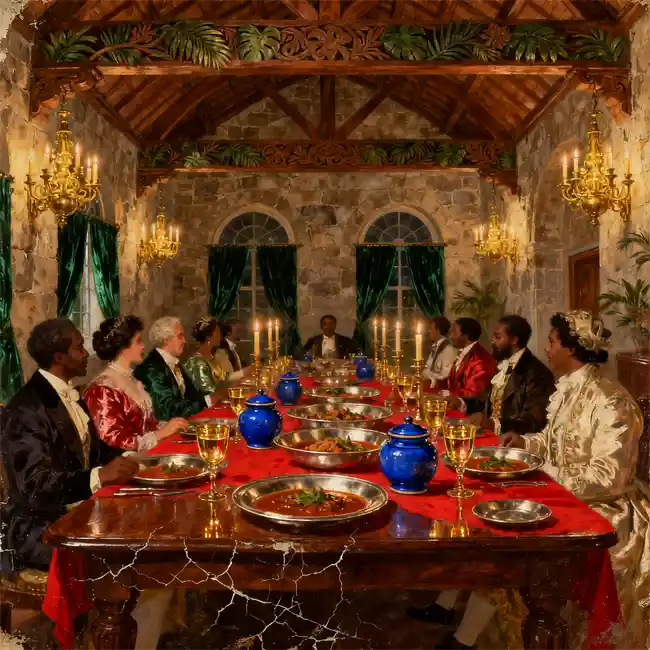
This is the codex that opens the sealed sauce-books of Guyana's high houses and old aristocracy — flavour lineages between 200 and 1,000 years old, carried from indigenous chiefs' fire-pits to Dutch planter manors and colonial governor's tables.
(A quick honest note before we begin: Guyana is a proud republic and has never had a crown of its own. So when we say "royal" here, we mean the aristocratic table — indigenous chiefly households, Dutch and British colonial gentry, the great estate kitchens of Demerara, and the merchant elite of Georgetown. That's the lineage we're unlocking.)
⚔️📜 The Storyteller's Intro: What the Old Houses Never Wrote Down
Okay, sit down. Pour something cold. Let me tell you why Guyana might be the most under-rated sauce country on the planet.
Most cuisines guard a recipe. Guyana guards a pot. There are households in this country where the sauce at the bottom of the pepperpot pot has technically been alive longer than the person stirring it — fed, topped up, re-boiled, passed down. That's not a recipe. That's an heirloom with a pulse. And that single idea is the thread running through every "aristocratic" sauce in this article.
Here's how the timeline breaks down. Think of it as five eras, roughly 1,000 years of flavour engineering:
✦ Era 1 — The Ancestral Fire (c. 900–1500 CE): The Warrau, Arawak (Lokono), Carib, Wapishana and Makushi peoples of the rivers and savannahs figure out something genuinely brilliant: how to take bitter cassava, a root loaded with natural toxins, and cook its juice down into a black, syrupy, self-preserving sauce. That sauce is cassareep. It is the mother of Guyanese cuisine, and it predates every European ship by centuries. In chiefly households, the pot that never went cold was a marker of status — a house with a permanently simmering pepperpot was a house that could feed anyone who walked in, any hour.
✦ Era 2 — The Dutch Manor Era (c. 1600s–1796): Dutch settlers carve Essequibo, Demerara and Berbice out of tidal mud, build dykes and kokers, and — crucially — adopt the indigenous cassareep method wholesale. Estate great-houses start keeping their own "signature pot." This is where the sauce goes aristocratic: cinnamon, cloves, orange peel and imported spice get folded into an ancient indigenous base. Wealth is literally tasted.
✦ Era 3 — The British Colonial Table (1814–1900s): British Guiana becomes a sugar superpower. Demerara sugar makes the colony's name a global brand. The planter class and colonial officials in Georgetown build a formal dining culture — and the enslaved and, later, indentured cooks who actually ran those kitchens are the ones who fused everything. African, Portuguese (Madeiran), Chinese and Indian techniques all land in the same pot within a few generations.
✦ Era 4 — The Great Fusion (1838–1950s): Indian indentured labourers bring masala, tamarind, mango chutney logic and the sour-sweet-hot balance. Chinese arrivals bring soy, ginger and the wok. Madeiran Portuguese bring garlic-and-vinegar curing. Africans bring the deep braise, the ground provision, the callaloo. The "sauce shelf" of a well-off Guyanese household becomes the most cosmopolitan condiment collection in South America.
✦ Era 5 — The Republic & the Revival (1966–today): Independence turns the elite pot into a national pot. Pepperpot moves from the manor to the Christmas morning table of every household. And now, a new generation of chefs and food historians is going back to the old books.
How the old houses actually lived and ate — the part nobody tells you:
• Meals ran on a sauce hierarchy, not a course structure. The base was starch and protein; the status was the condiments. A guest judged you by how many jars came to the table.
• The Sunday and Christmas rhythm was sacred. Pepperpot was almost never a Tuesday food. It was the dish of feast days, and the pot was re-boiled daily to keep it eternal.
• Nothing was wasted. Green mango too hard to eat? Sour. Cassava too bitter to eat? Cassareep. This is aristocratic thrift — a plantation economy where the kitchen was expected to be self-sufficient.
• Fire was a spectrum, not a switch. Elite tables served graded heat, so a host could offer a gentle sauce to a visitor and the nuclear jar to the family.
• The "green" foundation — a wet herb paste now called green seasoning — was made fresh weekly, in quantity, and stored in the coolest corner of the house. No green seasoning, no cooking. Full stop.
🗺️ The Royal Culinary Tourism: Mapping Flavors to Historic Landscapes
Here's my favourite thing about Guyana as a food destination: the sauces are geographically honest. You can literally trace each one back to a landscape you can still visit.
Guyana is roughly the size of the UK with under a million people, and about 85% of it is intact rainforest. So the country splits into a coastal belt (where the colonial aristocracy built everything) and a vast, wild interior (where the sauce recipes were actually born). Understanding that split is the whole map.
Why this makes Guyana the best "flavour trail" in South America:
• The coast is the archive. Georgetown, Fort Island, New Amsterdam, the old sugar estates. This is where the manor recipes were written, adapted and served on porcelain.
• The interior is the source. Cassava, wiri wiri peppers, wild game, bush herbs, forest fruit. The raw genius comes from here.
• Rivers are the highways. The Essequibo, Demerara, Berbice and Mazaruni didn't just move sugar — they moved recipes. Follow a river and you're following a flavour migration route.
• It's still uncrowded. You're not queueing behind 400 people for a photo. Guyanese food tourism is genuinely early-stage, which means access, warmth and real conversations.
• Hospitality is the point. In both indigenous villages and old coastal towns, feeding a guest generously is a matter of honour. That's a direct inheritance from the "pot that never goes cold."
🚣 Cradle of Royal Delicacies — The Rivers, the Coast & the Manor Belt
This is the aristocratic heartland. Flat, fertile, below sea level in places, and stitched together by Dutch engineering that still works 300 years later.
🏛️ Georgetown — The Garden City's High Table
• The old capital of British Guiana, laid out in canals and tree-lined avenues, with St George's Cathedral (one of the world's tallest wooden buildings) and the timber-lace Stabroek Market clock tower as anchors.
• This is where the merchant and colonial elite ate. Formal dining rooms, imported china, local sauces.
• Signature flavours to hunt here: the full pepperpot in its refined "city" form; garlic pork (the Madeiran-Portuguese Christmas dish, garlic-and-thyme cured); Chinese-Guyanese chow mein with local seasoning; and the legendary pepper sauce jars sold in every market stall.
• Traveller tip: Stabroek Market is your sauce pilgrimage. Cassareep, wiri wiri, mango sour, achar — all in one glorious, chaotic block.
⚓ Fort Island & the Essequibo — Where the Dutch Manor Pot Was Born
• Fort Zeelandia (1743) and the Court of Policy Hall sit on Fort Island in the mouth of the Essequibo — the mightiest river in the country, dotted with an estimated 365 islands.
• This is ground zero for the Dutch aristocratic kitchen: European spice cabinets meeting an indigenous cassava base for the first time.
• Signature flavours: the deepest, most cinnamon-and-clove-forward pepperpot in Guyana; smoked river fish; and cassava bread eaten the old way.
• Traveller tip: Combine with Bartica (the gateway town to the interior) and the ruins of Kyk-Over-Al, a Dutch outpost dating to the early 1600s.
🍬 Demerara & Berbice — Sugar, Sours and the Estate Kitchens
• The Demerara name is on sugar packets worldwide. Berbice, further east, holds New Amsterdam and Dutch-era heritage sites.
• Estate kitchens here produced the sweet-sour condiment tradition: mango sour, tamarind sour, and the sharp fruit pickles that cut through heavy braises.
• Signature flavours: mango sour with wiri wiri; cook-up rice (the one-pot rice-and-peas-and-coconut-milk masterpiece); metemgee; and Indo-Guyanese seven curry served on a lily leaf.
• Traveller tip: Time a visit around Phagwah (Holi) or Diwali on the Corentyne coast for the full sensory experience.
🐟 The Pomeroon & the Northwest — Coconut, Cassava and Quiet Water
• A gorgeous, slow-moving river region famous for coconut, cassava farms and Amerindian communities.
• Signature flavours: fresh coconut oil cooking, cassava-based breads and drinks, and a lighter, brighter pepper sauce style.
• Traveller tip: Boat trips here feel like time travel. Also, Shell Beach — one of the world's key nesting grounds for four species of sea turtle.
⛰️ Kingdom of Wild Aromatics & Heritage — The Interior, Highlands & Deep Forest
If the coast wrote the recipes, the interior invented them. This is where you understand that Guyana's "royal" sauces are really indigenous royal sauces.
💦 Kaieteur Falls — The Cathedral of the Potaro
• A single, uninterrupted drop of around 226 metres — roughly five times the height of Niagara — smashing into a gorge surrounded by untouched rainforest.
• Almost nobody is there when you arrive. No handrails, no crowds, no gift-shop circus.
• Flavour connection: The Patamona people of this region hold deep cassava knowledge. Kaieteur is the emotional centre of any Guyanese food-history trip — you stand there and finally get why the forest was treated as a pantry and a temple at the same time.
🌾 The Rupununi Savannah — Cattle Country & Makushi Fire
• Vast golden grassland in the south, running to the Kanuku Mountains, with ranches like Dadanawa that date back over a century.
• Home to the Makushi and Wapishana peoples, and to the fiercest, purest cassareep and pepper traditions in the country.
• Signature flavours: farine (toasted cassava meal), tuma pot (the indigenous ancestral broth that pepperpot descends from), fire-roasted meats, and wiri wiri peppers grown in village gardens.
• Traveller tip: Community-run eco-lodges like Surama and Rewa let you eat exactly what a chiefly household would have eaten — and the money stays in the village. This is the most ethical food tourism in the region, full stop.
🐆 Iwokrama & the Canopy — The Living Spice Cabinet
• A million-acre protected rainforest reserve with a canopy walkway 30+ metres up.
• One of the best places on Earth to spot jaguar, plus giant river otters, harpy eagles and black caiman.
• Flavour connection: Bush herbs, wild peppers and forest fruit that never made it onto a European ingredient list. The aromatics that make old Guyanese sauces taste unplaceable often come from exactly this ecosystem.
🏔️ Mount Roraima & the Pakaraimas — The Table in the Clouds
• The flat-topped tepui at the triple border with Brazil and Venezuela — the landscape that inspired The Lost World.
• Flavour connection: Highland Amerindian communities preserve some of the oldest cassava-processing techniques still practised anywhere. It's genuinely one of the last places where you can watch a 1,000-year-old sauce technique performed as daily routine.
🤔🛡️ Royal FAQ: Unlocking Palace Kitchen Mysteries
Q1.So did Guyana actually have royalty?
Not its own, no — and that's what makes this story better. Guyana's "high table" was a layered aristocracy: indigenous chiefs (the Toshao tradition survives today), then Dutch patricians, then British colonial gentry and a wealthy Georgetown merchant class. Each layer inherited the previous layer's sauces and added its own. What you're tasting isn't one court's cuisine — it's four social worlds stacked on top of each other in a single pot.
Q2.Is the "eternal pepperpot" real, or just a nice story?
Real, and scientifically sound. Cassareep is a natural preservative with antibacterial properties, and the daily re-boil resets the pot. Historically, well-to-do households kept a pot going for months — and there are credible family accounts of pots maintained for years, topped up with fresh meat as the old was eaten. In manor kitchens this was a flex: infinite hospitality, on demand.
Q3.Why is the wiri wiri pepper such a big deal?
Because it's a Guyanese endemic personality. Little cherry-shaped peppers, roughly 100,000–350,000 Scoville — habanero-and-scotch-bonnet territory — but with a distinctly fruity, almost floral, slightly smoky aroma the bigger peppers just don't have. Elite kitchens used it for perfume as much as punch. If you've had "Caribbean hot sauce" and thought it was one-dimensional, you haven't met wiri wiri.
Q4.What separates a genuine Guyanese sauce from a generic Caribbean one?
Three things, and they're all structural:
The cassareep base. Bitter, sweet, smoky and dark all at once. No other Caribbean nation builds on this.
The green seasoning foundation. A wet herb paste of eschallot, thyme, culantro (chadon beni), garlic and peppers, made in advance and used in everything.
The sour tradition. Mango sour, tamarind sour, lime sour — a deliberate acid course engineered to reset your palate between rich bites. That's an aristocratic dining idea hiding in a humble jar.
🧠 Final Thoughts: The Timeless Allure of Aristocratic Gastronomy
Here's what I want you to take away.
Guyana's sauces aren't a footnote to Caribbean cooking. They're the oldest continuously practised sauce tradition in the Americas that anyone can still walk up and taste. A thousand years, four social orders, six diasporas — reduced, literally reduced, into a few dark jars.
And we've barely opened the codex. What you just read is the map. The treasure is still buried.
📍 What's coming next on this page — pin it now:
✦ The Cassareep Codex — the mother sauce, decoded properly. Bitter cassava to black gold, plus how the old manor kitchens spiced theirs differently from the village pot.
✦ Wiri Wiri Pepper Sauce: The Graded-Heat Method — three intensity tiers, exactly how a high-house table served it.
✦ Mango Sour, the Aristocrat's Palate-Cleanser — the sweet-sour-hot triangle that makes Guyanese dining work.
✦ Green Seasoning: The Foundation Stone — the weekly ritual paste behind every single dish above.
✦ The Eternal Pepperpot — the full feast-day protocol, timing, and why cinnamon and cloves belong in a savoury pot.
Bookmark this. Each one drops as its own deep-dive, with measurements, technique and the historical reasoning behind every step. We're not doing "add to taste" here — we're doing the actual method.
👑 Credit to the Keepers of the Culture (The Legacy)
Everything above belongs to people, not to a website.
✦ To the Warrau, Lokono (Arawak), Carib, Makushi, Wapishana, Patamona, Akawaio, Wai-Wai and Arecuna peoples — the original food scientists of this land. Cassareep is your invention. Pepperpot is your invention. The world eats your genius and rarely says your names. We're saying them.
✦ To the African-descended cooks of Guyana, whose skill, resilience and deep braising traditions built the coastal kitchen under conditions no one should have endured. The technique survived because you refused to let it die.
✦ To the Indo-Guyanese families who carried masala, tamarind, chutney and the sour-sweet-hot balance across an ocean, and turned indenture into a culinary inheritance.
✦ To the Chinese-Guyanese and Portuguese-Madeiran communities, whose ginger, soy, garlic and vinegar traditions are now inseparable from the national palate.
✦ To the grandmothers, aunties and market vendors — the actual archivists. Stabroek Market, Bourda Market, and a thousand kitchen counters have preserved more culinary history than any library.
✦ To the Guyanese diaspora in New York, Toronto and London, who kept the pot going far from home and are the reason the world is finally paying attention.
We're guests at this table. Every recipe that follows is offered with respect, sourced with care, and credited to where it came from. 🇬🇾❤️
👑🥘 The Lost Aristocratic Sauce of Guyana — And How to Finally Make It at Home
👉 Master Iconic Guyanese Royal Sauces
| 🌐 👑🥘 < Back | 🇬🇾 👑🍱 < Previous |