
🏠 Home > 🗺️ Recipes > 👑🥘 Signature Royal Sauces (Sauces) > 🇬🇾 Guyana Signature Royal Sauces (Sauces) Recipes > 👑🥘 1.Cassareep Noir — The Aristocratic Guyanese Pepperpot Sauce
👑🥘 The Lost Aristocratic Sauce of Guyana — And How to Finally Make It at Home
Published by Supakorn | Updated: September 2026
⚜️👑 The Forgotten Aristocratic Legacy of Guyana: The Amerindian Chieftains and the Demerara Great Houses
Guyana never had kings or queens of its own. There were no gilded thrones on the banks of the Essequibo, no crowned heirs riding through Georgetown. But make no mistake — this land had its own aristocracy, and it ate extraordinarily well.
Before the Dutch arrived, the Arawak and Kalina peoples had chieftains, elders and ceremonial houses where certain foods were reserved for the honoured few. Later, the Dutch and British planters of Demerara built great houses with kitchens that rivalled anything in Europe, staffed by cooks who quietly fused three continents onto a single plate. What survived from all of that is not a crown. It is a sauce.
📜 The Storyteller's Intro
Picture it: it is somewhere around 1770, deep in the Dutch colony of Demerara-Essequibo. The heat is thick enough to lean on. Inside a shuttered kitchen behind a plantation great house, a pot has been sitting on low coals since before dawn — and honestly, since before last dawn too.
Inside that pot is something almost black. It smells like burnt sugar, cinnamon, cloves and something older that you cannot quite name. A cook stirs it slowly with a wooden paddle, checking the way it clings to the wood. She learned this from an Amerindian woman who learned it from her grandmother, who learned it in a village that no longer appears on any map.
That pot never fully empties. It gets topped up, reboiled, carried forward. Some families in Guyana will tell you their pepperpot pot has been running, on and off, for generations. That is not a marketing story. That is genuinely how this sauce works.
🌍 The Global Value
Here is the part that surprises people. Cassareep — the sauce at the heart of all this — is one of the oldest continuously used culinary preparations in the Americas, and almost nobody outside Guyana and a few Caribbean islands has heard of it.
For a long time it stayed that way on purpose. Access to the good stuff was limited. The best cassareep came from specific interior villages, made by specific families, traded slowly along rivers rather than roads. In the colonial era, the finished pepperpot made with it appeared on the tables of governors, merchants and planters at Christmas — the households with the ovens, the spice cupboards and the meat. The people who actually made the sauce were rarely the people served the dish.
Then refrigeration arrived. Then imported bottled sauces arrived. And a preparation that had survived a thousand years of humidity and colonial upheaval nearly got quietly replaced by convenience. It did not die — but it came uncomfortably close to becoming a museum item.
🗝️ The Collection
So this guide is a small act of rescue. We are going to reconstruct the aristocratic version of Guyana's signature sauce — the rich, glossy, spice-layered cassareep sauce that turns an ordinary pot of meat into pepperpot, the country's national dish.
You will get the real ingredient ratios, the substitutions that actually work in a normal kitchen, the ritual of cooking it properly, and the small technical secrets that separate a flat brown sauce from something with genuine depth. No mystique for the sake of mystique. Just the method, explained like a friend is standing next to you.
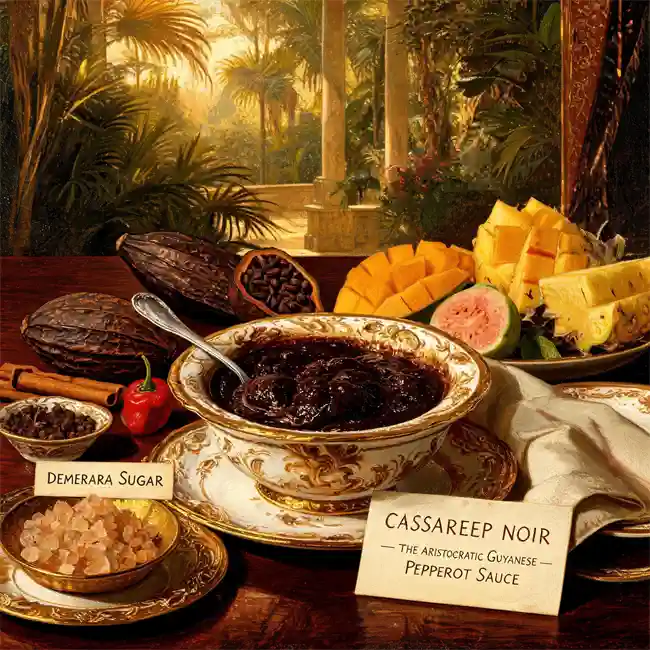
🍲 Recipe: Cassareep Noir — The Aristocratic Guyanese Pepperpot Sauce
✨ About this Aristocratic Secret
Cassareep is the reduced, spiced juice of bitter cassava. That is the whole idea. Bitter cassava is toxic when raw, and Amerindian cooks worked out — thousands of years ago, without a laboratory — that grating it, pressing the juice out and boiling it long and hard renders it completely safe and, better than that, delicious. It is one of the most elegant pieces of food science in the Western Hemisphere.
The finished sauce does two jobs at once. It flavours, and it preserves. Meat simmered in cassareep and stored properly in a cool place keeps far longer than it has any right to. That is precisely why pepperpot became the great Guyanese Christmas dish: you cook it once, reboil it each morning, and it feeds a full house of visitors for days without anyone standing over a stove.
At the great houses of Demerara, this was the centrepiece of the holiday table — served with thick slices of plait bread, ladled hot, deeply dark, faintly sweet, faintly sharp. It was the dish that announced the household could afford to be generous.
You are about to make the sauce that makes that dish possible.
🌿 Ingredients & The Aristocratic Touch
✦ The Royal Pantry
The luxury here is not truffles or saffron. It is patience and provenance. The traditional pantry called for freshly pressed bitter cassava juice from tubers pulled that same morning, unrefined dark Demerara sugar from the estates that gave the region its name, whole cinnamon bark rather than powder, and whole cloves that still snapped when you pressed them. Orange peel was often added — dried on a windowsill, never wasted. Every element was local, seasonal and slightly imperfect, which is exactly why the result tasted alive.
The real extravagance was time. A properly made batch could take six to eight hours of slow reduction. Nobody in that kitchen was in a hurry, because the sauce was going to outlive the week anyway.
✦ Modern Substitutes
Let us be practical, because most home kitchens are not going to be pressing bitter cassava.
• Bitter cassava juice — Use ready-made bottled cassareep from a Caribbean grocer or online. This is the recommended route for almost everyone. It is authentic, affordable and completely safe. Only attempt raw bitter cassava if you have hands-on guidance from someone experienced.
• Sweet cassava (yuca) — The common supermarket variety. It will not give you true cassareep depth, but it works in a simplified version. Never treat it as a one-to-one swap for the bitter kind.
• Demerara sugar — Dark brown sugar or muscovado works well. Molasses can stand in for part of it, but use a light hand or the sauce turns bitter.
• Cinnamon bark — Cassia sticks are fine. Ground cinnamon works in a pinch at roughly one third the quantity, though you lose some clarity.
• Whole cloves — No good substitute. Skip rather than replace with allspice, which pulls the profile somewhere else entirely.
• Wiri wiri peppers — The signature Guyanese chilli. Scotch bonnet or habanero are the closest matches. Use half the quantity, since they are hotter.
• Fresh thyme — Dried thyme at one third the volume is acceptable, added later in the cook.
• Orange peel — Fresh zest works. Avoid the white pith.
✦ The Measurements
This makes roughly 2 cups of finished sauce.
• Bottled cassareep — 3 cups (or 8 cups fresh pressed bitter cassava juice, reduced first)
• Dark brown or Demerara sugar — 1/2 cup, adjusted to taste at the end
• Cinnamon sticks — 2 sticks, about 3 inches each
• Whole cloves — 1 tablespoon, roughly 12 to 15 cloves
• Wiri wiri peppers — 4 whole, left unbroken (or 2 scotch bonnets)
• Fresh thyme — 6 to 8 sprigs
• Dried orange peel — 2 strips, about 2 inches each
• Fine sea salt — 1 teaspoon
• Water — 1/2 cup, only if the reduction tightens too quickly
Ratio to remember: for every 3 parts cassareep base, use roughly 1 part sugar by volume. Everything else is aromatic seasoning and adjusts to taste.
🔥 The Chef's Ritual
1.Warm the base gently. Pour the cassareep into a heavy-bottomed pot — enamelled cast iron is ideal. Set it over the lowest steady heat you can manage. Never start hot. Sudden heat scorches the sugars already present and you will taste it for the rest of the sauce's life.
2.Wake the spices. In a dry pan, toast the cinnamon sticks and cloves for about 45 seconds, until the kitchen smells like a bakery. This is a small step with a disproportionate payoff. Add them straight to the pot.
3.Add the sugar slowly. Sprinkle it in over a minute or two, stirring continuously with a wooden spoon. Let each addition dissolve fully before the next. Dumping it in all at once creates a grainy layer that sits at the bottom and burns.
4.Introduce the aromatics. Add the thyme sprigs, orange peel and salt. Slide in the whole peppers without cutting them. Whole peppers give perfume and a gentle warmth. Cut peppers give aggressive heat that flattens everything else.
5.Reduce with patience. Let it hold at a bare simmer — the surface should barely tremble, with a bubble breaking every few seconds. Aim for 90 minutes to 2 hours. Stir every 15 minutes, scraping the base each time.
6.Watch for the coat. The sauce is ready when it coats the back of a spoon and holds a clean line when you draw a finger through it. It should look like dark molasses and move like warm syrup, not like water.
7.Taste and balance. Remove from heat. It should read sweet first, then smoky-bitter, then a slow warmth at the back of the throat. Too sharp, add a spoonful more sugar. Too flat, a pinch more salt.
8.Strain and rest. Pass it through a fine sieve, pressing gently on the solids. Cool completely. Bottle in sterilised glass. Store in a cool dark cupboard or the refrigerator — it improves noticeably after a week.
🕯️ Secrets of the Palace Kitchen (Tips & Mistakes)
• The pot matters more than the recipe. Thin pans create hot spots and hot spots create burnt sugar. Heavy base, always.
• Never let it boil hard. A rolling boil breaks the texture and makes the finished sauce grainy and harsh. Low and slow is not a suggestion here.
• Do not pierce the peppers. The old cooks were adamant about this. Whole peppers infuse aroma. Broken peppers dominate.
• Salt early, sugar late. Salt helps the reduction develop evenly. Final sugar adjustments should happen only after the sauce has thickened, because reduction concentrates sweetness on its own.
• Skim the surface. A little foam appears in the first 30 minutes. Lift it off. Leaving it makes the sauce cloudy.
• Wooden spoon, not metal. Traditional, yes, but also practical — wood lets you feel when solids start catching on the base before you can smell it.
• Let it age. Fresh cassareep sauce tastes good. Two-week-old cassareep sauce tastes remarkable. The spices need time to settle into the sugars.
• The classic mistake: rushing the reduction on medium-high heat to save an hour. It never works. You get a thin, bitter, slightly acrid sauce and you cannot fix it afterwards.
• Safety note worth repeating: only ever use bitter cassava that has been properly processed and thoroughly boiled, or simply buy prepared cassareep. This is not a step to improvise on.
❓👸 Royal FAQ
Q1.Is cassareep the same thing as browning sauce?
No, though they look similar in the bottle. Browning is caramelised sugar. Cassareep is reduced cassava juice with its own tangy, faintly bitter, almost fermented complexity. Swapping one for the other gives you colour but none of the character.
Q2.How long does this sauce keep?
Properly reduced, strained and bottled, it keeps for a year or more in a cool dark place, and effectively indefinitely refrigerated. It is a preservative by nature. Just use a clean spoon every time.
Q3.What do I actually cook with it?
Pepperpot is the classic — beef, oxtail and pork simmered slowly in the sauce with extra cinnamon and pepper, served with dense bread. But it is also excellent brushed onto roasted meats in the last few minutes, stirred into black beans, or used as the backbone of a glaze for roasted root vegetables.
Q4.Can I make it without any cassava at all?
You can make something dark and tasty, but you should not call it cassareep. If genuine cassareep is unavailable, a blend of molasses, tamarind paste and a splash of strong brewed tea gets you somewhere in the neighbourhood. It is a stand-in, not a replacement.
🏺 The Taste of History (Summary)
What you end up with in that bottle is a piece of continuity. The same technique, more or less, that Arawak cooks used long before European ships appeared on the horizon. The same pot logic that let a Demerara household feed twenty guests through a hot Christmas week without a refrigerator.
It tastes dark and layered — molasses and clove up front, a low smoky bitterness underneath, warmth trailing behind it. It does not taste like anything else in your cupboard. That is rather the point.
🍽️ Final Thoughts: Bringing History to Your Table
Here is the honest truth: this sauce is not difficult. It is just slow. There is no advanced technique, no equipment you do not already own, no ingredient you cannot source with one online order. The only real skill involved is being willing to leave a pot alone on low heat for two hours while you do something else.
So do not be intimidated by the history. The people who created this were working with clay pots and open fires, and they got it right. You have a thermostat and a timer. You are going to be fine.
Make it once. Taste it a week later. You will understand immediately why families guarded this.
💌 The Call to Action (The Golden Hook)
If a taste of history like this moves you, help keep it alive. Cook it. Photograph it. Tell someone where it came from. Share this guide with a friend who thinks they have tried every sauce worth trying — they have not tried this one.
Every kitchen that makes cassareep is one more kitchen where a thousand-year-old technique refuses to disappear. Join us in preserving the world's disappearing food secrets, one pot at a time.
🙏 Credit to the Keepers of the Culture (The Legacy)
This sauce is not ours, and it was never a European invention. Cassareep belongs to the Indigenous peoples of the Guianas — the Arawak, Kalina, Wapishana, Macushi, Patamona, Warrau and others — who developed the processing of bitter cassava into safe, delicious food over thousands of years of careful observation.
It was carried forward by generations of Guyanese cooks, many of them enslaved and indentured people whose names were never recorded, who blended it with African, Indian, Portuguese, Chinese and European techniques to create what is now recognised as Guyanese cuisine.
Pepperpot is Guyana's national dish because it is genuinely national — every community on that coast and in that interior has a hand in it. If you cook this, cook it with that in mind. Say where it comes from. Buy your cassareep from Guyanese and Caribbean producers where you can. Recipes survive because people respect them, not just because people like them.
| 🇬🇾 👑🥘 < Back |