
🏠 Home > 🗺️ Recipes > 🏛️🍯 Wild Earth Sweets & Foraged Bites > 🏝️ Kingdom of Kerma: Wild Earth Sweets & Foraged Bites Recipes > 🏛️🍯 1.Kerma's Honeyed Wild Date Cakes
🏛️🍯 Nubia's Lost Sweet — How Kerma's People Preserved Dates in Honey
Published by Supakorn | Updated: October 2026
🛕🏺 Ancient Civilization Origins: Kingdom of Kerma, Nubia
📜 The Storyteller's Intro: 5,000 Years of Ancestral Flavors
Picture this. The sun is dropping low over the Nile, somewhere south of Aswan, in a land the Egyptians feared and respected in equal measure. Mudbrick towers rise against a dusty gold sky. Cattle low in the distance. And somewhere in a kitchen built from river clay, someone is doing something humans have done forever — trying to keep food from going bad, and trying to make it taste good while they're at it.
That's where our story starts. Not in Egypt, not in Mesopotamia, but in a kingdom most people never learned about in school: Kerma, the heart of ancient Nubia, flourishing from around 2500 BC. While pyramids were rising to the north, an entirely separate African civilization was building its own cities, its own temples, its own trade networks — and its own cuisine. One sticky, sun-warmed, honey-soaked secret from that cuisine survived just long enough for us to taste it again.
🌍 The Global Value of Antique Heritage
Here's the thing people miss about ancient food history — it's not just "old recipes." It's evidence. Every grain of sorghum, every date pit, every trace of honey residue found in a Kerma storage jar tells archaeologists something about trade routes, climate, social status, and even religious ritual. Kerma sat on one of the richest trade corridors in the ancient world, moving gold, ivory, and ebony between Central Africa and Egypt. Food wasn't just survival — it was currency, diplomacy, and status all rolled into one dish.
When UNESCO and archaeological teams catalog sites like Kerma's famous Deffufa temple complex, they're not just preserving stone. They're preserving the last physical clues to how an entire sub-Saharan African kingdom — one of the earliest ever documented — fed its people, celebrated its gods, and fed its armies before marching on Egypt itself. That's heritage worth protecting, and honestly, worth tasting.
🔥 The Culinary Resurrection
For centuries, Nubian food history lived in the shadow of its more famous northern neighbor. Egyptologists got the headlines; Nubian archaeologists got footnotes. But that's changing fast. Excavated bakery complexes at Kerma — yes, entire ancient industrial-scale bread ovens — have shown us that this was a sophisticated food culture, not a rural backwater.
Dates and honey, specifically, show up again and again in Nile Valley archaeology as the primary sweeteners of the ancient world, used long before refined sugar ever existed. Combine that with Nubia's wild date palms (different from the cultivated varieties Egypt relied on later) and you get a dish that's uniquely Kerma — not borrowed, not imported, but born from the land itself. We're bringing it back, as close to the original as modern kitchens allow.
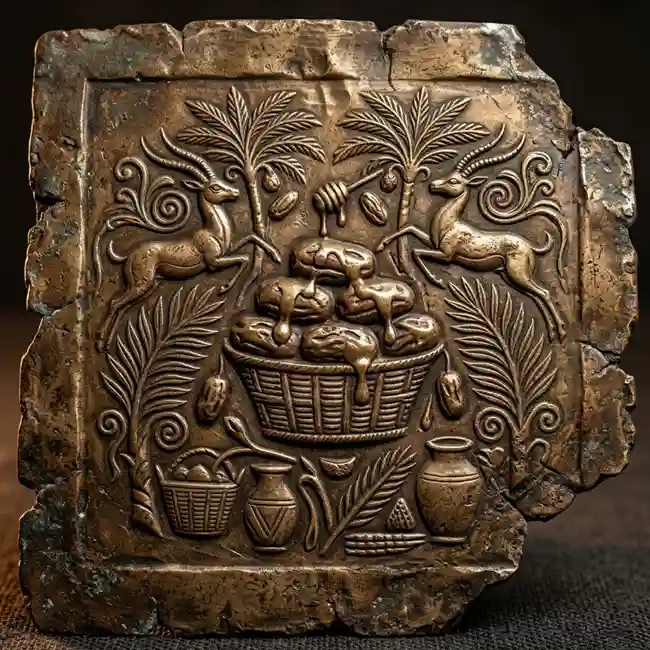
🍯 Recipe: Kerma's Honeyed Wild Date Cakes
📖 Legends Behind This Excavated Secret
Archaeologists working the Kerma necropolis have pulled date pits, honey residue, and grinding stones from tombs dating back nearly five millennia. In Nubian burial tradition, the dead were sent into the afterlife with food — real food, prepared the way they liked it in life. That tells us something powerful: honeyed dates weren't just a snack. They were considered worthy of the gods, worthy of eternity.
Local oral tradition in modern Sudan — passed down in communities near the Kerma basin — still references a "sweet of the ancestors," a dense, chewy date cake sweetened with wild honey and bound with ground grain. Whether this is a direct echo of the ancient recipe or a cultural memory reshaped over centuries, nobody can say for certain. But the ingredients match the archaeological record almost perfectly, and that's rare enough to take seriously.
🌾 Ingredients & The Noble Pantry
🏛️ The Ancestral Staples
Back in Kerma, nothing in this recipe came from a market shelf — it came from the land, the river, and the wild palm groves that lined the Nile's banks. Wild dates grew smaller and more fibrous than today's cultivated Medjool varieties, but they packed an intense, almost caramel-like sweetness. Honey was harvested from wild bee colonies nesting in acacia trees, a dangerous and prized job reserved for skilled gatherers. Grain — likely sorghum or emmer wheat — was ground by hand on stone querns, the same querns archaeologists keep finding buried next to cooking hearths. This wasn't peasant food or royal food exclusively; it crossed social lines because the ingredients were simply what the Nile provided.
🔄 Modern Substitutes
You don't need to track down wild Nubian honey or forage along the Nile to make this work in your own kitchen. Here's what translates well:
• Wild dates → substitute with Medjool or Deglet Noor dates, pitted and roughly chopped
• Wild acacia honey → substitute with raw, unfiltered honey (the darker and rawer, the closer to the original flavor profile)
• Sorghum flour → substitute with whole wheat flour or a sorghum/almond flour blend if you want it closer to ancient texture
• Ground emmer wheat → substitute with spelt flour, which has a similar nutty, dense quality
• River water → just use filtered water, obviously
• A warm clay pan or griddle → a cast-iron skillet or heavy non-stick pan does the job perfectly
⚖️ Ancient Proportions
Instead of exact grams, think in ratios — the way ancient cooks would have measured by hand, by feel, and by eye:
• 4 parts chopped dates to 1 part honey (dates are the bulk, honey is the binding sweetness)
• 2 parts flour (sorghum or whole wheat) to 1 part chopped dates
• 1 small handful of crushed nuts (pistachios or almonds work well) per every 2 cups of the date mixture
• A pinch of salt for every 3 cups of combined dry ingredients — just enough to wake up the sweetness
• Enough warm water, added slowly, to bring the flour and date mixture together into a thick, moldable dough — usually around half a cup per 2 cups of flour, but add it gradually
• A light coating of honey brushed over the finished cakes while still warm, roughly 1 tablespoon per cake
🔨 The Chef's Ancient Ritual
Think of this less like following a recipe card and more like performing a small ceremony, because that's genuinely close to how it would have been done.
First, the dates are chopped and gently warmed with the honey over low heat, almost like coaxing them to release their natural stickiness — not boiling, just softening until they form a thick, dark paste. This step would have been done over an open hearth, the honey slowly caramelizing in the heat.
Next, the flour is worked into the date-honey paste by hand, a little at a time, until it forms a dense, workable dough. Ancient cooks didn't have mixers — this was kneaded with bare hands on a stone slab, which actually gives you better control over the texture than you'd expect.
Once the dough comes together, it's shaped into small flattened rounds or little mounded cakes, roughly palm-sized. This shape matters — it's consistent across Nile Valley archaeological finds, likely because it cooked evenly on a hot stone or clay surface.
The cakes are then cooked low and slow on a dry, heated surface — no oil needed, since the natural sugars in the dates and honey caramelize beautifully on their own. Flip them once the bottom develops a deep golden-brown crust, usually after a few minutes per side.
Finally, while still warm, each cake gets a final brush of raw honey and a scatter of crushed nuts pressed gently into the top. This final touch wasn't just decorative — in Nubian tradition, honey was considered a blessing, almost an offering layered onto the food itself.
🕯️ Secrets of the Ancestral Hearth
◦ Don't rush the date-honey softening step — if you heat it too fast, the honey scorches and turns bitter instead of caramel-rich.
◦ Use raw, unfiltered honey whenever possible. Processed honey lacks the depth and slight smokiness the ancient version would have had from wild hives.
◦ If your dough feels too dry, add water one small spoonful at a time. Ancient cooks adjusted by feel, not by measurement, and that instinct still matters here.
◦ Resist the urge to use a non-stick spray or oil on your cooking surface. A dry, hot pan actually mimics the ancient clay griddle far better and gives you that authentic caramelized crust.
◦ Let the cakes rest for a few minutes after cooking before eating. They firm up slightly and the flavors settle, which makes a noticeable difference.
◦ Don't skip the salt. It sounds like a small detail, but without it the sweetness tastes flat and one-dimensional.
◦ If you want a closer texture to the original, avoid overly smooth modern flours. A coarser, stone-ground flour gives you that rustic, slightly gritty bite that matches the archaeological descriptions.
🦛❓ Ancient Civilization Origins FAQ
Q1:Was honey really used as a sweetener 5,000 years ago?
Yes. Long before refined sugar existed anywhere in the ancient world, honey and dried fruit — especially dates — were the primary sweeteners across the Nile Valley, including in Nubia and Egypt.
Q2:Why is the Kingdom of Kerma less famous than ancient Egypt?
Mostly historical bias in early archaeology, which focused heavily on Egypt. Kerma was actually a powerful, sophisticated kingdom in its own right, with monumental architecture and strong enough armies to challenge Egypt directly at points in its history.
Q3:Did ordinary people eat honeyed dates, or was this only for royalty?
Evidence suggests both. Simpler versions likely fed everyday families, while more elaborate versions — sometimes buried with the dead — carried ceremonial or elite significance.
Q4:Can I really recreate an ancient Nubian recipe with modern grocery store ingredients?
Absolutely. While nothing replaces the exact wild varieties used 5,000 years ago, the substitutes above get remarkably close in flavor and texture, and the ratios are based directly on what archaeological residue analysis has suggested.
🏜️ The Taste of Archeology
There's something genuinely humbling about biting into something that echoes a recipe from five millennia ago. It's not refined. It's not fussy. It's dense, sticky, sweet in a way that feels earthy rather than sugary, with a caramelized crust that tells you exactly how it was cooked — low, slow, over real heat. This is what Nubian kitchens along the Nile tasted like before Egypt even reached its golden age. That's not a small thing.
🏡 Final Thoughts: Bringing Antiquity to Your Modern Table
You don't need a time machine or an archaeology degree to taste a piece of history. You just need dates, honey, a bit of flour, and a willingness to slow down and cook the way people did before timers and thermostats existed. Make a batch this weekend. Share it with someone and tell them it's a recipe from a kingdom most people have never heard of. Watch their face when they realize it's real.
🌟 The Golden Hook (The Sacred Union)
Here's the honest truth — recipes like this survive because people keep making them, keep sharing them, keep refusing to let them disappear into dusty museum archives. If this one found its way to you, you're already part of that chain. So go make it. Post it. Tag a friend who loves history as much as food. Let's keep this ancient flavor alive together, one honeyed date cake at a time.
🙏 Credit to the Keepers of the Culture
Deep respect goes to the archaeologists, historians, and Nubian communities in modern Sudan who have worked tirelessly to preserve and share the history of the Kingdom of Kerma — a civilization that deserves far more recognition than it's historically received. This recipe is our small way of honoring their research and the living cultural memory still carried by descendants of the Nile Valley today. Their work is why stories like this can still be told, and still be tasted.
| 🏝️ 🏛️🍯 < Back |