
🏠 Home > 🗺️ Recipes > 🏛️🍲 Clay-Pot Broths & Stews > 🏝️ Lapita Culture: Clay-Pot Broths & Stews Recipes > 🏛️🍲 1.Lapita Voyager's Clay Pot Reef Broth with Taro and Coconut
🏛️🍲 Cooking With the Ocean's First Voyagers: The Lapita Clay Pot Seafood Broth
Published by Supakorn | Updated: October 2026
🏯🌊 Ancient Civilization Origins: The Lapita Islands of the Western Pacific
📜 The Storyteller's Intro: 3,000 Years of Salt, Fire, and Sea Spray
Picture this, my friend. It's about 3,000 years ago, and you're standing on a white-sand beach somewhere in the Bismarck Archipelago, off the coast of what we now call Papua New Guinea. Behind you, palm trees lean into the trade winds. In front of you, the lagoon turns from turquoise to deep sapphire where the reef drops away. Near a small cooking fire, a woman presses a tiny toothed stamp into the wet clay of a pot, making a pattern of dots and curves so detailed it looks like lace.
These people were the Lapita, and they were some of the boldest explorers the world has ever seen. Long before compasses or maps existed, they paddled and sailed outrigger canoes across huge stretches of open ocean, reading the stars, the swells, and the flight paths of birds. They went from island to island, reaching Vanuatu, New Caledonia, Fiji, Tonga, and Samoa, places no human had ever walked before.
They carried their pots, their plants, their animals, and their recipes with them. Tonight, we're bringing one of those flavors back.
🏺 The Global Value of Antique Heritage
So why should a home cook in Ohio, Manchester, or Melbourne care about a culture that disappeared from the archaeological record around 2,500 years ago?
Because the Lapita are the ancestors of the Polynesian peoples. Every Hawaiian luau, every Samoan umu, every Tongan feast and Māori hāngī traces part of its family tree back to these seafaring potters. Archaeologists consider Lapita pottery, with its distinctive "dentate-stamped" decoration, one of the most important clues to how humans settled the remote Pacific. Fragments of these pots have turned up across a stretch of ocean thousands of miles wide.
Think about it. While the pyramids of Egypt were already ancient and Bronze Age kingdoms rose and fell in the Mediterranean, the Lapita were quietly pulling off one of history's great migrations. Their heritage belongs to the whole world, not only to the Pacific. It's a story about courage, curiosity, and the very human urge to see what's beyond the horizon.
And what kept them going on those voyages? Food, of course.
🔥 The Culinary Resurrection
Here's what makes this dish special. Most ancient recipes reach us through written cookbooks, like Roman texts or Babylonian clay tablets. The Lapita left no writing at all. Their recipes are written in shell middens, fish bones, charred plant remains, and the soot-blackened bellies of their clay pots.
Archaeologists digging at Lapita sites have found the remains of reef fish, shellfish, sea turtles, and other marine life, along with evidence of the "canoe plants" these voyagers carried from island to island, including taro, yams, bananas, and coconut. Some of their pots show signs of use over fire, which suggests boiling or simmering.
What you're about to cook is a respectful reconstruction, not a recipe copied from an ancient text. Nobody found one. Instead, we've pieced together a warm, nourishing seafood broth from ingredients the Lapita had, made with a cooking method they knew. It's a way of tasting history, one spoonful at a time.
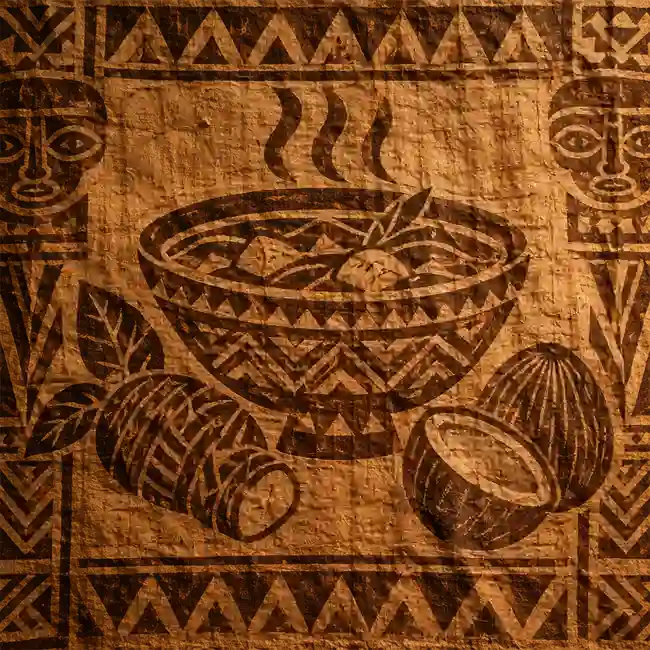
🍲 Recipe: Lapita Voyager's Clay Pot Reef Broth with Taro and Coconut
🗿 Legends Behind This Excavated Secret
Every great dish deserves a story, so here's one. To be clear, this is an imagined tale inspired by the archaeology, not a recorded legend.
Imagine a voyaging family arriving on a new, uninhabited island after weeks at sea. Their stores are nearly gone. The children are tired, the elders are weak, and everyone is craving something warm. The first night ashore, the fishermen wade into the shallows and come back with a parrotfish, a handful of clams, and some spiny lobster. The women dig up the taro corms they've carefully kept alive in damp coconut fiber for the whole crossing. Someone cracks open a fresh coconut.
Everything goes into the precious clay pot, one of the few things that survived the journey, and it simmers slowly over driftwood coals. As the scent of sea and smoke drifts over the beach, the family knows they've made it. This new island is home.
Whether or not it happened exactly like that, it's easy to believe a broth like this marked new beginnings. It tastes like arrival.
🧺 Ingredients & The Noble Pantry
🌴 The Ancestral Staples
The Lapita pantry was simple but rich. The ocean gave them almost everything: reef fish, clams, cockles, octopus, crabs, and lobsters. From their gardens came starchy staples like taro and yams, carried as living cuttings across the sea. The coconut palm was the tree of life, giving them food, water, oil, fiber, and shade. Seawater itself seasoned their food. Many scholars also think aromatic roots like ginger and turmeric were among the plants Austronesian voyagers spread through the Pacific, so we've added them for warmth and color.
There was no cane sugar, no black pepper, and no tomatoes. Everything came straight from the reef, the garden, and the fire.
🛒 Modern Substitutes
You don't need a canoe or a coral reef to make this. Here's what to look for:
◦ Reef fish: Snapper, grouper, sea bass, or mahi-mahi. Any firm white fish works. Cod or haddock are fine in a pinch.
◦ Fish bones and heads: Ask your fishmonger for these. They're often free and make the broth incredibly rich.
◦ Shellfish: Clams, cockles, or mussels. Use fresh, live shellfish that close when tapped.
◦ Shrimp or lobster: Shell-on shrimp give the most flavor. Lobster tails make it a feast.
◦ Taro root: Found in Asian, Caribbean, Pacific Islander, and Latin markets. Swap in sweet potato, yam, or waxy potatoes if you can't find it.
◦ Taro leaves: Hard to find and must always be cooked thoroughly. Baby spinach or Swiss chard are easy, safe substitutes.
◦ Fresh coconut milk: Canned full-fat coconut milk works beautifully.
◦ Seawater: Please don't scoop it from your local beach! Use good sea salt dissolved in filtered water instead.
◦ Fresh ginger and turmeric: Both are usually in the produce section. If you can't find fresh turmeric, use a pinch of ground turmeric.
◦ Lime: Not strictly Lapita, but a squeeze at the end brightens everything. Leave it out for a purist version.
◦ Clay pot: An unglazed clay pot, a Spanish cazuela, a Korean ttukbaegi, or a Chinese sandy pot. A heavy Dutch oven also works if you don't have clay.
⚖️ Ancient Proportions (Serves 4)
◦ 1 whole small reef fish or 1 lb (450 g) fish heads and bones, for the broth base
◦ 1 lb (450 g) firm white fish fillets, cut into 2-inch chunks
◦ 1 lb (450 g) fresh clams or mussels, scrubbed
◦ 8 oz (225 g) shell-on shrimp
◦ 1 lb (450 g) taro root, peeled and cut into 1-inch cubes
◦ 1 can (13.5 oz / 400 ml) full-fat coconut milk
◦ 6 cups (1.4 liters) filtered water
◦ 2 teaspoons sea salt, adjusted to taste
◦ 2-inch piece fresh ginger, sliced into thin coins
◦ 1-inch piece fresh turmeric, sliced (or 1/2 teaspoon ground)
◦ 2 large handfuls baby spinach or chopped Swiss chard
◦ 1 lime, cut into wedges (optional)
◦ 2 green onions, sliced, for garnish (optional modern touch)
◦ Ratio to remember: about 1 part seafood to 1.5 parts liquid, with taro making up roughly a quarter of the solids. This keeps the broth hearty without turning it into a stew.
🕯️ The Chef's Ancient Ritual
Slow down for this part. The Lapita didn't rush, and neither should you.
✦ Step 1 – Awaken the Clay If you're using an unglazed clay pot, soak it in cool water for 15–30 minutes. The clay absorbs moisture, which helps protect it from cracking and creates gentle steam as it heats. Ancient potters knew their vessels were alive in a way. Treat yours with the same respect.
✦ Step 2 – Summon the Spirit of the Sea Rinse the fish bones and heads well, removing any gills (they make the broth bitter). Place them in the clay pot with the 6 cups of water, ginger, and turmeric. Start on low heat and raise it slowly to medium-low over about 10 minutes. Clay hates sudden temperature changes.
✦ Step 3 – The Long Whisper Let the bones simmer gently for 30–40 minutes. You want a lazy bubble, not a rolling boil. Skim off any foam that rises. This is the quiet heart of the ritual. Your kitchen will start to smell like a seaside village at dusk.
✦ Step 4 – Strain and Renew Strain the broth through a fine sieve, throw out the bones, and pour the golden liquid back into the pot. Keep the ginger slices if you like a stronger kick.
✦ Step 5 – Offer the Earth's Gift Add the taro cubes and sea salt. Simmer for 15–20 minutes until the taro is fork-tender. Taro naturally thickens the broth a bit, giving it a silky, comforting body. (Important: taro must always be fully cooked, because raw taro contains compounds that irritate the mouth and throat.)
✦ Step 6 – The Coconut Blessing Pour in the coconut milk and stir gently. Keep the heat low so the coconut milk doesn't split.
✦ Step 7 – Call the Reef Home Add the fish chunks first and simmer for 4 minutes. Then add the clams or mussels and the shrimp. Cover and cook for another 4–5 minutes, until the shellfish open and the shrimp turn pink. Throw away any shellfish that stay closed.
✦ Step 8 – The Green Crown Stir in the spinach or chard right at the end. It'll wilt in about a minute.
✦ Step 9 – Share the Arrival Feast Taste and adjust the salt. Ladle into bowls, add a squeeze of lime and some green onions if you're using them, and serve straight from the clay pot at the center of the table. In the Pacific, food is meant to be shared.
🔮 Secrets of the Ancestral Hearth
These are the tips and common mistakes that separate a good broth from an unforgettable one:
• Never shock the clay. Don't put a cold clay pot on high heat or pour cold liquid into a hot pot. That's the fastest way to crack it. Always heat slowly.
• Use a heat diffuser on electric or glass stovetops. Clay pots can crack from direct contact with flat electric burners. A simple metal diffuser fixes this.
• Don't boil the broth hard. A rough boil makes fish broth cloudy and can turn delicate seafood rubbery. Gentle simmering is the ancient way.
• Remove the gills. Fish gills give the broth a muddy, bitter taste. Rinse heads well and cut the gills out.
• Add seafood in stages. Fish, shellfish, and shrimp all cook at different speeds. Adding everything at once leaves some overcooked and some underdone.
• Never eat taro or taro leaves undercooked. They contain calcium oxalate crystals that cause an itchy, burning feeling. Thorough cooking makes them safe and delicious.
• Purge your clams. Soak live clams in salted cold water for 20–30 minutes before cooking so they spit out any sand.
• Go easy on the salt at first. Shellfish release their own briny liquor, so taste before adding more.
• Season your clay pot over time. Clay soaks up flavor with each use. Many cooks keep one pot just for seafood so it builds a deeper, richer character.
• Don't wash clay with harsh soap. Unglazed clay can absorb soap flavors. Clean it with hot water, a brush, and a little baking soda if needed.
⛪❓ Ancient Civilization Origins FAQ
Q1:Who were the Lapita people?
The Lapita were an ancient seafaring culture that appeared in the Bismarck Archipelago around 3,300–3,500 years ago and spread east across Melanesia into Western Polynesia. They're known for their finely decorated pottery and are considered ancestors of today's Polynesian peoples.
Q2:Is this an authentic 3,000-year-old recipe?
It's an archaeology-inspired reconstruction. The Lapita left no written recipes, but the ingredients (reef fish, shellfish, taro, coconut) and the method (simmering in a clay pot over fire) are all supported by evidence from Lapita sites. Think of it as an educated, respectful interpretation.
Q3:Can I make this without a clay pot?
Absolutely. A heavy-bottomed Dutch oven or stockpot works well. You'll miss a little of the earthy character clay gives, but the flavor will still be wonderful.
Q4:Is Lapita seafood broth healthy?
It's packed with lean protein, omega-3 fats from the fish, minerals from the shellfish, and filling fiber from the taro. Coconut milk adds richness, so if you're watching calories, use half the amount and replace the rest with extra broth.
🏝️ The Taste of Archeology
So what does 3,000 years taste like? It's clean and briny, like a sea breeze. It's earthy from the taro, gently sweet from the coconut, and warm from the ginger and turmeric. Most of all, it's honest. There are no shortcuts and no fancy techniques, just good ingredients treated with patience.
When you eat this broth, you're tasting the same basic flavors that fed the people who first crossed the Pacific. It's humbling. It reminds us that great food has never needed much more than fresh ingredients, fire, and someone who cares enough to cook.
🍽️ Final Thoughts: Bringing Antiquity to Your Modern Table
Here's my honest advice: make this recipe this weekend. You don't need special skills or a big budget. You just need a free afternoon, a trip to the fish counter, and a bit of curiosity.
Make it a little event. Put on some ocean sounds, set the clay pot in the middle of the table, and tell your family or friends the story of the Lapita voyagers while everyone ladles out their bowl. Kids especially love hearing that they're eating something "explorers ate 3,000 years ago."
Once you've got the basic method down, play with it. Try octopus, crab, or a mix of whatever's freshest at the market. Add breadfruit or green bananas instead of taro. The Lapita adapted to every new island they reached, and you can adapt this recipe to your kitchen the same way.
Ancient food doesn't belong in a museum. It belongs on your table.
🤝 The Golden Hook (The Sacred Union)
Now I've got a small favor to ask, and it's important.
Recipes like this survive only when people cook them, share them, and talk about them. Every time you make a dish inspired by an ancient culture, you help keep a piece of human history alive. And you're not just a reader here. You're joining a community of home cooks around the world who believe the past still has something delicious to teach us.
So here's your invitation:
◦ Cook it and tell us in the comments how it turned out.
◦ Share your twist. Did you use lobster? Sweet potato? Your grandmother's clay pot?
◦ Save this recipe so you can come back to it when you need a warm, comforting meal.
◦ Pass it on to the friend who loves history, travel, or seafood.
◦ Together, we're the new keepers of the world's forgotten kitchens. Let's make sure these flavors never get lost again. 🌺
🙏 Credit to the Keepers of the Culture (The Legacy)
This recipe would not exist without the Lapita people, whose courage, seamanship, and craftsmanship shaped the history of an entire ocean. We honor their memory and their remarkable journey.
We also deeply respect the Indigenous peoples of Melanesia and Polynesia: the communities of Papua New Guinea, the Solomon Islands, Vanuatu, New Caledonia, Fiji, Tonga, Samoa, and beyond. They're the living descendants and guardians of these traditions. Their food knowledge, passed down through countless generations, is a treasure that belongs first and foremost to them.
Thanks also go to the archaeologists, researchers, and local communities who have spent decades carefully excavating, studying, and protecting Lapita sites. Their work lets us understand how these ancient voyagers lived, cooked, and thrived.
This dish is offered as a humble, respectful tribute, not a claim of ownership. If you come from a Pacific Island heritage and have family knowledge to share, we'd be honored to learn from you.
Malo, vinaka, fa'afetai, and thank you. 🌊
| 🏝️ 🏛️🍲 < Back |