
🏠 Home > 🗺️ Recipes > 🏛️🍲 Clay-Pot Broths & Stews > 🏝️ Lapita Culture: Clay-Pot Broths & Stews Recipes
🏝️ 🏛️🍲 Lapita Culture: Clay-Pot Broths & Stews Recipes
Published by Supakorn | Updated: October 2026
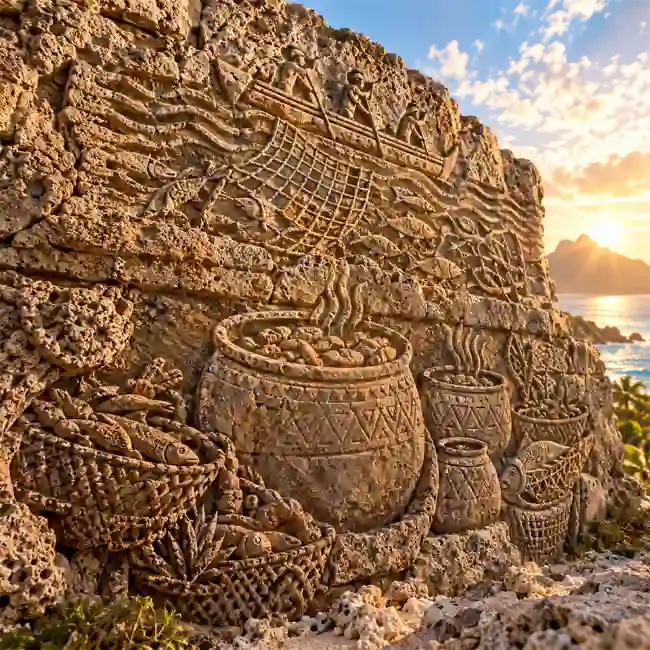
🏟️📜 The Storyteller's Intro: 5,000 Years of Ancestral Flavors
Picture this. You're sitting on a white-sand beach somewhere in the western Pacific. A canoe has just landed after days on open ocean. The people stepping off it carry pigs, chickens, taro cuttings, coconuts, and something fragile wrapped carefully for the trip: clay pots. Some are covered in tiny stamped zigzags and faces. Others are plain, round-bellied, and blackened with soot from hundreds of fires.
Those plain, smoky pots are what this story is about. They were the first slow cookers of the Pacific, and they belonged to one of the most impressive seafaring cultures the world has ever seen: the Lapita people.
One quick, honest note before we go further. The Lapita culture itself shows up in the archaeological record around 3,500 years ago. But the ancestral journey that led to it, and the flavors that went with it, goes back much further, roughly 5,000 years. That's how far back the story of their cooking really starts. Here's the big-picture timeline, era by era:
⛵ Era 1: The Austronesian Departure (around 5,000–4,000 years ago)
• Rice-growing, pottery-making communities in Taiwan start heading south by boat.
• They island-hop through the Philippines and into Island Southeast Asia, picking up new crops and cooking habits as they go.
• This is where the "language family" of the Pacific, Austronesian, starts spreading across thousands of miles of ocean.
🌋 Era 2: The Bismarck Fusion (around 3,500–3,300 years ago)
• The travelers reach the Bismarck Archipelago near Papua New Guinea.
• They mix with people who had already lived in New Guinea for tens of thousands of years, the original masters of taro, banana, and yam farming.
• Out of that mix comes the culture archaeologists call Lapita, with its famous dentate-stamped pottery.
🌊 Era 3: The Great Eastward Voyage (around 3,000–2,800 years ago)
• In just a few centuries, Lapita voyagers sail east into places nobody had ever lived: Vanuatu, New Caledonia, Fiji, Tonga, and Samoa.
• It's one of the fastest human migrations in history, and it happened by sail and paddle.
🔥 Era 4: From Pot to Earth Oven (around 2,500 years ago onward)
• Decorated Lapita pottery slowly gets simpler and then disappears in many islands, especially in western Polynesia.
• Cooking shifts more and more to the earth oven (think hot stones in a pit, still used today as the Fijian lovo or Samoan umu).
• In places like Fiji, though, pottery never really died, and that thread is still alive in some villages today.
The Lapita people didn't leave cookbooks. They didn't write anything down. But they left pots, bones, shells, starch grains, and words, and from those clues we can rebuild a surprisingly tasty picture of what was simmering on their fires.
📜 Iconic Excavated Menus: The Lapita Clay-Pot Table
Let's get this out of the way, because you deserve the truth: there are no written Lapita recipes. Nobody carved a stew recipe onto a stone tablet. What we have instead is detective work. Archaeologists study charred residue inside pots, animal bones in rubbish heaps, microscopic starch grains on tools, and chemical signatures in human bones. Linguists rebuild ancient words (called Proto-Oceanic words, marked with an asterisk) that tell us which foods were important enough to name.
Put all that together and you get a "menu" of dishes the evidence strongly points to. The names below are descriptive titles based on what's been found, not original names.
🍲 Clay-Pot Broths & Simmered Stews
• Reef Fish & Shellfish Pot Broth: heaps of reef fish bones and shells at Lapita sites suggest seafood was a daily staple, and plain cooking pots were ideal for gentle simmering.
• Coconut-Cream Taro Stew: coconut (*niuR in Proto-Oceanic) and taro (*talo) were core crops carried on voyages; a slow-cooked root stew enriched with coconut is one of the most likely pot dishes.
• Yam & Greens Pottage: yams (*qupi) and leafy greens likely went into thick, filling pottages, food built to last through long working days.
• Sea Turtle Broth: turtle bones show up at early sites like Teouma in Vanuatu, and turtle was a prized, often special-occasion food across the Pacific.
• Shellfish Stew of the Lagoon: clams, giant clams, and other mollusks left huge shell middens, and many would have been cooked down into rich, briny broths.
🐖 Pot-Cooked Meats from the Voyaging Canoe
• Village Pig Stew: pigs (*boRok) traveled on Lapita canoes, and their bones appear at many sites.
• Island Chicken Broth: chickens (*manuk) were another "canoe animal," and ancient DNA from Pacific chicken bones has helped trace the migration routes.
• Wild Bird Pot: early settlers found islands full of birds that had never seen humans, including megapodes, and many bird bones turn up in the earliest layers.
• Fruit Bat Stew: isotope studies of people buried at Teouma point to a diet that included land animals like fruit bats alongside reef foods.
🌴 Starchy Sides & Island Staples
• *Breadfruit Mash (kuluR): breadfruit was a key tree crop that could be cooked, mashed, or fermented and stored.
• Steamed Banana Bundles: bananas and plantains, inherited from New Guinea's ancient farmers, were cooked in leaves or pots.
• Canarium Nut Paste: nutshells of the Canarium almond are common at sites in the Bismarck Archipelago, a sign this rich nut was a favorite.
🗣️ The Ancient Kitchen Vocabulary
Some of the most fascinating "excavated menu" clues are words, not objects:
◦ *kuron: a reconstructed Proto-Oceanic word for "cooking pot."
◦ *qumu: the earth oven, the pit cooking method that later became the Pacific's signature technique.
◦ *ika: fish, the protein that tied every Lapita community together.
When a word survives in hundreds of languages spread over thousands of miles, it tells you that food or tool was important from the very beginning. That's ancient culinary secrets hiding in plain sight, inside everyday speech.
🗺️ Lapita Foodways: How They Lived, Ate & Where to Trace Them Today
🏡 Everyday Life on Stilts and Sand
Many Lapita communities built houses on stilts over shallow lagoons or right along the beach. The best-known example is Talepakemalai on the Mussau Islands in Papua New Guinea, where wooden posts from stilt houses were preserved in waterlogged sand. Living right over the water made sense: fish and shellfish practically came to the front door.
Daily life probably looked something like this:
◦ Morning: fishing in the lagoon, collecting shellfish at low tide, checking garden plots.
◦ Midday: tending taro, yams, and tree crops further inland.
◦ Evening: gathering around fires where pots sat on hearthstones, broth slowly bubbling.
◦ Special days: feasts with pig, turtle, and earth-oven food, plus elaborately decorated pots that may have been used for serving or ritual rather than daily cooking.
🏺 Two Kinds of Pots, Two Kinds of Meals
This is one of the coolest details. Archaeologists find two main types of Lapita ceramics:
◦ Decorated dentate-stamped ware: covered in fine stamped patterns, sometimes with stylized human faces; likely used for serving, display, or ceremony.
◦ Plain ware: simple, round cooking pots, often with soot on the outside. These were the everyday stew pots.
So you basically had "the good china" and "the everyday pots," just like grandma's kitchen.
✈️ Travel Trails: Following the Lapita Food Story
If you're into food history travel, the Lapita trail is one of the most rewarding in the world. Here's where to go:
◦ 🇵🇬 Mussau & the Bismarck Archipelago, Papua New Guinea: the cradle of Lapita culture; remote but unforgettable for adventurous travelers.
◦ 🇻🇺 Efate Island, Vanuatu: home of the Teouma site near Port Vila, one of the oldest Lapita cemeteries ever found. The national museum and cultural center in Port Vila is a great first stop.
◦ 🇳🇨 Koné, New Caledonia: the original "Lapita" site that gave the culture its name. The name reportedly comes from a local word, misheard by early excavators, that refers to the place where people dug.
◦ 🇫🇯 Sigatoka & Suva, Fiji: coastal Lapita sites, a national museum with pottery collections, and living pottery traditions.
◦ 🇹🇴 Nukuleka, Tonga: often described as one of the earliest settlements in Polynesia, a quiet village with huge historical weight.
◦ 🇼🇸 Mulifanua, Samoa: a Lapita site found underwater, a reminder of how much coastline has changed in 3,000 years.
🍽️ Taste the Legacy on Your Trip
You won't find "Lapita stew" on a menu, but you'll taste its descendants everywhere:
◦ Fiji: lovo earth-oven feasts and kokoda (fish in coconut cream and citrus).
◦ Samoa: umu cooking and palusami (taro leaves baked in coconut cream).
◦ Tonga: lu pulu, leaf-wrapped bundles slow-cooked with coconut cream.
◦ Vanuatu: lap lap, the national dish of grated root crops baked with coconut cream.
Notice the pattern? Coconut cream, root crops, slow heat. That's a 3,000-year-old flavor signature still on the table.
🚣 Sigatoka River Valley & the Rewa: Fiji's Historic Pottery Waterways
If you're looking for the river-valley side of Lapita history, Fiji is your place.
🌾 The "Salad Bowl of Fiji"
The Sigatoka River on Viti Levu runs through one of the most fertile valleys in the South Pacific, nicknamed the "Salad Bowl of Fiji." Rich river soil, fresh water, and easy access to the coast made it perfect for farming communities over thousands of years.
◦ Food link: taro, cassava, and greens grown along the river echo the root-crop farming the Lapita settlers brought.
◦ Travel tip: valley tours often include village visits, river crossings, and local meals cooked the traditional way.
🏺 Living Pottery Villages
This is where history comes alive. Along the lower Sigatoka, a few villages are known for keeping traditional Fijian pottery going, shaping clay by hand with paddle-and-anvil techniques that have deep roots in the region.
◦ What you'll see: women potters shaping, smoothing, and firing pots in open fires.
◦ Why it matters: it's one of the very few places in the Pacific where an unbroken pottery tradition links modern life to ancient clay-pot cooking.
◦ Respect tip: always visit with a local guide, bring a small gift if it's customary, and ask before taking photos.
🌊 The Rewa River Delta
Over on the east side of Viti Levu, the Rewa River delta near Suva is another historic waterway with its own pottery heritage. It's an easy add-on if you're visiting the capital and the national museum.
🏜️ Sigatoka Sand Dunes: The Pacific's Surprising "Desert" of Ancient Pots
Okay, the Pacific isn't exactly known for deserts. But Fiji has something close: the Sigatoka Sand Dunes, a protected national park of towering, wind-sculpted dunes right where the Sigatoka River meets the sea.
🏺 A Sandy Time Capsule
◦ Archaeological treasure: shifting sand has exposed pottery sherds from Lapita times onward, plus ancient burial sites, making this one of Fiji's most important heritage landscapes.
◦ Layers of time: different pottery styles found in the dunes show how cooking and pot-making changed over many centuries.
◦ Golden rule: never pick up or take sherds. They're protected and part of a scientific record that's still being studied.
🥾 Visiting Tips for Dune Explorers
◦ Best time: go early morning or late afternoon; midday sand gets seriously hot.
◦ What to bring: water, sunscreen, a hat, and sturdy shoes for the climbs.
◦ Trail options: short loops for casual walkers, longer routes over the dunes and down to the beach for the energetic.
◦ Pair it with: a trip up the Sigatoka Valley for a full day of river, pottery, and dune history.
It's the closest thing to an "oasis adventure" you'll find in Lapita country: sun, sand, wind, and the whispers of ancient cooking fires under your feet.
🛎️❓ Ancient Civilization FAQ: Unlocking Palace Kitchen Mysteries
Q1: Did the Lapita people have palace kitchens or royal chefs?
Not in the way ancient Egypt or Mesopotamia did. There's no evidence of palaces or a big centralized state. Lapita communities were mostly coastal villages, likely organized around family groups and respected leaders. Later Pacific societies like Tonga did develop powerful chiefly systems with elaborate feasts, and you can see those roots in Lapita-era feasting, especially the special decorated pots and the importance of pigs and turtles.
Q2: How do scientists know what was cooked in Lapita pots without written records?
They combine several kinds of evidence:
◦ Residue analysis: traces of food left in or on pot surfaces.
◦ Starch grain studies: microscopic plant particles that can identify taro, yams, and other crops.
◦ Animal bones and shells: rubbish heaps show which fish, birds, and animals were eaten.
◦ Stable isotope analysis: chemical signatures in human bones reveal the balance of marine and land foods in someone's diet.
◦ Historical linguistics: reconstructed Proto-Oceanic words show which foods and tools mattered most.
Q3: Why did many islands stop making clay pots?
Great question, and there's no single answer. Likely reasons include:
◦ Clay limits: some islands, especially coral atolls, simply lacked good clay.
◦ The earth oven took over: for root crops like taro and breadfruit, the umu or lovo is efficient and can cook huge amounts at once.
◦ Coconut-shell containers and bamboo: lightweight alternatives could hold liquids and even cook with hot stones.
◦ Cultural change: as societies grew and changed, the meaning of pottery may have faded.
Q4: Was coconut cream really part of Lapita cooking?
Coconut was definitely there. It's one of the most widely shared Pacific food words, and coconut remains appear at sites. Whether people grated it into "cream" exactly like today's cooks is harder to prove directly. But given how central coconut cream is to almost every descendant cuisine across the region, it's a very reasonable guess.
🧠 Final Thoughts: The Timeless Allure of Antique Gastronomy
Here's what gets me about Lapita food. These people crossed thousands of miles of open ocean with no maps, no compasses, and no guarantee land was out there. Yet they still made room in their canoes for clay pots, seedlings, pigs, and chickens. They weren't just surviving. They were bringing their whole kitchen, their whole way of life, to brand-new islands.
The flavors they carried, slow-simmered seafood, earthy taro, creamy coconut, smoky pig, still shape Pacific tables today. Every bowl of kokoda, every lap lap from the oven, every lu pulu unwrapped at a Sunday feast carries a little of that ancient voyaging spirit.
These really are forgotten ancient recipes, rebuilt from shards and bones and words. And in upcoming posts, we'll do just that: we'll take the evidence and turn it into full, step-by-step clay-pot broth and stew recipes you can try in your own kitchen. Expect reef fish broth, coconut-taro stew, and more, all with modern swaps if you don't happen to own a 3,000-year-old pot.
So grab your apron (and maybe a sense of adventure). The canoe's about to leave. 🌊
🏛️ Credit to the Keepers of the Culture (The Legacy)
No article about Lapita food would be complete without honoring the people who made this story possible, and those who keep it alive.
🌺 The Pacific Island Communities
◦ The descendants of the Lapita voyagers: the peoples of Papua New Guinea, the Solomon Islands, Vanuatu, New Caledonia, Fiji, Tonga, Samoa, and the wider Polynesian world. This is their heritage first and foremost.
◦ Traditional potters: especially the women potters of Fiji, who have kept hand-built clay pottery alive across generations.
◦ Village cooks and elders: keepers of earth-oven knowledge, coconut-cream techniques, and the food customs that link today to the deep past.
◦ Kastom landowners: the communities who protect ancestral sites and share them with researchers and visitors.
🔍 The Archaeologists and Researchers
◦ Edward Gifford and Richard Shutler Jr.: who excavated the Lapita site in New Caledonia in 1952, giving the culture its name.
◦ Patrick Kirch: whose work at Talepakemalai in the Mussau Islands revealed stilt-house villages and rich food remains.
◦ Matthew Spriggs and Stuart Bedford: who led research at Teouma in Vanuatu, one of the most important Lapita sites ever found.
◦ Pacific Islander scholars, museum staff, and cultural centers: across the region, whose knowledge, fieldwork, and care for collections keep this history in good hands.
◦ Linguists of the Austronesian and Oceanic language families: who rebuilt the ancient words that let us "hear" the Lapita kitchen.
🙏 A Note of Respect
Everything in this article is built on the work, patience, and generosity of these communities and researchers. If you visit Lapita country, go as a respectful guest: listen to local voices, support village artisans and local cooks, follow site rules, and leave every sherd exactly where you found it. That's how we make sure this 3,000-year-old food story is still around for the next 3,000 years. 🌴
🏛️🍲 Cooking With the Ocean's First Voyagers: The Lapita Clay Pot Seafood Broth
👉 Discover Lapita Culture's Clay-Pot Broths & Stews
| 🌐 🏛️🍲 < Back | 🏝️ 🍖 < Previous | Next > 🍯 🏝️ |