🏠 Home > 🗺️ Recipes > 🏛️🌾 Primitive Grains & Flatbreads > 🏝️ Lapita Culture: Primitive Grains & Flatbreads Recipes > 🏛️🌾 1.The Sacred Lapita Earth Cakes of Taro and Canarium
🏛️🌾 How the Lapita Voyagers Baked Survival Into Sacred Root and Seed Cakes
Published by Supakorn | Updated: October 2026
🏯📜 The Storyteller’s Intro: 3,000 Years of Ancestral Flavors
Close your eyes for a second. Imagine the year is 1200 BCE.
The sun is brutal. The Pacific is endless and blue-black. You are on a double-hulled canoe, the wind is tearing at your woven pandanus sail, and you have not seen land for weeks. Your ancestors from Taiwan and the northern Philippines taught you how to read the stars, how to read the birds, how to read the waves. You are Lapita. You are the people who will settle an ocean.
And you are hungry.
But in the bottom of your canoe, wrapped carefully in giant, waxy taro leaves and tucked inside a clay pot stamped with that iconic, dentate, geometric pattern that archaeologists will obsess over thousands of years later, is your future. It is not gold. It is better. It is a dense, fragrant cake made from pounded roots and toasted seeds. It does not spoil. It gives you strength. It remembers home.
This is not just food, my friend. This is the first energy bar in human history. This is the recipe that fueled the greatest maritime expansion our species has ever known. And today, we are going to bake it together.
🌍 The Global Value of Antique Heritage
When we talk about ancient civilizations, we usually think of Rome, Egypt, or Mesopotamia. We think of stone pyramids and marble columns. But the Lapita culture, which flourished from roughly 1600 BCE to 500 BCE across the Bismarck Archipelago, Vanuatu, New Caledonia, Fiji, Tonga, and Samoa, left something far more incredible. They left a blueprint for how to live with the ocean.
Their pottery is famous. Those intricate, comb-stamped pots are how we track their migration. But what was inside those pots? For decades, archaeologists just guessed. Then came the breakthroughs in residue analysis, in studying ancient hearths called umu or lovo, and in listening to the oral traditions of Pacific elders.
What we learned changed everything. The Lapita did not just survive on fresh fish and coconut. They were master agriculturalists and food preservers. They took the humble taro, yam, and breadfruit and combined them with Canarium nuts, sea almond, and wild seeds to create a food that was calorie-dense, nutrient-rich, and, crucially, portable for months at sea.
This heritage is priceless. It is the ancestor of every Pacific pudding, every Fijian vakalolo, every Samoan fa'ausi. It is the original zero-waste, plant-based, survival cuisine. In a world obsessed with fast food, this is slow food at its most sacred. It reminds us that our ancestors were not primitive. They were brilliant food scientists.
🔥 The Culinary Resurrection
So why did this recipe disappear?
As Lapita people settled and became the Polynesians, Micronesians, and Melanesians we know today, fresh food became abundant. They did not need to make long-voyage cakes anymore. The recipe became a ceremonial food, made only for chiefs, for navigators, and for sacred voyages. Then, with colonization, it was almost lost completely.
But here is the beautiful part. We are bringing it back.
This is a culinary resurrection. We are not just following a recipe. We are re-lighting a fire that has been cold for nearly three thousand years. By recreating this cake in your modern kitchen, you are doing archaeological work. You are honoring the voyagers who carried life across one-third of the planet's surface in nothing but a canoe and courage.
It is time to taste what history actually tasted like.
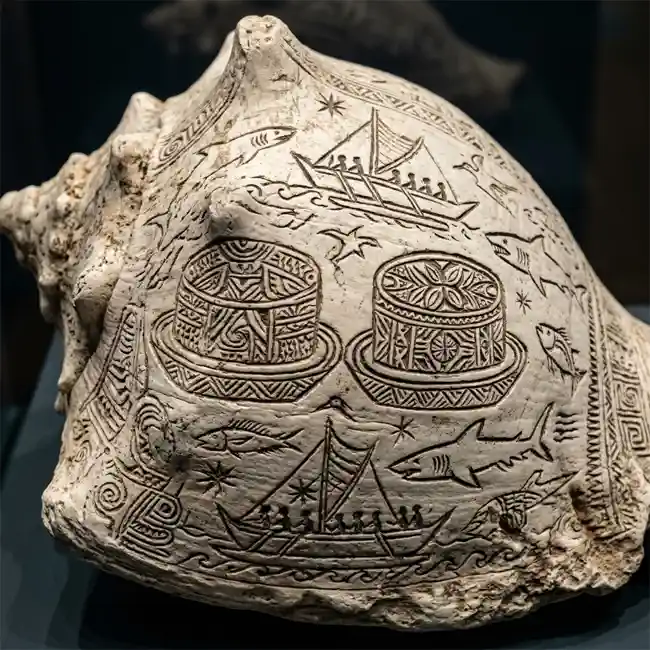
🍠 Recipe: The Sacred Lapita Earth Cakes of Taro and Canarium
🗿 Legends Behind This Excavated Secret
The elders in Vanuatu still tell a story. They say that the first woman who made the magavaka cake was not a cook. She was a navigator-priestess named Sina-Mae.
Before a great voyage to find the island of endless white sand, now known as Fiji, the warriors were afraid. Their canoes were light, and the sea was hungry. Sina-Mae went to the earth oven. She took the largest taro corms, the ones that had grown for seven moons, and the Canarium nuts that had been buried and fermented to remove their bitterness. She pounded them together with charred coconut flesh and seawater, singing as she worked.
She baked them not with direct fire, but with hot stones, wrapped in leaves, buried underground for a full night. When she unwrapped them at dawn, the cakes were dark, smoky, and smelled like the earth after rain. She said, "This cake carries the island with it. As long as you eat it, you will never be lost."
The fleet ate nothing else for twenty-three days. And they found Fiji.
Archaeologists found carbonized remains of very similar cakes in the Teouma site in Vanuatu, dating back to 1000 BCE. They were found alongside Lapita dentate-stamped pottery, right next to the ancient earth ovens. This is not legend anymore. This is evidence.
🧺 Ingredients & The Noble Pantry
This recipe is humble, but every ingredient has a soul. We are using ingredients your local store will have, but I will tell you the ancient original too, so you understand the story.
💥 The Ancestral Staples
Our ancestors did not have supermarkets. They had the forest, the garden, and the reef. The base was always a starchy root that could be pounded into a smooth, sticky paste. True Pacific taro, known as Colocasia esculenta, was king. It is creamy, slightly nutty, and when cooked, becomes almost like dough. The second hero was the Canarium nut, or ngali nut. These are wild, buttery nuts that grow tall in the forests of the Solomon Islands and Vanuatu. They had to be collected, cracked, and then slightly fermented or smoked to be edible. That smoky, fatty richness is what made the cakes last. Finally, they used wild seeds like sea almond and toasted coconut, and a little sea ash or sea salt to bind it and preserve it. Everything was wrapped in banana or taro leaves, which steamed the cake and gave it a green, tea-like aroma.
💥 Modern Substitutes
Do not worry, you can absolutely make this without hunting for wild nuts in a Pacific jungle. Here is how we translate the ancient pantry for your modern kitchen:
◦ For Taro Root: Fresh large taro corms are best, find them in any Asian market. If you cannot find taro, you can use white-fleshed sweet potato or Ube purple yam. Both give that same starchy, sticky texture. Avoid orange sweet potato, it is too wet.
◦ For Canarium Nuts: These are very hard to find outside the Pacific. The perfect modern substitute is raw macadamia nuts or roasted chestnuts. Macadamia gives you that same buttery, oily richness that preserves the cake. Cashews also work in a pinch.
◦ For Sea Almond and Wild Seeds: Use a mix of toasted sunflower seeds and toasted pumpkin seeds. They provide that earthy crunch and ancient seed flavor.
◦ For Charred Coconut: Use unsweetened desiccated coconut, toasted until dark brown in a dry pan. This is crucial for the smoky flavor.
◦ For Wrapping Leaves: Banana leaves are sold frozen in Asian and Latin stores and they are perfect. If you cannot find them, you can use parchment paper and foil, but you will lose that beautiful leaf aroma.
◦ For Sea Ash: We will use a pinch of high-quality sea salt and a tiny bit of coconut ash if you can find it, or just use smoked sea salt.
💥 Ancient Proportions
This will make about 8 small sacred cakes, enough for a family ceremony or a week of ancient-style snacking.
◦ Large fresh taro root, peeled and cubed: 800 grams, about 2 large corms
◦ Raw macadamia nuts or roasted chestnuts, roughly chopped: 150 grams, about one cup
◦ Toasted mixed seeds, sunflower and pumpkin: 80 grams, about half cup
◦ Unsweetened desiccated coconut: 100 grams, about one cup
◦ Fresh banana leaves for wrapping: 4 large sheets, washed and softened over flame
◦ Smoked sea salt: 1 teaspoon
◦ Fresh water: 120 milliliters, about half cup
◦ Coconut oil or extra virgin coconut cream for binding: 2 tablespoons
👩🍳 The Chef’s Ancient Ritual
This is not fast cooking. This is a ritual. Put on some ocean sounds. Take your time. This is how the navigators did it.
✦ Step One: The Awakening of the Root
Place your cubed taro in a large pot of cold salted water. Bring it to a boil and simmer for 20 to 25 minutes until it is completely soft, almost falling apart. Drain it very well. While it is still hot, pound it or mash it aggressively with a heavy pestle, potato masher, or stand mixer with a dough hook. You want a completely smooth, sticky, elastic paste with no lumps. This pounding is the heart of the recipe. In ancient times, this could take an hour. Add your half cup of water little by little if it is too dry.
✦ Step Two: The Toasting of the Ancestors
In a dry cast-iron pan over medium heat, toast your desiccated coconut until it is deep golden brown and smells like campfire. It will go from light to burnt quickly, so watch it. Set it aside. In the same pan, lightly toast your macadamia nuts and mixed seeds for 2 to 3 minutes until fragrant. Do not burn the nuts. Roughly chop them after toasting.
✦ Step Three: The Sacred Union
In a large bowl, combine your hot taro paste, the toasted coconut, the chopped nuts and seeds, and the smoked sea salt. Add the coconut oil or thick coconut cream. Now, with wet hands, knead it all together like bread dough for 5 full minutes. You are forcing the oils from the nuts and coconut into the taro. The dough should become darker, glossier, and hold together perfectly. It should smell earthy and incredible.
✦ Step Four: The Wrapping
Cut your banana leaves into 8 rectangles, about 20 by 25 centimeters each. Quickly pass each leaf over an open flame or hot pan for 5 seconds to make it pliable and release its oil. Place about a tennis-ball-sized portion of dough in the center of each leaf. Fold the leaf over like an envelope, creating a neat, tight parcel. This parcel is your ancient lunchbox.
✦ Step Five: The Earth Oven
This is the magic. You have two options. For the authentic method, if you have a grill or oven: Preheat your oven to 180 degrees Celsius, about 350 degrees Fahrenheit. Place the parcels seam-side down on a baking tray. Bake for 45 minutes. Then, and this is important, turn off the oven and leave the parcels inside for another 30 minutes. They are steaming in their own heat, just like in a buried umu. For the extra smoky method, you can place the parcels on a covered barbecue with indirect heat.
When you unwrap one, it should be firm on the outside, soft and steamy inside, dark brown, and smell of smoke, leaves, and earth. Let them rest for 10 minutes. They firm up as they cool.
💡 Secrets of the Ancestral Hearth
• Do Not Use Wet Taro: The biggest mistake modern cooks make is not draining the taro enough. If the paste is watery, your cakes will be mushy and will not preserve. Let the taro steam-dry for 5 minutes after draining before you pound it.
• Toast, Do Not Fry: Do not toast your nuts and coconut in oil. Dry toasting is the ancient way and it creates the smoky, bitter-sweet notes that balance the bland taro. Oil will make it greasy and spoil faster.
• The Leaf is Flavor: Do not skip the banana leaf if you can help it. Parchment paper will cook it, but banana leaf adds a subtle green tea and vanilla aroma that is irreplaceable. Frozen leaves work perfectly fine after you soften them.
• Patience in the Buried Oven: Do not open the oven during that final 30-minute resting period. That residual steam is what cooks the inside without drying it out. This mimics the ancient earth oven where stones slowly release heat overnight.
• They Taste Better Tomorrow: Like many ancient foods, these cakes are better the next day. Once cool, keep them wrapped in their leaves in the fridge. The flavors meld, the smoke deepens, and the texture becomes chewier and more satisfying. They will keep for 4 to 5 days easily.
⛩️❓ Ancient Civilization Origins FAQ
Q1: Is this recipe really 3,000 years old? How do we know?
A: Yes, in essence it is. We know from carbonized food remains found at the Teouma burial site in Vanuatu and other Lapita sites. Chemical analysis of the charred crusts inside Lapita pots shows residues of taro starch and Canarium nut oils cooked together. We combined that hard evidence with the living oral traditions of Vanuatu, Fiji, and Samoa, where similar leaf-wrapped root puddings are still made for ceremonies today.
Q2: What does it actually taste like? Will my kids like it?
A: Imagine a savory, slightly sweet, smoky mochi or a dense tamale. It is not sugary. It is earthy, nutty, with a wonderful chew from the taro and a satisfying crunch from the toasted seeds. Kids who like sticky rice, roasted chestnuts, or even soft pretzels usually love it. You can add a drizzle of honey or coconut cream on top for a modern, kid-friendly touch.
Q3: Can I make this gluten-free and vegan?
A: It already is! This is naturally 100 percent gluten-free, vegan, dairy-free, and nut-free if you use seeds only. It is one of the oldest hypoallergenic survival foods in the world. That is part of its genius. It was designed to be eaten by everyone in the canoe, with no one getting sick.
Q4: Why is it called a cake if it is not sweet?
A: Great question. We use the word cake today to mean sweet dessert, but for thousands of years, cake meant any pounded, shaped, and baked staple. Think of oatcakes or rice cakes. This is a savory, sacred staple cake, meant to give you energy, not sugar. It is the original definition of cake.
🏺 The Taste of Archeology
Take a bite. Really.
Close your eyes again. That first taste is soft, then chewy. Then the smoke hits you. Then the buttery macadamia, the toasted coconut, the faint salt of the sea, and that green, clean finish from the banana leaf.
You are not just eating taro. You are eating starlight navigation. You are eating courage. You are eating a canoe that crossed an ocean with no map, only memory.
It is dense, so a little goes a long way. One small cake with some fresh fish or tropical fruit would have fueled a Lapita paddler for an entire day. It is grounding. It makes you feel connected to the earth, in a way that modern bread never does. This is the taste of archeology. It is not in a museum. It is warm in your hands.
✨ Final Thoughts: Bringing Antiquity to Your Modern Table
I know what you might be thinking. This is a lot of work for a root cake.
But friend, that is the point. We live in a world of instant noodles and 30-second delivery. We have forgotten what it feels like to make food that matters. Food that has a story.
You do not have to make this every week. Make it once. Make it on a rainy Sunday. Make it with your family and tell them the story of Sina-Mae and the canoe to Fiji. Let your kids pound the taro. Let them wrap the clumsy leaf parcels. Let them smell the smoke.
When you finally sit down and unwrap that steaming, fragrant package, you will understand something profound. The Lapita did not just bake cakes. They baked resilience. They baked community. They baked home, so they could carry it with them wherever they went.
And now, that same home is in your kitchen. This is how we keep ancient wisdom alive. Not by reading about it, but by eating it.
So go ahead. Light that oven. You are now part of the voyage.
🤝 The Golden Hook (The Sacred Union)
If you felt something while reading this, if your kitchen smelled a little more like an ancient island while you cooked, then you are one of us now. You are a Keeper of the Secret.
The Lapita left no written books. Their library was the ocean, their recipes, and their stories. Every time one of us bakes this cake, we add another page to that library.
I invite you to join our sacred union of ancient food keepers. Make this recipe. Take a photo of your leaf-wrapped cakes. Share it with someone and tell them where it came from. Tell them about the voyagers who settled the Pacific with nothing but stars and root cakes.
Leave a comment below and tell me: What did your cake smell like when you unwrapped it? What story did you think of?
Let us keep this 3,000-year-old fire burning, together. One earth oven at a time.
🙏 Credit to the Keepers of the Culture (The Legacy)
This recipe would not exist without the deepest respect and gratitude to the rightful custodians of this knowledge.
Full credit and profound thanks to the Indigenous peoples of Oceania, the descendants of the Lapita culture: the ni-Vanuatu communities of Efate and Teouma, the Kanak people of New Caledonia, the Fijian, Tongan, and Samoan elders, and the Melanesian and Polynesian knowledge keepers who have preserved the methods of earth-oven cooking, taro cultivation, and leaf-wrapping through oral tradition for 100 generations.
Our reconstruction is based on archaeological findings from the Teouma Archaeological Site in Vanuatu, as documented by researchers at the Australian National University and the Vanuatu Cultural Centre, and on ethnobotanical studies of Canarium nuts and Colocasia taro.
This article is written with humility. We are not owners of this recipe. We are students. We share it to honor and to preserve, never to appropriate. The true legacy belongs to the Pacific.
| 🏝️ 🏛️🌾 < Back |