
🏠 Home > 🗺️ Recipes > 👑🍷 Noble Elixirs & Teas (Drinks) > 🇲🇽 Mexico Noble Elixirs & Teas (Drinks) Recipes > 👑🍷 1.Aristocratic Mexican Cacao & Vanilla Heritage Infusion
👑🍷 1,000 Years of Forgotten Mexican Aristocratic Tea Traditions
Published by Supakorn | Updated: August 2026
🤴🏛️ The Forgotten Aristocratic Legacy of Mexico: From Ancient Mesoamerica to New Spain
When we hear the phrase “royal tea recipes,” it is easy to imagine a European palace, a silver tea service, and a monarch sitting beside a roaring fireplace. Mexico tells a very different story.
Long before tea became associated with elegant afternoon rituals around the world, the civilizations of Mesoamerica had their own sophisticated traditions of preparing aromatic, nourishing, ceremonial, and medicinal beverages. They worked with ingredients such as cacao, vanilla, flowers, native herbs, maize, spices, and fragrant seeds, creating drinks that could carry social, ceremonial, and cultural meaning.
That is why the idea behind Lost Royal Recipes: 1,000-Year Mexican Tea Secrets is best understood as a historical-inspired journey rather than a claim that Mexico possessed a continuous royal tea tradition for exactly 1,000 years. Ancient Mexico did not have one uninterrupted monarchy stretching across a millennium. Instead, different civilizations and later colonial-era elites developed their own food and beverage traditions.
So, throughout this article, we use “aristocratic” rather than “royal” when describing Mexican culinary heritage.
And honestly, that makes the story even more fascinating.
The beverage we are bringing back to the modern table is inspired by the luxurious ingredient combinations that could have appeared in elite Mesoamerican or later Mexican households. It is not presented as a surviving palace manuscript or an authenticated recipe belonging to one specific emperor. Instead, it is a respectful culinary reconstruction inspired by historical Mexican ingredients and techniques.
🕯️ The Storyteller’s Intro: A Fragrant Evening in an Ancient Mexican Kitchen
Imagine walking through an ancient settlement as the afternoon heat begins to disappear.
The stone pathways are quieter now. Smoke rises gently from cooking fires. Somewhere nearby, toasted cacao beans release their deep, earthy fragrance into the evening air.
Inside an elite household, a cook prepares a special infusion.
There is no porcelain teapot.
There is no imported black tea.
Instead, the kitchen is filled with ingredients that belong to the land itself.
A small amount of cacao brings depth. Fragrant cinnamon, introduced to Mexico after the arrival of Old World ingredients, adds warm spice. Vanilla contributes its unmistakable floral sweetness, while native aromatic herbs bring freshness and complexity.
The mixture is prepared slowly.
Nothing is rushed.
The cook tastes, adjusts, waits, and tastes again.
That slow approach is part of what makes historical-inspired cooking so enjoyable today. You are not simply following a recipe. You are recreating a feeling—the feeling of entering a kitchen where ingredients were valuable, preparation mattered, and food carried a story.
Our modern recipe follows that spirit while remaining practical enough for an ordinary home kitchen.
🌎 The Global Value: When Culinary Knowledge Becomes Heritage
Throughout history, food traditions have often been closely connected to social status.
Certain ingredients were difficult to obtain. Some required specialized preparation. Others were reserved for ceremonies, important visitors, religious occasions, or households with access to greater resources.
Cacao is one of the best-known examples from ancient Mesoamerica.
It was highly valued and prepared in sophisticated ways. Historical evidence shows that cacao beverages could be flavored with different ingredients and prepared with considerable care. Rather than being treated simply as a sweet modern chocolate drink, cacao belonged to a much broader culinary world.
Herbs and flowers also mattered.
Many plants were valued not only for flavor but also for fragrance, traditional knowledge, and cultural significance. Over generations, culinary knowledge could pass from household to household, sometimes changing dramatically along the way.
This is where the idea of “lost recipes” becomes meaningful.
A recipe does not have to disappear completely to become forgotten.
Sometimes its ingredients survive while its original purpose disappears. Sometimes a traditional technique is replaced by a faster method. Sometimes an ingredient becomes difficult to find. And sometimes a dish continues to exist but no longer resembles its earliest form.
The goal of historical food writing is therefore not to pretend that every modern reconstruction is an untouched ancient original.
The goal is to understand, respect, and creatively reconnect with the culinary heritage that inspired it.
📜 The Collection: Bringing an Aristocratic Mexican Infusion Back to Life
This collection begins with a single beverage designed around historically significant Mexican flavors.
Our featured recipe combines cacao, vanilla, cinnamon, and aromatic herbs into a warm infusion that feels luxurious without requiring rare equipment.
The result is somewhere between an herbal tea, a cacao infusion, and a fragrant ceremonial beverage.
It is earthy.
Floral.
Lightly spiced.
Deeply aromatic.
And completely different from the heavily sweetened chocolate drinks many people associate with Mexico today.
Most importantly, the recipe is adaptable.
You can make it more herbal, more cacao-forward, more floral, or slightly sweeter depending on your preference.
Think of it as a bridge between culinary history and your own kitchen.
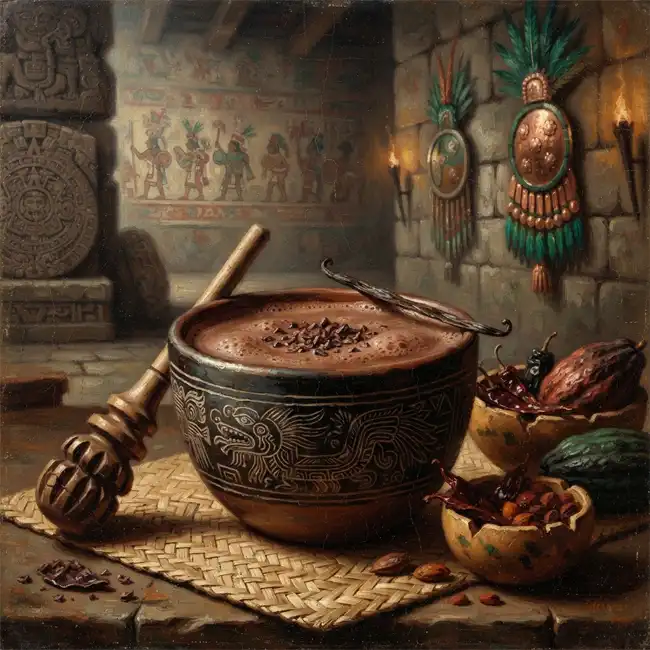
Recipe: Aristocratic Mexican Cacao & Vanilla Heritage Infusion
👑 About This Aristocratic Secret
There is no reliable historical evidence that this exact recipe was served to a particular Mexican emperor or preserved as a literal palace formula.
Instead, this recipe is a historically inspired reconstruction built around ingredients and flavor concepts associated with Mexican culinary heritage.
Its inspiration comes from the sophisticated use of cacao and aromatic ingredients in Mesoamerican food culture, combined with later Mexican ingredients and techniques.
Imagine it being prepared for an important gathering in an elite household.
A distinguished guest arrives.
The kitchen becomes unusually quiet.
The cacao has already been gently toasted. Vanilla is carefully measured. Aromatic herbs are bruised just enough to release their fragrance.
The cook prepares the infusion shortly before serving so that its aroma remains fresh.
There is something wonderfully aristocratic about that idea—not because the recipe belongs to a documented royal court, but because it treats a simple beverage as something worthy of patience and attention.
And that is exactly what makes it special.
🌿 Ingredients & The Aristocratic Touch
🏺 The Royal Pantry
The original inspiration begins with cacao.
Cacao provides a deep roasted character without turning the beverage into a conventional hot chocolate. Choose unsweetened cacao nibs or lightly roasted cacao pieces whenever possible.
Vanilla brings another layer.
Its floral, almost honey-like aroma works beautifully with cacao, especially when you use it carefully rather than allowing it to dominate.
Cinnamon contributes warmth and familiarity. Modern Mexican cuisine has embraced cinnamon in countless sweet and savory preparations, making it a natural partner for this historical-inspired infusion.
For the herbal element, use an aromatic Mexican herb such as cedrón, commonly known in English as lemon verbena. Its bright citrus character cuts through the richness of cacao.
A tiny amount of dried hibiscus can also be used for color and gentle tartness, although it should remain secondary to the main flavors.
The result should never taste like a dessert.
It should taste like an aromatic infusion with a sophisticated roasted backbone.
📍 Modern Substitutes
If some ingredients are difficult to find, there is no need to abandon the recipe.
• Cacao nibs: Use unsweetened roasted cacao pieces as the closest practical alternative.
• Fresh vanilla bean: Pure vanilla extract can be used, although the flavor will be less nuanced.
• Cedrón or lemon verbena: Use fresh lemon verbena, dried lemon verbena, or a small amount of lemongrass.
• Mexican cinnamon: Ceylon cinnamon works well if Mexican cinnamon is unavailable.
• Piloncillo: Use a small amount of raw cane sugar or another minimally processed sweetener.
• Hibiscus: Leave it out if you prefer a softer, less tart infusion.
• Fresh herbs: Dried herbs are perfectly acceptable; simply reduce the quantity because dried herbs are more concentrated.
⚖️ The Measurements
This recipe makes approximately 2 generous cups.
• 2 tablespoons roasted unsweetened cacao nibs
• 1 small cinnamon stick, approximately 5 centimeters
• 1/2 vanilla bean, split lengthwise
• 1 teaspoon dried lemon verbena or 2 teaspoons fresh lemon verbena
• 1 teaspoon dried hibiscus, optional
• 500 milliliters filtered water
• 1 to 2 teaspoons piloncillo or raw cane sugar, optional
• 1 tiny pinch of sea salt
The measurements are intentionally balanced.
The cacao should be noticeable but not overpowering.
The cinnamon should provide warmth without turning the infusion into a strongly spiced drink.
The vanilla should sit quietly in the background.
And the herbs should create a fresh finish.
That balance is what gives the beverage its refined character.
🔥 The Chef’s Ritual
1. Toast the Cacao
Place the cacao nibs in a dry saucepan over low heat.
Warm them gently for approximately 2 to 3 minutes.
Do not burn them.
You are looking for a deeper roasted aroma, not smoke.
As soon as the cacao becomes fragrant, remove the pan from the heat.
This simple step gives the final infusion much greater depth.
2. Warm the Cinnamon and Vanilla
Place the cinnamon stick and split vanilla bean into a small saucepan.
Add the water.
Bring the mixture slowly toward a gentle simmer.
Avoid a violent boil.
Historical-inspired cooking benefits from patience, and this recipe is particularly sensitive to excessive heat.
3. Add the Cacao
Add the toasted cacao nibs.
Reduce the heat and allow everything to gently infuse for approximately 8 to 10 minutes.
The water will gradually become darker and more aromatic.
You should begin to smell roasted cacao, warm cinnamon, and vanilla together.
4. Introduce the Herbs
Add the lemon verbena during the final 2 to 3 minutes.
If using hibiscus, add only a small amount.
The herbs should remain bright and fragrant.
If they are boiled aggressively for too long, their delicate character can disappear.
5. Add the Aristocratic Finishing Touch
Remove the saucepan from the heat.
Add the tiny pinch of sea salt.
Taste.
If you want a slightly sweeter version, add 1 teaspoon of piloncillo or raw cane sugar and stir until dissolved.
Add another teaspoon only if necessary.
The goal is not to create a sugary beverage.
The goal is to make the cacao, vanilla, cinnamon, and herbs taste more complete.
6. Strain and Serve
Strain the infusion through a fine sieve.
Serve it immediately in warmed ceramic cups.
For a more atmospheric presentation, place the cups on a simple stoneware or terracotta-style serving dish.
The visual experience should feel rustic and refined at the same time.
🗝️ Secrets of the Palace Kitchen: Tips & Mistakes
Even though this is not an authenticated palace manuscript recipe, several old-world cooking principles can make the modern version dramatically better.
1.Never burn the cacao.
Burnt cacao becomes bitter and smoky. Gentle toasting is all you need.
2.Do not overpower the vanilla.
Vanilla is powerful. Half a bean is enough for this quantity.
3.Keep the herbs toward the end.
Delicate herbs lose their fragrance when boiled aggressively.
4.Use low heat.
A gentle infusion produces a cleaner flavor than rapid boiling.
5.Do not make it too sweet.
Excess sugar can completely hide the roasted cacao and herbal notes.
6.Taste before adding more cinnamon.
Cinnamon becomes stronger as it infuses. Adding too much at the beginning can make the final drink harsh.
7.Use fresh spices whenever possible.
Old cinnamon and stale cacao will produce a flat result.
8.Let the infusion rest briefly.
After straining, allow it to sit for 1 minute before serving. This gives the aromas time to settle.
9.Experiment carefully.
You can add a little more lemon verbena or cacao, but change only one ingredient at a time so you understand its effect.
10.Respect the historical distinction.
Do not present this modern reconstruction as a verified recipe from a specific Aztec ruler or Mexican royal palace. Its value comes from connecting historically relevant ingredients with a respectful modern interpretation.
❓🏯 Royal FAQ
Q1.Is this a genuine 1,000-year-old Mexican tea recipe?
No. This is a historically inspired reconstruction, not a surviving 1,000-year-old manuscript recipe. Ancient Mexican beverage traditions were diverse, and the modern concept of “tea” does not perfectly describe all of them.
Q2.Did ancient Mexicans drink tea like people do today?
Not in the modern tea-culture sense. Mesoamerican peoples prepared numerous beverages from cacao, maize, herbs, flowers, seeds, and other ingredients. This recipe uses the word “tea” broadly to describe an infused beverage.
Q3.Why use the word aristocratic instead of royal?
Mexico did not maintain one continuous royal dynasty across the last 1,000 years. Ancient Mesoamerican societies had different political and social structures, including rulers and elite classes. “Aristocratic” is therefore a safer descriptive term for this historical-inspired culinary theme.
Q4.Can I make this recipe without cacao?
Yes. You can replace the cacao with additional aromatic herbs and spices, but the character will change significantly. Cacao provides the roasted foundation that makes this particular infusion distinctive.
👅 The Taste of History
The first sip is surprisingly complex.
You notice the roasted cacao first.
It is dark and earthy but not overwhelmingly chocolate-like.
Then the cinnamon arrives, bringing gentle warmth.
Vanilla follows with a soft floral sweetness.
Finally, the lemon verbena lifts everything with a clean citrus note.
If you added hibiscus, there will be a subtle tart finish.
The tiny pinch of salt quietly ties everything together.
What makes this beverage interesting is the absence of a single dominant flavor.
It feels layered.
It feels deliberate.
And it demonstrates something that historical cooking often teaches us: luxury does not always come from using dozens of expensive ingredients.
Sometimes luxury comes from knowing exactly how much of each ingredient to use.
That principle is timeless.
🏺 Final Thoughts: Bringing History to Your Table
Ancient Mexican culinary heritage is far too rich to be reduced to one “secret royal recipe.”
Its real beauty lies in the diversity of civilizations, ingredients, techniques, landscapes, and generations of cooks that shaped the region's food traditions.
This cacao and vanilla infusion is simply one doorway into that larger story.
You can make it on a quiet morning.
You can prepare it when friends visit.
You can serve it after a meal as a fragrant alternative to ordinary sweet drinks.
Or you can simply make a small pot when you want something that feels different from the usual cup of tea.
And you do not need a palace kitchen.
You do not need rare equipment.
You do not need to be a professional chef.
A saucepan, a strainer, good cacao, aromatic herbs, and a little patience are enough.
That is perhaps the most enjoyable part of historical-inspired cooking.
You take something connected to another time and place, then give it a new life in your own kitchen.
🔑 The Call to Action: The Golden Hook
If you love discovering forgotten flavors and culinary traditions from around the world, keep exploring with us.
Every historic ingredient has a story.
Every traditional preparation carries clues about the people who created it.
And every carefully recreated recipe gives us another opportunity to appreciate the cultures that shaped our global food heritage.
So, make this Mexican cacao infusion slowly.
Smell the roasted cacao.
Notice the cinnamon.
Let the vanilla open gradually.
Taste the herbs.
Then imagine how different kitchens, centuries, and generations can all meet in a single cup.
If you love the flavors of history, join us in preserving the world's culinary secrets—one forgotten recipe, one traditional ingredient, and one unforgettable taste at a time.
🌎 Credit to the Keepers of the Culture: The Legacy
The greatest respect we can show historical cuisine is to recognize that it belongs to real cultures and communities—not simply to a modern recipe collection.
Mexican culinary heritage has roots that reach across many civilizations and centuries. Mesoamerican food traditions contributed ingredients, techniques, and culinary ideas that continue to influence Mexico and the wider world.
Cacao, vanilla, maize, chili, beans, herbs, flowers, and countless other ingredients are more than ingredients on a shopping list. They are part of a much larger cultural history.
That is why this recipe should be enjoyed as an inspired interpretation, not as a claim of exact historical authenticity.
Where the historical record is clear, we should respect it.
Where evidence is incomplete, we should say so.
And where modern adaptation is necessary, we should make that distinction visible.
The phrase “1,000-Year Mexican Tea Secrets” may sound mysterious and dramatic, but the real treasure is not pretending that one perfect recipe survived unchanged for a millennium.
The real treasure is discovering how culinary traditions evolve.
Ancient Mesoamerican cooks worked with the ingredients available to them. Later Mexican cooks adapted new ingredients and techniques. Families passed knowledge between generations. Regional traditions developed their own personalities.
That process is still happening today.
So when you prepare this infusion, you are not claiming to drink exactly what an ancient ruler once drank.
Instead, you are taking part in a much more honest and meaningful tradition: using historical flavors as inspiration while respecting the culture from which they came.
And perhaps that is the finest way to bring the past to your table.
Not as a museum piece.
Not as a fantasy.
But as a living culinary conversation between yesterday and today.
| 🇲🇽 👑🍷 < Back |