
🏠 Home > 🗺️ Recipes > 👑🥗 Aristocratic Garden Greens (Salads) > 🇲🇽 Mexico Aristocratic Garden Greens (Salads) Recipes > 👑🥗 1.The Silver Hacienda Pomegranate and Nopal Rose Salad
👑🥗 The Lost Aristocratic Salad of Mexico's Silver Palaces
Published by Supakorn | Updated: August 2026
🤴🛕 The Forgotten Royal Legacy of Mexico: The Porfirian Aristocracy
📜 The Storyteller’s Intro
Imagine stepping back to the year 1895, inside a grand hacienda in Puebla. Outside, the sun blazes over agave fields, but inside the stone-walled kitchen, the air is cool and scented with toasted pumpkin seeds and lime. The heavy wooden doors are closed to the world. Only the head cook, Doña Elena, and her two trusted nieces are allowed to touch this dish. It was never written down, only whispered from one generation of women to the next. This was not food for the workers in the fields. This was food for the masters of the silver empire.
🌎 The Global Value
For over 300 years, Mexico's most exquisite recipes were locked away behind hacienda walls. While the world knew tacos and mole, the true aristocratic cuisine of Mexico – the cuisine influenced by French techniques, indigenous Aztec botanical knowledge, and Spanish silver-wealth – was deliberately kept secret. These were not restaurant dishes. They were status symbols. To know how to balance the sourness of xoconostle with the creaminess of fresh cheese was a sign of your family’s breeding and power. When the Mexican Revolution swept through in 1910, many of these grand families fled, and their kitchens were abandoned. Their recipe books were burned or lost. We almost lost this salad forever.
✨ The Collection
Today, we are bringing it back. This article revives one of the most stunning secrets of that era – a salad that was once served only on porcelain imported from Limoges, to celebrate the first harvest of pomegranates. It reflects the absolute peak of Mexican aristocratic opulence: vibrant, refreshing, complex, and utterly unlike any Mexican salad you have ever tasted. This is not your everyday side dish. This is history on a plate.
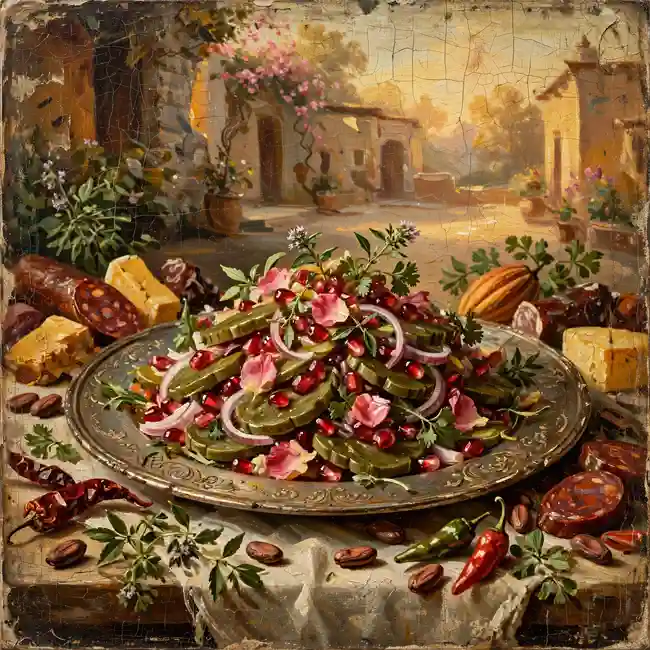
🥗 Recipe: The Silver Hacienda Pomegranate and Nopal Rose Salad
👑 About this Royal Secret
This dish was known in the private kitchens as Ensalada de Nochebuena de la Hacienda. It was the favorite of the ladies of the Porfirian high society, served during the cool afternoons of late August and September, when both prickly pears and pomegranates were at their sweetest.
Legend says it was created for the wife of a silver baron in Zacatecas, who found regular lettuce salads too plain for her Parisian guests. She commanded her cook to create something that tasted like Mexico but looked like Versailles. The result was this masterpiece. It was served as a palate cleanser between rich courses of roasted meats and creamy soups, but guests would often ask for a second serving, ignoring etiquette completely. It was light, but it made a statement: we are Mexican, we are refined, and our land is abundant.
🛒 Ingredients & The Aristocratic Touch
🌿 The Royal Pantry
In the Porfirian era, ingredients were a language. Using nopal cactus pads showed you understood the ancient wisdom of the land. Using fresh pomegranate seeds, which had to be hand-peeled one by one without breaking, showed you had a staff large enough to afford such tedious work. The cheese was never store-bought; it was fresh queso fresco made that morning from hacienda cows. And the pumpkin seeds were not just toasted – they were toasted with a whisper of smoked chili from Oaxaca, a secret touch that only the most connected families could source.
🔄 Modern Substitutes
Do not worry, you do not need a hacienda to make this. We have made it accessible for your modern kitchen while keeping its soul intact.
For the cactus pads, if you cannot find fresh nopales, you can use jarred nopalitos, just be sure to rinse them very well to remove the brine. If you cannot find xoconostle, which is a sour prickly pear, use a mix of regular prickly pear and an extra squeeze of lime. For queso fresco, if you live somewhere where it is hard to find, a good quality feta cheese in brine or even fresh farmer's cheese works beautifully. And for the smoky touch, a pinch of chipotle powder will give you that same Oaxacan depth.
📝 The Measurements
Here is exactly what you will need to serve 4 people as an elegant appetizer.
For the Salad Base:
• 3 medium fresh nopal cactus pads, cleaned of thorns and diced into half-inch cubes, about 2 cups
• 1 cup fresh pomegranate seeds, from about 1 large pomegranate
• 2 large ripe xoconostle or prickly pears, peeled and diced, about 1 cup
• 1 small red onion, very thinly sliced into half-moons
• 1 cup fresh queso fresco, crumbled by hand into large chunks
• 1/2 cup toasted pumpkin seeds, also known as pepitas
• 1/4 cup fresh mint leaves, torn
• 1/4 cup fresh cilantro leaves, whole
For the Aristocratic Lime and Honey Dressing:
• 4 tablespoons extra virgin olive oil, the best quality you have
• 3 tablespoons fresh lime juice, about 2 limes
• 1 tablespoon light raw honey or agave nectar
• 1 teaspoon finely grated lime zest
• 1/2 teaspoon sea salt, plus more to taste
• 1/4 teaspoon freshly ground black pepper
• 1/4 teaspoon ground chipotle or smoked paprika
👨🍳 The Chef’s Ritual
◦ Step 1: Taming the Nopal
This is the most important step the old cooks never skipped. Bring a pot of salted water to a boil. Add the diced nopal and blanch for exactly 2 minutes. This removes the sticky texture. Drain immediately and plunge into a large bowl of ice water. This keeps them bright green and crisp. Drain again and pat completely dry with a clean kitchen towel. Set aside in a large, beautiful serving bowl.
◦ Step 2: The Jewels Preparation
If you are using fresh prickly pears, wear gloves. Peel them carefully. The flesh should be a deep ruby or golden color. Dice them gently. Add them to the bowl with the nopal, along with the pomegranate seeds and the thinly sliced red onion. Do this with care, as if you were handling jewels, because in a way, you are.
◦ Step 3: The Toasting
In a dry skillet over medium heat, toast the pumpkin seeds for about 3 to 4 minutes, shaking the pan often, until they start to pop and become fragrant. Remove from heat instantly. They can burn in seconds. Let them cool.
◦ Step 4: The Emulsion
In a small jar or bowl, combine all the dressing ingredients. Whisk vigorously or shake the jar until the honey dissolves and the dressing becomes slightly thick and glossy. Taste it. It should be a perfect balance of bright sour, soft sweet, and smoky warmth. Adjust salt if needed.
◦ Step 5: The Assembly
Pour about three quarters of the dressing over the cactus and fruit mixture. Toss very gently with your hands, not with metal tongs, to keep the delicate shapes intact. Let it rest for 10 minutes. This allows the nopal to drink in the dressing.
◦ Step 6: The Crowning
Just before serving, scatter the crumbled queso fresco, the toasted pumpkin seeds, the torn mint, and the cilantro over the top. Drizzle the remaining dressing over everything. Do not toss again. Serve immediately on chilled plates.
🤫 Secrets of the Palace Kitchen
• Never Serve Nopal Slimy: The old hacienda cooks had a trick. After blanching and cooling the nopal, they would toss it with a tiny pinch of salt and let it sit in a colander for 15 minutes. The salt draws out any remaining viscous liquid. Pat dry again before mixing. This guarantees a crisp, clean bite every time.
• The Pomegranate Water Method: To get perfect seeds without bitter white pith, cut the pomegranate in half and submerge it in a large bowl of water. Break it apart under water. The seeds sink, the pith floats. It is the method the kitchen maids used for hours, and it works flawlessly.
• Cheese Mistake to Avoid: Do not use pre-crumbled cheese or add the cheese too early. The acid in the lime will make it melt and become grainy. The aristocratic way is to keep the chunks large and add them at the very last second, so they stay creamy and stand out against the green and red.
• Temperature is Everything: This salad should never be served at room temperature. The bowl and the plates should be chilled for at least 20 minutes in the refrigerator. The Porfirian aristocrats believed a cold plate kept the flavors noble and refreshing, especially in the Mexican heat.
❓🕌 Royal FAQ
Q1: What does nopal actually taste like? Is it too sour?
Not at all when prepared correctly. Fresh nopal tastes like a cross between a green bean and a green bell pepper, with a slight citrus tang. The blanching method in this recipe removes almost all of the sourness and stickiness, leaving just a wonderfully crisp, vegetal flavor that pairs beautifully with sweet fruit.
Q2: Can I make this salad ahead of time for a party?
You can prep the components ahead, but you should only assemble at the last moment. You can blanch the nopal, prepare the dressing, and seed the pomegranate up to a day in advance, keeping everything in separate sealed containers in the fridge. Toss everything together no more than 20 minutes before your guests arrive to keep the colors vibrant.
Q3: Is this salad considered authentic Mexican food?
It is authentically aristocratic Mexican food, which is a rare and different category. Most Mexican food known abroad comes from street kitchens and family homes. This recipe comes from the grand hacienda kitchens that combined indigenous ingredients like nopal and xoconostle with European presentation and French techniques. It is a true, but forgotten, part of Mexican culinary heritage.
👅 The Taste of History
Close your eyes when you take the first bite. First, you get the bright pop of pomegranate, sweet and tart like a jewel bursting. Then the cool, crisp bite of the cactus, followed by the creamy saltiness of the fresh cheese that melts on your tongue. Then the finish – the warm, smoky crunch of the toasted pumpkin seeds and the fresh lift of mint. It is sweet, salty, sour, creamy, and crunchy all at once. It is not just a salad. It is a conversation between ancient Aztec agriculture and 19th-century European elegance. This is what the Mexican aristocracy tasted.
💭 Final Thoughts: Bringing History to Your Table
It is easy to think that aristocratic recipes are too complicated or too precious for a regular Tuesday night. They are not. The beauty of this salad is in its simplicity once you understand the method. The hacienda cooks did not have thermometers or food processors. They had intuition, patience, and respect for incredible ingredients.
With the guide above, you have more than a recipe. You have the exact ritual that was once guarded behind closed doors. You can now recreate that moment of Porfirian luxury in your own kitchen, no silver mine required. Let your kitchen become the palace kitchen, if only for an evening.
💛 The Call to Action
If you fell in love with the taste of this forgotten history, please help us keep its memory alive. Share this recipe with a friend who loves stories as much as flavors, leave a comment telling us what ancient ingredient you would like us to revive next, and join our community of history keepers. The world's most beautiful recipes should never be lost again.
🙏 Credit to the Keepers of the Culture
This recipe is a tribute to the unnamed Cocineras Mayores, the head cooks of Mexico's haciendas, and to the indigenous Mixtec and Zapotec farmers who have cultivated nopal and xoconostle for thousands of years. Their botanical knowledge is the true foundation of this dish. We also honor the food historians in Puebla and Oaxaca who are working tirelessly to preserve Mexico's aristocratic culinary manuscripts from the Porfiriato era, ensuring that these voices from the past can still teach and nourish us today. This culture belongs to them, we are merely honored to share its flavor.
| 🇲🇽 👑🥗 < Back |