
🏠 Home > 🗺️ Recipes > 👑🥘 Signature Royal Sauces (Sauces) > 🇲🇽 Mexico Signature Royal Sauces (Sauces) Recipes > 👑🥘 1.The Marquise's Velvet Mole Poblano de Convento
👑🥘 The Aristocratic Sauces of Mexico You Were Never Meant to Taste
Published by Supakorn | Updated: August 2026
🤴🌹 The Forgotten Aristocratic Legacy of Mexico: The Second Empire and New Spain
📜 The Storyteller’s Intro
Imagine stepping back to the year 1865. Inside the cool, stone-walled kitchens of Chapultepec Castle, far from the dusty streets of Mexico City, the air is thick with the scent of toasted chilies, dark chocolate, and roasting almonds. Copper pots simmer for hours, and the private chefs of Emperor Maximilian and Empress Carlota are not cooking for an army, but for a single, intimate dinner. The recipes they whisper about are not written down for the public. They are secrets of the state, guarded by the criollo aristocracy of New Spain.
These were not the salsas you find on a street taco stand today. These were sauces of power.
💎 The Global Value
For nearly 300 years, the highest culinary art in Mexico was locked behind palace gates. During the Viceroyalty of New Spain and later the brief Second Mexican Empire, aristocratic families and convent kitchens of Puebla and Mexico City created sauces that required ingredients from three continents. They were too expensive, too complex, and too time-consuming for anyone outside the nobility to make.
Because Mexico never kept a permanent monarchy, these recipes were never archived in a royal library like in France or Japan. They survived only in the handwritten notebooks of marquesas, convent mother superiors, and private family chefs. When the Empire fell and the Revolution came, most of those notebooks were burned, lost, or hidden away in trunks. What we know today as Mexican sauce is only a shadow of what the aristocracy once tasted. This is food history on the verge of disappearing forever.
✨ The Collection
In this article, we are bringing that hidden history back to your table. We have pieced together three of the most legendary aristocratic sauces that defined the peak of Mexican high society. These are not everyday salsas. These are the sauces that were served to archbishops, marqueses, and foreign ambassadors. Each one tells a story of wealth, faith, and the incredible fusion that makes Mexican cuisine a UNESCO Intangible Cultural Heritage.
Get ready to cook like a 19th-century Mexican aristocrat.
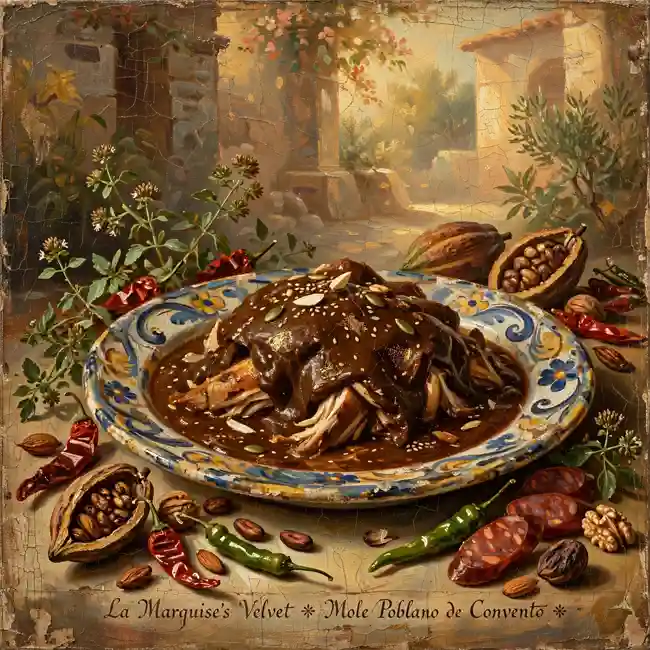
🥘 Recipe: The Marquise's Velvet Mole Poblano de Convento
This is the crown jewel. While common mole poblano is famous worldwide, the aristocratic version made for the nobility in Puebla's convents was entirely different. It was smoother, more velvety, less smoky, and balanced with expensive European ingredients.
👑 About this Royal Secret
This was the signature dish of the Convent of Santa Rosa in Puebla, but the version reserved for the visit of a Viceroy or a Marquesa was known as Mole de Estado, or State Mole. Legend says that Sor Andrea de la Asunción created this refined version in 1821 to honor Doña María de la Soledad, the Marquesa de Uluapa, who was known for her delicate palate and dislike for excessive heat.
It was only served on two occasions: Christmas Eve and when a new Bishop was appointed. The nuns would start the preparation three days in advance. The secret? They removed the aggressive bitterness of the chilies and replaced it with velvety richness from almonds, a touch of aristocratic sweetness from plantain and Maria biscuits, and the deepest flavor from pure Mexican vanilla. This was mole not meant to be fiery, but to be profound, complex, and unforgettable. It was literally considered a taste of heaven.
🛒 Ingredients & The Aristocratic Touch
• The Royal Pantry: In the 18th century, these ingredients were a display of pure power. Chilhuacle negro chilies had to be brought from Oaxaca by mule, almonds and sesame came from Spain at great cost, and true Ceylon cinnamon was worth more than silver. The chocolate used was not sweet, but 100 percent pure Soconusco cacao, reserved only for the nobility. The presence of these on your table meant your family had connections to the Manila Galleon trade route.
• Modern Substitutes: Do not worry, you do not need a galleon. For Chilhuacle negro, which is very hard to find, you can use a mix of Mulato and Pasilla chilies to replicate that deep, fruity, non-smoky base. If you cannot find authentic Maria biscuits, use a single slice of toasted brioche or plain water crackers. For the lard, which gives the authentic aristocratic silkiness, you can use a high-quality unsalted butter, but lard is truly superior here.
• The Measurements:
For the Chili Base:
◦ 4 large Mulato chilies, stemmed and seeded
◦ 2 large Ancho chilies, stemmed and seeded
◦ 2 Pasilla chilies, stemmed and seeded
◦ 2 tablespoons lard or unsalted butter, divided
◦ 1 medium white onion, thickly sliced
◦ 6 cloves garlic, unpeeled
◦ 2 medium Roma tomatoes, halved
For the Aristocratic Blend:
◦ 1/3 cup whole raw almonds
◦ 1/4 cup sesame seeds
◦ 1/4 cup golden raisins
◦ 1 small ripe plantain, sliced into half-inch pieces
◦ 2 Maria biscuits or 1 slice toasted brioche
◦ 1/4 teaspoon ground Ceylon cinnamon
◦ 1/8 teaspoon ground cloves
◦ 1/4 teaspoon ground anise seed
◦ 1 small piece of authentic 100 percent dark Mexican chocolate, about 30 grams, chopped
◦ 3 and 1/2 cups rich chicken or turkey broth, preferably homemade
◦ 1 teaspoon sea salt, plus more to taste
◦ 1 teaspoon piloncillo or dark brown sugar
◦ 1/2 teaspoon pure Mexican vanilla extract
👨🍳 The Chef’s Ritual
1.Awaken the Chilies: Heat a large comal or heavy skillet over medium heat. Toast the Mulato, Ancho, and Pasilla chilies for 20 to 30 seconds per side until fragrant and pliable. Be careful not to burn them or they will turn bitter. Place them in a bowl and cover with hot water for 30 minutes until completely soft.
2.Roast the Foundation: In the same skillet, add 1 tablespoon of lard. Roast the sliced onion, unpeeled garlic, and tomatoes until they are deeply charred and soft, about 8 minutes. Peel the garlic after roasting. This char is not for smokiness, but for sweetness.
3.Build the Velvet: In the same pan, add the remaining lard. Fry the almonds until golden, about 2 minutes. Remove and set aside. Then fry the sesame seeds until light golden, about 1 minute. Then fry the plantain slices until caramelized, about 3 minutes. Finally, quickly fry the raisins and Maria biscuits for 30 seconds. This layering is the secret of the palace kitchen.
4.The First Grind: In a high-powered blender, combine the softened, drained chilies with 1 and 1/2 cups of broth. Blend until completely, completely smooth, at least 2 full minutes. Strain this puree through a fine-mesh sieve into a bowl, pushing with a spoon. This step is non-negotiable for the aristocratic texture. Discard any skins left behind.
5.The Second Grind: In the same blender, now combine the roasted onion, garlic, tomatoes, fried almonds, sesame seeds, raisins, plantain, biscuits, cinnamon, cloves, and anise with another 1 cup of broth. Blend until as smooth as velvet.
6.The Royal Union: In a large, heavy pot or cazuela, heat a little more lard over medium heat. Pour in the chili puree and fry it, stirring constantly, for 5 minutes until it darkens slightly. This is called sazonar. Then pour in the second nut and fruit puree. Stir to combine beautifully.
7.The Slow Patience: Add the remaining 1 cup of broth, the salt, piloncillo, and chopped dark chocolate. Bring to a very gentle simmer, not a boil. Let it whisper and bubble slowly for at least 45 minutes, stirring every few minutes to prevent sticking. The mole will thicken and its color will become a deep, elegant mahogany. In the final 5 minutes, stir in the vanilla extract. Taste and adjust salt. If it is too thick, add a splash more broth. It should coat the back of a spoon like heavy cream.
🤫 Secrets of the Palace Kitchen
• The Double Strain Secret: Aristocratic chefs never served a gritty mole. After step 5, many palace chefs would strain the second puree as well. If you want true nobility-level smoothness, strain it twice. Your guests will feel the difference instantly.
• Common Mistake: Rushing the Fry: Most modern recipes skip frying the chili puree in lard. Do not skip this. This 5-minute fry is what separates a raw chili taste from a deep, cooked, complex aristocratic sauce. If you skip it, your mole will taste flat and bitter.
• The Balance Tip: The aristocratic palate hated overwhelming heat. If your chilies are too spicy, add one more Maria biscuit or a little more plantain to tame the fire without adding sugar. The goal is warmth, not burn.
• The Day-After Rule: The nuns of Puebla always said mole is better the next day. Make it a day ahead. The flavors marry and deepen overnight in the refrigerator. Reheat gently with a little extra broth to loosen it.
🤴🙋 H3: Royal FAQ
Q1: Can I make this mole vegan and still keep it aristocratic?
A: Absolutely, my friend. The original convent version used lard for silkiness, but you can use a neutral oil or vegan butter. Use a rich, dark vegetable broth made with roasted mushrooms and onions instead of chicken broth. The richness will still be there.
Q2: What do I serve this aristocratic mole with?
A: In the palaces, it was never served with chicken legs. It was served with a whole, poached turkey breast, sliced elegantly, or with stuffed capon. For a modern home, it is stunning with roasted turkey, duck breast, or even simply drizzled over roasted cauliflower steaks for an elegant vegetarian main.
Q3: How long can I store this sauce?
A: This is a great make-ahead aristocratic secret. It keeps beautifully in an airtight container in the refrigerator for up to 7 days, and it freezes perfectly for up to 3 months. In fact, many Mexican families freeze a large batch for the holidays.
📖 The Taste of History
When you taste this Mole Poblano de Convento, you are not just tasting chilies and chocolate. You are tasting the moment when indigenous Aztec ingredients met Spanish wealth and convent patience. It is sweet, savory, slightly fruity, deeply earthy, and incredibly smooth. It does not attack your palate; it embraces it, layer by layer, exactly as it was designed to impress a Marquesa over 200 years ago.
💭 Final Thoughts: Bringing History to Your Table
So there you have it, my friend. A sauce that was once guarded by nuns and reserved for the highest aristocracy of Mexico is now simmering in your own kitchen. Do not be intimidated by the long ingredient list. Think of it as a ritual, not just a recipe. Each step is a little piece of history you are recreating.
The beauty of these forgotten aristocratic recipes is that they remind us that Mexican cuisine has always been world-class haute cuisine, long before the term existed. You do not need a palace to make it. You just need patience, good ingredients, and a respect for the story behind it.
Which part of the story resonated with you the most? The secret convent kitchens or the luxury of the ingredients?
💌 The Call to Action
If you fell in love with the taste of this forgotten history, you are now a keeper of its secret too. Share this recipe with someone who appreciates real food stories, and try making it for your next special dinner. Tag us with your creation, because every time we cook a lost recipe, we make sure it is never forgotten again.
Do you want me to resurrect the next secret? The lost Pipian Rosa of the Marquesas, made with pink pine nuts and rose petals?
🙏 Credit to the Keepers of the Culture
This recipe and its history would not exist without the incredible culinary guardians of Mexico. Our deepest respect and gratitude go to the convent cooks of Puebla, especially the Sisters of Santa Rosa and Santa Clara, the indigenous market women who preserved the knowledge of heirloom chilies, and the traditional cocineras of Mexico who have passed these techniques down through generations.
All historical interpretations are based on public culinary archives, convent records from the colonial period, and the oral traditions of Puebla. We honor the living culture of Mexico as the true owner of this magnificent heritage.
| 🇲🇽 👑🥘 < Back |