
🏠 Home > 🗺️ Recipes > 👑🥪 Royal Starters (Appetizers) > 🇲🇽 Mexico Royal Starters (Appetizers) Recipes > 👑🥪 1.Imperial Tenochtitlan Roasted Tomato & Pumpkin Seed Bites
👑🥪 Ancient Mexican Court Starters: Forgotten Flavors from the Mexica World
Published by Supakorn | Updated: August 2026
👑🏛️ The Forgotten Royal Legacy of Mexico: The Mexica Imperial Era
Before modern Mexico existed as a nation, the Valley of Mexico was home to sophisticated civilizations with powerful cities, ceremonial centers, noble households, marketplaces, farmers, cooks, and highly organized food traditions. Among the most famous were the Mexica, whose capital, Tenochtitlan, became one of the great urban centers of the ancient Americas.
Strictly speaking, calling these foods “royal Mexican recipes” is a modern storytelling expression. The Mexica political system was an imperial one rather than a European-style kingdom, and surviving historical evidence rarely gives us complete recipes with exact measurements. So, throughout this article, “royal” refers to the imperial court, noble households, ceremonial dining, and elite culinary traditions associated with the Mexica world.
That distinction matters because the real history is fascinating enough without inventing a fictional palace cookbook.
Ancient Mexican cuisine was built around ingredients that may look simple to us today but represented an extraordinary culinary system: maize, beans, squash, tomatoes, chiles, amaranth, herbs, cacao, avocado, cactus, mushrooms, turkey, fish, insects, and countless native fruits and seeds.
For elite households, food could also become a statement of status. The difference was not always an expensive imported ingredient. Sometimes it was the quality of preparation, the rarity of a seasonal ingredient, the presentation, or the skill required to transform humble foods into something worthy of a ceremonial table.
🕯️ The Storyteller’s Intro: A Meal Beyond the Palace Walls
Imagine the Valley of Mexico centuries ago.
Morning light spreads across the waters and canals surrounding Tenochtitlan. The city is already alive. Traders move through busy markets, cooks prepare maize, servants carry baskets of vegetables and herbs, and the aroma of roasted chiles drifts through courtyards.
Inside an elite household, the preparation of a formal meal begins long before guests arrive.
A cook grinds maize by hand. Another prepares fresh herbs. Tomatoes are roasted until their skins darken. Chiles are toasted carefully, never allowed to burn. Pumpkin seeds are ground into a rich paste. Fresh avocado is sliced only when needed.
There is no modern refrigerator, food processor, stainless-steel kitchen, or measuring cup.
Instead, there is experience.
A cook knows when a chile is perfectly toasted by its aroma. They understand how much water maize flour can absorb. They know when ground seeds have released enough oil and when a sauce has reached the right thickness.
That is where the real luxury begins.
Not in extravagance, but in mastery.
🌎 The Global Value: When Everyday Ingredients Became Elite Cuisine
Many ingredients that are now inseparable from global cooking originated in the Americas.
Tomatoes, maize, cacao, chiles, squash, beans, vanilla, avocado, and other native foods eventually traveled far beyond Mesoamerica and transformed cuisines around the world.
Yet their modern popularity can make us forget how culturally important they were in their original environment.
For ancient Mexican societies, maize was far more than a staple. It was central to food, agriculture, community, and worldview. Chiles brought heat and aroma. Tomatoes added acidity and freshness. Seeds created body and richness. Herbs supplied fragrance.
Elite dining did not necessarily mean abandoning these everyday ingredients.
Quite the opposite.
The most sophisticated dishes could take familiar foods and arrange them into a more refined culinary experience.
That idea is particularly useful when recreating historical cuisine today. Instead of imagining a European-style banquet with unfamiliar luxury ingredients, we can appreciate the sophistication of native Mexican ingredients themselves.
📜 The Collection: Bringing Forgotten Flavors Back to the Table
This collection focuses on a historically inspired starter that captures several characteristics associated with ancient Mexican and elite Mesoamerican food traditions.
It is not presented as an authenticated manuscript recipe. There is no surviving document saying that an ancient Mexica cook used precisely these quantities.
Instead, the recipe uses historically appropriate ingredients and techniques to create a modern interpretation inspired by the culinary world that surrounded the Mexica elite.
The result is a small starter built around roasted tomato, chile, avocado, pumpkin seeds, herbs, and maize.
It is simple enough for a home kitchen, but layered enough to feel worthy of a ceremonial table.
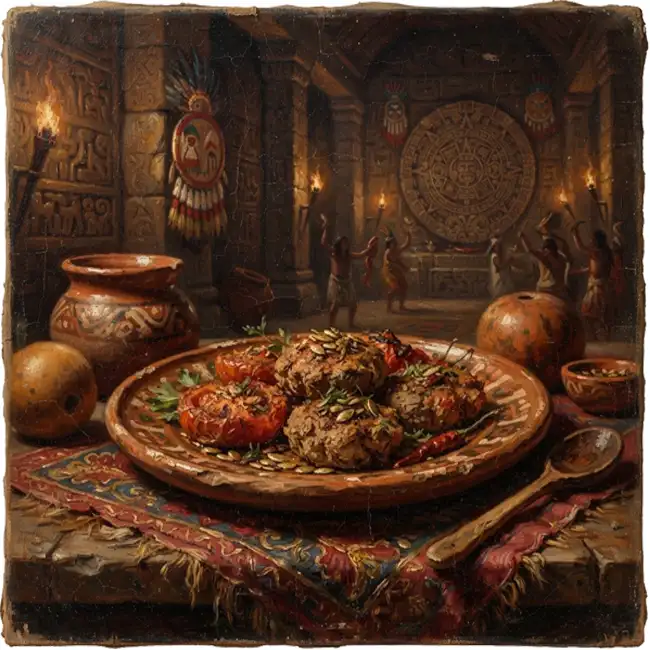
🌽 Recipe: Imperial Tenochtitlan Roasted Tomato & Pumpkin Seed Bites
👑 About this Royal Secret
Picture a ceremonial meal where the first course is not intended to overwhelm the guests.
It is meant to awaken them.
These roasted tomato and pumpkin seed bites are inspired by the flavor architecture of ancient Mesoamerican cuisine: roasted vegetables, chile, maize, seeds, fresh herbs, and creamy avocado.
The combination creates a fascinating contrast.
The tomato contributes acidity and gentle sweetness. Roasted chile adds warmth. Pumpkin seeds provide nuttiness and texture. Avocado brings richness. Fresh herbs brighten everything, while maize gives the starter a grounding, familiar character.
Rather than claiming this was the personal dish of a particular Mexica ruler, it is more historically responsible to think of it as an elite-court-inspired creation.
It represents the kind of carefully prepared small dish that could have fit naturally into a larger ceremonial meal built around ingredients available in central Mexico.
And honestly, that makes it more interesting.
We're not pretending to possess a lost cookbook.
We're reconstructing a culinary atmosphere.
🥑 Ingredients & The Aristocratic Touch
🌿 The Royal Pantry
The heart of this starter lies in ingredients that were deeply connected with Mesoamerican food culture.
Tomatoes should be ripe but firm. When roasted, their flavor becomes deeper and slightly smoky.
Pumpkin seeds are especially important because they add richness without requiring dairy. When lightly toasted and ground, they can transform a simple vegetable mixture into something much more substantial.
Fresh chile provides fragrance and heat, while avocado creates a luxurious texture.
Maize brings the entire dish together. Instead of treating corn as merely a side ingredient, use it as part of the foundation.
The aristocratic touch is therefore not about adding modern luxury ingredients.
It is about respecting the original ingredients and giving each one a deliberate role.
🔄 Modern Substitutes
If some ingredients are difficult to find, the recipe can still work beautifully.
• Use Roma tomatoes when traditional varieties are unavailable.
• Use jalapeño for a moderate, fresh chile flavor.
• Use serrano chile when you want brighter and sharper heat.
• Replace fresh Mexican herbs with fresh cilantro if the original herb is unavailable.
• Use pumpkin seeds without shells for convenience.
• Use good-quality corn tortillas if fresh maize preparation is impractical.
• Choose a ripe but firm Hass avocado for the creamy element.
• For a completely mild version, remove the chile seeds and use only a small amount of chile flesh.
The goal is not to make the recipe difficult.
The goal is to preserve its character.
📏 The Measurements
For approximately 12 small starter bites:
• 4 medium ripe tomatoes
• 1 small jalapeño or 1–2 small serrano chiles
• ½ cup raw pumpkin seeds
• 1 medium ripe avocado
• ½ cup finely chopped fresh cilantro
• ¼ cup finely chopped white onion
• 1 tablespoon fresh lime juice
• ½ teaspoon sea salt, plus more to taste
• 8 small corn tortilla rounds
• 1 tablespoon pumpkin seed oil or neutral oil, optional
• 2 tablespoons water, as needed
• 1 small garlic clove, optional for the modern interpretation
The quantities are intentionally practical rather than pretending to reproduce an exact ancient measurement system.
🔥 The Chef’s Ritual
1. Roast the Tomatoes
Place the tomatoes and chile on a hot dry skillet or under a broiler.
Turn them occasionally until the skins develop dark roasted patches and the tomatoes soften.
This is one of the most important stages.
Do not rush it.
The goal is not to burn the vegetables. You want concentrated flavor and gentle smokiness.
2. Toast the Pumpkin Seeds
Place the pumpkin seeds in a dry skillet over medium heat.
Toast them until they become fragrant and lightly golden.
Remove them immediately from the pan so they do not continue cooking from residual heat.
Set aside about two tablespoons for garnish.
3. Build the Seed Mixture
Grind the remaining pumpkin seeds until they become a coarse meal.
You can use a mortar and pestle for a more traditional feel or a modern food processor for convenience.
Add a little water if the mixture becomes too dry.
You want a thick, spoonable paste rather than a completely smooth puree.
4. Create the Roasted Tomato Base
Peel the roasted tomatoes if desired.
Combine them with the roasted chile, onion, salt, lime juice, and optional garlic.
Mash or pulse until the mixture becomes chunky rather than completely smooth.
A little texture makes the starter much more interesting.
5. Add the Pumpkin Seed Richness
Fold the ground pumpkin seeds into the roasted tomato mixture.
Taste carefully.
If the tomatoes are particularly acidic, add a little more avocado later rather than trying to sweeten the mixture.
If the chile is too powerful, increase the tomato and avocado.
This is where the cook's judgment matters more than strict measurements.
6. Prepare the Maize Base
Warm the small corn tortilla rounds in a dry skillet until flexible and lightly toasted.
For a crispier presentation, cook them a little longer until they become firm.
The maize base should remain sturdy enough to support the topping.
7. Finish with Avocado
Mash the avocado lightly with a pinch of salt and a few drops of lime juice.
Do not make it completely smooth.
Small pieces of avocado provide a pleasant contrast against the roasted tomato mixture.
8. Assemble the Bites
Place a small spoonful of pumpkin-seed tomato mixture onto each maize round.
Add a small amount of avocado.
Finish with toasted pumpkin seeds and fresh cilantro.
Serve immediately.
The final bite should offer several sensations at once: crisp maize, creamy avocado, roasted tomato, gentle chile warmth, fresh herbs, and nutty seeds.
That balance is the real secret.
🗝️ Secrets of the Palace Kitchen (Tips & Mistakes)
Historical cooking rewards patience, and this starter is no exception.
Here are the techniques that make the biggest difference:
1.Do not burn the chile.
A properly roasted chile smells fragrant and earthy. A badly burned chile becomes bitter very quickly.
2.Roast the tomatoes until they soften.
Pale, barely warmed tomatoes will taste watery. Proper roasting concentrates their natural sweetness.
3.Toast pumpkin seeds gently.
They contain natural oils and can burn surprisingly quickly.
4.Keep the pumpkin seeds slightly coarse.
Completely powdered seeds can make the mixture heavy. A little texture gives the starter character.
5.Use avocado at the last moment.
Fresh avocado looks and tastes best when prepared shortly before serving.
6.Do not drown the maize base.
Too much topping can make the tortilla soft and difficult to eat.
7.Balance heat instead of chasing it.
The purpose of chile is not simply to make the dish painfully hot. Aroma and flavor should remain noticeable.
8.Taste after every major step.
Ancient cooks did not have standardized kitchen scales and digital timers. Sensory judgment was essential.
9.Do not overload the garnish.
A refined presentation is usually better than a mountain of toppings.
10.Serve small portions.
This is a starter, so the idea is to awaken the appetite rather than make the guest full before the main meal arrives.
🛕❓ Royal FAQ
Q1.Was this an authentic Aztec royal recipe?
No exact surviving recipe confirms these precise ingredients and measurements as a specific dish served at the Mexica imperial court. This is a historically inspired reconstruction based on ingredients and culinary traditions associated with ancient Mesoamerica.
Q2.What ingredients make this starter distinctly Mexican?
The combination of maize, tomato, chile, pumpkin seeds, avocado, and fresh herbs reflects ingredients strongly associated with traditional Mesoamerican foodways and later Mexican cuisine.
Q3.Can I make this starter without spicy chiles?
Absolutely. Use a small amount of mild chile or remove the seeds and inner membranes. The roasted tomato and pumpkin seed combination remains flavorful even with very little heat.
Q4.Can this recipe be prepared ahead of time?
The roasted tomato and pumpkin seed mixture can be prepared several hours ahead. However, assemble the maize bites and avocado close to serving time so the texture stays fresh.
🏺 The Taste of History
The most fascinating thing about historical cuisine is that it does not always require exotic ingredients.
Sometimes history is hiding in plain sight.
A tomato may look ordinary today, yet its journey through the culinary world is extraordinary. The same is true of maize, chile, avocado, and pumpkin seeds.
When these ingredients meet, the result feels familiar and ancient at the same time.
The roasted tomato delivers depth. The chile adds a spark. Pumpkin seeds create a rich, almost buttery nuttiness. Avocado softens the edges. Fresh herbs bring the entire bite back to life.
And underneath it all is maize.
That foundation is important.
Rather than trying to imitate a European royal feast, this dish celebrates the sophistication of Mesoamerican ingredients on their own terms.
That is what makes the recipe feel genuinely aristocratic.
Luxury is not always about rarity.
Sometimes luxury is the ability to take ordinary ingredients and understand them completely.
🏛️ Final Thoughts: Bringing History to Your Table
There is something wonderfully satisfying about recreating an old culinary tradition in a modern kitchen.
You may not have an ancient palace courtyard.
You may not have servants preparing the meal.
You probably do not have a stone grinding tool sitting beside your stove.
And that's perfectly fine.
What you do have is the ability to slow down, roast your ingredients carefully, taste as you go, and appreciate where those ingredients came from.
This Mexican court-inspired starter is designed to make that experience approachable.
You can prepare it for a dinner party, serve it as a conversation-starting appetizer, or simply make it on a quiet weekend when you feel like cooking something with a story.
The recipe may be modern in its measurements, but its inspiration reaches back toward an extraordinary culinary world.
And perhaps that is the most enjoyable way to experience historical food: not by pretending we can perfectly recreate the past, but by allowing its flavors to inspire what we cook today.
✨ The Call to Action: The Golden Hook
If you love discovering flavors that carry a piece of history, keep exploring.
Every traditional ingredient has a story.
Every forgotten technique has something to teach us.
And every old culinary tradition gives us another opportunity to understand the people who created, prepared, shared, and protected those foods across generations.
So bring the maize to the table.
Roast the tomatoes slowly.
Toast the pumpkin seeds.
Let the chile release its fragrance.
Then take that first bite and imagine the centuries of culinary knowledge behind it.
If you have fallen in love with these flavors of history, join us in keeping the world's culinary heritage alive—one recipe, one ingredient, and one unforgettable meal at a time.
🌎 Credit to the Keepers of the Culture: The Legacy
The greatest credit belongs not to modern recipe writers, but to the Indigenous communities and generations of cooks whose knowledge allowed Mesoamerican food traditions to survive.
Ancient food culture was never created by a single ruler or a single palace kitchen.
It was built collectively.
Farmers cultivated maize and squash. Growers preserved native plants. Traders moved ingredients between communities. Families passed techniques from one generation to another. Cooks learned through observation, repetition, memory, and experience.
Much of that knowledge existed outside written cookbooks.
That is why historical Mexican cuisine deserves respect beyond the romantic idea of “lost royal recipes.”
The real legacy belongs to the people who maintained these ingredients and culinary practices through enormous historical change.
When we recreate an ancient Mexican-inspired dish today, we should do so with curiosity and humility.
We should distinguish documented history from creative reconstruction.
We should avoid assigning invented dishes to specific rulers when evidence does not support the claim.
And most importantly, we should recognize that Mexican culinary heritage is not simply a relic of the past.
It is living culture.
The maize, chile, tomato, pumpkin seed, avocado, herbs, and countless other ingredients that shaped ancient Mesoamerican foodways continue to influence kitchens throughout Mexico and far beyond its borders.
So this starter is more than a recipe.
It is an invitation to look deeper.
Behind every ingredient is a landscape.
Behind every technique is a teacher.
Behind every traditional dish is a community.
And behind every surviving flavor is a story worth protecting.
| 🇲🇽 👑🥪 < Back |