
🏠 Home > 🗺️ Recipes > 🏛️🍯 Wild Earth Sweets & Foraged Bites > 🏟️ Minoan Crete: Wild Earth Sweets & Foraged Bites Recipes
🏟️ 🏛️🍯 Minoan Crete: Wild Earth Sweets & Foraged Bites Recipes
Published by Supakorn | Updated: September 2026
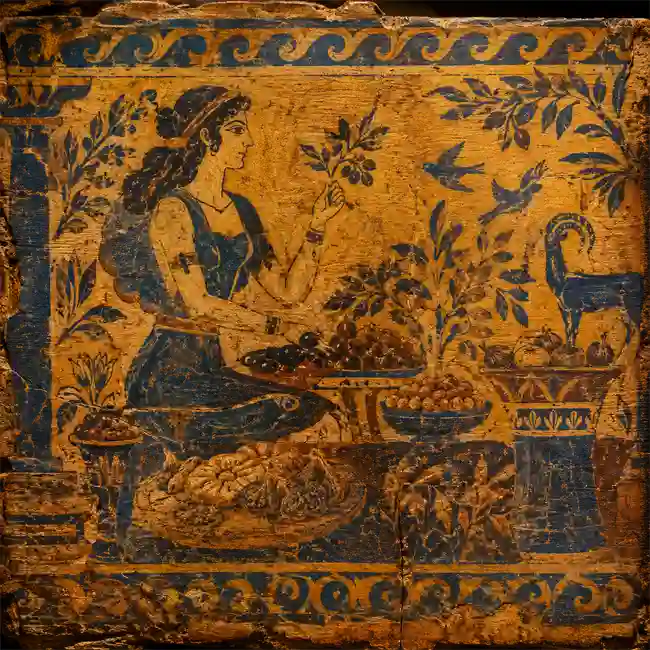
🐙📜 The Storyteller’s Intro: 5,000 Years of Ancestral Flavors
Long before the familiar cuisines of modern Greece took shape, the island of Crete was already home to a sophisticated Bronze Age civilization.
Today we call them the Minoans, a name given by archaeologist Sir Arthur Evans after the legendary King Minos. Their civilization flourished on Crete for many centuries, leaving behind palaces, pottery, frescoes, storage jars, writing tablets, agricultural remains and cooking vessels that allow archaeologists to reconstruct fragments of everyday life.
And food is one of the most fascinating fragments.
The story of Minoan food stretches back much further than the famous palace period. Archaeological evidence shows human occupation at Knossos extending thousands of years before the great Bronze Age palaces. The broader Minoan civilization is generally placed within the Bronze Age, approximately 3000–1100 BCE, while the major palace centers emerged during the second millennium BCE.
For convenience, Minoan history is commonly discussed through three broad chronological phases:
✦ Early Minoan Period — roughly the third millennium BCE, when communities, farming systems and craft traditions developed across Crete.
✦ Middle Minoan Period — particularly important from around 1900 BCE, when major palace centers such as Knossos, Phaistos, Malia and Zakros became powerful economic and ceremonial hubs.
✦ Late Minoan Period — the later Bronze Age, when Crete experienced increasing connections with the Mycenaean world and eventually underwent major cultural and political changes.
The palace era is especially important for understanding food. The great centers were not simply magnificent buildings. They appear to have been places where agricultural products were collected, stored, redistributed and administered. Large storage jars, known as pithoi, were used for commodities such as grain and olive oil.
But there is another side to this story.
Not everything on the Minoan table came from a palace storeroom.
Some foods came directly from the landscape.
Wild plants, cereals, pulses, fruits, nuts, olives and other botanical resources formed part of the wider food economy of prehistoric Crete. Archaeobotanical studies have identified remains including barley, wheat, lentils, peas, chickpeas, broad beans, olives, grapes, figs and almonds at different Minoan sites.
This is where our idea of “Wild Earth Sweets & Foraged Bites” begins.
Imagine walking across Bronze Age Crete.
There are no supermarkets. No modern pastry shops. No packaged sugar. No printed cookbook waiting on a kitchen shelf.
Instead, a cook looks toward the fields, olive groves, hillsides and gardens.
A handful of grain.
A few dried fruits.
Nuts.
Wild greens.
Olive oil.
And perhaps the most precious natural sweetener available — honey.
Honey is particularly interesting because Linear B records from Knossos and Khania mention honey, including quantities associated with offerings, while residue evidence from Late Minoan vessels at Khania has also been interpreted as evidence for honey being used in cooking, eating and possibly ritual activity.
That gives us a tantalizing glimpse into a world where sweetness could be precious, natural and deeply connected to landscape and ceremony.
📜 Iconic Excavated Menus: Archaeological Flavors of Minoan Crete
One important distinction should be made before we enter the ancient kitchen.
Archaeologists have recovered food remains, plant remains, cooking vessels, storage vessels and administrative records, but we do not possess a surviving Minoan cookbook containing complete recipes with ingredient quantities and cooking instructions.
So the names below are modern descriptive reconstructions inspired by archaeological evidence, rather than claimed original Minoan menu titles.
That distinction matters.
It allows us to enjoy the culinary imagination of the ancient world without turning archaeological evidence into something it cannot prove.
🍯 Honeyed Grain Bites
Archaeological inspiration: cereals + honey
Cereals were fundamental to Minoan food systems. Research at Knossos-Gypsades has identified evidence suggesting cereals were stored after dehusking and later cooked together with other plants.
Honey provides the intriguing sweet component.
A modern reconstruction might imagine cooked or ground cereal transformed into small hand-shaped bites and lightly sweetened with honey.
There is no surviving Minoan recipe proving that this exact confection existed.
But the combination of grain and honey is archaeologically plausible within the food environment of Bronze Age Crete.
🌾 Wild-Grain Hearth Cakes
Archaeological inspiration: cereals + grinding + cooking
The humble grain was anything but boring.
Grinding stones and food-processing evidence reveal the importance of cereal preparation, while cooking-vessel research at Minoan sites helps archaeologists investigate how plant foods were actually prepared.
A reconstructed hearth cake might therefore use coarsely ground grain, water and perhaps a little olive oil before being shaped and cooked directly over a heated surface.
Think rustic rather than delicate.
This would be food designed for hands, hearth and hunger.
🍇 Sun-Dried Fruit & Nut Bites
Archaeological inspiration: grapes + figs + almonds
Fruit and nuts appear repeatedly in archaeobotanical research on prehistoric Crete.
Evidence from Minoan contexts includes figs, grapes, almonds and olives, although their quantities and contexts vary between archaeological sites.
A reconstructed bite could combine dried fruit with crushed almonds, producing something naturally sweet and energy-dense.
It would have required no refined sugar.
Just the concentrated sweetness of fruit and the richness of nuts.
🌰 Almond & Honey Palace Bites
Archaeological inspiration: almonds + honey
Almonds are particularly interesting because recent archaeobotanical work at Minoan Mochlos found them in significant quantities in some contexts.
That makes almonds a compelling ingredient for a reconstructed Minoan sweet.
Imagine toasted or crushed almonds bound together with a small amount of honey.
Simple.
Dense.
A little sticky.
And remarkably luxurious for a Bronze Age ingredient combination.
🌿 Wild-Green Olive Oil Bites
Archaeological inspiration: edible plants + olive oil
The phrase “foraged bites” is especially appropriate for Crete because wild plants form an important part of the island's broader food tradition.
Modern ethnobotanical research shows the continuing importance of wild Cretan greens, which may be eaten fresh, boiled or cooked. This modern tradition cannot automatically be projected backward unchanged into the Minoan period, but it provides useful cultural context for understanding the island's long relationship with edible wild vegetation.
Archaeological research at Knossos-Gypsades has also detected plant remains associated with cooking activities.
The ancient version may therefore have been far more rustic than today's polished Cretan dishes.
🗺️ From Palace Storerooms to Hillside Foraging: Eating and Living in Minoan Crete
To understand Minoan food, it helps to leave the palace behind.
Crete is an island of mountains, valleys, fertile plains and coastal landscapes.
That geography shaped food.
The famous palace centers included Knossos, Malia, Phaistos and Zakros, distributed across different parts of the island. Their locations connected agricultural production, settlements, trade routes and maritime networks.
At Knossos, enormous pithoi were used for storage.
These vessels could hold commodities such as grain and olive oil, giving us a visual sense of the scale at which food resources were managed.
But daily eating was not necessarily “palace food.”
Archaeological research at Gypsades indicates that cereals and pulses were being stored and processed in domestic contexts, demonstrating that food preparation belonged to ordinary household life as well as larger economic systems.
This creates an interesting contrast.
The Minoan world had monumental architecture and elite spaces, yet much of its food story is incredibly practical:
store it → grind it → cook it → eat it.
That is the ancient kitchen in its simplest form.
And then there was the landscape.
The hills supplied wild plants.
The fields supplied cereals and pulses.
The olive groves supplied olives and oil.
The vines supplied grapes.
Trees supplied almonds and other fruits.
Bees supplied honey.
Food was therefore closely connected to seasonality and place.
🚣 The Maritime Food Network of Bronze Age Crete
Crete was never an isolated island.
During the second millennium BCE, Minoan Crete participated in active trade networks across the Mediterranean. Archaeological evidence points to exchanges involving materials, agricultural products and luxury goods.
The sea was therefore more than scenery.
It was a highway.
From coastal settlements, ships could connect Crete with other Aegean and eastern Mediterranean communities.
This maritime environment helps explain why Minoan material culture contains such strong visual references to the natural world.
Octopuses, marine creatures and other sea imagery appear prominently in Minoan art and pottery. The famous Knossos storage jar in the Ashmolean Museum, for example, features an octopus and dates to approximately 1450–1400 BCE.
For food history, the sea also mattered.
Archaeological research suggests Minoan diets included a mixture of plant and animal-derived foods, with the exact composition varying by place, period and social setting. Studies of cooking vessels from Malia and Sissi have identified evidence for animal-derived products alongside plant-based foods.
So the Minoan table should not be imagined as exclusively vegetarian or exclusively meat-based.
It was diverse.
And highly regional.
🏜️ Beyond the Desert: The Minoan Landscape Was Different
A desert-and-oasis foodway does not accurately describe Minoan Crete.
This is an island Mediterranean civilization rather than a desert civilization.
Instead of searching for an oasis, the more appropriate journey is through:
• Mountain foothills
• Fertile plains
• Olive-growing landscapes
• Coastal settlements
• Vine-growing areas
• Woodland and scrub
• Springs and cultivated gardens
The Mesara Plain is particularly important when considering Minoan agriculture.
Recent archaeological research at Koumasa, situated around the margins of the Mesara plain and the Asterousia Mountains, is using archaeobotanical evidence to reconstruct how people obtained, transformed and consumed plant foods between approximately 1950 and 1450 BCE.
This landscape perspective changes how we think about “ancient sweets.”
A Minoan sweet was not necessarily something produced inside an elaborate pastry kitchen.
It might have begun outside:
a tree → a field → a hillside → a beehive → a grinding stone → a cooking vessel → the table.
That chain is the real ancient recipe.
🐂❓ Ancient Civilization FAQ: Unlocking Palace Kitchen Mysteries
Q1.Did the Minoans really have ancient desserts?
Probably some forms of naturally sweetened food existed, but we should be careful with the modern word “dessert.”
There is no surviving Minoan cookbook establishing a standardized dessert course comparable to modern cuisine.
However, archaeological evidence for honey, fruits, cereals and nuts creates a strong foundation for reconstructing sweet food combinations. Honey is especially well documented through Linear B records and residue research.
Q2.What did Minoans use instead of modern sugar?
Honey would have been an important natural sweetener.
There is direct textual evidence for honey in Linear B records from Crete, including quantities associated with offerings. Archaeological residue research also supports its use in food-related contexts.
Fruits such as figs and grapes could also contribute natural sweetness.
So a reconstructed Minoan sweet does not need modern refined sugar to feel convincing.
Q3.Did Minoans eat wild plants?
Archaeological research demonstrates that plant resources were an important part of Minoan food systems.
At Knossos-Gypsades, microbotanical evidence from cooking vessels provides information about cereals and other plants used during food preparation. Recent research from Mochlos likewise identifies cereals and numerous pulses in Minoan contexts.
However, not every wild plant eaten by modern Cretans can automatically be identified as a Minoan food.
That is why responsible reconstruction separates archaeological evidence from modern culinary interpretation.
Q4.Were Minoan palace foods different from ordinary household foods?
There are indications that food practices varied according to context, building and access to resources.
Recent archaeobotanical work at Mochlos, for example, identifies differences between areas of the settlement and suggests that agricultural resources could have had different everyday, economic or ritual roles.
Meanwhile, evidence from Knossos-Gypsades demonstrates food preparation in a domestic neighborhood near the palace.
The palace and household therefore belonged to the same food system, but they should not automatically be treated as identical kitchens.
🧠 Final Thoughts: The Timeless Allure of Antique Gastronomy
There is something wonderfully mysterious about Minoan food.
We can see the storage jars.
We can study the seeds.
We can examine the cooking vessels.
We can read fragments of administrative records.
We can identify cereals, pulses, olives, grapes, figs and almonds.
We can even find evidence that honey was important enough to appear in administrative and ritual records.
Yet the final recipe often remains just out of reach.
That is precisely what makes Minoan Crete: Wild Earth Sweets & Foraged Bites so fascinating.
The ancient kitchen leaves clues rather than complete instructions.
A charred seed becomes a clue.
A fragment of pottery becomes a clue.
A storage jar becomes a clue.
A Linear B tablet becomes a clue.
A residue inside an ancient vessel becomes another.
Together, they allow modern researchers to reconstruct fragments of a culinary world that disappeared thousands of years ago.
But the mystery remains.
What did a honey-sweetened Minoan bite actually taste like?
How coarse was the grain?
Which wild plants were gathered for a particular meal?
Were certain sweet foods reserved for ceremonies?
Did palace cooks have specialized recipes that never survived?
We can investigate.
We can reconstruct.
But we should always leave a little room for the unknown.
And perhaps that is the most delicious part of ancient gastronomy.
The recipe is lost — but the archaeological clues are still waiting to be unlocked.
The next step is to move from the archaeological landscape into the ancient kitchen itself, where reconstructed ingredients, ratios and cooking techniques can bring these forgotten flavors closer to the modern table.
🏛️ Credit to the Keepers of the Culture (The Legacy)
The story of Minoan cuisine belongs first to the people of ancient Crete whose agricultural practices, craft traditions and foodways created this remarkable cultural legacy.
Modern archaeological research continues that work by carefully studying material evidence rather than inventing certainty where none exists.
Institutions such as the Ashmolean Museum, the Metropolitan Museum of Art, the University of Oxford's School of Archaeology, and archaeological research teams working across Crete have helped preserve, document and interpret evidence from Minoan settlements.
Recent archaeobotanical studies at places such as Mochlos, Koumasa, Malia, Sissi and Knossos-Gypsades are particularly valuable because they move the discussion beyond spectacular palaces and toward the everyday realities of food preparation, agriculture and consumption.
Their work reminds us of an important principle when exploring ancient food:
Respect the evidence. Respect the culture. And let the mystery remain part of the story.
The Minoan kitchen may have vanished 3,000–5,000 years ago, but its ingredients still whisper through the archaeological record.
And the next chapter is where those whispers become recipes.
🏛️🍯 Unearthing Bronze Age Flavors: How to Make a 5,000-Year-Old Minoan Honey Sweet at Home
👉 Taste Minoan Crete: Wild Earth Sweets & Foraged Bites
| 🌐 🏛️🍯 < Back | 🏟️ 🍲 < Previous | Next > 🧪 🏟️ |