
🏠 Home > 🗺️ Recipes > 🔥🧉 Primal Foraged Nectars (Raw Herbal Infusions) > 🐉 Nihewan Basin & Zhoukoudian: Primal Foraged Nectars (Raw Herbal Infusions) Recipes > 🔥🧉 1.Dragon Bone Hill Ember-Toasted Walnut & Hackberry Hearth Tea
🔥🧉 Peking Man's Hearth Brew: Recreating the Wild Walnut Tea of Dragon Bone Hill
Published by Supakorn | Updated: November 2026
Picture a limestone hill about 50 kilometers southwest of modern Beijing. Today there are tour groups, a museum and a parking lot. Rewind roughly half a million years and the same place was a cave system full of hyenas, wild horses, deer and a population of Homo erectus that scientists later named "Peking Man."
The locals call the site Longgushan, which means Dragon Bone Hill. For generations, villagers dug up "dragon bones" there and sold them as traditional medicine. Those bones turned out to be fossils, and some of them belonged to our distant relatives.
In this post we're making a cozy, earthy, slightly sweet wild walnut tea inspired by the plants and fire stories of Zhoukoudian. To be clear from the start: nobody has found a 500,000-year-old teacup. This is a reconstruction. It's a "what if" brew built from foods that grew around the site, prepared with methods early humans could plausibly have used. It's still a delicious way to taste a little deep history in your own kitchen.
🦴 Prehistoric Ancestral Palate: The Lower Paleolithic (approx. 2.5 million – 300,000 years ago)
🐉 The Dawn of Fire & Stone: 300,000 - 2,500,000 Years of Early Hominid Survival
Close your eyes for a second. A cold wind moves down the valley and whistles through cracks in the limestone. Somewhere deeper in the cave, sharp clicks bounce off the rock walls as someone strikes one stone against another to knock off a fresh cutting edge.
That sound was the soundtrack of the Lower Paleolithic, the longest chapter of the human story. For more than two million years our ancestors lived by the same basic rules: find food, avoid becoming food, and keep the group together.
In Africa and western Eurasia, this period is famous for the teardrop-shaped Acheulean handaxe, the Swiss Army knife of the ancient world. At Zhoukoudian, the toolkit looked a bit different. It was mostly quartz flakes, choppers and scrapers, which were simpler but no less useful. They cut hides, scraped meat off bones, cracked marrow, and almost certainly cracked nuts too.
Life outside that cave was rough. Peking Man shared northern China with giant hyenas, saber-toothed cats, wild boar, rhinos and huge deer with antlers like tree branches. Every meal was earned. Nothing was wasted, and survival depended on knowing the land better than anything else living on it.
🌿 The Primordial Genesis of Human Sustenance
Why does any of this matter for a cup of tea? Because the story of human food is really the story of the human brain.
Homo erectus had a much bigger brain than earlier hominins, and brains are hungry. Your brain makes up about 2 percent of your body weight but uses around a fifth of your energy. To fuel that, our ancestors needed dense, rich foods like fat, marrow, meat, nuts and starchy roots.
Nuts fit the bill. They're packed with fats and protein, they keep for months, and they don't run away. If you could crack them, you had a portable energy bar long before anyone thought of wrapping one in foil.
Then there's fire. Researchers still debate exactly how early Peking Man controlled fire. Some layers at Zhoukoudian contain burned bones and ash-like deposits, while other scientists argue that some of these traces formed naturally. What isn't in doubt is that across the Lower Paleolithic, fire slowly turned from a terrifying force into a tool. A flame that pushed back the dark, kept predators away and turned tough, bitter food into something softer and sweeter changed everything.
♨️ The Lower Paleolithic Culinary Awakening
Strip away pots, pans, ovens and spice racks. What's left? It turns out you can still do a lot.
Early hunter-gatherer cooking was all about direct contact. Meat was laid on hot coals, roots were buried in warm ash, and bones were cracked with a hammerstone to get at the creamy marrow inside. Seeds and nuts could be toasted on a flat rock at the edge of the fire until they smelled amazing.
Some of the oldest cooking stories in the world are sealed under layers of sediment, ash and fossilized bone. They don't come with written instructions, but they leave clues: scorch marks, cut marks, smashed long bones, and seeds tucked into cave deposits. Our job is to read those clues like detectives and turn them into something you can actually make on a Tuesday night.
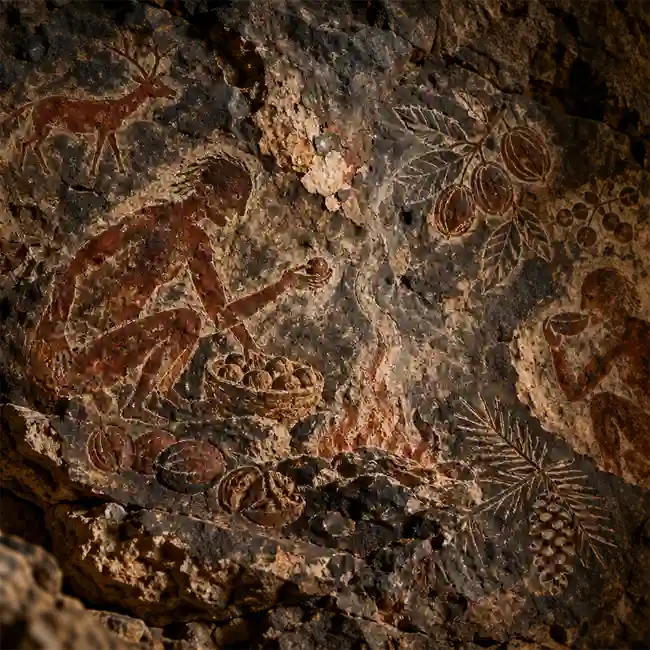
🍵 Recipe: Dragon Bone Hill Ember-Toasted Walnut & Hackberry Hearth Tea
🕯️ Whispers from the Ancient Cave Wall
Here's the detail that inspired this recipe. When archaeologists excavated Locality 1 at Zhoukoudian in the 1920s and 1930s, they found large numbers of hackberry seeds (Celtis) mixed into the cave layers. Hackberries are small, sweet, date-like fruits that grow on trees across northern China. Many researchers think the people living in the cave were gathering and eating them, although that interpretation is still discussed.
The surrounding hills were also home to nut-bearing trees. The Manchurian walnut (Juglans mandshurica) grows wild across northeastern China today, and its close relatives have deep roots in the region. Pines and hazels were part of that ancient landscape too.
Add the evidence of burned animal bones and stone tools covered in cut marks, and you start to picture a scene. A small group sits close together near the mouth of a cave. A fire crackles. Someone cracks walnuts on a stone anvil while someone else passes around a handful of dried hackberries. Bones from yesterday's hunt are being split for marrow.
Did they brew anything? Honestly, we don't know. Early humans had no pottery, but some researchers believe later hunter-gatherers heated liquids by dropping hot stones into hide or bark containers, a technique called stone boiling. Our tea borrows that idea and combines it with the flavors Dragon Bone Hill really did offer: toasted nuts, sweet wild fruit, woody roots and smoke.
🌰 Wild Savannah Treasures & The Hominid Larder
🍂 The Primitive Staples
The ancient larder at Zhoukoudian was seasonal, wild and full of contrast:
• Big game and deer: These provided lean meat and, more importantly, fatty marrow cracked out of long bones with a hammerstone.
• Bone marrow: It was the "butter" of the Stone Age. It's rich and creamy, and it was probably highly prized.
• Wild walnuts and hazelnuts: They were hard to crack, deeply nutritious, and easy to store through cold months.
• Hackberries: These small, dry-sweet fruits taste a bit like dates and were one of the few natural sweet treats available.
• Wild roots and tubers: These were roasted in hot ash until soft, adding earthy starch and gentle sweetness.
• Wood smoke: It isn't an ingredient you eat, but it was in every bite and every breath.
🛒 Modern Kitchen Substitutes
Here's how to build the same flavor profile from a normal grocery store. This makes about 4 cups.
• Raw walnut halves: 1 cup (about 100 g), standing in for wild Manchurian walnuts
• Dried hackberries or dried jujubes (red dates): 6 to 8 pieces, pitted and torn. Dried dates or figs also work.
• Roasted chicory root or dried burdock root: 1 tablespoon, for the earthy, slightly bitter "wild root" note
• Dried walnut leaves (optional): 1 teaspoon, if you can buy them from a reliable herbal supplier
• Raw honey (optional): 1 to 2 teaspoons, a nod to the wild honey early humans may have raided
• Beef marrow fat, grass-fed butter or ghee (optional "hunter's version"): 1 teaspoon per cup, which gives a rich, savory, silky finish
• Filtered water: 5 cups (about 1.2 liters)
• Flaky sea salt: a tiny pinch, to bring out the nutty sweetness
⚖️ Paleolithic Proportions
If you want to scale up or down, think in simple "parts":
• Walnuts: 4 parts
• Dried hackberries or jujubes: 2 parts
• Roasted root (chicory or burdock): 1 part
• Walnut leaves (optional): half a part
• Water: about 20 parts by volume
• Honey: to taste, starting with the smallest amount
• Marrow fat or butter: a small dot per cup, never more than a teaspoon
🪓 The Handaxe Culinary Ritual
✨ Step 1: Wake the fire. If you're cooking outdoors, build a small hardwood fire and let it burn down to glowing coals. That takes about 30 to 40 minutes. Indoors, preheat a heavy cast-iron skillet over medium heat. Cast iron is the closest thing to a flat hearth stone most of us have.
✨ Step 2: Toast the walnuts like a cave dweller. Spread the walnuts in a single layer on the hot skillet, or on a clean flat stone set beside the coals. Toast them for 4 to 6 minutes, shaking or turning them often. You want deep golden color and a toasty, buttery smell. Pull them the second they start to darken because walnuts go from perfect to bitter fast.
✨ Step 3: Crack and crush. Let the walnuts cool for a minute, then crush them roughly. A mortar and pestle is great for this. A clean, smooth river stone on a cutting board is even more fun. You're not making flour, just breaking them into chunky pieces to release their oils.
✨ Step 4: Ember-kiss the fruit. Toss the torn hackberries or jujubes into the skillet for about 1 minute, just until they puff slightly and smell like caramel. This deepens their natural sweetness.
✨ Step 5: The stone-boil steep. Bring the water to a gentle simmer in a heavy pot. Add the crushed walnuts, fruit and roasted root. Lower the heat and let everything simmer very softly for 15 to 20 minutes. If you're using walnut leaves, add them for only the last 5 minutes so the tea doesn't turn too tannic.
Want the full ancestral experience? Outdoors, you can heat a few smooth, dense, completely dry stones (granite works well) in the coals, then lift them with tongs into a cast-iron pot of water to bring it to a simmer. Never use stones from a riverbed or anything wet or porous, since trapped moisture can make them crack or burst.
✨ Step 6: Rest and strain. Turn off the heat and let the brew sit, covered, for 5 minutes. Strain it through a fine sieve or cheesecloth, pressing gently on the solids to extract all that nutty goodness.
✨ Step 7: Finish around the fire. Pour the tea into mugs. Stir in honey if you like, add a tiny pinch of flaky salt, and for the hunter's version drop in a small dot of marrow fat or butter. Watch it melt into golden rings on the surface. Sip slowly, preferably with good people nearby.
Flavor check: Expect a toasty, nutty, gently sweet tea with a woody backbone and a hint of smoke. The butter version tastes almost like a savory latte.
🔥 Secrets of the Primordial Hearth
◦ Use hardwood, not softwood. Oak, hickory, maple, fruitwood and beech burn hotter, cleaner and longer. Resinous pine gives off sooty, bitter smoke that can ruin your toasting.
◦ Coals, not flames. Real ancient cooks worked over embers, not roaring fire. Flames scorch the outside and leave the inside raw.
◦ Watch the walnuts like a hawk. Over-toasted walnuts turn harsh and bitter fast. Stop at golden brown with a strong nutty smell.
◦ Don't boil hard. A rolling boil pulls out too many tannins and makes the tea astringent. Keep it at a lazy simmer.
◦ Keep the fat small. Marrow fat and butter add body, but too much makes the tea greasy. One teaspoon per cup is plenty.
◦ Save the solids. The steeped walnut and fruit pulp is great stirred into oatmeal, yogurt or a morning porridge. Early humans wasted nothing, and neither should we.
◦ Mistake to avoid: wet stones. Never heat river rocks or any stone that might hold water inside. They can split violently.
◦ Mistake to avoid: random foraging. Only use wild plants if you're 100 percent sure of the identification and the land is clean and legal to harvest. When in doubt, buy from a trusted supplier.
◦ Mistake to avoid: green walnut hulls. The fresh green husks of walnuts are very astringent and stain everything. Stick to the shelled nuts and properly dried leaves.
◦ Safety first: This tea contains tree nuts, so skip it if you have a nut allergy. If you're pregnant, nursing or on medication, check with a health professional before using herbal leaves or roots.
🐲❓ Lower Paleolithic Wisdom & Secrets FAQ
Q1: Did Peking Man really drink walnut tea?
There's no direct evidence of brewed drinks at Zhoukoudian. Early humans had no pottery, and liquids don't fossilize. This recipe is an inspired reconstruction built from foods that grew around the site, like hackberries and nut trees, and from cooking methods like ember toasting and stone heating. Think of it as edible archaeology rather than a historical record.
Q2: Why was bone marrow such a big deal for early humans?
Marrow is extremely calorie-dense and rich in fat, which growing brains and hard-working bodies needed. Smashed long bones with stone tool marks show up at many Lower Paleolithic sites, which suggests our ancestors deliberately went after marrow. In this recipe, a small spoonful of marrow fat or butter gives a nod to that tradition and makes the tea rich and satisfying.
Q3: Is it safe to forage wild walnuts, hackberries or roots?
Many are edible, but correct identification is everything. Several plants have toxic look-alikes, and roadside or polluted areas can contaminate wild food. Unless you're an experienced forager working with a local expert, buy walnuts, dried fruit and roasted roots from reliable shops. You'll get the same flavor with none of the risk.
Q4: How did early humans enjoy sweetness without sugar?
Their sweetness came from nature: ripe wild fruits like hackberries, honey raided from wild hives, and starchy roots that turned sweeter after roasting in hot ash. Toasting nuts and fruit, as we do in this recipe, brings out natural sugars through caramelization and gives a gentle, honest sweetness that sugar can't quite copy.
🌄 The Untamed Soul of Primeval Flavor
There's something wild about a drink like this. No flavor syrups, no powders, no ingredient list you can't pronounce. Just nuts, fruit, roots, water and fire, the same basic elements our ancestors worked with for hundreds of thousands of years.
The taste is bold but honest. You get smoky toast from the walnuts, deep caramel from the fruit, an earthy edge from the roots, and silky richness if you add a dot of fat. It doesn't try to impress you. It just feels grounding, like sitting with your back against cool stone while a fire warms your face.
Every sip connects you, even if only in imagination, to the people of Dragon Bone Hill who stared into the same kind of flame and figured out how to survive one more winter.
🏕️ Final Thoughts: Unleashing the Lower Paleolithic Heritage in Your Modern Kitchen
You don't need a cave, a hammerstone or a hide container to taste the past. A heavy skillet, a pot of water and a handful of real ingredients are enough to turn your kitchen into a small ancestral hearth.
Next time it's cold outside, try this. Turn the lights down, toast your walnuts slowly, and let the smell fill the room. Crush them by hand. Watch the brew turn deep amber. Share it with someone and tell them the story of Dragon Bone Hill, the fossils sold as medicine, and the early humans who sat by the fire half a million years ago.
Food was humanity's first story, and fire was the first storyteller. Bringing those two together at home is one of the simplest ways to reconnect with where we came from.
🛡️ The Sacred Tribe (Claim Your Lower Paleolithic Heritage)
If you're into Paleo, ancestral eating, primal cooking or just love a good story with your food, you're already part of the tribe.
We're digging through the deep past, from Dragon Bone Hill to ancient African riverbanks to the ice-age plains of Europe, to bring back primitive cooking secrets and early human recipes you can actually make at home. They're grounded in real archaeology and adapted for real modern kitchens.
So make this tea, light your own little hearth, and tell us how it went. Did you try the hunter's version with marrow fat? Did you stone-boil it outdoors? Share your experience and pass this recipe to a fellow ancestral food lover. Every tribe grows one fire at a time. 🔥
🙏 Credit to the Keepers of the Lower Paleolithic Legacy
This recipe is inspired by the Lower Paleolithic story of our earliest ancestors, roughly 2.5 million to 300,000 years ago, and especially by the fossil-rich cave deposits of Zhoukoudian, home of Peking Man. Our work draws on archaeological discoveries of burned bones, stone tool assemblages, preserved hackberry seeds and ancient hearth evidence, along with the many researchers who have spent lifetimes interpreting them.
We have carefully reimagined these wild, primordial flavors for the modern kitchen. Every step aims to honor the resourcefulness, resilience and quiet genius of the hunter-gatherers who learned to read the land, tame the flame and share food together long before history was written.
| 🐉 🔥🧉 < Back |