
🏠 Home > 🗺️ Recipes > 🍞 Breads > 🇵🇬 Papua New Guinea Breads
🇵🇬 🍞 Papua New Guinea Breads Recipes
Published by Supakorn | Updated: February 2026
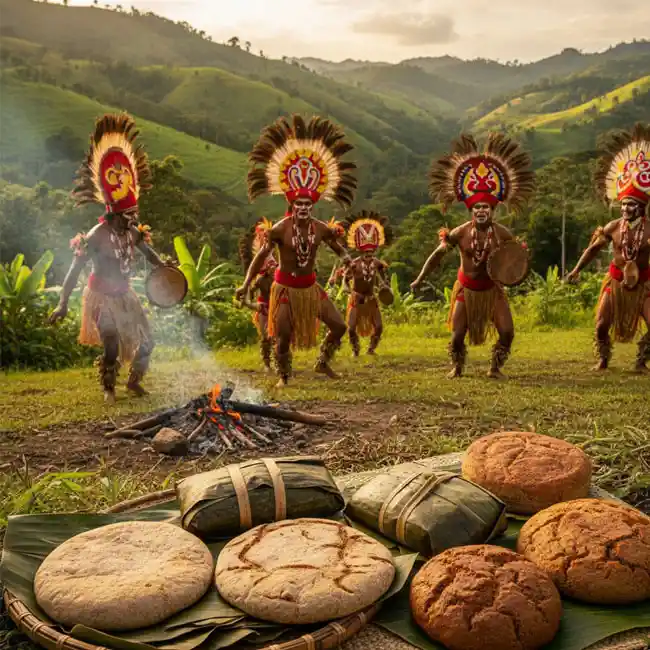
Hello, my fellow carb-lover! If you’ve spent your life thinking that "bread" only comes from wheat, flour, and a yeast packet, you are in for a serious awakening. Today, we are traveling to the magnificent shores and misty valleys of Papua New Guinea (PNG) to explore their fascinating take on bread.
In the Western world, bread is often something you buy in a plastic bag at the store. But in Papua New Guinea, "bread" is an ancient art form. It’s a creative solution to a beautiful challenge: how do you make a satisfying, doughy staple when traditional wheat doesn't grow in your tropical backyard? The answer lies in the trees, the roots, and the coconuts.
Buckle up, because we’re about to explore the most unique bakery on the planet—the "Garden of PNG."
🥥 Beyond the Wheat: What Makes PNG "Bread" Unique?
In Papua New Guinea, the concept of bread is deeply tied to the land. Since large-scale wheat farming isn't native to the region, the local people have spent thousands of years perfecting "bread-like" staples using what is naturally available.
🌴 The Sago Revolution
For many coastal and river-dwelling communities, the Sago Palm is the "Wheat of the Pacific." Instead of grinding grain, locals extract starch from the trunk of the palm tree. This white, powdery starch is the base for almost all traditional PNG doughs. It’s naturally gluten-free, incredibly energy-dense, and has a unique texture that can be anywhere from crispy to chewy.
🥔 Root Vegetable "Flours"
When sago isn't the star, root vegetables take the stage. Cassava, taro, and yams are often grated, mashed, or turned into a paste to create a dough-like consistency. These "breads" are much heartier than a typical sourdough; they are dense, filling, and packed with the earthy flavors of the soil.
🥥 Coconut: The Ultimate Fat Source
You won't find much butter or olive oil in traditional PNG bread making. Instead, fresh coconut cream provides the moisture and fat. This gives PNG breads a natural sweetness and a rich, velvety mouthfeel that pairs perfectly with the starchy bases.
🥯 Iconic Papua New Guinea Breads and Dough-Based Treats
While "bread" in PNG might look more like a pancake, a scone, or a steamed parcel, these dishes serve the exact same purpose as a dinner roll or a slice of toast—they are the comforting, starchy heart of the meal.
🥞 1. Sago Pancakes (The Breakfast of Champions)
If you visit a village in the Sepik region, you’ll likely wake up to the smell of Sago Pancakes cooking over an open fire. These are the simplest form of PNG bread. Sago flour is mixed with water (and often grated coconut or mashed bananas) to form a thick batter.
These are cooked on a flat clay plate or a hot stone. They come out slightly crispy on the edges with a wonderful, gummy chewiness in the middle. They are the ultimate "blank canvas"—you can eat them plain, dip them into a savory soup, or top them with fresh tropical fruit.
🥥 2. Coconut Scones (The Colonial Fusion)
As PNG interacted more with outside cultures, "flour bread" began to appear, but with a distinctly local twist. PNG Coconut Scones are a beloved snack found in markets across the country.
These are made using wheat flour but are heavily infused with thick, fresh coconut milk instead of dairy. They are often baked until they have a hard, golden crust and a soft, airy interior. You’ll see people carrying bags of these at bus stops or enjoying them during a mid-morning break. They are the perfect "bridge" between traditional island flavors and Western baking.
🍠 3. Cassava Bread (The Hardy Loaf)
Cassava bread is a staple that really showcases the resourcefulness of PNG cooks. Grated cassava is pressed to remove the juice and then mixed with coconut and sometimes a bit of sugar or salt.
This mixture is often wrapped in banana leaves and steamed or baked. The result is a dense, heavy "bread" that stays fresh for a long time—perfect for hunters or gardeners who need to take a portable, high-energy meal into the bush. It has a nutty, fermented flavor that is incredibly addictive.
🥯 4. Damper (The Fire-Roasted Classic)
Inspired by the Australian Outback but adapted for the PNG bush, Damper is a simple soda bread made by travelers and hikers. In PNG, it’s often cooked directly in the ashes of a campfire or wrapped in leaves and buried under hot coals.
The traditional PNG version might include mashed Kau Kau (Sweet Potato) inside the dough, which keeps the bread moist and adds a beautiful orange hue to the center of the loaf.
🍌 5. Banana Bread (The PNG Way)
While the world loves banana bread, the PNG version is a whole different beast. Forget the cake-like loaves you see in cafes. Traditional PNG banana bread is often made by mixing mashed overripe bananas with sago starch or grated coconut. It’s then wrapped in leaves and steamed. It’s dense, moist, and naturally sweet, functioning more like a heavy energy bread than a light dessert.
🌋 The "Ground Oven": Baking Without an Oven
One of the coolest things about PNG bread culture is the way it’s cooked. You won't find many stainless steel convection ovens in the villages!
🍃 The Banana Leaf Wrap
The banana leaf is the "parchment paper" of Papua New Guinea. Wrapping dough in these leaves protects it from the direct flame, seals in the moisture, and adds a subtle, tea-like fragrance to the bread. It’s an eco-friendly packaging system that has worked for thousands of years.
🔥 Stone Baking
For many breads, hot stones are the key. By placing dough on or under heated volcanic rocks, the bread cooks evenly with a gentle, radiant heat. This gives the "crust" of PNG breads a smoky, rustic character that you simply can't replicate in a modern kitchen.
🥥 The Lifestyle: Bread as a Social Bond
In Papua New Guinea, you don't just "grab a slice" of bread. The act of making and eating these starchy staples is a deeply social activity.
🤝 Sharing the "Sago"
Extracting sago to make bread is a massive job. It involves the men felling the tree and the women washing and filtering the starch. Because it takes so much work, the "bread" produced is always shared. When a batch of sago pancakes is made, the whole "Wantok" (extended family/community) is usually there to enjoy it.
🧺 The Market Culture
If you ever find yourself in a PNG town, the local market is the place to be. You’ll see women sitting behind colorful umbrellas, selling stacks of coconut scones or parcels of cassava bread. Buying these isn't just a transaction; it’s a chance to catch up on local news, share a laugh, and support the local gardeners.
🌾 Why PNG Breads are the Next "Superfood" Trend
In a world obsessed with ancient grains and gluten-free living, the traditional breads of Papua New Guinea are finally getting the recognition they deserve.
1.Naturally Gluten-Free: Sago and Cassava breads are a dream come true for those with celiac disease or gluten intolerance.
2.Low Glycemic Index: Many of these root-based breads provide "slow-release" energy, meaning you don't get the sugar crash associated with white wheat bread.
3.Minimalist Ingredients: Most PNG breads have three ingredients or fewer: a starch, coconut, and water. No preservatives, no stabilizers—just food.
🍞 Bringing a Slice of the Pacific to Your Home
You might not have a sago palm in your backyard, but you can still channel the PNG spirit in your kitchen. Using cassava flour or even adding coconut cream to your regular bread recipes can give you a hint of that island magic.
The real lesson from PNG bread culture isn't just about the recipes; it’s about the appreciation for the source. It’s about realizing that bread can come from a tree, a root, or a fruit, as long as it’s made with care and shared with love.
❓ FAQ: Everything You Want to Know About PNG Breads
Q1: Is sago bread healthy?
Sago is primarily a carbohydrate, meaning it’s a fantastic source of pure energy. While it’s low in protein and vitamins on its own, PNG locals always eat it paired with "Kumu" (greens) and fish, making it part of a perfectly balanced, traditional diet. For an athlete or someone with a busy lifestyle, it's a great "fuel" bread.
Q2: Does PNG bread taste like Western bread?
Not exactly! If you’re expecting a salty, yeasty sourdough, you’ll be surprised. PNG breads are usually denser, moister, and have a more "earthy" or "nutty" flavor profile. The texture is often the biggest difference—traditional PNG breads are often pleasantly chewy rather than light and crumbly.
Q3: Can I store these breads for a long time?
Traditional breads like steamed cassava or sago parcels are designed to be quite shelf-stable. Wrapped in their original leaves, they can stay fresh for a couple of days even in the tropical heat. However, like any natural food without preservatives, they are always best enjoyed fresh off the fire!
I hope this has opened your eyes to the incredible, starch-filled world of Papua New Guinea! It’s a place where every "loaf" tells a story of the forest and the community.
🍞 The Warmth of the Pacific: Authentic Homemade Breads from Papua New Guinea
👉 Enjoy 3 Specialty Papua New Guinea Breads
| 🌐 🍞 < Back | 🇵🇬 🥗 < Previous | Next > 🍱 🇵🇬 |