
🏠 Home > 🗺️ Recipes > 🏛️🍲 Clay-Pot Broths & Stews > 🏯 Sanxingdui: Clay-Pot Broths & Stews Recipes > 🏛️🍲 1.Sanxingdui Ginseng Pot Broth
🏛️🍲 Rediscovering the Sacred Ginseng Broths of Sanxingdui
Published by Supakorn | Updated: September 2026
There are meals, and then there are meals that carry the weight of thousands of years on their spoons. The ginseng pot broth of Sanxingdui belongs firmly to the second category. If you've ever wondered what it might taste like to sip from the same kind of pot that fed a forgotten Bronze Age civilization, keep reading — this one's for you.
🏯🏺 Ancient Civilization Origins: Sanxingdui, China
📜 The Storyteller's Intro: 5,000 Years of Ancestral Flavors
Picture the Sichuan Basin long before it appeared on any modern map. Mist rolling off distant peaks, rivers cutting silver lines through dense green valleys, and somewhere in the middle of it all, a mysterious Bronze Age culture quietly building one of the most enigmatic civilizations archaeologists have ever unearthed. This was Sanxingdui — a site so unusual, with masks so otherworldly and bronze trees so intricate, that researchers still debate exactly how its people lived, worshipped, and, yes, cooked.
Buried alongside ceremonial bronzes and jade artifacts, traces of cooking vessels and organic residue hint at something remarkable: a broth-making tradition built around roots, herbs, and slow, patient simmering. It's from these fragments of pottery and scorched hearth-stones that the story of the Sanxingdui ginseng pot broth begins — part historical inference, part culinary folklore, and entirely delicious.
🌏 The Global Value of Antique Heritage
Ancient recipes like this one aren't just curiosities for historians. They're a bridge. Every civilization that has ever existed left behind clues about how they nourished themselves, and those clues tell us as much about their values as their temples or their tools. A slow-simmered broth wasn't just dinner — it was medicine, ritual, and community wrapped into a single clay pot.
When we talk about "antique heritage" in the culinary sense, we're really talking about preserved wisdom. Long before packaged bouillon cubes and instant soup mixes, people understood that time, patience, and the right combination of roots and bones could produce something nourishing enough to sustain a family through a hard season. That kind of knowledge has global value — it belongs to anyone curious enough to bring it back into their kitchen.
🔥 The Culinary Resurrection
What makes this project exciting isn't just historical accuracy — it's resurrection. Taking fragments of what we know about ancient Sichuan foodways and translating them into something you can actually cook tonight, in your own kitchen, with ingredients from your local grocery store. This isn't a museum exhibit behind glass. It's a living recipe, meant to simmer, to fill your home with steam and aroma, and to be shared around a table the same way it may have been thousands of years ago.
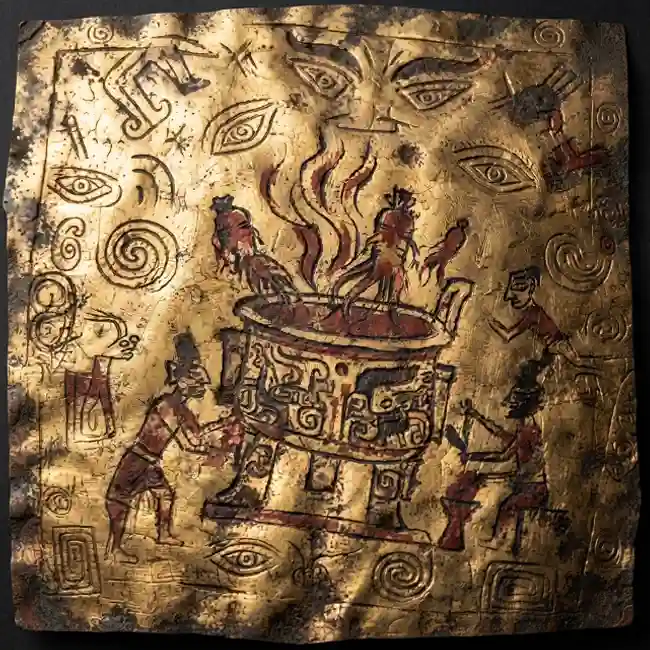
🍲 Recipe: Sanxingdui Ginseng Pot Broth
🐉 Legends Behind This Excavated Secret
Local legend — passed down through generations of Sichuan folk cooks long after Sanxingdui itself faded into myth — tells of a broth reserved for moments of transition: harvest festivals, the changing of seasons, and gatherings meant to honor ancestors. Ginseng, prized even in ancient times for its deep, earthy character, was said to be the root that connected the drinker to the strength of the mountains themselves.
Whether or not every detail of the legend survived intact through the centuries, one thing is certain: the combination of ginseng, slow-simmered broth, and warming aromatics has stood the test of time for a reason. It simply works.
🌿 Ingredients & The Noble Pantry
✦ The Ancestral Staples
Long before refrigeration or grocery stores, ancient cooks relied on what grew nearby and what could be dried, stored, and rehydrated through the colder months. Roots like ginseng, wild mushrooms, and mountain herbs would have been dried in the sun, strung from rafters, and pulled down for special broths exactly like this one. Bones — often from foraged or farmed game — were simmered for hours, sometimes days, to coax out every bit of flavor and nourishment.
✦ Modern Substitutes
You don't need to forage a mountainside to make this broth today. Here's what works beautifully in a modern kitchen:
• Fresh or dried ginseng root (found at most Asian grocery stores or herbal shops) in place of foraged wild ginseng
• Chicken thighs or a whole chicken carcass as an accessible stand-in for ancient game bones
• Shiitake or wood ear mushrooms instead of foraged mountain mushrooms
• Goji berries for a touch of natural sweetness and color, similar to dried ancient fruits
• Fresh ginger and scallion as aromatic staples
• Chinese red dates (jujubes) to round out the broth's natural sweetness
• Filtered water in place of mountain spring water
✦ Ancient Proportions
For a pot that serves 4 to 6 people:
◦ 1 whole chicken (about 1.5 kilograms) or 1 kilogram of chicken thighs and bones
◦ 20 grams dried ginseng root, sliced (roughly 3 to 4 medium pieces)
◦ 10 grams goji berries (a small handful)
◦ 6 to 8 dried red dates, pitted
◦ 4 slices fresh ginger
◦ 2 scallions, cut into long sections
◦ 8 dried shiitake mushrooms, rehydrated
◦ 2.5 liters filtered water
◦ 1 teaspoon sea salt, adjusted to taste at the end
🕯️ The Chef's Ancient Ritual
1.Prepare the vessel. Rinse your pot thoroughly — in ancient times, this was often a clay vessel set directly into embers. Today, a heavy-bottomed stockpot or clay Chinese sand pot works wonderfully.
2.Cleanse the bones. Blanch the chicken in boiling water for 3 to 5 minutes, then rinse under cold water. This ancient technique removes impurities and results in a clearer, cleaner broth.
3.Build the base. Place the chicken back into the pot along with the ginger and scallion. Cover with the filtered water and bring to a gentle boil.
4.Lower the flame. Once boiling, reduce to the lowest simmer possible. Ancient hearths cooked low and slow for hours, and this step matters more than almost any other.
5.Add the sacred roots. Introduce the sliced ginseng, rehydrated shiitake mushrooms, red dates, and goji berries. Let everything simmer together, uncovered or partially covered, for 2.5 to 3 hours.
6.Season with patience. Only at the very end, once the broth has reduced and deepened in color, add salt to taste. Seasoning too early can mute the layered flavors that develop over the long simmer.
7.Rest before serving. Let the broth sit off the heat for 10 minutes before ladling. This allows the flavors to settle, just as it would have after being pulled from an open hearth.
🪔 Secrets of the Ancestral Hearth
◦ Never let the broth reach a rolling boil after the initial skimming stage — a gentle simmer preserves clarity and delicate flavor
◦ Skim any foam or impurities that rise in the first 20 minutes for a cleaner, more refined broth
◦ Dried ginseng releases more flavor the longer it simmers, so don't rush this step
◦ Adding salt too early can make the broth taste flat once it reduces — always season at the end
◦ If the broth tastes thin, simmer uncovered a little longer rather than adding more water
◦ Letting the broth rest overnight in the refrigerator and reheating the next day often deepens the flavor even further
◦ Use bone-in chicken rather than boneless cuts for a broth with real body and richness
🀄❓ Ancient Civilization Origins FAQ
Q1.Is this an authentic Sanxingdui recipe?
This recipe is a thoughtful, research-inspired interpretation based on regional Sichuan culinary traditions and what we know about ancient broth-making practices. It's crafted to honor that spirit while being fully practical for a modern kitchen.
Q2.Can I make this broth without chicken?
Yes. A vegetable or mushroom-based version works well — simply replace the chicken with extra shiitake mushrooms, a piece of kombu, and a bit more ginseng for depth.
Q3.How long can I store the broth?
Refrigerate for up to 4 days, or freeze in portions for up to 3 months. The flavor often improves after a day of resting.
Q4.What does ginseng taste like in this broth?
Ginseng lends a subtly earthy, slightly bitter-sweet undertone that mellows beautifully after hours of simmering, balanced by the natural sweetness of the red dates and goji berries.
🍵 The Taste of Archeology
The first sip is deceptively simple — warm, clean, faintly sweet. But then the ginseng arrives, low and earthy, followed by the gentle richness of slow-simmered chicken and the soft chew of rehydrated mushroom. It's a flavor that feels older than it should, grounding in a way that instant broths never quite manage. This is what it might mean to taste a fragment of history: not a recreation of a single ancient meal, but the echo of an entire way of cooking that valued time above all else.
🌅 Final Thoughts: Bringing Antiquity to Your Modern Table
You don't need a clay hearth or a Bronze Age pantry to bring a piece of ancient culinary wisdom into your home. All it really takes is a good pot, a few hours of patience, and a willingness to slow down in a world that rarely asks us to. This ginseng pot broth is proof that some recipes are worth resurrecting — not because they're exotic, but because they remind us that nourishing food has always been, and will always be, an act of care passed from one generation to the next.
🤝 The Golden Hook
Every time this broth simmers in a kitchen far from Sichuan, a small piece of ancient culinary knowledge survives another generation. If this recipe found its way to your table, you're now part of a much longer story — one that stretches back thousands of years and continues every time someone chooses to cook slowly, intentionally, and with respect for where a recipe came from. Try it, share it, and pass it on.
🏛️ Credit to the Keepers of the Culture
This recipe is inspired by the culinary traditions and archaeological insights surrounding the ancient Sanxingdui civilization of the Sichuan Basin in China. We have carefully adapted the measurements and techniques for modern kitchens while striving to preserve the spirit of its ancestral, ritual-rich roots.
| 🏯 🏛️🍲 < Back |