
🏠 Home > 🗺️ Recipes > 🏛️🍲 Clay-Pot Broths & Stews > 🏯 Sanxingdui: Clay-Pot Broths & Stews Recipes
🏯 🏛️🍲 Sanxingdui: Clay-Pot Broths & Stews Recipes
Published by Supakorn | Updated: September 2026
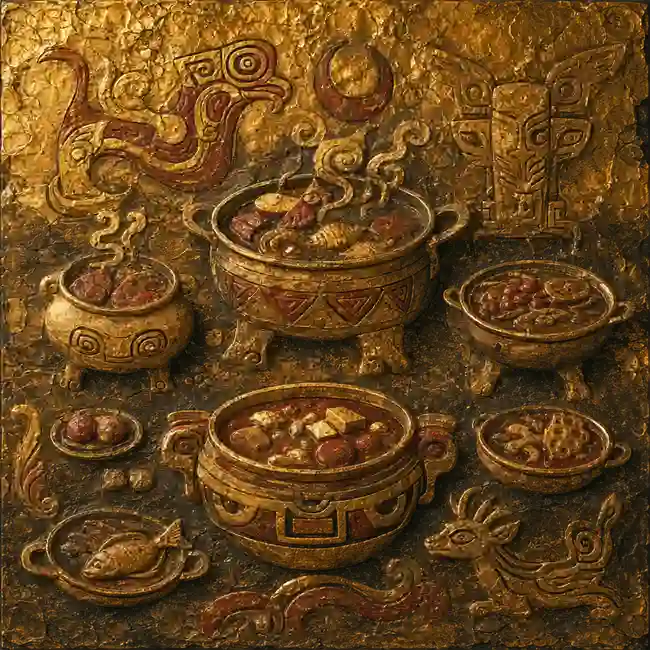
If you've ever stood in front of a museum case full of strange bronze masks and thought, "okay, but what did these people actually eat for dinner?" — you're not alone. That's exactly the rabbit hole we're diving into today. Grab a cup of tea (a modern one, since we're not talking drinks here), get comfy, and let's wander back into the smoky, clay-pot kitchens of one of China's most mysterious Bronze Age civilizations: Sanxingdui.
🐲📜 The Storyteller's Intro: 5,000 Years of Ancestral Flavors
Picture this: it's roughly 5,000 years ago on the fertile Chengdu Plain in what's now Sichuan Province, China. Long before anyone had written down a single recipe, a community was already simmering broths in hand-shaped clay pots over open fires. That community would eventually become known to the modern world as the Sanxingdui culture — and honestly, it's one of the coolest "we-had-no-idea-this-existed" archaeological stories of the last century.
Sanxingdui (literally "three-star mound") sits near the city of Guanghan, just a short drive north of Chengdu. Archaeologists generally place the culture's timeline somewhere between about 5,000 and 2,600 years ago, unfolding across four distinct phases as the settlement grew from a humble farming village into what many scholars believe was the capital of the ancient Shu Kingdom — a kingdom so old it's mentioned in early Chinese historical texts as an ally that helped topple the Shang dynasty.
Here's the fun part for foodies: while the world fell in love with Sanxingdui's jaw-dropping gold masks, bronze heads, and towering bronze trees, archaeologists were quietly piecing together something equally fascinating — how these people actually lived and ate day to day. And the humble clay pot turns out to be one of the biggest clues we have.
Unlike the flashy bronze ritual objects, everyday pottery doesn't usually make the front page. But it tells an honest story. Layer after layer of excavated flat-bottomed jars, wide-mouthed basins, and deep-bellied cooking vessels shows a people who relied heavily on slow, moist-heat cooking — the ancestor of what we'd recognize today as broths, soups, and stews. Long before "clay-pot cooking" became a trendy restaurant category, it was simply how you fed your family.
A few things worth knowing about the timeline:
• The site was first stumbled upon by a local farmer in the late 1920s while digging a ditch.
• Formal archaeological excavation began in the 1930s, led by early collaborations between Chinese and Western researchers.
• The truly earth-shaking discoveries came in 1986, when two massive sacrificial pits were uncovered, packed with bronze, jade, gold, ivory, and pottery.
• Fresh excavations between 2020 and 2022 uncovered even more pits, adding thousands of new artifacts — including everyday cookware — to the story.
So when we talk about "5,000 years of ancestral flavors," we're not exaggerating for effect. We're talking about a food culture old enough to predate written Chinese history as we usually think of it, preserved entirely through what people cooked in, ate from, and left behind.
📜 Iconic Excavated Menus: Treasures from the Shu Kitchen
Now, let's be upfront about something: Sanxingdui didn't leave behind a neat cookbook with dish names and step-by-step instructions. There's no ancient scroll labeled "Grandma's Famous Broth." What we do have is something almost better for food detectives — an enormous collection of cooking and serving vessels that tell us exactly how meals were prepared, even if the recipes themselves are lost to time.
Here's what archaeologists have pulled from the ground, and what each piece hints about the ancient Shu kitchen:
• Flat-bottomed pottery jars — By far one of the most common finds at Sanxingdui. These sturdy, wide-based jars were built to sit steadily over a fire or hearth, which strongly suggests they were used for long, slow simmering — basically the ancient version of a stockpot.
• Deep-bellied cooking basins — Rounder, heavier-walled vessels believed to have handled thicker stews or porridge-like dishes, where ingredients needed extended cooking time to soften.
• Tall-stemmed ceremonial vessels — Elegant, elevated pottery pieces likely used less for everyday cooking and more for presenting food during rituals or feasts, hinting that food wasn't just fuel — it was part of ceremony and status.
• High-handled jars and jugs — Useful for storage and pouring, these suggest the community also preserved and transported broths, grains, or liquids between the fire and the table (or altar).
• Ivory and bone-carved pieces — While not cookware themselves, decorative items shaped like birds and animals found alongside kitchen pottery suggest mealtimes, at least for the elite, carried artistic and symbolic meaning.
What's genuinely exciting is that this pottery wasn't a random assortment — it evolved in style over the culture's four phases, showing a slow refinement in cooking technique and vessel design. Later Sanxingdui-style pottery, especially the small flat-based jars, shares clear design DNA with the nearby Jinsha culture that followed it, hinting at a continuous, generations-deep food tradition passed down across the Chengdu Plain.
🏺 Featured Ancient Shu–Inspired Menu Names
✦ The Three-Star Clay-Pot Stew
A hearty ancient Shu–inspired stew imagined around slow cooking in a humble earthen vessel, reflecting the enduring importance of communal grain-and-food preparation.
✦ Ancient Shu Wild-Greens Broth
A rustic broth inspired by the edible plants and seasonal resources that would have surrounded communities on the fertile Chengdu Plain.
✦ Sanxingdui Earth-Pot Grain Stew
A thick, nourishing grain-based preparation inspired by the agricultural world of ancient Sanxingdui, where rice and millet formed important parts of the food economy.
✦ Bronze Age Rice & Vegetable Clay-Pot Soup
A historically inspired reconstruction combining the agricultural heritage of ancient Shu with the simple cooking tradition of simmering ingredients in pottery vessels.
✦ Ancient Millet Hearth Stew
A rustic grain-centered dish inspired by millet cultivation and the warmth of communal cooking fires in early Southwest China.
✦ Chengdu Plain Harvest Broth
A seasonal-style broth inspired by the fertile landscape of the Chengdu Plain and its long history of rice cultivation, plant gathering, and mixed food production.
✦ Ancient Shu Field & Forest Stew
A symbolic reconstruction bringing together cultivated grains and the wild resources of the surrounding Sichuan landscape.
✦ Earthen Vessel Rice Broth of Ancient Shu
A simple, comforting preparation inspired by the relationship between rice agriculture, pottery technology, and everyday cooking in ancient Southwest China.
✦ Sanxingdui Millet & Garden Stew
A grain-rich dish concept inspired by ancient agricultural life, seasonal vegetables, and the practical cooking traditions of early Shu communities.
✦ The Ancestral Clay-Pot Harvest Stew
A ceremonial-sounding reconstruction celebrating the grains, plants, and agricultural labor that sustained ancient communities around Sanxingdui.
🗺️ Chengdu Plain Food Trail: Wandering the Land of the Ancient Shu
If you ever find yourself in Sichuan and want to follow the ancient Shu food trail in person, you're in luck — this region takes its culinary heritage seriously, and a lot of it traces straight back to Sanxingdui-era roots.
• Sanxingdui Museum, Guanghan — This is ground zero. Beyond the famous bronze masks, keep an eye out for the pottery galleries, where the everyday cooking vessels of ancient Shu families are quietly on display, often overshadowed by their flashier bronze neighbors but arguably just as revealing.
• Jinsha Site Museum, Chengdu — A cultural cousin of Sanxingdui, located right inside modern Chengdu. Many artifacts here show a clear stylistic evolution from Sanxingdui-era pottery, including those small flat-based jars we mentioned earlier.
• Chengdu's old teahouse and street-food culture — Modern Sichuan cuisine is world-famous for bold, layered flavors, and while today's dishes are far removed from Bronze Age cooking, the region's deep-rooted love of slow-simmered pots and communal eating can trace an emotional thread all the way back to those ancient hearths.
• Guanghan City itself — A relaxed, walkable base for exploring the ruins, with a food scene that leans heavily into Sichuan's clay-pot and slow-cooked stew traditions — a nice, poetic way to eat dinner practically on top of 5,000 years of culinary history.
Traveling this route isn't just about ticking off a museum visit. It's about standing in the same fertile plain that fed a civilization for thousands of years and realizing the "farm-to-pot" philosophy is nothing new — it's just really, really old.
🚣 The Min River Basin: Cradle of the Clay-Pot Tradition
No ancient food culture grows in isolation, and Sanxingdui is a perfect example of geography shaping the dinner table. The Chengdu Plain sits within the upper reaches of the Yangtze River system, nourished by the Min River and its network of smaller waterways winding down from the mountains to the west.
Here's why that matters for our food story:
• Fertile, flood-fed soil — The rivers flowing off the Sichuan mountains deposited rich silt across the plain, creating ideal farmland for grains and vegetables that would end up simmering in those clay pots.
• Reliable water access — A steady water supply meant communities could settle permanently instead of constantly relocating, which is exactly the kind of stability that allows slow-cooking traditions (broths, stews, anything that takes hours over a fire) to develop and be passed down.
• Natural transport routes — The river network likely helped connect Sanxingdui to neighboring communities, allowing ingredients, pottery styles, and cooking techniques to spread and evolve across the wider Chengdu Plain, eventually influencing cultures like Jinsha.
• A foundation for later engineering marvels — This same river system is why, centuries later, the region built the famous Dujiangyan irrigation system, still in use today — proof that the relationship between this land, its rivers, and its food never really stopped.
In short: without this river-fed plain, there's no fertile soil, no stable farming village, no full clay pots bubbling away — and no Sanxingdui as we know it.
🧧❓ Ancient Civilization FAQ: Unlocking Palace Kitchen Mysteries
Q1.What did the people of Sanxingdui actually eat?
We don't have a written menu, but based on the pottery evidence — flat-bottomed jars, deep basins, and storage jars — researchers believe daily meals centered around slow-simmered broths and stews, likely built from grains, vegetables, and whatever proteins were locally available on the fertile Chengdu Plain.
Q2.How old is the Sanxingdui culture, exactly?
Most archaeologists date the site's occupation to somewhere between roughly 5,000 and 2,600 years ago, spanning four cultural phases. The most famous discoveries — the 1986 sacrificial pits — date to the later, most developed phase of the civilization.
Q3.Did Sanxingdui have written recipes like other ancient civilizations?
No confirmed written recipes have been found from this culture. What survives instead is the physical cooking equipment itself, which is why archaeologists read pottery shapes almost like a recipe book — vessel by vessel.
Q4.Where can I actually see this ancient cookware today?
The Sanxingdui Museum near Guanghan houses the bulk of the excavated pottery collection, alongside the more famous bronze and jade artifacts. The related Jinsha Site Museum in Chengdu is also well worth a visit to see how these food traditions evolved over time.
🧠 Final Thoughts: The Timeless Allure of Antique Gastronomy
There's something quietly moving about the fact that, thousands of years before smartphones, subway systems, or even the earliest known Chinese script, a family on the Chengdu Plain was doing something so familiar — filling a clay pot, setting it over a fire, and waiting for dinner to come together. No recipe card, no measuring cup, just instinct, patience, and generations of passed-down know-how.
Sanxingdui reminds us that the flashiest artifacts aren't always the ones that tell the deepest story. Sometimes it's the humble, soot-stained cooking pot — not the golden mask — that whispers the most honest truth about how people actually lived. We may never know the exact flavor of a Sanxingdui broth, but we know the shape of the tradition, and honestly, that's a pretty magical thing to hold onto.
Stay tuned, because the story of ancient clay-pot cooking is far from over — and there are plenty more forgotten civilizations (and their kitchens) still waiting to be explored.
🏛️ Credit to the Keepers of the Culture (The Legacy)
Huge respect is owed to the archaeologists, historians, and cultural institutions who've spent decades — and continue to spend decades — carefully uncovering and preserving this story, including the Sichuan Provincial Institute of Cultural Relics and Archaeology, the teams behind the Sanxingdui Museum and Jinsha Site Museum, and the generations of local Sichuan communities whose living culinary traditions still echo the slow-cooked, clay-pot spirit of their ancient Shu ancestors. This piece is written in tribute to their tireless work of digging up the past so the rest of us can taste, even just in imagination, a little piece of it.
🏛️🍲 Rediscovering the Sacred Ginseng Broths of Sanxingdui
👉 Savor Sanxingdui: Clay-Pot Broths & Stews
| 🌐 🏛️🍲 < Back | 🏯 🍖 < Previous | Next > 🍯 🏯 |